Page 250 of 464
temperature you would like the system to maintain.
When the system is set to your comfort level, it is not
necessary to change the settings. You will experience the
greatest efficiency by allowing the system to function
automatically. The system will operate fully automati-
cally in either�AUTO HI�or�AUTO LO�. The�AUTO
LO�setting will limit the maximum fan speed and should
be used when more quiet operation is desired. Use the
�AUTO HI�setting when the quickest cool-down or
warm-up performance is desired.
NOTE:
•It is not necessary to move the temperature settings for
cold or hot vehicles. The system automatically adjusts
the temperature, mode and fan speed to provide
comfort as quickly as possible.
•The temperature can be displayed in U.S. or Metric by
selecting the US/M customer programmable feature.Refer to the “Electronic Vehicle Information Center-
Customer Programmable Features” in Section 3 of this
manual.
To provide you with maximum comfort in the automatic
mode, during cold start-ups the blower fan will remain
off and “DELAY” will appear in the display until the
engine warms up. An estimate of the time remaining
until the “DELAY” is complete will appear periodically
in the display. However, the fan will engage immediately
if the defrost mode is selected or by pushing the blower
switch and manually adjusting the fan speed.
This feature may be disabled using the following proce-
dure:
•Press and hold the Heated Rear Window and Auto LO
buttons for 5 seconds.
•The “DELAY” symbol will flash to indicate that the
feature as been disabled.
250 UNDERSTANDING YOUR INSTRUMENT PANEL
Page 257 of 464
•While holding the recirculation button, turn the igni-
tion switch to the “RUN” position.
•Continue holding the recirculation button for 4 sec-
onds, then release.
The recirculation control is now programmed so that the
recirculation mode willnotreset to the outside air mode
when the engine is restarted. The recirculation program-
ming can be changed back by repeating this procedure.
Rear Blower Operation
To operate the rear fan, press the�REAR�button. The first
time this button is pressed the�REAR AUTO�display
will illuminate indicating that the rear fan speed is
automatically controlled. To manually control the rear
fan speed, press the�REAR�button again and only
�REAR�will illuminate in the display. This allows the rear
seat occupants to control the rear fan speed using theswitch located in the center console between the second
row seats. By pressing the�REAR�button a third time,
the rear fan will shut off.
When the ATC display reads�REAR AUTO�or when the
rear fan is off, the switch located in the center console
between the second row seats is not functional. When the
ATC display reads�REAR�, only the rear seat occupants
can control the rear fan speed from the rear switch. When
in the “REAR” mode, the rear occupants can set the rear
switch to any fan speed including�OFF�,or�AUTO�.
While in the�AUTO�position, the rear fan speed will be
automatically controlled.
Summer Operation
The engine cooling system in air conditioned vehicles
must be protected with a high-quality antifreeze coolant
to provide proper corrosion protection and to protect
against engine overheating. A 50% solution of ethylene
UNDERSTANDING YOUR INSTRUMENT PANEL 257
4
Page 258 of 464
glycol antifreeze coolant in water is recommended. Refer
to section 7, Maintenance Procedures, of this manual for
proper coolant selection.
Winter Operation
To insure the best possible heater and defroster perfor-
mance, make sure the engine cooling system is function-
ing properly and the proper amount, type, and concen-
tration of coolant is used. Refer to section 7, Maintenance
Procedures, of this manual for proper coolant selection.
Use of the air Recirculation mode during winter months
is not recommended because it may cause window
fogging.
Vacation Storage
Anytime you store your vehicle, or keep it out of service
(i.e. vacation) for two weeks or more, run the air condi-
tioning system at idle for about five minutes in the fresh
air and high blower setting. This will insure adequatesystem lubrication to minimize the possibility of com-
pressor damage when the system is started again.
Window Fogging
Vehicle windows tend to fog on the inside in mild rainy
or humid weather. To clear the windows, use the A/C
button to reduce the humidity inside the vehicle.
Fogging on the inside of the windshield can be quickly
removed by pressing the defrost button and increasing
the blower speed.
Do not use the Recirculation mode without the A/C
button for long periods as fogging may occur.
Outside Air Intake
Before driving, always make sure the air intake located
directly in front of the windshield is free of obstructions
such as leaves, ice, or snow, which could reduce airflow
and/or plug the water drain tube inside the plenum.
258 UNDERSTANDING YOUR INSTRUMENT PANEL
Page 261 of 464
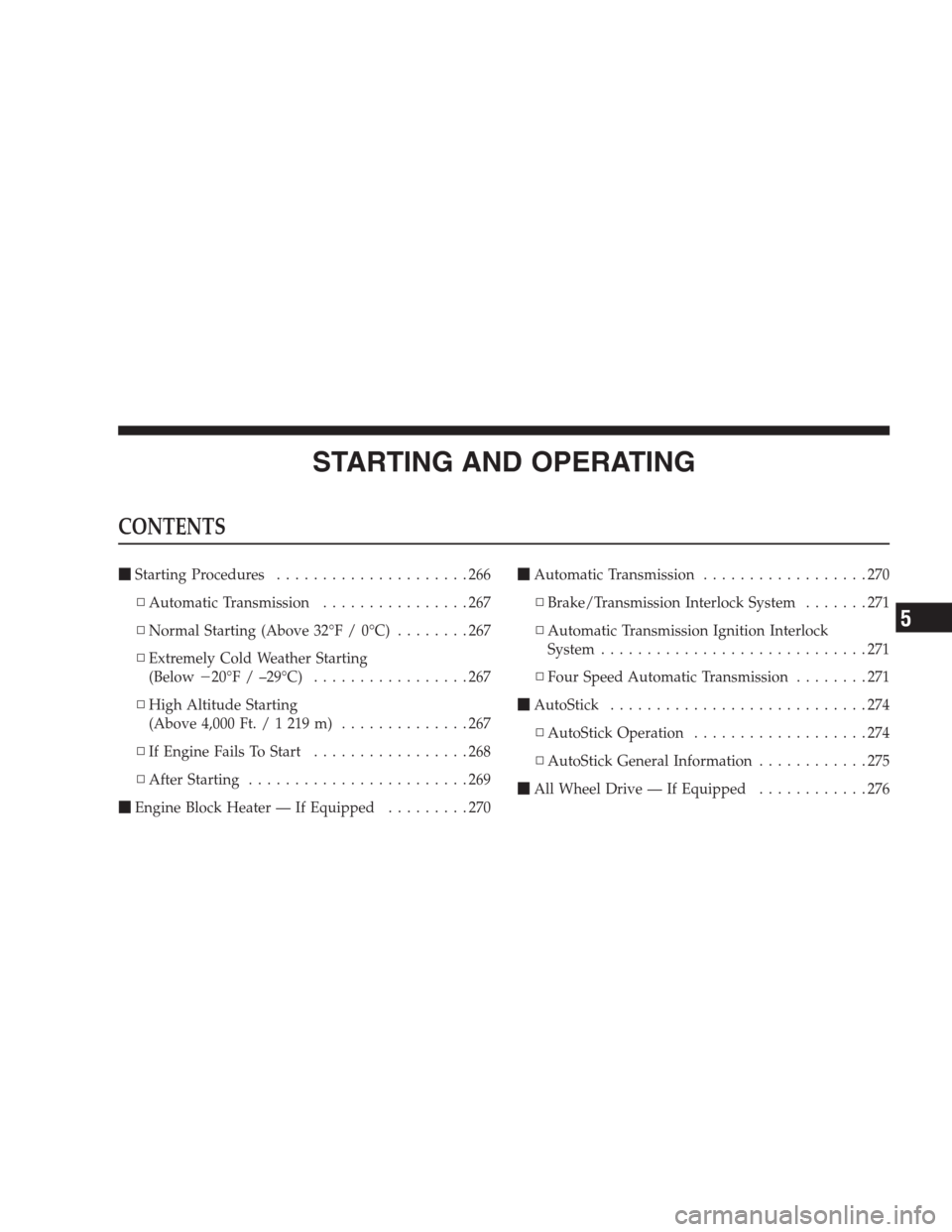
STARTING AND OPERATING
CONTENTS
�Starting Procedures.....................266
▫Automatic Transmission................267
▫Normal Starting (Above 32°F / 0°C)........267
▫Extremely Cold Weather Starting
(Below�20°F / –29°C).................267
▫High Altitude Starting
(Above 4,000 Ft. / 1 219 m)..............267
▫If Engine Fails To Start.................268
▫After Starting........................269
�Engine Block Heater — If Equipped.........270�Automatic Transmission..................270
▫Brake/Transmission Interlock System.......271
▫Automatic Transmission Ignition Interlock
System.............................271
▫Four Speed Automatic Transmission........271
�AutoStick............................274
▫AutoStick Operation...................274
▫AutoStick General Information............275
�All Wheel Drive — If Equipped............276
5
Page 264 of 464
▫Carbon Monoxide Warnings..............321
�Adding Fuel..........................321
▫Fuel Filler Cap (Gas Cap)...............321
▫Loose Fuel Filler Cap Message............323
�Flexible Fuel— (Fleet Vehicles Only).........324
▫E-85 General Information................324
▫Ethanol Fuel (E-85)....................324
▫Fuel Requirements....................324
▫Selection Of Engine Oil For Flexible Fuel
Vehicles (E-85) And Gasoline Vehicles.......325
▫Starting............................325
▫Cruising Range.......................326
▫Replacement Parts.....................326▫Maintenance.........................326
�Vehicle Loading........................326
▫Vehicle Certification Label...............327
▫Gross Vehicle Weight Rating (GVWR).......327
▫Gross Axle Weight Rating (GAWR).........327
▫Overloading.........................328
▫Loading............................328
�Trailer Towing.........................329
▫Common Towing Definitions.............330
▫Trailer Hitch Classification...............333
▫Trailer Towing Weights
(Maximum Trailer Weight Ratings).........334
▫Trailer And Tongue Weight..............335
264 STARTING AND OPERATING
Page 266 of 464
STARTING PROCEDURES
Before starting your vehicle, adjust your seat, adjust both
inside and outside mirrors, and fasten your seat belts.WARNING!
•Be sure to turn off the engine if you want to rest or
sleep in your car. Accidents can be caused by
inadvertently moving the gear selection lever or by
pressing the accelerator pedal. This may cause ex-
cessive heat in the exhaust system, resulting in
overheating and vehicle fire which may cause seri-
ous or fatal injuries.
•NEVER leave children alone in a vehicle. Leaving
children in a vehicle unattended is dangerous for a
number of reasons. A child or others could be
seriously or fatally injured. Don’t leave the keys in
the ignition. A child could operate power windows,
other controls, or move the vehicle
•Do not leave children or animals inside parked
vehicles in hot weather. Interior heat build up may
cause serious injury or death.
266 STARTING AND OPERATING
Page 267 of 464
Automatic Transmission
The gear selector must be in the NEUTRAL or PARK
position before you can start the engine. Depress the
brake pedal before shifting into any driving gear.
Normal Starting (Above 32°F / 0°C)
1. Do not depress the accelerator.
2. Turn and hold the ignition key in the START position
and release when engine starts.
3. If engine does not start after 3 seconds, depress the
accelerator lightly (while still cranking the engine).
4. If engine does not start after 15 seconds, turn the
ignition key off.
5. Wait 10 to 15 seconds, and repeat steps 1 — 5 shown
above.NOTE: This vehicle is equipped with a transmission
shift interlocking system. The brake pedal must be
depressed to shift out of Park (P).
Extremely Cold Weather Starting (Below�20°F /
–29°C)
Follow the same instructions in the “Normal Starting
Process” as shown above.
To insure reliable starting at these temperatures, use of an
externally powered electric engine block heater (available
from your dealer) is recommended.
High Altitude Starting (Above 4,000 ft. / 1 219 m)
Follow the same instructions in the “Normal Starting
Process” as shown above.
To insure reliable starting at these temperatures, use of an
externally powered electric engine block heater (available
from your dealer) is recommended.
STARTING AND OPERATING 267
5
Page 268 of 464
If Engine Fails To Start
If the engine fails to start after you have followed the
normal starting procedure, it may be flooded. Push the
accelerator pedal all the way to the floor and hold it there
while cranking the engine. This should clear any excess
fuel in case the engine is flooded.
CAUTION!
To prevent damage to the starter, do not crank the
engine for more than 15 seconds at a time. Wait 10 to
15 seconds before trying again.
WARNING!
Never pour fuel or other flammable liquid into the
throttle body air inlet opening in an attempt to start
the vehicle. This could result in flash fire causing
serious personal injury.
268 STARTING AND OPERATING