Page 118 of 574
PARK (P):This position locks the rear wheels.
It is the best position to use when you start
the engine because your vehicle cannot move
easily.
{CAUTION:
It is dangerous to get out of your vehicle
if the shift lever is not fully in PARK (P)
with the parking brake rmly set. Your
vehicle can roll.
Do not leave your vehicle when the engine
is running unless you have to. If you have
left the engine running, the vehicle can
move suddenly. You or others could be
injured. To be sure your vehicle will not
move, even when you are on fairly level
ground, always set your parking brake
and move the shift lever to PARK (P). See
Shifting Into Park (P) on page 127.Ifyou
are pulling a trailer, seeTowing a Trailer
on page 368.
{CAUTION:
If you have four-wheel drive, your vehicle
will be free to roll — even if your shift
lever is in PARK (P) — if your transfer
case is in NEUTRAL. So, be sure the
transfer case is in a drive gear — not in
NEUTRAL. SeeFour-Wheel Drive on
page 121. SeeShifting Into Park (P) on
page 127.
Make sure the shift lever is fully in PARK (P)
before starting the engine. Your vehicle has an
automatic transmission shift lock control system.
You have to fully apply the regular brakes rst and
then press the shift lever button before you can
shift from PARK (P) when the ignition key is
in RUN. If you cannot shift out of PARK (P), ease
pressure on the shift lever and push the shift
lever all the way into PARK (P) as you maintain
brake application. Then press the shift lever button
and move the shift lever into another gear.
SeeShifting Out of Park (P) on page 129.
118
Page 125 of 574
Shifting into NEUTRAL
Before shifting the transfer case to NEUTRAL,
rst make sure the vehicle is parked so that it will
not roll.
1. Set the parking brake.
2. Start the vehicle.
3. Put the transmission in NEUTRAL (N).
4. Shift the transfer case to Two-Wheel High.
5. Turn the transfer case knob all of the way past
Four-Wheel Low and hold it there for a
minimum of 10 seconds. The neutral indicator
light will come on.
6. With the engine running, shift the transmission
to REVERSE (R) for one second, then shift
the transmission to DRIVE (D) for one second,
to ensure that the transfer case is in
NEUTRAL.
7. Turn the engine off, by turning the key to
ACCESSORY.
8. Place the transmission shift lever in PARK (P).
9. Turn the ignition to LOCK.
Shifting Out of NEUTRAL
To shift the transfer case out of NEUTRAL, do the
following:
1. Set the parking brake and apply the regular
brake pedal.
2. Turn the ignition to RUN with the engine off.
3. Put the transmission in NEUTRAL (N).
4. Turn the transfer case knob to the desired
position (Two-Wheel High, Four-Wheel
High, or Auto Four-Wheel Drive).
5. After the transfer case has shifted out of
NEUTRAL, the indicator light will go out.
6. Release the parking brake.
7. Start the engine and shift the transmission to
the desired position.
125
Page 127 of 574
Shifting Into Park (P)
{CAUTION:
It can be dangerous to get out of your
vehicle if the shift lever is not fully in
PARK (P) with the parking brake rmly set.
Your vehicle can roll. If you have left the
engine running, the vehicle can move
suddenly. You or others could be injured.
To be sure your vehicle will not move, even
when you are on fairly level ground, use
the steps that follow. With four-wheel drive,
your vehicle will be free to roll — even if
your shift lever is in PARK (P) — if your
transfer case is in NEUTRAL. So, be sure
the transfer case is in a drive gear — not in
NEUTRAL. SeeFour-Wheel Drive on
page 121. Always put the shift lever fully in
PARK (P) with the parking brake rmly set.
If you are pulling a trailer, seeTowing a
Trailer on page 368.To shift into PARK (P):
1. Hold the brake pedal down with your foot and
set the parking brake.
2. Move the shift lever into PARK (P) by pressing
the button on the side of the shift lever and
pushing the lever all the way toward the front
of the vehicle.
3. Turn the ignition key to LOCK.
4. Remove the key and take it with you. You
know your vehicle is in PARK (P) if the key
can be removed from the ignition.
127
Page 145 of 574
Outside Heated Mirrors
If the vehicle has this feature, when the rear
window defogger is turned on, the outside driver’s
and passenger’s rearview mirrors also heat to
help clear them of ice, snow, and condensation.
SeeDual Climate Control System on page 187or
Dual Automatic Climate Control System on
page 190for more information.
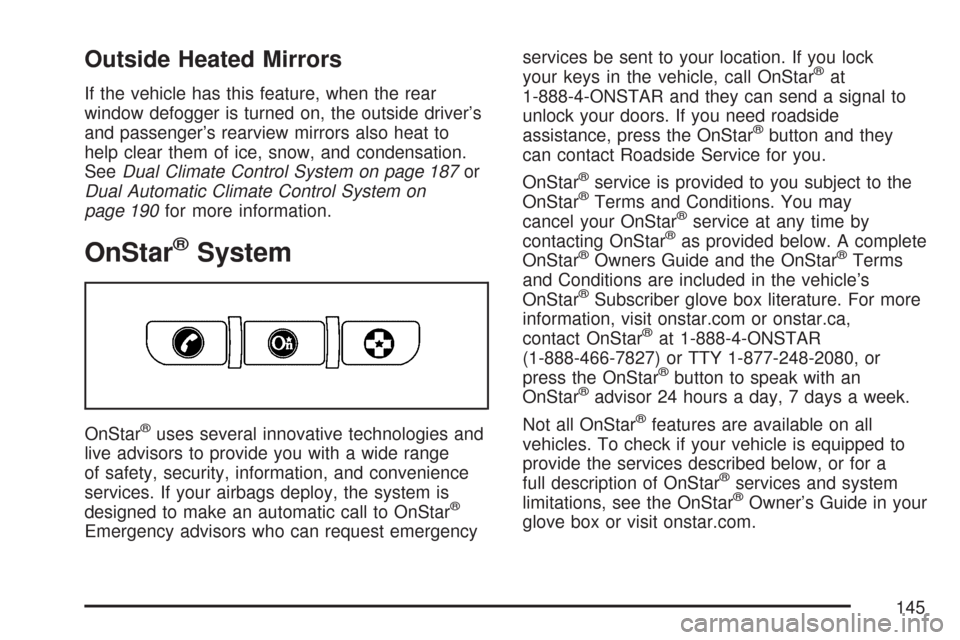
OnStar®System
OnStar®uses several innovative technologies and
live advisors to provide you with a wide range
of safety, security, information, and convenience
services. If your airbags deploy, the system is
designed to make an automatic call to OnStar
®
Emergency advisors who can request emergencyservices be sent to your location. If you lock
your keys in the vehicle, call OnStar
®at
1-888-4-ONSTAR and they can send a signal to
unlock your doors. If you need roadside
assistance, press the OnStar
®button and they
can contact Roadside Service for you.
OnStar
®service is provided to you subject to the
OnStar®Terms and Conditions. You may
cancel your OnStar®service at any time by
contacting OnStar®as provided below. A complete
OnStar®Owners Guide and the OnStar®Terms
and Conditions are included in the vehicle’s
OnStar
®Subscriber glove box literature. For more
information, visit onstar.com or onstar.ca,
contact OnStar
®at 1-888-4-ONSTAR
(1-888-466-7827) or TTY 1-877-248-2080, or
press the OnStar
®button to speak with an
OnStar®advisor 24 hours a day, 7 days a week.
Not all OnStar
®features are available on all
vehicles. To check if your vehicle is equipped to
provide the services described below, or for a
full description of OnStar
®services and system
limitations, see the OnStar®Owner’s Guide in your
glove box or visit onstar.com.
145
Page 161 of 574
Storage Areas
Glove Box
To open, pull up on the handle. Use the key to
lock and unlock.
Overhead Console
Your vehicle may have this feature. The overhead
console may include reading lamps, a Universal
Home Remote and a sunroof switch. SeeSunroof
on page 166andUniversal Home Remote
System on page 150for more information.
Center Console Storage Area
Squeeze the front lever on the center console
while lifting the top to open it.
Your vehicle’s console will have cupholders
located on the front and rear of the storage
compartment.
The console may also contain one or more of the
following components:
Rear Seat Audio Controls
Rear Seat Accessory Power Outlets
Rear Climate Control
To open the center armrest compartment, lift the
cover by pulling up on the latch handle located
underneath the front edge of the armrest.
161
Page 172 of 574
Hazard Warning Flashers
The hazard warning ashers warn others.
They also let police know you have a problem.
Your front and rear turn signal lamps will
ash on and off.
The hazard warning
asher button is
located on top of the
steering column.
The hazard warning ashers work no matter what
ignition position the key is in, and even if the
key is not in the ignition.Press the button to make the front and rear turn
signal lamps ash on and off. Press the button
again to turn the ashers off.
When the hazard warning ashers are on, your
turn signals will not work.
Other Warning Devices
If you carry reective triangles, you can set
them up at the side of the road about
300 feet (100 m) behind your vehicle.
Horn
To sound the horn, press the horn symbols on
the steering wheel pad.
172
Page 181 of 574
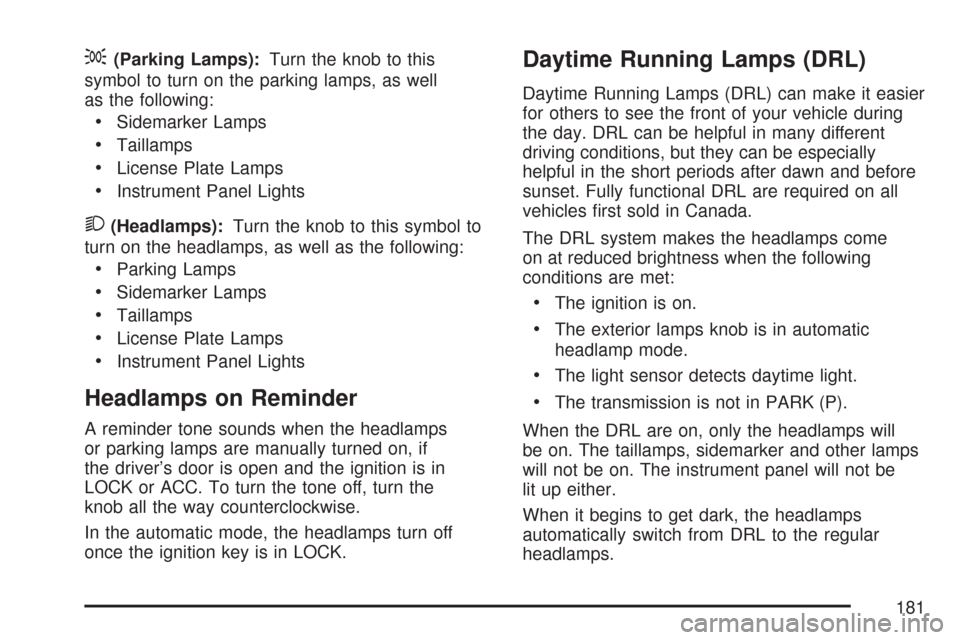
;(Parking Lamps):Turn the knob to this
symbol to turn on the parking lamps, as well
as the following:
Sidemarker Lamps
Taillamps
License Plate Lamps
Instrument Panel Lights
2(Headlamps):Turn the knob to this symbol to
turn on the headlamps, as well as the following:
Parking Lamps
Sidemarker Lamps
Taillamps
License Plate Lamps
Instrument Panel Lights
Headlamps on Reminder
A reminder tone sounds when the headlamps
or parking lamps are manually turned on, if
the driver’s door is open and the ignition is in
LOCK or ACC. To turn the tone off, turn the
knob all the way counterclockwise.
In the automatic mode, the headlamps turn off
once the ignition key is in LOCK.
Daytime Running Lamps (DRL)
Daytime Running Lamps (DRL) can make it easier
for others to see the front of your vehicle during
the day. DRL can be helpful in many different
driving conditions, but they can be especially
helpful in the short periods after dawn and before
sunset. Fully functional DRL are required on all
vehicles rst sold in Canada.
The DRL system makes the headlamps come
on at reduced brightness when the following
conditions are met:
The ignition is on.
The exterior lamps knob is in automatic
headlamp mode.
The light sensor detects daytime light.
The transmission is not in PARK (P).
When the DRL are on, only the headlamps will
be on. The taillamps, sidemarker and other lamps
will not be on. The instrument panel will not be
lit up either.
When it begins to get dark, the headlamps
automatically switch from DRL to the regular
headlamps.
181
Page 184 of 574
Dome Lamp Override
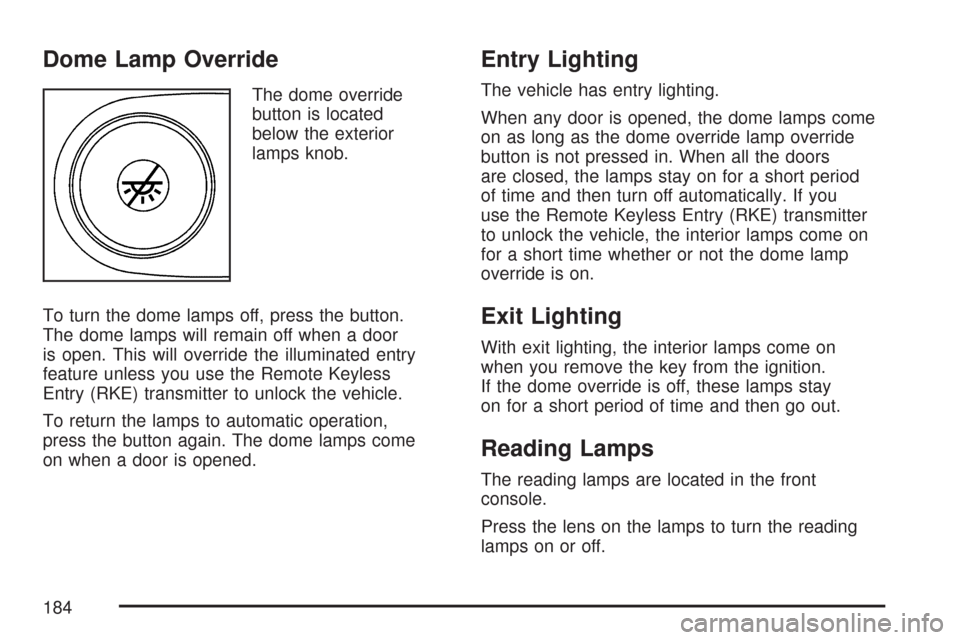
The dome override
button is located
below the exterior
lamps knob.
To turn the dome lamps off, press the button.
The dome lamps will remain off when a door
is open. This will override the illuminated entry
feature unless you use the Remote Keyless
Entry (RKE) transmitter to unlock the vehicle.
To return the lamps to automatic operation,
press the button again. The dome lamps come
on when a door is opened.
Entry Lighting
The vehicle has entry lighting.
When any door is opened, the dome lamps come
on as long as the dome override lamp override
button is not pressed in. When all the doors
are closed, the lamps stay on for a short period
of time and then turn off automatically. If you
use the Remote Keyless Entry (RKE) transmitter
to unlock the vehicle, the interior lamps come on
for a short time whether or not the dome lamp
override is on.
Exit Lighting
With exit lighting, the interior lamps come on
when you remove the key from the ignition.
If the dome override is off, these lamps stay
on for a short period of time and then go out.
Reading Lamps
The reading lamps are located in the front
console.
Press the lens on the lamps to turn the reading
lamps on or off.
184