2007 CHEVROLET TRAIL BLAZER climate control
[x] Cancel search: climate controlPage 197 of 574
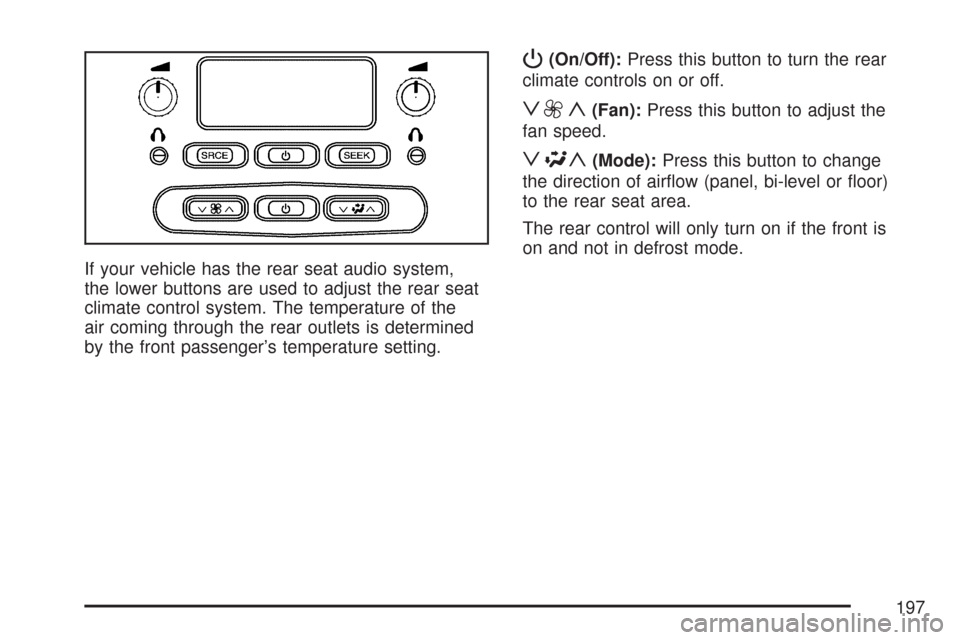
If your vehicle has the rear seat audio system,
the lower buttons are used to adjust the rear seat
climate control system. The temperature of the
air coming through the rear outlets is determined
by the front passenger’s temperature setting.
P(On/Off):Press this button to turn the rear
climate controls on or off.
z9y(Fan):Press this button to adjust the
fan speed.
z\y(Mode):Press this button to change
the direction of airow (panel, bi-level or oor)
to the rear seat area.
The rear control will only turn on if the front is
on and not in defrost mode.
197
Page 377 of 574
CAUTION: (Continued)
Do not use the climate control setting
for maximum air because it only
recirculates the air inside your vehicle.
SeeDual Climate Control System on
page 187orDual Automatic Climate
Control System on page 190.
Towing a trailer requires a certain amount of
experience. Before setting out for the open road,
you’ll want to get to know your rig. Acquaint
yourself with the feel of handling and braking with
the added weight of the trailer. And always
keep in mind that the vehicle you are driving is
now a good deal longer and not nearly as
responsive as your vehicle is by itself.
Before you start, check all trailer hitch parts and
attachments, safety chains, electrical connection,
lamps, tires and mirror adjustment. If the trailer has
electric brakes, start your vehicle and trailer moving
and then apply the trailer brake controller by hand
to be sure the brakes are working. This lets you
check your electrical connection at the same time.During your trip, check occasionally to be sure
that the load is secure, and that the lamps and any
trailer brakes are still working.Following Distance
Stay at least twice as far behind the vehicle ahead
as you would when driving your vehicle without
a trailer. This can help you avoid situations
that require heavy braking and sudden turns.
Passing
You’ll need more passing distance up ahead when
you’re towing a trailer. And, because you’re a
good deal longer, you’ll need to go much farther
beyond the passed vehicle before you can
return to your lane.
Backing Up
Hold the bottom of the steering wheel with
one hand. Then, to move the trailer to the left, just
move that hand to the left. To move the trailer
to the right, move your hand to the right. Always
back up slowly and, if possible, have someone
guide you.
377
Page 469 of 574
Uniform Tire Quality Grading
Quality grades can be found where applicable on
the tire sidewall between tread shoulder and
maximum section width. For example:
Treadwear 200 Traction AA Temperature A
The following information relates to the system
developed by the United States National Highway
Traffic Safety Administration (NHTSA), which
grades tires by treadwear, traction, and
temperature performance. This applies only to
vehicles sold in the United States. The grades are
molded on the sidewalls of most passenger car
tires. The Uniform Tire Quality Grading (UTQG)
system does not apply to deep tread, winter-type
snow tires, space-saver, or temporary use
spare tires, tires with nominal rim diameters of
10 to 12 inches (25 to 30 cm), or to some
limited-production tires.
While the tires available on General Motors
passenger cars and light trucks may vary with
respect to these grades, they must also conform
to federal safety requirements and additional
General Motors Tire Performance Criteria (TPC)
standards.
Treadwear
The treadwear grade is a comparative rating
based on the wear rate of the tire when tested
under controlled conditions on a specied
government test course. For example, a tire
graded 150 would wear one and a half (1.5) times
as well on the government course as a tire
graded 100. The relative performance of tires
depends upon the actual conditions of their use,
however, and may depart signicantly from
the norm due to variations in driving habits, service
practices, and differences in road characteristics
and climate.
Traction – AA, A, B, C
The traction grades, from highest to lowest, are AA,
A, B, and C. Those grades represent the tire’s
ability to stop on wet pavement as measured under
controlled conditions on specied government test
surfaces of asphalt and concrete. A tire marked C
may have poor traction performance.
Warning:The traction grade assigned to this tire
is based on straight-ahead braking traction
tests, and does not include acceleration, cornering,
hydroplaning, or peak traction characteristics.
469
Page 511 of 574
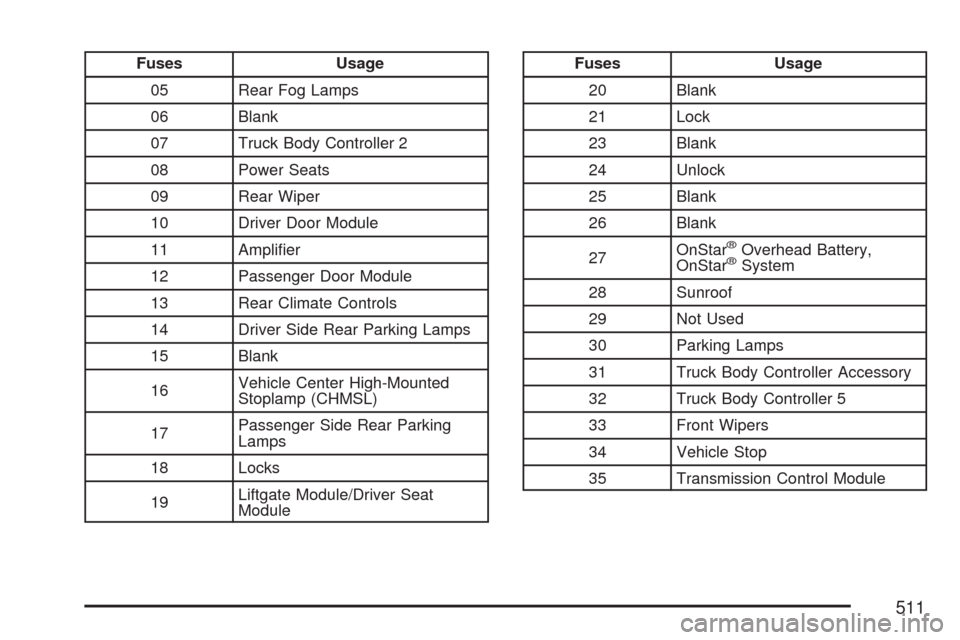
Fuses Usage
05 Rear Fog Lamps
06 Blank
07 Truck Body Controller 2
08 Power Seats
09 Rear Wiper
10 Driver Door Module
11 Amplier
12 Passenger Door Module
13 Rear Climate Controls
14 Driver Side Rear Parking Lamps
15 Blank
16Vehicle Center High-Mounted
Stoplamp (CHMSL)
17Passenger Side Rear Parking
Lamps
18 Locks
19Liftgate Module/Driver Seat
ModuleFuses Usage
20 Blank
21 Lock
23 Blank
24 Unlock
25 Blank
26 Blank
27OnStar
®Overhead Battery,
OnStar®System
28 Sunroof
29 Not Used
30 Parking Lamps
31 Truck Body Controller Accessory
32 Truck Body Controller 5
33 Front Wipers
34 Vehicle Stop
35 Transmission Control Module
511
Page 562 of 574
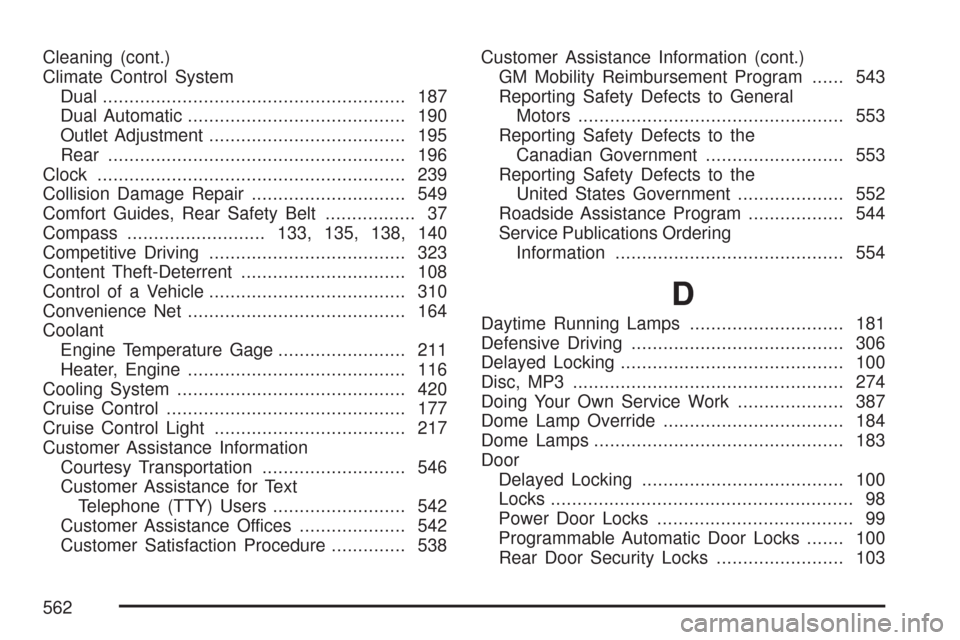
Cleaning (cont.)
Climate Control System
Dual......................................................... 187
Dual Automatic......................................... 190
Outlet Adjustment..................................... 195
Rear........................................................ 196
Clock.......................................................... 239
Collision Damage Repair............................. 549
Comfort Guides, Rear Safety Belt................. 37
Compass..........................133, 135, 138, 140
Competitive Driving..................................... 323
Content Theft-Deterrent............................... 108
Control of a Vehicle..................................... 310
Convenience Net......................................... 164
Coolant
Engine Temperature Gage........................ 211
Heater, Engine......................................... 116
Cooling System........................................... 420
Cruise Control............................................. 177
Cruise Control Light.................................... 217
Customer Assistance Information
Courtesy Transportation........................... 546
Customer Assistance for Text
Telephone (TTY) Users......................... 542
Customer Assistance Offices.................... 542
Customer Satisfaction Procedure.............. 538Customer Assistance Information (cont.)
GM Mobility Reimbursement Program...... 543
Reporting Safety Defects to General
Motors.................................................. 553
Reporting Safety Defects to the
Canadian Government.......................... 553
Reporting Safety Defects to the
United States Government.................... 552
Roadside Assistance Program.................. 544
Service Publications Ordering
Information........................................... 554
D
Daytime Running Lamps............................. 181
Defensive Driving........................................ 306
Delayed Locking.......................................... 100
Disc, MP3................................................... 274
Doing Your Own Service Work.................... 387
Dome Lamp Override.................................. 184
Dome Lamps............................................... 183
Door
Delayed Locking...................................... 100
Locks......................................................... 98
Power Door Locks..................................... 99
Programmable Automatic Door Locks....... 100
Rear Door Security Locks........................ 103
562
Page 563 of 574
Driver
Position, Safety Belt................................... 25
Driver Information Center (DIC)................... 220
DIC Operation and Displays..................... 221
DIC Vehicle Customization....................... 231
DIC Warnings and Messages................... 224
Driving
At Night................................................... 339
City.......................................................... 344
Defensive................................................. 306
Drunken................................................... 307
Freeway................................................... 345
Hill and Mountain Roads.......................... 348
In Rain and on Wet Roads...................... 340
Off-Road.................................................. 323
Recovery Hooks....................................... 355
Rocking Your Vehicle to Get it Out.......... 354
Winter...................................................... 350
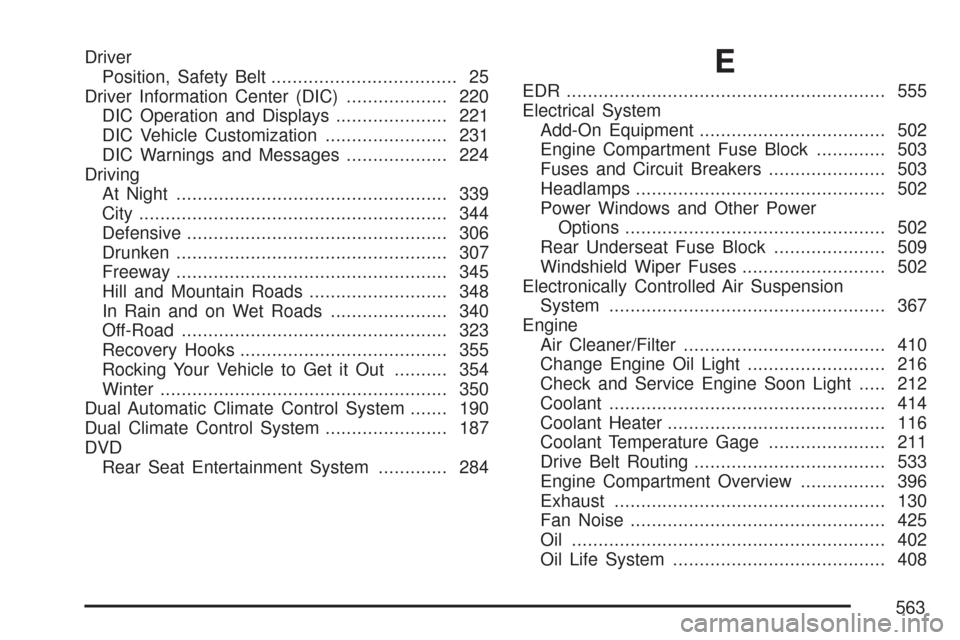
Dual Automatic Climate Control System....... 190
Dual Climate Control System....................... 187
DVD
Rear Seat Entertainment System............. 284E
EDR ............................................................ 555
Electrical System
Add-On Equipment................................... 502
Engine Compartment Fuse Block............. 503
Fuses and Circuit Breakers...................... 503
Headlamps............................................... 502
Power Windows and Other Power
Options................................................. 502
Rear Underseat Fuse Block..................... 509
Windshield Wiper Fuses........................... 502
Electronically Controlled Air Suspension
System.................................................... 367
Engine
Air Cleaner/Filter...................................... 410
Change Engine Oil Light.......................... 216
Check and Service Engine Soon Light..... 212
Coolant.................................................... 414
Coolant Heater......................................... 116
Coolant Temperature Gage...................... 211
Drive Belt Routing.................................... 533
Engine Compartment Overview................ 396
Exhaust................................................... 130
Fan Noise................................................ 425
Oil ........................................................... 402
Oil Life System........................................ 408
563
Page 569 of 574
Passenger Sensing System........................... 80
Passing....................................................... 321
Passlock
®.................................................... 110
Power
Door Locks................................................ 99
Electrical System..................................... 502
Lumbar Controls........................................ 11
Reduced Engine Light.............................. 217
Retained Accessory (RAP)....................... 113
Seat.......................................................... 10
Steering Fluid.......................................... 426
Windows.................................................. 106
Pretensioners, Safety Belt............................. 40
Privacy........................................................ 555
Event Data Recorders.............................. 556
Navigation System................................... 557
OnStar..................................................... 557
Radio Frequency Identication.................. 557
Programmable Automatic Door Locks.......... 100
Q
Questions and Answers About Safety Belts...... 24
R
Radiator Pressure Cap................................ 418
Radio Frequency Identication (RFID),
Privacy..................................................... 557
Radios........................................................ 238
Care of Your CD and DVD Player............ 302
Care of Your CDs and DVDs................... 302
Navigation/Radio System, see
Navigation Manual................................ 284
Radio with CD................................240, 250
Radio with Six-Disc CD............................ 260
Rear Seat Audio...................................... 298
Setting the Time...................................... 239
Theft-Deterrent......................................... 300
Understanding Reception......................... 301
Reading Lamps........................................... 184
Rear Axle.................................................... 438
Locking.................................................... 313
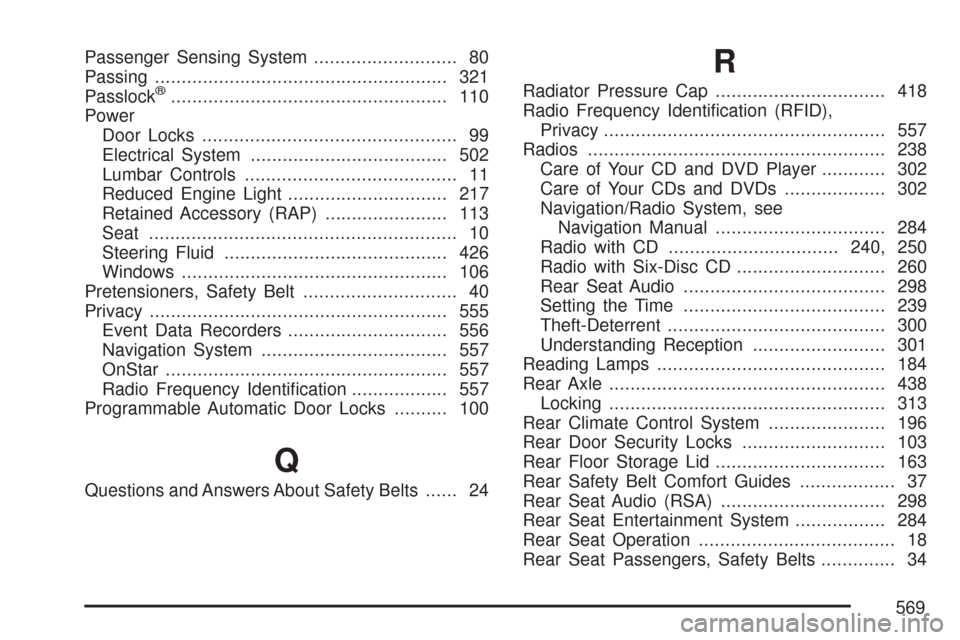
Rear Climate Control System...................... 196
Rear Door Security Locks........................... 103
Rear Floor Storage Lid................................ 163
Rear Safety Belt Comfort Guides.................. 37
Rear Seat Audio (RSA)............................... 298
Rear Seat Entertainment System................. 284
Rear Seat Operation..................................... 18
Rear Seat Passengers, Safety Belts.............. 34
569