Page 255 of 430

What Fuel to Use in Canada
Canadian fuels are blended for seasonal changes.
Diesel Type “A” fuel is blended for better cold
weather starting (below 0°F or−18°C); however,
you may notice some power and fuel economy
loss. If Type “A” fuel is used in warmer
temperatures, stalling and hard starting may
occur. Diesel Type “B” fuel is blended for
temperatures above 0°F (−18°C).
It is important that diesel-powered trucks are
refueled only with ultra low-sulfur fuel. The
emission control system requires the use of diesel
fuel with ultra low-sulfur (0.0015% by weight, or
15 ppm, maximum) content. Both ultra low-sulfur
and higher sulfur diesel fuels are available in
the United States. Use of fuels with higher-sulfur
content will affect the function of the emission
components and may cause reduced performance,
excessive smoke, and unpleasant odor.
At a minimum, the diesel fuel you use should
meet the latest version of specification
CAN/CGSB-3.517 (Low Sulfur Diesel) in Canada.
In addition, the Engine Manufacturers Association
(EMA) has identified properties of an improved
diesel fuel for better engine performance and
durability (FQP-1A). Diesel fuels corresponding tothe EMA description could provide better starting,
less noise, and better vehicle performance. If
there are questions about the fuel you are using,
contact your fuel supplier.
If your vehicle has the 6.6L engine, it is acceptable
to use diesel fuel containing up to 5% biodiesel
(B5), but the final blended fuel must meet the same
specification, CAN/CGSB-3.517 (Low Sulfur Diesel)
in Canada, as other fuels used in your vehicle, and
the biodiesel used for making this fuel must meet
the latest version of ASTM specification D 6751.
Biodiesel is produced from vegetable oils or animal
fat that have been chemically modified to reduce
the possibility of damage to your fuel system and
engine. Higher concentration (i.e., greater than B5)
biodiesel-containing fuels or the use of unmodified
bio-oils blended into diesel fuel at any concentration
is not recommended and could damage your fuel
system and engine. Such damage would not be
covered by your warranty. If there are questions
about the biodiesel-containing fuels you are using,
contact your fuel supplier.
255
Page 256 of 430

Very Cold Weather Operation
Follow the instructions listed previously under the
heading “What Fuel to Use.”
Notice:Never use home heating oil or
gasoline in your diesel engine. They can cause
engine damage.
In cold weather, your fuel filter may become
clogged (waxed). To unclog it, move the vehicle to
a warm garage area and warm the filter to
between 32°F and 50°F (0°C to 10°C). You will
not need to replace it. Additional information on the
fuel filter follows.
Water in Fuel
{CAUTION:
Diesel fuel containing water is still
ammable. You could be burned. If you
ever try to drain water from your fuel,
keep sparks, ames and smoking
materials away from the mixture.Notice:If there is water in your diesel fuel
and the weather is warm or humid, fungus and
bacteria can grow in the fuel. They can
damage your fuel system. A diesel fuel biocide
can be used to sterilize your fuel system.
However, your fuel system may still need to be
cleaned. Your dealer can advise you of the
appropriate solution.
If your fuel tank needs to be purged to remove
water, see your dealer or a qualied technician.
Improper purging can damage your fuel system.
Sometimes, water can be pumped into your fuel
tank along with your diesel fuel. This can happen if
a service station does not regularly inspect and
clean its fuel tanks, or if it gets contaminated fuel
from its suppliers.
If this happens, the
water-in-fuel light, if
equipped, will come on
in the instrument panel.
If it does, the water must
be drained. Your dealer
can show you how to
do this.
256
Page 258 of 430

4. Open the drain
valve by turning
two to three turns.
When fuel empties
from the valve,
all the water
has been drained.
Close the valve
hand-tight.
5. Remove the fuel-resistant container and
properly dispose of the contaminated fuel.
To find out how to properly dispose of
contaminated diesel fuel, seeEngine Oil
(Caterpillar
®Diesel Engine) on page 268or
Engine Oil (Gasoline Engine) on page 268or
Engine Oil (DURAMAX
®/Isuzu Diesel
Engine) on page 272.6. Install the fuel cap.
7. Start the engine and let it run for a few
minutes. If the engine stalls, the fuel system
may need to be primed. While draining
the water from the fuel filter, air may enter the
fuel system. If air has entered the fuel
system the fuel system will need to be primed.
If the water-in-fuel light comes on again after
driving a short distance or the engine runs rough
or stalls, a large amount of water has probably
been pumped into the fuel tank. The fuel
tank should be purged.
Fuel Priming
If your vehicle has a Caterpillar®diesel engine,
see the Caterpillar®Diesel Engine Operation and
Maintenance Manual provided with your vehicle.
If your vehicle has a DURAMAX
®/Isuzu diesel
engine, in order for the fuel system to work
properly, the fuel lines must be full of fuel and
contain no air. If air gets into the fuel lines, it will
be necessary to prime the fuel lines to eliminate air
before operating the vehicle.
258
Page 261 of 430

Priming the 7.8L Isuzu 6H Diesel Engine
If your vehicle is equipped with the 7.8L Isuzu 6H
diesel engine, use the following procedure to
prime the engine:
1. Make sure there is fuel in the fuel tank.
2. Make sure the specified fuel filter is properly
installed.
3. Make sure the fuel lines are securely
connected.
4. Make sure the fuel filter is cool to the touch.
5. Use a clean cloth to remove dirt and oil
from the fuel filter head and breather valve.6. Use the palm of your hand to repeatedly
press and release the plunger (1) at the
top of the fuel filter priming pump. Continue
until the plunger resistance becomes firm. This
may take from 20 to 100 times, depending
upon fuel tank location.
7. Turn the fuel filter breather valve screw (2)
counterclockwise several turns to open the
breather valve.
8. Use the palm of your hand to repeatedly
press and release the plunger (1) at the
top of the fuel filter priming pump until fuel
begins to seep from the breather valve.
9. Tighten the fuel filter breather screw (2) to the
specified torque, 4.9
Y(43 in. lbs).
10. Use the palm of your hand to press and
release the plunger (1) at the top of the
fuel filter priming pump about 20 more times.
This sends fuel to the engine.
11. Use a clean cloth to remove any fuel from the
fuel filter and surrounding area.
12. Start the engine and allow it to idle for a
few minutes.
13. Check the fuel filter for leakage.
261
Page 266 of 430
Filling a Portable Fuel Container
{CAUTION:
Never ll a portable fuel container while it
is in your vehicle. Static electricity
discharge from the container can ignite the
gasoline vapor. You can be badly burned
and your vehicle damaged if this occurs.
To help avoid injury to you and others:
Dispense gasoline only into approved
containers.
Do not ll a container while it is inside a
vehicle, in a vehicle’s trunk, pickup
bed, or on any surface other than the
ground.
Bring the ll nozzle in contact with the
inside of the ll opening before
operating the nozzle. Contact should
be maintained until the lling is
complete.
Do not smoke while pumping gasoline.
Checking Things Under
the Hood
{CAUTION:
Things that burn can get on hot engine
parts and start a re. These include
liquids like fuel, oil, coolant, brake uid,
windshield washer and other uids, and
plastic or rubber. You or others could be
burned. Be careful not to drop or spill
things that will burn onto a hot engine.
266
Page 268 of 430
When you tilt the hood far enough, the cables will
support it. When you close the hood, make
sure both latches are secured.
Engine Oil (Caterpillar®Diesel
Engine)
See your Caterpillar®Operation & Maintenance
Manual for information on oil quality and viscosities
as well as the temperature range chart.
Engine Oil (Gasoline Engine)
If the low oil light
appears on the
instrument cluster, it
means you need
to check the engine oil
level right away.
For more information, seeLow Oil Level Light on
page 176.
You should check the engine oil level regularly;
this is an added reminder.
268
Page 269 of 430

Checking Engine Oil
It is a good idea to check the engine oil every time
you get fuel. In order to get an accurate reading,
the oil must be warm and the vehicle must be
on level ground.
The engine oil
dipstick is located in the
engine compartment
on the driver’s side
of the vehicle.
1. Turn off the engine and give the oil several
minutes to drain back into the oil pan. If you
do not do this, the oil dipstick might not
show the actual level.
2. Pull out the dipstick and clean it with a paper
towel or cloth, then push it back in all the
way. Remove it again, keeping the tip down,
and check the level.
When to Add Engine Oil
If the oil is below the cross-hatched area at the tip
of the dipstick, you will need to add at least one
quart/liter of oil. But you must use the right
kind. This section explains what kind of oil to use.
For engine oil crankcase capacity, seeCapacities
and Specications on page 347.
Notice:Do not add too much oil. If the engine
has so much oil that the oil level gets above the
cross-hatched area that shows the proper
operating range, the engine could be damaged.
269
Page 270 of 430
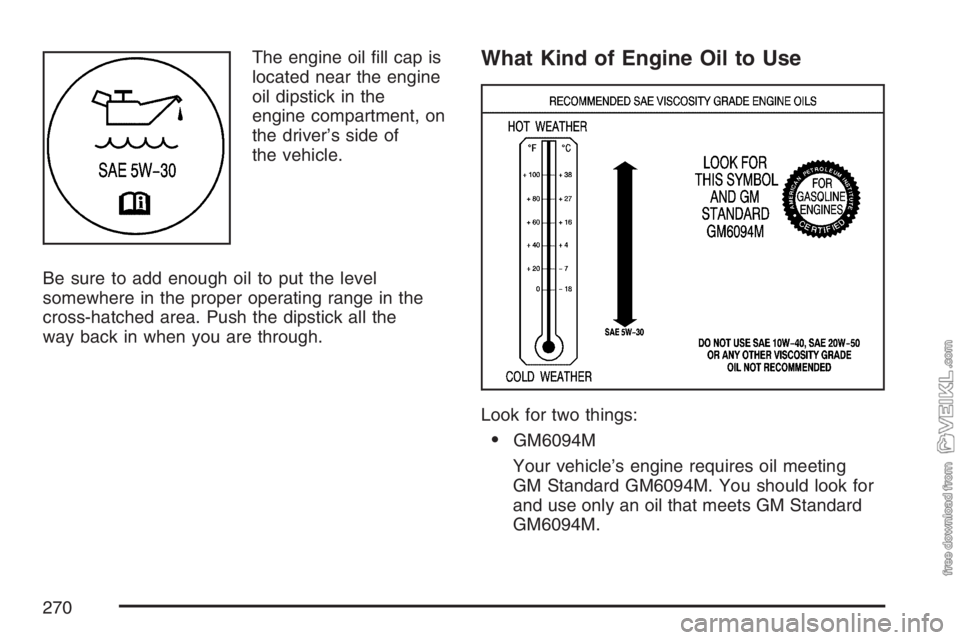
The engine oil fill cap is
located near the engine
oil dipstick in the
engine compartment, on
the driver’s side of
the vehicle.
Be sure to add enough oil to put the level
somewhere in the proper operating range in the
cross-hatched area. Push the dipstick all the
way back in when you are through.What Kind of Engine Oil to Use
Look for two things:
•GM6094M
Your vehicle’s engine requires oil meeting
GM Standard GM6094M. You should look for
and use only an oil that meets GM Standard
GM6094M.
270