2007 CHEVROLET KODIAK engine oil
[x] Cancel search: engine oilPage 176 of 430

Low Oil Level Light
Your vehicle may have
a low oil level light.
This light should come on as a check, when you
start your engine. If the light fails to come on, have
it repaired as soon as possible so you will be
aware when the oil level is low.
Vehicles that have Caterpillar
®diesel engines may
not have a low oil level light. In this case, the light
will neither come on as a check when you start your
engine, nor will it come on to indicate a low oil level.
If this light comes on and stays on, it means your
engine is low on oil. You need to check the oil level
right away. SeeEngine Oil (Caterpillar
®DieselEngine) on page 268orEngine Oil (Gasoline
Engine) on page 268orEngine Oil (DURAMAX
®/
Isuzu Diesel Engine) on page 272for further
information.
Notice:Lack of proper engine oil maintenance
may damage the engine. The repairs would
not be covered by your warranty. Always follow
the maintenance schedule in this manual for
changing engine oil.
Change Engine Oil Light
The change engine oil
light should come on
briefly as a bulb
check when you start
the engine. If the
light does not come on,
have it serviced.
If the change engine oil light comes on and stays
on after you start the engine, have the oil
changed.
176
Page 177 of 430

For additional information on when to change
engine oil for gasoline engines or DURAMAX®
diesel engines, seeEngine Oil (Caterpillar®Diesel
Engine) on page 268orEngine Oil (Gasoline
Engine) on page 268orEngine Oil (DURAMAX
®/
Isuzu Diesel Engine) on page 272andScheduled
Maintenance on page 363. To reset the change
engine oil light, seeEngine Oil Life System
(Gasoline Engine) on page 276orEngine Oil Life
System (DURAMAX
®Diesel) on page 278or
Engine Oil Life System (Caterpillar®Diesel Engine)
on page 279.
Engine Overspeed Warning Light
If your vehicle has this
light, it will come on if
your engine is operating
at too many revolutions
per minute (rpm).
It will also come on for a moment as a check
when you start your engine.
If it comes on when you’re driving, reduce your
engine speed immediately.
Engine Shutdown Warning Light
If your vehicle has the
engine shutdown
feature, this light will
come on when engine
shutdown is active.
For more information, seeEngine Alarm and
Automatic ShutdownunderStarting the Diesel
Engine on page 100.
177
Page 178 of 430

Transmission Temperature Gage
If you have an automatic
transmission and this
gage, it is located above
the switchbank in the
center of the instrument
panel.
When your ignition is on, the gage shows the
temperature of the transmission oil. A reading in
the warning zone, the red area beginning at 300°F
(150°C), means you must stop driving and
check into the cause. One possible cause is a low
oil level in the transmission.
Notice:If you drive your vehicle with the
transmission temperature gage above normal
operating range, you can damage the
transmission. This could lead to costly repairs
that would not be covered by your warranty.
Do not drive your vehicle while the
transmission temperature gage reading is
above normal. See your dealer for service.
Exhaust Brake Indicator Light
If your vehicle is
equipped with an
exhaust brake, you will
have this light, located
above the climate
controls in the center of
the instrument panel.
The exhaust brake indicator light will come on and
stay on whenever the diesel engine exhaust brake
or exhaust restrictor is active. For more information,
seeDiesel Engine Exhaust Brake on page 112and
Exhaust Restrictor (Engine Warm-Up) on page 108.
Differential Lock Indicator Light
If your vehicle has this
feature, this light is
located in the center of
the instrument panel.
The light is on when the
rear differential lock
system is in use.
178
Page 180 of 430

Low Washer Fluid Warning Light
This light is located
above the climate
controls in the center of
the instrument panel.
This light will come on when your vehicle is low on
windshield washer fluid.
For more information, seeWindshield Washer
Fluid on page 296.
Check Gages Warning Light
This light will come on
as you’re starting the
engine, just as a check.
If this light comes on and stays on while you are
driving. It means that either your engine coolant
temperature gage or your engine oil pressure gage
may be showing a reading in the warning zone.
When the check gages light comes on, you
will also hear a warning tone. The tone and the
light will stay activated until the problem is
corrected.
This light may also come on if your vehicle is
equipped with the optional automatic engine
shutdown system and engine shutdown has
begun. SeeEngine Alarm and Automatic
ShutdownunderStarting the Diesel Engine on
page 100.
180
Page 245 of 430

Service........................................................ 248
California Proposition 65 Warning.............. 248
Doing Your Own Service Work.................. 249
Engine Fan Breakage................................ 250
Fuel............................................................. 251
Gasoline Octane........................................ 251
Gasoline Specifications.............................. 251
Additives................................................... 252
Diesel Engine Fuel.................................... 253
What Fuel to Use...................................... 253
Very Cold Weather Operation.................... 256
Water in Fuel............................................ 256
Running Out of Fuel.................................. 262
Fuel Filter Replacement............................. 263
Fuels in Foreign Countries........................ 264
Filling the Tank......................................... 264
Filling a Portable Fuel Container............... 266Checking Things Under the Hood.............. 266
Hood Latches............................................ 267
Engine Oil (Caterpillar
®Diesel Engine)...... 268
Engine Oil (Gasoline Engine).................... 268
Engine Oil (DURAMAX
®/Isuzu Diesel
Engine).................................................. 272
Engine Oil Life System
(Gasoline Engine).................................. 276
Engine Oil Life System
(DURAMAX
®Diesel)............................... 278
Engine Oil Life System
(Caterpillar
®Diesel Engine).................... 279
Engine Air Cleaner/Filter............................ 280
Automatic Transmission Fluid.................... 282
Manual Transmission Fluid........................ 283
Engine Coolant (Gas and
DURAMAX
®/Isuzu Engines).................... 284
Engine Coolant (Caterpillar®Diesel
Engines)................................................ 287
Coolant Surge Tank Pressure Cap............ 288
Section 5 Service and Appearance Care
245
Page 246 of 430
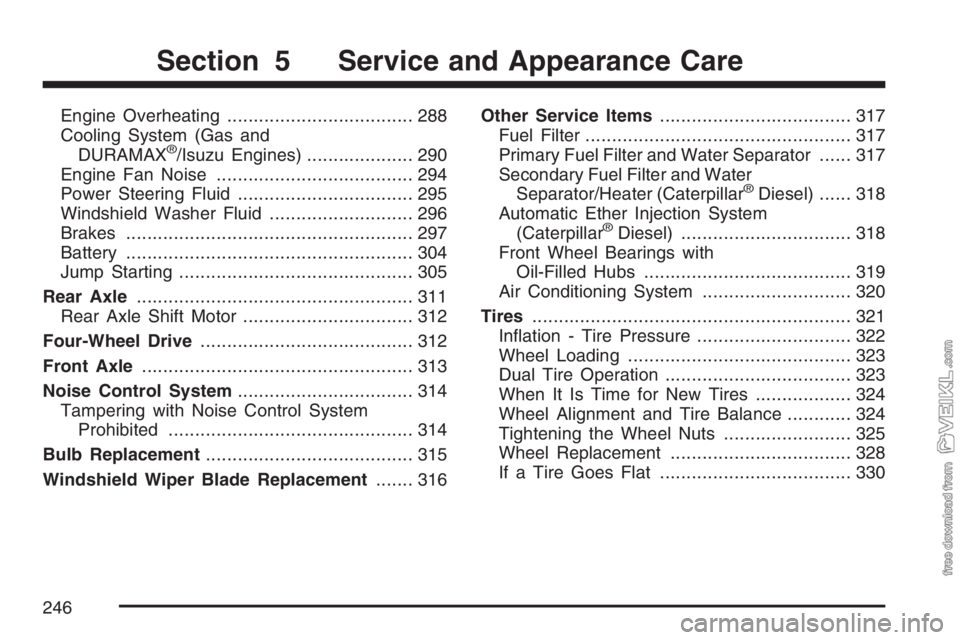
Engine Overheating................................... 288
Cooling System (Gas and
DURAMAX
®/Isuzu Engines).................... 290
Engine Fan Noise..................................... 294
Power Steering Fluid................................. 295
Windshield Washer Fluid........................... 296
Brakes...................................................... 297
Battery...................................................... 304
Jump Starting............................................ 305
Rear Axle.................................................... 311
Rear Axle Shift Motor................................ 312
Four-Wheel Drive........................................ 312
Front Axle................................................... 313
Noise Control System................................. 314
Tampering with Noise Control System
Prohibited.............................................. 314
Bulb Replacement....................................... 315
Windshield Wiper Blade Replacement....... 316Other Service Items.................................... 317
Fuel Filter.................................................. 317
Primary Fuel Filter and Water Separator...... 317
Secondary Fuel Filter and Water
Separator/Heater (Caterpillar
®Diesel)...... 318
Automatic Ether Injection System
(Caterpillar
®Diesel)................................ 318
Front Wheel Bearings with
Oil-Filled Hubs....................................... 319
Air Conditioning System............................ 320
Tires............................................................ 321
Inflation - Tire Pressure............................. 322
Wheel Loading.......................................... 323
Dual Tire Operation................................... 323
When It Is Time for New Tires.................. 324
Wheel Alignment and Tire Balance............ 324
Tightening the Wheel Nuts........................ 325
Wheel Replacement.................................. 328
If a Tire Goes Flat.................................... 330
Section 5 Service and Appearance Care
246
Page 253 of 430

Diesel Engine Fuel
For the Caterpillar®diesel, see the Caterpillar®
Operation & Maintenance Manual for information
concerning fuel usage.
Notice:Diesel fuel or fuel additives not
recommended in this manual could damage
your fuel system and engine. Your warranty
would not cover this damage. And:
Diesel fuel that has been mixed with engine
oil or automatic transmission uid could
damage your engine and emission controls.
Aftermarket diesel fuel additives are not
tested by General Motors. Some additives,
particularly those which contain alcohol or
water emulsiers, may damage your fuel
system. If you believe that unique
circumstances call for a fuel additive to be
used, consult your dealer for advice.
If you ever run out of diesel fuel, it can be
difficult to restart your engine. To avoid this,
never let your tank get empty.
If gasoline is ever accidentally added to the fuel
tank, to avoid severe engine damage, do not run
the engine until the fuel tank can be drained.
If you run out of fuel,Running Out of Fuel on
page 262tells you how to restart your engine.
What Fuel to Use
In the United States, for best results use
No. 2-D diesel fuel year-round (above and below
freezing conditions) as oil companies blend
No. 2-D fuel to address climate differences.
No. 1-D diesel fuel may be used in very cold
temperatures (when it stays below 0°F or−18°C);
however, it will produce a power and fuel
economy loss. Avoid the use of No. 1-D diesel
fuel in warm or hot climates. It may result in
stalling, poor starting when the engine is hot, and
may damage the fuel injection system.
It is important that diesel-powered trucks are
refueled only with ultra low-sulfur fuel. The
emission control system requires the use of diesel
fuel with ultra low-sulfur (0.0015% by weight, or
15 ppm, maximum) content. Both ultra low-sulfur
and higher sulfur diesel fuels are available in
the United States and ultra low-sulfur diesel fuel is
available in Canada. However, only higher
sulfur diesel fuel is available in Mexico. Use of
fuels with higher-sulfur content will affect the
function of the emission components and may
cause reduced performance, excessive smoke,
and unpleasant odor.
253
Page 254 of 430

At a minimum, the diesel fuel you use
should meet the latest version of ASTM
specification D 975 (Grades No. 2-D or No. 1-D
S15 commonly known as Ultra Low Sulfur diesel)
in the United States. In addition, the Engine
Manufacturers Association (EMA) has identified
properties of an improved diesel fuel for better
engine performance and durability. Diesel
fuels corresponding to the EMA Recommended
Guideline on Premium Diesel Fuel (FQP-1A) could
provide better starting, less noise, and better
vehicle performance. If there are questions about
the fuel you are using, contact your fuel supplier.
If your vehicle has the 6.6L engine, it is
acceptable to use diesel fuel containing up to
5% biodiesel (B5), but the final blended fuel must
meet the same specification, ASTM D 975 (Grades
No. 2-D or No. 1-D S15 commonly known as Ultra
Low Sulfur diesel), as other fuels used in your
vehicle, and the biodiesel used for making this
fuel must meet the latest version of ASTM
specification D 6751. Biodiesel is produced from
vegetable oils or animal fat that have been
chemically modified to reduce the possibility of
damage to your fuel system and engine. Higher
concentration (i.e., greater than B5)
biodiesel-containing fuels or the use ofunmodified bio-oils blended into diesel fuel at any
concentration is not recommended and could
damage your fuel system and engine. Such
damage would not be covered by your warranty. If
there are questions about the biodiesel-containing
fuels you are using, contact your fuel supplier.
Diesel fuel may foam when you fill your tank. This
can cause the automatic pump nozzle to shut
off, even though your tank is not full. If this
happens, just wait for the foaming to stop and
then continue to fill your tank. SeeFilling the Tank
on page 264.
{CAUTION:
Heat coming from the engine may cause
the fuel to expand and force the fuel out
of your tank. If something ignites the fuel,
a re could start and people could be
burned. To help avoid this, ll your fuel
tank only until the automatic nozzle shuts
off. Do not try to top it off.
254