2007 CHEVROLET IMPALA traction control
[x] Cancel search: traction controlPage 252 of 460
Control of a Vehicle
The following three systems help to control your
vehicle while driving — brakes, steering, and
accelerator. At times, as when driving on snow
or ice, it is easy to ask more of those control
systems than the tires and road can provide.
Meaning, you can lose control of your vehicle.
SeeTraction Control System (TCS) on page 256.
Adding non-dealer/non-retailer accessories can
affect your vehicle’s performance. SeeAccessories
and Modications on page 296.
Braking
SeeBrake System Warning Light on page 181.
Braking action involves perception time and
reaction time.First, you have to decide to push on the brake
pedal. That is perception time. Then you have to
bring up your foot and do it. That is reaction time.
Average reaction time is about three-fourths of a
second. But that is only an average. It might be less
with one driver and as long as two or three seconds
or more with another. Age, physical condition,
alertness, coordination, and eyesight all play a part.
So do alcohol, drugs, and frustration. But even in
three-fourths of a second, a vehicle moving at
60 mph (100 km/h) travels 66 feet (20 m). That
could be a lot of distance in an emergency, so
keeping enough space between your vehicle and
others is important.
And, of course, actual stopping distances vary
greatly with the surface of the road, whether it is
pavement or gravel; the condition of the road,
whether it is wet, dry, or icy; tire tread; the condition
of the brakes; the weight of the vehicle; and the
amount of brake force applied.
252
Page 256 of 460
Traction Control System (TCS)
Your vehicle may have a traction control system
that limits wheel spin. This is especially useful
in slippery road conditions. The system operates
only if it senses that one or both of the front wheels
are spinning or beginning to lose traction. When
this happens, the system reduces engine
power and may also upshift the transmission
and apply the front brakes to limit wheel spin.
This light will ash
when your traction
control system is
limiting wheel spin.
You may feel or hear the system working, but this
is normal.
If your vehicle is in cruise control when the
traction control system begins to limit wheel spin,
the cruise control will automatically disengage.
When road conditions allow you to safely
use it again, you may re-engage the cruise
control. SeeCruise Control on page 157.The traction control system operates in all
transmission shift lever positions. But the system
can upshift the transmission only as high as
the shift lever position you’ve chosen, so you
should use the lower gears only when necessary.
SeeAutomatic Transaxle Operation on page 116.
When the system is on,
this warning light will
come on and stay on to
let you know if there’s
a problem.
A SERVICE TRACTION CONTROL message will
also appear on the DIC. When this warning
light is on, the system will not limit wheel spin.
Adjust your driving accordingly. SeeDIC Warnings
and Messages on page 199for more information.
To limit wheel spin, especially in slippery road
conditions, you should always leave the traction
control system on. But you can turn the system off
if you ever need to. You should turn the system
off if your vehicle ever gets stuck in sand, mud or
snow and rocking the vehicle is required.
256
Page 257 of 460
SeeRocking Your Vehicle to Get It Out on
page 277andIf Your Vehicle is Stuck in Sand,
Mud, Ice, or Snow on page 276for more
information.
To turn the system on
or off, press the traction
control button located
on the left side of
the instrument panel.
When you turn the system off, a chime will sound,
the traction control warning light will come on
and stay on and a TRACTION CONTROL OFF
message will appear on the DIC. If the traction
control system is limiting wheel spin when
you press the button to turn the system off,
the warning light will come on and the system
will turn off right away.
You can turn the system back on at any time by
pressing the button again. The traction control light
should go off.
Adding non-dealer/non-retailer accessories can
affect your vehicle’s performance. SeeAccessories
and Modications on page 296for more
information.Steering
Power Steering
If you lose power steering assist because the
engine stops or the system is not functioning,
you can steer but it will take much more effort.
Steering Tips
It is important to take curves at a
reasonable speed.
A lot of the “driver lost control” accidents mentioned
on the news happen on curves. Here is why:
Experienced driver or beginner, each of us is
subject to the same laws of physics when driving on
curves. The traction of the tires against the road
surface makes it possible for the vehicle to change
its path when you turn the front wheels. If there is
no traction, inertia will keep the vehicle going in the
same direction. If you have ever tried to steer a
vehicle on wet ice, you will understand this.
257
Page 258 of 460
The traction you can get in a curve depends on
the condition of the tires and the road surface, the
angle at which the curve is banked, and your
speed. While you are in a curve, speed is the
one factor you can control.
Suppose you are steering through a sharp curve.
Then you suddenly apply the brakes. Both
control systems — steering and braking — have
to do their work where the tires meet the road.
Unless you have four-wheel anti-lock brakes,
adding the hard braking can demand too much of
those places. You can lose control.
The same thing can happen if you are steering
through a sharp curve and you suddenly
accelerate. Those two control systems — steering
and acceleration — can overwhelm those
places where the tires meet the road and make
you lose control.What should you do if this ever happens? Ease up
on the brake or accelerator pedal, steer the
vehicle the way you want it to go, and slow down.
Speed limit signs near curves warn that you
should adjust your speed. Of course, the posted
speeds are based on good weather and road
conditions. Under less favorable conditions you will
want to go slower.
If you need to reduce your speed as you approach
a curve, do it before you enter the curve, while
the front wheels are straight ahead.
Try to adjust your speed so you can “drive”
through the curve. Maintain a reasonable, steady
speed. Wait to accelerate until you are out of
the curve, and then accelerate gently into
the straightaway.
Adding non-dealer/non-retailer accessories can
affect your vehicle’s performance. SeeAccessories
and Modications on page 296.
258
Page 262 of 460
Loss of Control
Let us review what driving experts say about what
happens when the three control systems — brakes,
steering, and acceleration — do not have enough
friction where the tires meet the road to do what the
driver has asked.
In any emergency, do not give up. Keep trying to
steer and constantly seek an escape route or
area of less danger.
Skidding
In a skid, a driver can lose control of the vehicle.
Defensive drivers avoid most skids by taking
reasonable care suited to existing conditions, and
by not overdriving those conditions. But skids
are always possible.
The three types of skids correspond to your
vehicle’s three control systems. In the braking skid,
the wheels are not rolling. In the steering or
cornering skid, too much speed or steering in a
curve causes tires to slip and lose cornering force.
And in the acceleration skid, too much throttle
causes the driving wheels to spin.A cornering skid and an acceleration skid are
best handled by easing your foot off the
accelerator pedal.
If your vehicle starts to slide, ease your foot off
the accelerator pedal and quickly steer the
way you want the vehicle to go. If you start
steering quickly enough, your vehicle may
straighten out. Always be ready for a second skid
if it occurs.
Of course, traction is reduced when water, snow,
ice, gravel, or other material is on the road.
For safety, you will want to slow down and adjust
your driving to these conditions. It is important
to slow down on slippery surfaces because
stopping distance will be longer and vehicle
control more limited.
While driving on a surface with reduced traction, try
your best to avoid sudden steering, acceleration,
or braking, including reducing vehicle speed by
shifting to a lower gear. Any sudden changes could
cause the tires to slide. You may not realize the
surface is slippery until your vehicle is skidding.
Learn to recognize warning clues — such as
enough water, ice, or packed snow on the road to
make a mirrored surface — and slow down when
you have any doubt.
262
Page 273 of 460
Driving on Snow or Ice
Most of the time, those places where the tires
meet the road probably have good traction.
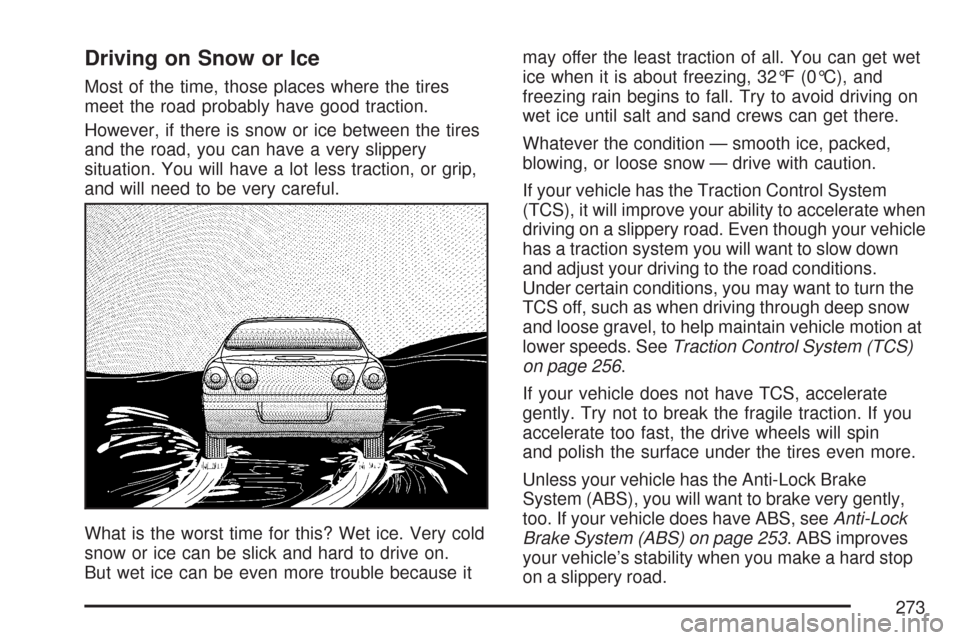
However, if there is snow or ice between the tires
and the road, you can have a very slippery
situation. You will have a lot less traction, or grip,
and will need to be very careful.
What is the worst time for this? Wet ice. Very cold
snow or ice can be slick and hard to drive on.
But wet ice can be even more trouble because itmay offer the least traction of all. You can get wet
ice when it is about freezing, 32°F (0°C), and
freezing rain begins to fall. Try to avoid driving on
wet ice until salt and sand crews can get there.
Whatever the condition — smooth ice, packed,
blowing, or loose snow — drive with caution.
If your vehicle has the Traction Control System
(TCS), it will improve your ability to accelerate when
driving on a slippery road. Even though your vehicle
has a traction system you will want to slow down
and adjust your driving to the road conditions.
Under certain conditions, you may want to turn the
TCS off, such as when driving through deep snow
and loose gravel, to help maintain vehicle motion at
lower speeds. SeeTraction Control System (TCS)
on page 256.
If your vehicle does not have TCS, accelerate
gently. Try not to break the fragile traction. If you
accelerate too fast, the drive wheels will spin
and polish the surface under the tires even more.
Unless your vehicle has the Anti-Lock Brake
System (ABS), you will want to brake very gently,
too. If your vehicle does have ABS, seeAnti-Lock
Brake System (ABS) on page 253. ABS improves
your vehicle’s stability when you make a hard stop
on a slippery road.
273
Page 277 of 460
Rocking Your Vehicle to Get It Out
First, turn the steering wheel left and right.
That will clear the area around the front wheels.
If your vehicle has traction control, you should turn
the traction control system off. SeeTraction
Control System (TCS) on page 256. Then shift
back and forth between REVERSE (R) and
a forward gear, spinning the wheels as little as
possible. Release the accelerator pedal while you
shift, and press lightly on the accelerator pedal
when the transaxle is in gear. By slowly spinning
the wheels in the forward and reverse directions,
you will cause a rocking motion that may free your
vehicle. If that does not get your vehicle out
after a few tries, it may need to be towed out.
If your vehicle does need to be towed out,
seeTowing Your Vehicle on page 282.
Loading Your Vehicle
It is very important to know how much weight your
vehicle can carry. Two labels on your vehicle
show how much weight it may properly carry, the
Tire and Loading Information label and the
Vehicle Certication label.
{CAUTION:
Do not load your vehicle any heavier than
the Gross Vehicle Weight Rating (GVWR),
or either the maximum front or rear Gross
Axle Weight Rating (GAWR). If you do,
parts on your vehicle can break, and it
can change the way your vehicle handles.
These could cause you to lose control
and crash. Also, overloading can shorten
the life of your vehicle.
277
Page 296 of 460
Service
Your dealer knows your vehicle best and wants
you to be happy with it. We hope you will go
to your dealer for all your service needs. You will
get genuine GM parts and GM-trained and
supported service people.
We hope you will want to keep your GM vehicle all
GM. Genuine GM parts have one of these marks:
Accessories and Modications
When you add non-GM accessories to your vehicle
they can affect your vehicle’s performance and
safety, including such things as, airbags, braking,
stability, ride and handling, emissions systems,
aerodynamics, durability, and electronic systems
like anti-lock brakes, traction control and
stability control. Some of these accessories may
even cause malfunction or damage not covered
by warranty.
GM Accessories are designed to complement and
function with other systems on your vehicle.
Your GM dealer/retailer can accessorize your
vehicle using genuine GM Accessories. When you
go to your GM dealer/retailer and ask for GM
Accessories, you will know that GM-trained and
supported service technicians will perform the work
using genuine GM Accessories.
296