2007 CHEVROLET AVALANCHE belt
[x] Cancel search: beltPage 201 of 618

Instrument Panel Overview........................ 204
Hazard Warning Flashers.......................... 206
Other Warning Devices............................. 206
Horn.......................................................... 206
Tilt Wheel.................................................. 207
Turn Signal/Multifunction Lever.................. 207
Turn and Lane-Change Signals................. 208
Headlamp High/Low-Beam Changer.......... 209
Flash-to-Pass............................................ 209
Windshield Wipers..................................... 209
Rainsense™ II Wipers............................... 210
Windshield Washer.................................... 211
Cruise Control........................................... 212
Exterior Lamps.......................................... 215
Headlamps on Reminder........................... 216
Daytime Running Lamps (DRL)................. 216
Automatic Headlamp System..................... 217
Fog Lamps................................................ 218
Exterior Cargo Lamps................................ 219
Instrument Panel Brightness...................... 219
Dome Lamps............................................. 220
Dome Lamp Override................................ 220
Entry/Exit Lighting...................................... 220
Reading Lamps......................................... 220
Electric Power Management...................... 220Battery Run-Down Protection..................... 221
Ultrasonic Rear Parking Assist (URPA)........ 222
Accessory Power Outlet(s)........................ 226
Ashtray(s) and Cigarette Lighter................ 226
Climate Controls......................................... 227
Dual Climate Control System..................... 227
Dual Automatic Climate Control System....... 230
Outlet Adjustment...................................... 238
Warning Lights, Gages, and Indicators..... 239
Instrument Panel Cluster........................... 240
Speedometer and Odometer...................... 241
Trip Odometer........................................... 241
Tachometer............................................... 241
Safety Belt Reminder Light........................ 241
Passenger Safety Belt Reminder Light......... 242
Airbag Readiness Light............................. 242
Passenger Airbag Status Indicator............. 243
Charging System Light.............................. 245
Voltmeter Gage......................................... 246
Brake System Warning Light..................... 246
Anti-Lock Brake System Warning Light........ 248
StabiliTrak
®Indicator Light......................... 248
Engine Coolant Temperature Gage............ 249
Tire Pressure Light.................................... 250
Section 3 Instrument Panel
201
Page 241 of 618

Speedometer and Odometer
Your speedometer lets you see your speed in
both miles per hour (mph) and kilometers per
hour (km/h). Your odometer shows how far
your vehicle has been driven, in either miles
(used in the United States) or kilometers
(used in Canada).
Trip Odometer
The trip odometer can tell you how far your
vehicle has been driven since you last set the
trip odometer to zero.
Press the reset button, located on the instrument
panel cluster next to the trip odometer display,
to toggle between the trip odometer and the
regular odometer. Holding the reset button for
approximately one second while the trip odometer
is displayed will reset it.
To display the odometer reading with the ignition
off, press the reset button.
Tachometer
Your tachometer displays the engine speed in
revolutions per minute (rpm).
Safety Belt Reminder Light
When the key is turned to RUN or START, a
chime will sound for several seconds to remind
people to buckle their safety belts. The driver
safety belt light will also be provided and stay on
for several seconds, then it will ash for several
more. You should buckle your seat belt.
This chime and light
will be repeated if
the driver remains
unbuckled and
the vehicle is
in motion.
If the driver’s belt is buckled, neither the chime
nor the light will come on.
241
Page 242 of 618

Passenger Safety Belt
Reminder Light
Several seconds after the key is turned to RUN or
START, a chime will sound for several seconds
to remind the front passenger to buckle their safety
belt. The passenger safety belt light will also
come on and stay on for several seconds, then
it will ash for several more.
This chime and light
will be repeated if the
passenger remains
unbuckled and
the vehicle is in motion.
If the passenger’s safety belt is buckled,
neither the chime nor the light will come on.
Airbag Readiness Light
There is an airbag readiness light on the instrument
panel, which shows the airbag symbol. The
system checks the airbag’s electrical system for
malfunctions. The light tells you if there is an
electrical problem. The system check includes the
airbag sensors, the airbag modules, the wiring and
the crash sensing and diagnostic module. For more
information on the airbag system, seeAirbag
System on page 72.
This light will come on
when you start your
vehicle, and it will ash
for a few seconds.
Then the light should go out. This means the
system is ready.
242
Page 245 of 618

If, after several seconds, all status indicator lights
remain on, or if there are no lights at all, there
may be a problem with the lights or the passenger
sensing system. See your dealer for service.
{CAUTION:
If the off indicator and the airbag
readiness light ever come on together,
it means that something may be wrong
with the airbag system. If this ever
happens, have the vehicle serviced
promptly, because an adult-size person
sitting in the right front passenger seat
may not have the protection of the frontal
airbag. SeeAirbag Readiness Light
on page 242.
Charging System Light
The charging system
light will come on briey
when you turn on the
ignition, but the engine is
not running, as a check
to show you it is working.
It should go out once the engine is running. If it
stays on, or comes on while you are driving, you
may have a problem with the charging system.
It could indicate that you have problems with the
generator, the generator drive belt, or another
electrical problem. Have it checked right away.
Driving while this light is on could drain your battery.
When this light comes on, the Driver Information
Center (DIC) will also display the SERVICE
BATTERY NOT CHARGING SYSTEM message.
SeeDIC Warnings and Messages on page 267
for more information.
If you must drive a short distance with the light
on, be certain to turn off all your accessories,
such as the radio and air conditioner, to reduce
the drain on your battery.
245
Page 352 of 618
Your Driving, the Road,
and Your Vehicle
Defensive Driving
The best advice anyone can give about
driving is: Drive defensively.
Please start with a very important safety
device in your vehicle: Buckle up. SeeSafety
Belts: They Are for Everyone on page 21.
{CAUTION:
Defensive driving really means “Be ready
for anything.” On city streets, rural roads,
or expressways, it means “Always expect
the unexpected.” Assume that pedestrians
or other drivers are going to be careless
and make mistakes. Anticipate what
they might do and be ready. Rear-end
collisions are about the most preventable
of accidents. Yet they are common.
Allow enough following distance.
Defensive driving requires that a driver
concentrate on the driving task. Anything
that distracts from the driving task makes
proper defensive driving more difficult
and can even cause a collision, with
resulting injury. Ask a passenger to help
do these things, or pull off the road in
a safe place to do them. These simple
defensive driving techniques could
save your life.
352
Page 364 of 618
Try to adjust your speed so you can “drive”
through the curve. Maintain a reasonable, steady
speed. Wait to accelerate until you are out of
the curve, and then accelerate gently into
the straightaway.
Adding non-GM accessories can affect your
vehicle’s performance. SeeAccessories and
Modications on page 433.
Steering in Emergencies
There are times when steering can be more
effective than braking. For example, you come
over a hill and nd a truck stopped in your lane,
or a car suddenly pulls out from nowhere, or
a child darts out from between parked cars and
stops right in front of you. You can avoid these
problems by braking — if you can stop in time.
But sometimes you cannot; there is not room.
That is the time for evasive action — steering
around the problem.
Your vehicle can perform very well in emergencies
like these. First, apply the brakes. SeeBraking
on page 356. It is better to remove as much speed
as you can from a possible collision. Then steer
around the problem, to the left or right depending
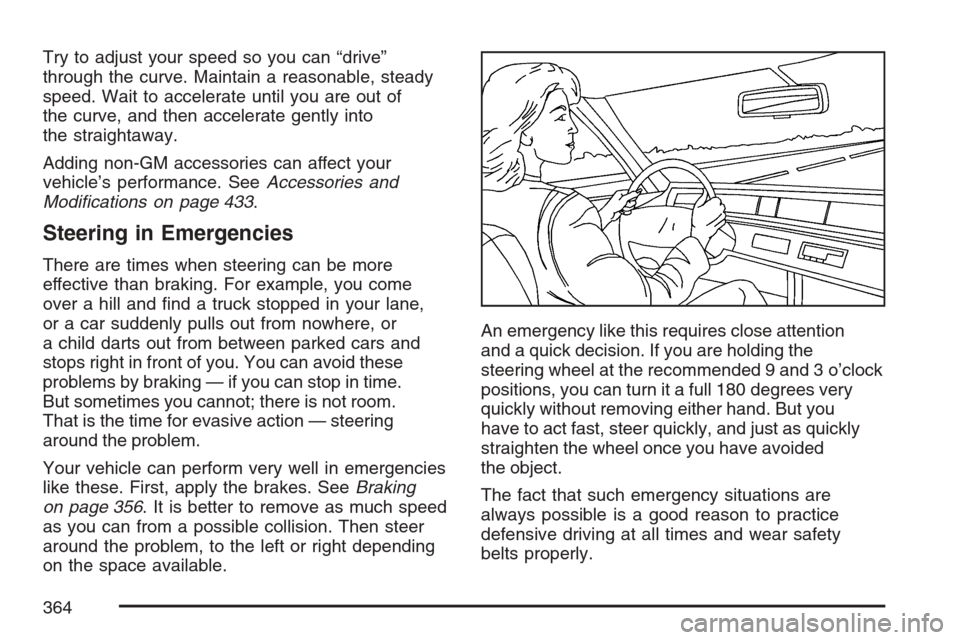
on the space available.An emergency like this requires close attention
and a quick decision. If you are holding the
steering wheel at the recommended 9 and 3 o’clock
positions, you can turn it a full 180 degrees very
quickly without removing either hand. But you
have to act fast, steer quickly, and just as quickly
straighten the wheel once you have avoided
the object.
The fact that such emergency situations are
always possible is a good reason to practice
defensive driving at all times and wear safety
belts properly.
364
Page 372 of 618

Traveling to Remote Areas
It makes sense to plan your trip, especially
when going to a remote area. Know the terrain and
plan your route. You are much less likely to get bad
surprises. Get accurate maps of trails and terrain.
Try to learn of any blocked or closed roads.
It is also a good idea to travel with at least
one other vehicle. If something happens to
one of them, the other can help quickly.
Does your vehicle have a winch? If so, be sure to
read the winch instructions. In a remote area, a
winch can be handy if you get stuck. But you will
want to know how to use it properly.
Getting Familiar with Off-Road Driving
It is a good idea to practice in an area that is
safe and close to home before you go into
the wilderness. Off-road driving does require some
new and different skills. Here is what we mean.
Tune your senses to different kinds of signals.
Your eyes, for example, need to constantly sweep
the terrain for unexpected obstacles. Your ears
need to listen for unusual tire or engine sounds.
With your arms, hands, feet, and body, you will
need to respond to vibrations and vehicle bounce.Controlling your vehicle is the key to successful
off-road driving. One of the best ways to control
your vehicle is to control your speed. Here are
some things to keep in mind. At higher speeds:
You approach things faster and you have less
time to scan the terrain for obstacles.
You have less time to react.
You have more vehicle bounce when you drive
over obstacles.
You will need more distance for braking,
especially since you are on an unpaved
surface.
{CAUTION:
When you are driving off-road, bouncing
and quick changes in direction can easily
throw you out of position. This could
cause you to lose control and crash.
So, whether you are driving on or off the
road, you and your passengers should
wear safety belts.
372
Page 426 of 618

When You Are Ready to Leave After
Parking on a Hill
1. Apply your regular brakes and hold the pedal
down while you:
start your engine,
shift into a gear, and
release the parking brake.
2. Let up on the brake pedal.
3. Drive slowly until the trailer is clear of the
chocks.
4. Stop and have someone pick up and store
the chocks.
Maintenance When Trailer Towing
Your vehicle will need service more often when
you’re pulling a trailer. See the Maintenance
Schedule for more on this. Things that are
especially important in trailer operation are
automatic transmission uid (don’t overll), engine
oil, axle lubricant, belts, cooling system and
brake system. Each of these is covered in this
manual, and the Index will help you nd them
quickly. If you’re trailering, it’s a good idea
to review these sections before you start your trip.
Check periodically to see that all hitch nuts and
bolts are tight.
426