2007 CHEVROLET AVALANCHE four wheel drive
[x] Cancel search: four wheel drivePage 412 of 618
Rear Towing (Rear Wheels Off the Ground)
Two-Wheel-Drive Vehicles
Use the following procedure to tow your vehicle
from the rear:
1. Drive the vehicle onto the dolly.
2. Firmly set the parking brake. SeeParking
Brake on page 138for more information.
3. Put the transmission in PARK (P).
4. Follow the dolly manufacturer’s instructions to
attach and secure the vehicle being towed to
the dolly and then the loaded dolly to the
tow vehicle.
Make sure the wheels are straight before
proceeding to the next steps.
5. Release the parking brake only after the
vehicle being towed is rmly attached to
the tow vehicle.
If the tow vehicle will not be started or driven
for six weeks or more, remove the battery
cable from the negative terminal (post) of the
battery to prevent your battery from draining
while towing.
Four-Wheel-Drive Vehicles
Use the following procedure to tow your vehicle
from the rear:
1. Drive the vehicle onto the dolly.
2. Firmly set the parking brake.
3. Put the transmission in PARK (P).
4. Turn the engine off, but leave the ignition on.
5. Follow the dolly manufacturer’s instructions
to attach and secure the vehicle being
towed to the dolly and then the loaded dolly
to the tow vehicle.
Make sure the wheels are straight before
proceeding to the next steps.
412
Page 413 of 618
{CAUTION:
Shifting the transfer case to NEUTRAL
can cause your vehicle to roll even if the
transmission is in PARK (P). You or
someone else could be seriously injured.
Be sure to set the parking brake before
placing the transfer case in NEUTRAL.
SeeParking Brake on page 138.
6. Shift the transfer case to NEUTRAL (N).
SeeFour-Wheel Drive on page 132for
the proper procedure to select the neutral
position for your vehicle.
7. Release the parking brake only after the
vehicle being towed is rmly attached to
the tow vehicle.
If the tow vehicle will not be started or driven
for six weeks or more, remove the battery
cable from the negative terminal (post) of
the battery to prevent your battery from
draining while towing.
Level Control
The self-adjusting rear suspension may come
as part of the premium smooth ride suspension
package.
This type of level control will provide a leveled
riding position as well as improved handling
under a variety of passenger and loading
conditions. A hydraulic pump inside each rear
shock absorber raises the rear of the vehicle to
the proper height, based on inputs from the
road surface, while the vehicle is being driven.
It take approximately 2 miles (3.2 km) of driving
for the leveling to complete, depending on the
road surface conditions.
If the loaded vehicle is not moved for
approximately 12 hours, the leveling system
may bleed down to a lower height. This can be
especially apparent if a trailer is left attached to
a parked vehicle for long periods of time. The
vehicle must be driven to re-level the vehicle.
If a weight-distributing hitch is being used, the
vehicle should be driven approximately 2 miles
(3.2 km) with the trailer prior to adjusting the hitch.
413
Page 425 of 618
3. When the wheel chocks are in place, release
the regular brakes until the chocks absorb
the load.
4. Reapply the regular brakes. Then apply your
parking brake and shift into PARK (P).
5. If you have a four-wheel-drive vehicle, be sure
the transfer case is in a drive gear and not in
NEUTRAL (N).
6. Release the regular brakes.
{CAUTION:
It can be dangerous to get out of your
vehicle if the shift lever is not fully in
PARK (P) with the parking brake rmly
set. Your vehicle can roll.
CAUTION: (Continued)
CAUTION: (Continued)
If you have left the engine running, the
vehicle can move suddenly. You or others
could be injured. To be sure your vehicle
will not move, even when you are on fairly
level ground, use the steps that follow.
Always put the shift lever fully in PARK (P)
with the parking brake rmly set.
If the transfer case on four-wheel-drive
vehicles is in NEUTRAL, your vehicle will
be free to roll, even if your shift lever is in
PARK (P). So, be sure the transfer case is
in a drive gear — not in NEUTRAL.
425
Page 429 of 618

Service........................................................ 432
Accessories and Modications................... 433
California Proposition 65 Warning.............. 433
Doing Your Own Service Work.................. 434
Adding Equipment to the Outside
of Your Vehicle...................................... 435
Fuel............................................................. 435
Gasoline Octane........................................ 436
Gasoline Specications.............................. 436
California Fuel........................................... 436
Additives................................................... 437
Fuel E85 (85% Ethanol)............................ 438
Fuels in Foreign Countries........................ 439
Filling the Tank......................................... 440
Filling a Portable Fuel Container............... 442
Checking Things Under the Hood.............. 442
Hood Release........................................... 443
Engine Compartment Overview.................. 444
Engine Oil................................................. 446
Engine Oil Life System.............................. 449Engine Air Cleaner/Filter............................ 451
Automatic Transmission Fluid.................... 454
Engine Coolant.......................................... 457
Coolant Surge Tank Pressure Cap............ 460
Engine Overheating................................... 460
Overheated Engine Protection
Operating Mode..................................... 463
Cooling System......................................... 464
Engine Fan Noise..................................... 469
Power Steering Fluid ................................. 469
Windshield Washer Fluid........................... 470
Brakes...................................................... 472
Battery...................................................... 475
Jump Starting............................................ 476
Rear Axle.................................................... 482
Four-Wheel Drive........................................ 483
Front Axle................................................... 484
Headlamp Aiming........................................ 485
Section 5 Service and Appearance Care
429
Page 474 of 618

Brake Wear
Your vehicle has four-wheel disc brakes.
Disc brake pads have built-in wear indicators that
make a high-pitched warning sound when the
brake pads are worn and new pads are needed.
The sound may come and go or be heard all
the time your vehicle is moving, except when
you are pushing on the brake pedal rmly.
{CAUTION:
The brake wear warning sound means that
soon the brakes will not work well. That
could lead to an accident. When you hear
the brake wear warning sound, have your
vehicle serviced.
Notice:Continuing to drive with worn-out
brake pads could result in costly brake repair.Some driving conditions or climates may cause a
brake squeal when the brakes are rst applied
or lightly applied. This does not mean something
is wrong with your brakes.
Properly torqued wheel nuts are necessary to help
prevent brake pulsation. When tires are rotated,
inspect brake pads for wear and evenly tighten
wheel nuts in the proper sequence to GM torque
specications.
Brake linings should always be replaced as
complete axle sets.
Brake Pedal Travel
See your dealer if the brake pedal does not return
to normal height, or if there is a rapid increase
in pedal travel. This could be a sign of brake
trouble.
Brake Adjustment
Every time you make a brake stop, your disc
brakes adjust for wear.
474
Page 477 of 618
2. Get the vehicles close enough so the jumper
cables can reach, but be sure the vehicles are
not touching each other. If they are, it could
cause a ground connection you do not
want. You would not be able to start your
vehicle, and the bad grounding could damage
the electrical systems.
To avoid the possibility of the vehicles rolling,
set the parking brake rmly on both vehicles
involved in the jump start procedure. Put
the automatic transmission in PARK (P) or a
manual transmission in NEUTRAL before
setting the parking brake. If you have a
four-wheel-drive vehicle, be sure the transfer
case is in a drive gear, not in NEUTRAL.
Notice:If you leave your radio or other
accessories on during the jump starting
procedure, they could be damaged.
The repairs would not be covered by
your warranty. Always turn off your radio
and other accessories when jump starting
your vehicle.3. Turn off the ignition on both vehicles.
Unplug unnecessary accessories plugged
into the cigarette lighter or the accessory
power outlets. Turn off the radio and all the
lamps that are not needed. This will avoid
sparks and help save both batteries.
And it could save the radio!
4. Open the hood on the other vehicle and locate
the positive (+) and negative (−) terminal
locations on that vehicle.
Your vehicle has a remote positive (+) jump
starting terminal and a remote negative (−)
jump starting terminal. You should always use
these remote terminals instead of the terminals
on the battery.
The remote positive (+) terminal, if equipped, is
located under a red plastic cover at the positive
battery post. To uncover the remote positive (+)
terminal, open the red plastic cover.
477
Page 483 of 618
What to Use
Refer to the Maintenance Schedule to determine
what kind of lubricant to use. SeeRecommended
Fluids and Lubricants on page 574.
Four-Wheel Drive
Lubricant checks in this section also apply to
these vehicles. There are two additional systems
that need lubrication.
Transfer Case
When to Check Lubricant
It is not necessary to regularly check transfer case
uid unless you suspect there is a leak, or you
hear an unusual noise. A uid loss could indicate
a problem. Have it inspected and repaired.
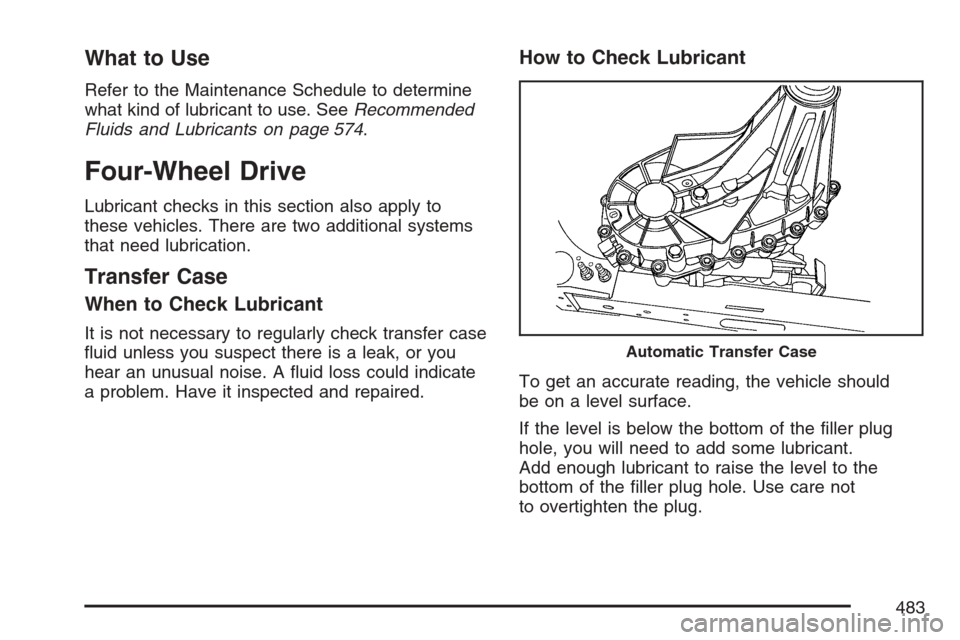
How to Check Lubricant
To get an accurate reading, the vehicle should
be on a level surface.
If the level is below the bottom of the ller plug
hole, you will need to add some lubricant.
Add enough lubricant to raise the level to the
bottom of the ller plug hole. Use care not
to overtighten the plug.
Automatic Transfer Case
483
Page 504 of 618

Your vehicle’s TPMS can alert you about a low
tire pressure condition but it does not replace
normal tire maintenance. SeeTire Inspection and
Rotation on page 506andTires on page 492.
Notice:Do not use a tire sealant if your
vehicle has Tire Pressure Monitors. The liquid
sealant can damage the tire pressure monitor
sensors.
Resetting the TPMS Identication Codes
Each TPMS sensor has a unique identication
code. Any time you rotate your vehicle’s tires
or replace one or more of the TPMS sensors,
the identication codes will need to be matched
to the new tire/wheel position. The sensors
are matched to the tire/wheel positions in the
following order: driver’s side front tire, passengers
side front tire, passengers side rear tire, and
driver’s side rear tire using a TPMS diagnostic tool.
See your GM dealer for service.The TPMS sensors may also be matched to each
tire/wheel position by increasing or decreasing
the tire’s air pressure. If increasing the tire’s
air pressure, do not exceed the maximum ination
pressure indicated on the tire’s sidewall.
You will have two minutes to match the rst
tire/wheel position, and ve minutes overall to
match all four tire/wheel positions. If it takes longer
than two minutes, to match the rst tire and
wheel, or more than ve minutes to match all
four tire and wheel positions the matching process
stops and you will need to start over.
The TPMS sensor matching process is outlined
below:
1. Set the parking brake.
2. Turn the ignition switch to RUN with the
engine off.
3. Using the DIC, press the vehicle information
button until the RELEARN TIRE POSITIONS
message displays. If your vehicle does not
have the DIC buttons, press the trip odometer
reset stem located on the instrument panel
cluster until the RELEARN TIRE POSITIONS
message displays.
504