Page 132 of 618
Four-Wheel Drive
If your vehicle has four-wheel drive, you can send
your engine’s driving power to all four wheels
for extra traction. Read the part that follows before
using four-wheel drive.
Notice:Driving on clean, dry pavement in
Four-Wheel-Drive High or Four-Wheel-Drive
Low for an extended period of time may cause
premature wear on your vehicle’s powertrain.
Do not drive on clean, dry pavement in
Four-Wheel-Drive High or Four-Wheel-Drive
Low for extended periods of time.
While driving on clean dry pavement and during
tight turns, you may experience a vibration in
the steering system.
Front Axle Locking Feature
The front axle locks and unlocks automatically
when you shift the transfer case. Some delay for
the axle to lock or unlock is normal.
Automatic Transfer Case
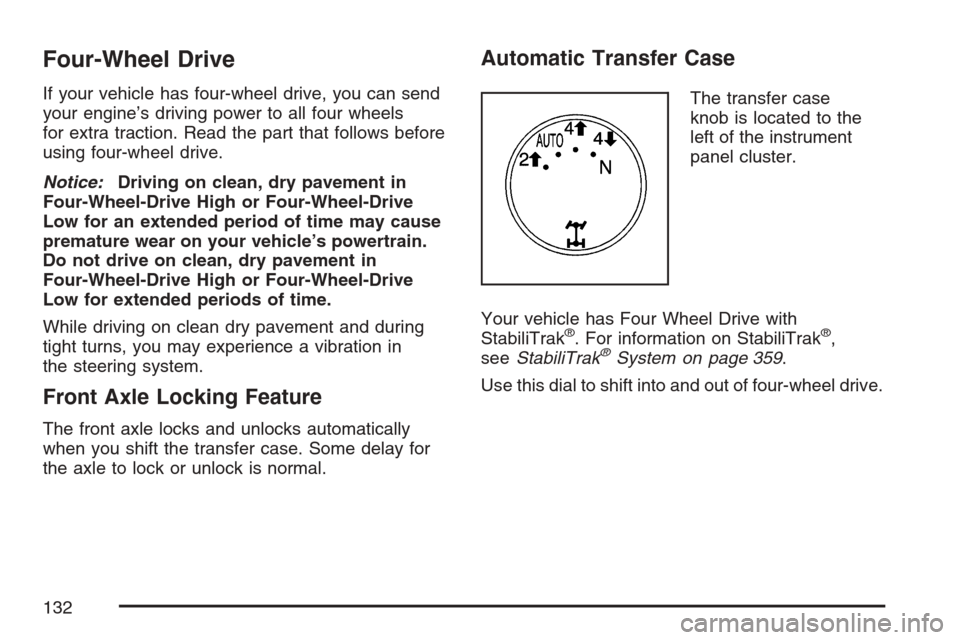
The transfer case
knob is located to the
left of the instrument
panel cluster.
Your vehicle has Four Wheel Drive with
StabiliTrak
®. For information on StabiliTrak®,
seeStabiliTrak®System on page 359.
Use this dial to shift into and out of four-wheel drive.
132
Page 135 of 618
Shifting Into Four-Wheel Drive Low
When Four-Wheel Low is engaged, vehicle
speed should be kept below 45 mph. Extended
high-speed operation in 4L may damage or
shorten the life of the drivetrain.
To shift to the Four-Wheel Drive Low position, the
ignition must be in RUN and the vehicle must
be stopped or moving less than 3 mph (5 km/h)
with the transmission in NEUTRAL (N). The
preferred method for shifting into Four-Wheel Drive
Low is to have your vehicle moving 1 to 2 mph
(1.6 to 3.2 km/h). Turn the knob to the Four-Wheel
Drive Low position. You must wait for the
Four-Wheel Drive Low indicator light to stop
ashing and remain on before shifting your
transmission in gear.Notice:Shifting the transmission into gear
before the Four-Wheel Drive Low indicator light
has stopped ashing could damage the
transfer case. To help avoid damaging your
vehicle, always wait for the Four-Wheel
Drive Low indicator light to stop ashing
before shifting the transmission into gear.
The vehicle may have signicant engagement noise
and bump when shifting between Four-Wheel Drive
Low and Four-Wheel Drive High ranges or from
NEUTRAL while the engine is running.
If the knob is turned to the Four-Wheel Drive Low
position when your vehicle is in gear and/or
moving, the Four-Wheel Drive Low indicator light
will ash for 30 seconds and not complete the
shift unless your vehicle is moving less than 3 mph
(5 km/h) and the transmission is in NEUTRAL (N).
After 30 seconds the transfer case will shift to
Four-Wheel Drive High mode.
135
Page 136 of 618

Shifting Out of Four-Wheel Drive Low
To shift from Four-Wheel Drive Low to Four-Wheel
Drive High, AUTO, or Two-Wheel Drive High, your
vehicle must be stopped or moving less than 3 mph
(5 km/h) with the transmission in NEUTRAL (N) and
the ignition in RUN. The preferred method for
shifting out of Four-Wheel Drive Low is to have your
vehicle moving 1 to 2 mph (1.6 to 3.2 km/h). Turn
the knob to the Four-Wheel Drive High, AUTO, or
Two-Wheel Drive High position. You must wait for
the Four-Wheel Drive High, AUTO, or Two-Wheel
Drive High indicator light to stop ashing and
remain on before shifting your transmission
into gear.
Notice:Shifting the transmission into gear
before the Four-Wheel Drive Low indicator light
has stopped ashing could damage the
transfer case. To help avoid damaging your
vehicle, always wait for the Four-Wheel
Drive Low indicator light to stop ashing
before shifting the transmission into gear.
The vehicle may have signicant engagement noise
and bump when shifting between Four-Wheel Drive
Low and Four-Wheel Drive High ranges or from
NEUTRAL while the engine is running.If the knob is turned to the Four-Wheel Drive High,
AUTO, or Two-Wheel Drive High switch position
when your vehicle is in gear and/or moving,
the Four-Wheel Drive High, AUTO or Two-Wheel
Drive High indicator light will ash for 30 seconds
but will not complete the shift unless your
vehicle is moving less than 3 mph (5 km/h) and
the transmission is in NEUTRAL (N).
Shifting into NEUTRAL
To shift the transfer case to NEUTRAL do the
following:
1. Make sure the vehicle is parked so that it will
not roll.
2. Set the parking brake and apply the regular
brake pedal. SeeParking Brake on page 138
for more information.
3. Start the vehicle or turn the ignition to RUN.
4. Put the transmission in NEUTRAL (N).
5. Shift the transfer case to Two-Wheel
Drive High.
136
Page 137 of 618

6. Turn the transfer case dial clockwise to
NEUTRAL till it stops and hold it for
10 seconds. Then slowly release the dial to
the four low position. The NEUTRAL light will
come on when the transfer case shift to
NEUTRAL is complete.
7. If the engine is running, verify that the
transmission is in NEUTRAL (N) by shifting
the transmission to REVERSE (R) for
one second, then shift the transmission to
DRIVE (D) for one second.
8. Turn the ignition to ACCESSORY, which will
turn the engine off.
9. Place the transmission shift lever in PARK (P).
10. Release the parking brake prior to moving
the vehicle.
11. Turn the ignition to LOCK.
Shifting Out of NEUTRAL
To shift out of NEUTRAL do the following:
1. Set the parking brake and apply the regular
brake pedal.
2. Shift the transmission to NEUTRAL (N) and
turn the ignition to RUN with the engine off.3. Turn the transfer case dial to the desired
transfer case shift position (Two-Wheel
Drive High, Four-Wheel Drive High, AUTO).
After the transfer case has shifted out of
NEUTRAL the NEUTRAL light will go out.
4. Release the parking brake prior to moving
the vehicle.
Notice:Shifting the transmission into gear
before the Four-Wheel Drive Low indicator
light has stopped ashing could damage the
transfer case. To help avoid damaging
your vehicle, always wait for the Four-Wheel
Drive Low indicator light to stop ashing
before shifting the transmission into gear.
5. Start the engine and shift the transmission to
the desired position.
Excessively shifting the transfer case into or out
of the different modes may cause the transfer
case to enter the shift protection mode. This will
protect the transfer case from possible damage
and will only allow the transfer case to respond
to one shift per 10 seconds. The transfer case
may stay in this mode for up to three minutes.
137
Page 139 of 618

If the ignition is on when the parking brake is
released, the brake system warning light will go off.
Notice:Driving with the parking brake on can
overheat the brake system and cause
premature wear or damage to brake system
parts. Verify that the parking brake is fully
released and the brake warning light is
off before driving.
If you are towing a trailer and are parking on any
hill, seeTowing a Trailer on page 414.
Shifting Into Park (P)
{CAUTION:
It can be dangerous to get out of your
vehicle if the shift lever is not fully in
PARK (P) with the parking brake rmly
set. Your vehicle can roll. If you have left
the engine running, the vehicle can move
suddenly. You or others could be injured.
CAUTION: (Continued)
CAUTION: (Continued)
To be sure your vehicle will not move,
even when you are on fairly level ground,
use the steps that follow. With four-wheel
drive, if your transfer case is in NEUTRAL,
your vehicle will be free to roll, even if
your shift lever is in PARK (P). So, be
sure the transfer case is in a drive
gear — not in NEUTRAL. If you are pulling
a trailer, seeTowing a Trailer on page 414.
1. Hold the brake pedal down with your right
foot and set the parking brake.
2. Move the shift lever into the PARK (P)
position by pulling the shift lever toward
you and moving it up as far as it will go.
3. Be sure the transfer case is in a drive
gear — not in NEUTRAL (N).
4. Turn the ignition key to LOCK.
5. Remove the key and take it with you. If you
can leave your vehicle with the ignition key in
your hand, your vehicle is in PARK (P).
139
Page 140 of 618
Leaving Your Vehicle With the
Engine Running
{CAUTION:
It can be dangerous to leave your vehicle
with the engine running. Your vehicle
could move suddenly if the shift lever is
not fully in PARK (P) with the parking
brake rmly set.
If you have four-wheel drive and your
transfer case is in NEUTRAL, your vehicle
will be free to roll, even if your shift lever
is in PARK (P). So be sure the transfer
case is in a drive gear — not in NEUTRAL.
CAUTION: (Continued)
CAUTION: (Continued)
And, if you leave the vehicle with the
engine running, it could overheat and
even catch re. You or others could be
injured. Do not leave your vehicle with
the engine running unless you have to.
If you have to leave your vehicle with the engine
running, be sure your vehicle is in PARK (P)
and the parking brake is rmly set before
you leave it. After you move the shift lever into
PARK (P), hold the regular brake pedal down.
Then, see if you can move the shift lever away
from PARK (P) without rst pulling it toward you.
If you can, it means that the shift lever was
not fully locked into PARK (P).
140
Page 143 of 618
Engine Exhaust
{CAUTION:
Engine exhaust can kill. It contains the
gas carbon monoxide (CO), which you
cannot see or smell. It can cause
unconsciousness and death.
You might have exhaust coming in if:
The exhaust system sounds strange
or different.
Your vehicle gets rusty underneath.
Your vehicle was damaged in a
collision.
CAUTION: (Continued)
CAUTION: (Continued)
Your vehicle was damaged when
driving over high points on the
road or over road debris.
Repairs were not done correctly.
Your vehicle or the exhaust system
has been modied improperly.
If you ever suspect exhaust is coming
into your vehicle:
Drive it only with all the windows
down to blow out any CO; and
Have your vehicle xed immediately.
143
Page 144 of 618
Running the Engine While Parked
It is better not to park with the engine running.
But if you ever have to, here are some things
to know.
{CAUTION:
Idling the engine with the climate control
system off could allow dangerous exhaust
into your vehicle. See the earlier caution
underEngine Exhaust on page 143.
Also, idling in a closed-in place can let
deadly carbon monoxide (CO) into your
vehicle even if the climate control fan is at
the highest setting. One place this can
happen is a garage. Exhaust — with
CO — can come in easily. NEVER park in
a garage with the engine running.
Another closed-in place can be a blizzard.
SeeWinter Driving on page 396.
{CAUTION:
It can be dangerous to get out of your
vehicle if the shift lever is not fully in
PARK (P) with the parking brake rmly
set. Your vehicle can roll. Do not leave
your vehicle when the engine is running
unless you have to. If you have left the
engine running, the vehicle can move
suddenly. You or others could be injured.
To be sure your vehicle will not move,
even when you are on fairly level ground,
always set your parking brake and move
the shift lever to PARK (P).
144