Page 207 of 528
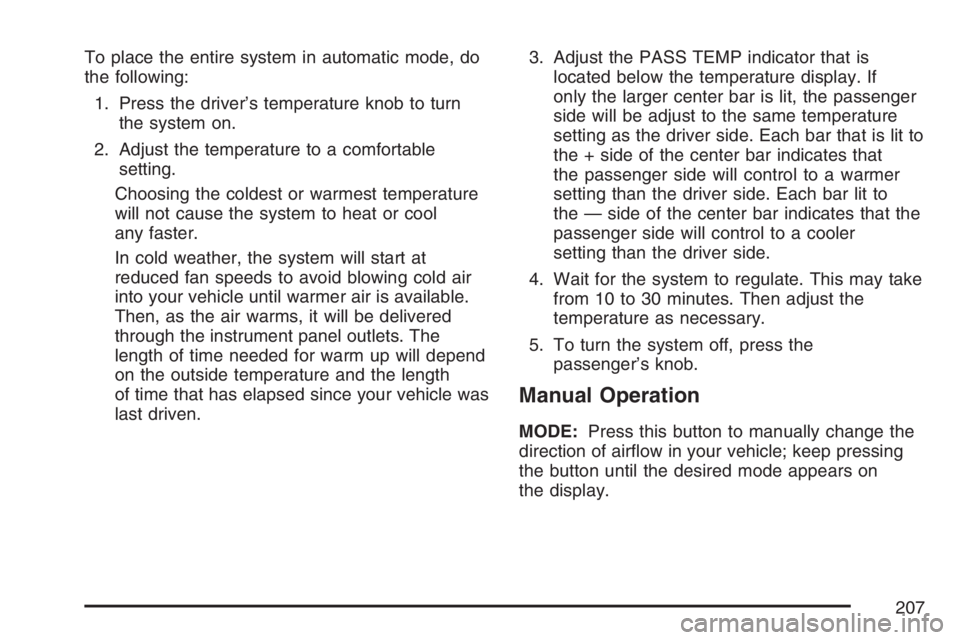
To place the entire system in automatic mode, do
the following:
1. Press the driver’s temperature knob to turn
the system on.
2. Adjust the temperature to a comfortable
setting.
Choosing the coldest or warmest temperature
will not cause the system to heat or cool
any faster.
In cold weather, the system will start at
reduced fan speeds to avoid blowing cold air
into your vehicle until warmer air is available.
Then, as the air warms, it will be delivered
through the instrument panel outlets. The
length of time needed for warm up will depend
on the outside temperature and the length
of time that has elapsed since your vehicle was
last driven.3. Adjust the PASS TEMP indicator that is
located below the temperature display. If
only the larger center bar is lit, the passenger
side will be adjust to the same temperature
setting as the driver side. Each bar that is lit to
the + side of the center bar indicates that
the passenger side will control to a warmer
setting than the driver side. Each bar lit to
the — side of the center bar indicates that the
passenger side will control to a cooler
setting than the driver side.
4. Wait for the system to regulate. This may take
from 10 to 30 minutes. Then adjust the
temperature as necessary.
5. To turn the system off, press the
passenger’s knob.
Manual Operation
MODE:Press this button to manually change the
direction of airow in your vehicle; keep pressing
the button until the desired mode appears on
the display.
207
Page 208 of 528

To change the current mode, select one of the
following:
H(Vent):This mode directs air to the instrument
panel outlets.
)(Bi-Level):This mode directs approximately
half of the air to the instrument panel outlets, then
directs the remaining air to the oor outlets and
the defroster and side window outlets. Cooler air is
directed to the upper outlets and warmer air to
the oor outlets.
6(Floor):This mode directs most of the air to
the oor outlets. Use this mode to send air to
the rear of the vehicle. Keep the area under the
front seats free of objects that could obstruct
airow to the rear of the vehicle.
The MODE button can also be used to select
defog. For more information, see “Defogging and
Defrosting” later in this section.
9(Fan):Press this button to increase to
decrease the fan speed; keep pressing the up or
down arrow until the desired fan speed appears
on the display.VENT:Press this button to turn the outside air
mode on or off. When this mode is on, outside air
will be circulated throughout your vehicle. VENT
can be used with all modes, but it cannot be used
with the recirculation mode.
@(Recirculation):This mode keeps outside air
from coming in the vehicle. It can be used to
prevent outside air and odors from entering your
vehicle or help heat or cool the air inside your
vehicle more quickly. Press this button to turn the
recirculation mode on or off. When the button
is pressed, an indicator light will come on.
The air-conditioning compressor also comes on.
The recirculation mode can be used with vent and
bi-level modes, but it cannot be used with oor,
defog, defrost or outside air modes.
Temperature Control:Use the DRIVER knob to
increase or decrease the air temperature inside
your vehicle. If the front passenger would like the
temperature to be warmer or cooler, use the
PASS knob to adjust the passenger’s temperature.
Air Conditioning:The air-conditioning
compressor will automatically come on when a
temperature cooler than the interior temperature is
chosen using the temperature knobs.
208
Page 212 of 528
Instrument Panel Cluster
Your instrument panel cluster is designed to let you know at a glance how your vehicle is running. You’ll
know how fast you’re going, how much fuel you’re using, and many other things you’ll need to drive
safely and economically. The indicator warning lights and gages are explained on the following pages.
United States up-level shown, United States base-level and Canadian similar
212
Page 215 of 528

Safety Belt Reminder Light
When the key is turned to ON or START, a chime
will come on for several seconds to remind
people to fasten their safety belts.
The safety belt light will
also come on and stay
on for several
seconds, then it will
ash for several more.
If the driver remains unbuckled when the ignition
is on and the vehicle is in motion, the chime
and the safety belt light will be repeated. You
should buckle your safety belt. If the driver’s belt
is already buckled, neither the chime nor the
light will come on.
Airbag Readiness Light
There is an airbag readiness light on the
instrument panel, which shows the airbag symbol.
The system checks the airbag’s electrical
system for malfunctions. The light tells you if there
is an electrical problem. The system check
includes the airbag sensor, the airbag modules,
the wiring, diagnostic module, and safety belt
pretensioners. For more information on the airbag
system, seeAirbag System on page 88. For
more information on safety belt pretensioners, see
Safety Belt Pretensioners on page 56.
215
Page 221 of 528
Your vehicle may have a Traction Control System
(TCS) warning light. The TCS warning light
may come on for the following reasons:
If you turn the TCS off by pressing the TRAC
OFF button located in the instrument panel
switchbank the TCS warning light will come on
and stay on. To turn the system back on,
press the button again. The TCS warning light
should go off. SeeTraction Control System
(TCS) on page 310for more information.
If there is an engine-related and brake system
problem that is specically related to traction
control, the TCS will turn off and the TCS
warning light will come on.
If the TCS warning light comes on and stays on
for an extended period of time when the system is
turned on, your vehicle needs service.
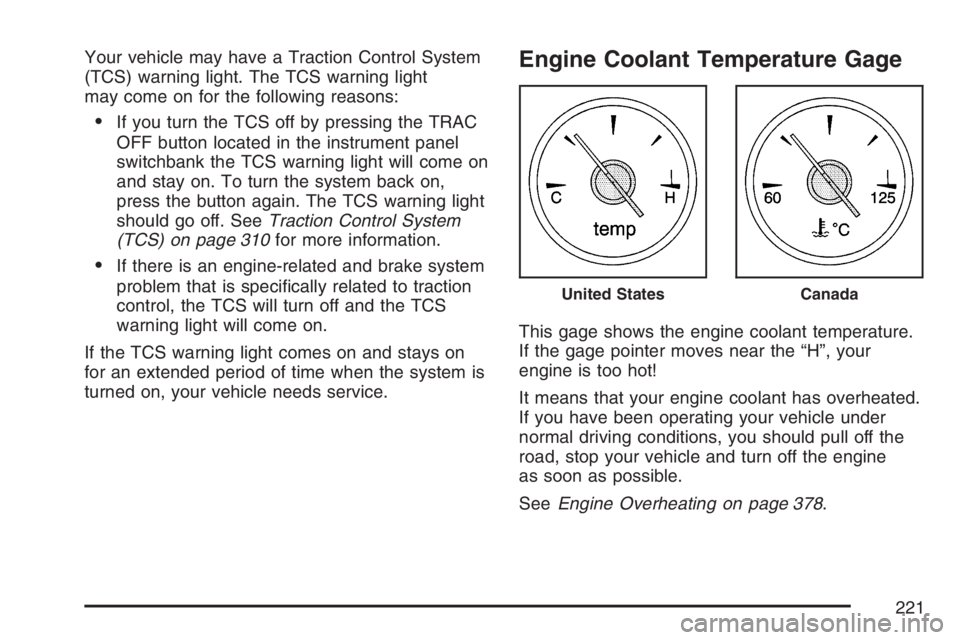
Engine Coolant Temperature Gage
This gage shows the engine coolant temperature.
If the gage pointer moves near the “H”, your
engine is too hot!
It means that your engine coolant has overheated.
If you have been operating your vehicle under
normal driving conditions, you should pull off the
road, stop your vehicle and turn off the engine
as soon as possible.
SeeEngine Overheating on page 378.
United StatesCanada
221
Page 225 of 528

This can happen if you have recently replaced your
battery or if your battery has run down. The
diagnostic system is designed to evaluate critical
emission control systems during normal driving.
This may take several days of routine driving. If you
have done this and your vehicle still does not pass
the inspection for lack of OBD system readiness,
your dealer can prepare the vehicle for inspection.
Fuel Gage
When the indicator nears empty, you still have a
little fuel left, but you should get more soon.If your fuel is low, the warning message in the
message center will come on. SeeLow Fuel
Warning Message on page 232.
Your fuel gage tells you about how much fuel you
have left when the ignition is on.
Here are four things that some owners ask about.
All these things are normal and do not indicate
that anything is wrong with the fuel gage.
At the gas station, the gas pump shuts off
before the gage reads full.
It takes a little more (or less) fuel to ll up
than the gage reads. For example, the
gage reads half full, but it took more (or less)
than half of the tank’s capacity to ll it.
The gage pointer may move while cornering,
braking or speeding up.
The gage may not indicate empty when the
ignition is turned off.
Message Center
The message center is located at the top of the
instrument panel cluster in between the tachometer
and speedometer. It gives you important safety
and maintenance facts.
United StatesCanada
225
Page 235 of 528
Highbeam Out Warning Message
If this message appears, one or both of the
vehicle’s high-beam headlamp bulbs needs
replacement. SeeBulb Replacement on page 399
for more information.
Driver Information Center (DIC)
If your vehicle has a Driver Information Center
(DIC), the display is located on the instrument
panel cluster in the tachometer gage. The DIC will
show information about the vehicle and the
surroundings.The DIC is capable of displaying English or
French. To change the language, press and hold
the MODE button until the language you want
is displayed. The MODE button is located on the
instrument panel, to the left of the steering
column. Release the button to set your choice.
SeeDIC Controls and Displays on page 236
to change the display from English to metric.
The DIC contains a compass display to show you
which direction the vehicle is driving. SeeDIC
Compass on page 238for more information.
United StatesCanada
235
Page 236 of 528

DIC Controls and Displays
When the ignition is turned to ON or START, the
DIC will display the following:
BUICK:BUICK will be displayed for three
seconds.
DRIVER #:This message will be displayed for
another three seconds after BUICK appears in the
display. The driver number corresponds to the
numbers, 1 or 2, on the back of the Remote
Keyless Entry (RKE) transmitters. This display lets
the driver know which driver’s RKE transmitter
is being used and the driver’s customization
features.
The DIC controls are
located to the left of the
steering column on
the instrument panel.The DIC will be in the last mode displayed when
the engine was turned off. To select a different
mode, press MODE. The display will cycle through
its options at each press of MODE.
MODE:This button lets you cycle through the
options on the display.
SET:This button is used to select and set the
options to your preference.
The DIC will always display the compass reading
and the outside temperature. If the temperature
is below 38°F (3°C), the temperature reading will
toggle between displaying the temperature and
the word ICE for two minutes.
AVG ECONOMY (Average Economy):Average
fuel economy is viewed as a long term
approximation of your overall driving conditions.
To learn the average fuel economy from a
new starting point, press and hold the SET button
while the average fuel economy is displayed on
the DIC. The average fuel economy will set
to zero.
236

