2007 BUICK LACROSSE change time
[x] Cancel search: change timePage 415 of 512

6. Proceed to the passenger side front tire,
and repeat the procedure in Step 5.
7. Proceed to the passenger side rear tire,
and repeat the procedure in Step 5.
8. Proceed to the driver side rear tire, and
repeat the procedure in Step 5.
9. After hearing the conrming horn chirp for the
driver side rear tire, the horn chirps two more
times to signal the tire learning process
has ended. Turn the ignition switch to OFF.
10. Set all four tires to the recommended air
pressure level as indicated on the tire and
loading information label.
11. Put the valve caps back on the valve stems.Federal Communications Commission
(FCC) and Industry and Science Canada
The Tire Pressure Monitor System (TPMS)
operates on a radio frequency and complies with
Part 15 of the FCC Rules. Operation is subject
to the following two conditions:
1. This device may not cause harmful
interference.
2. This device must accept any interference
received, including interference that may
cause undesired operation.
The Tire Pressure Monitor System (TPMS)
operates on a radio frequency and complies with
RSS-210 of Industry and Science Canada.
Operation is subject to the following two conditions:
1. This device may not cause interference.
2. This device must accept any interference
received, including interference that may
cause undesired operation of the device.
Changes or modications to this system by other
than an authorized service facility could void
authorization to use this equipment.
415
Page 417 of 512

{CAUTION:
Rust or dirt on a wheel, or on the parts to
which it is fastened, can make wheel nuts
become loose after time. The wheel could
come off and cause an accident. When
you change a wheel, remove any rust or
dirt from places where the wheel attaches
to the vehicle. In an emergency, you can
use a cloth or a paper towel to do this;
but be sure to use a scraper or wire brush
later, if needed, to get all the rust or dirt
off. SeeChanging a Flat Tire on page 426.
When It Is Time for New Tires
One way to tell when it
is time for new tires is
to check the treadwear
indicators, which will
appear when your tires
have only 1/16 inch
(1.6 mm) or less of
tread remaining.
You need a new tire if any of the following
statements are true:
You can see the indicators at three or more
places around the tire.
You can see cord or fabric showing through
the tire’s rubber.
The tread or sidewall is cracked, cut, or
snagged deep enough to show cord or fabric.
The tire has a bump, bulge, or split.
The tire has a puncture, cut, or other damage
that cannot be repaired well because of the
size or location of the damage.
417
Page 433 of 512
{CAUTION:
Rust or dirt on the wheel, or on the parts
to which it is fastened, can make the
wheel nuts become loose after time.
The wheel could come off and cause an
accident. When you change a wheel,
remove any rust or dirt from the places
where the wheel attaches to the vehicle.
In an emergency, you can use a cloth or
a paper towel to do this; but be sure to
use a scraper or wire brush later, if
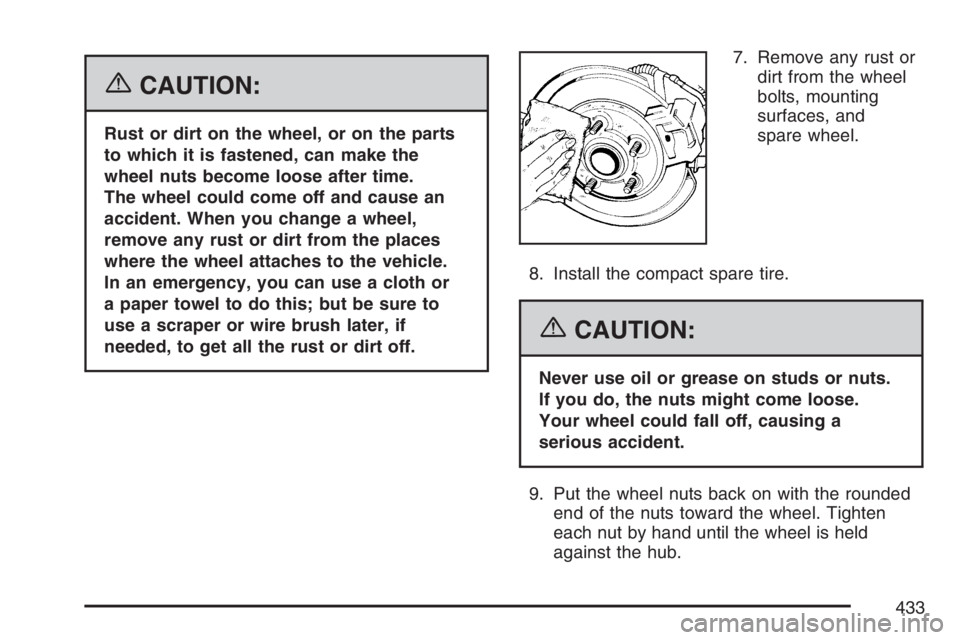
needed, to get all the rust or dirt off.7. Remove any rust or
dirt from the wheel
bolts, mounting
surfaces, and
spare wheel.
8. Install the compact spare tire.
{CAUTION:
Never use oil or grease on studs or nuts.
If you do, the nuts might come loose.
Your wheel could fall off, causing a
serious accident.
9. Put the wheel nuts back on with the rounded
end of the nuts toward the wheel. Tighten
each nut by hand until the wheel is held
against the hub.
433
Page 462 of 512

Scheduled Maintenance
When the change engine oil light or CHANGE OIL
SOON DIC message comes on, it means that
service is required for your vehicle. Have
your vehicle serviced as soon as possible within
the next 600 miles (1 000 km). It is possible that, if
you are driving under the best conditions, the
engine oil life system may not indicate that vehicle
service is necessary for over a year. However,
the engine oil and lter must be changed at least
once a year and at this time the system must
be reset. Your GM Goodwrench
®dealer has
GM-trained service technicians who will perform
this work using genuine GM parts and reset
the system.
If the engine oil life system is ever reset
accidentally, you must service your vehicle within
3,000 miles (5 000 km) since the last service.
Remember to reset the oil life system whenever
the oil is changed. SeeEngine Oil Life System on
page 356for information on the Engine Oil Life
System and resetting the system.When the light or message appears, certain
services, checks, and inspections are required.
Required services are described in the following
for “MaintenanceI” and “MaintenanceII.”
Generally, it is recommended that the rst service
be MaintenanceI, the second service be
MaintenanceII, and that you alternate
MaintenanceIand MaintenanceIIthereafter.
However, in some cases, MaintenanceIImay be
required more often.
MaintenanceI— Use MaintenanceIif the light
or message comes on within 10 months since
the vehicle was purchased or MaintenanceII
was performed.
MaintenanceII— Use MaintenanceIIif the
previous service performed was MaintenanceI.
Always use MaintenanceIIwhenever the light
or message comes on 10 months or more since
the last service or if the light or message has
not come on at all for one year.
462
Page 486 of 512
Alternative Service:There may be times,
when Roadside Assistance cannot provide
timely assistance, your advisor may authorize
you to secure local emergency road service,
and you will be reimbursed up to $100 upon
submission of the original receipt to Roadside
Assistance.
In many instances, mechanical failures are covered
under Buick’s Bumper-to-Bumper warranty for U.S.
customers, and the duration of the Base Warranty
Coverage for Canadian customers of the new
Vehicle Limited Warranty. However, any cost for
parts and labor for non-warranty repairs are the
responsibility of the driver.
For prompt and efficient assistance when calling,
please provide the following to the Roadside
Assistance Representative:
Your name, home address, and home
telephone number.
Telephone number of your location.
Location of the vehicle.
Model, year, color, and license plate number.
Odometer reading, Vehicle Identication
Number, and delivery date of the vehicle.
Description of the problem.
While we hope you never have the occasion to
use our service, it is added security while traveling
for you and your family. Remember, we are
only a phone call away. U.S. customers call Buick
Roadside Assistance:1-800-252-1112, TTY
users, call1-888-889-2438, Canadian customers
call1-800-268-6800.
Buick and General Motors of Canada Limited
reserve the right to limit services or reimbursement
to an owner or driver when, in their sole discretion,
the claims become excessive in frequency or type
of occurrence.
Roadside Assistance is not part of or included in
the coverage provided by the New Vehicle Limited
Warranty. Buick and General Motors of Canada
Limited reserve the right to make any changes or
discontinue the Roadside Assistance program
at any time without notication.
486
Page 489 of 512
Additional Program Information
All program options, such as shuttle service, may
not be available at every dealer. Please contact
your dealer for specic information about
availability. All Courtesy Transportation
arrangements will be administered by appropriate
dealer personnel.
General Motors reserves the right to unilaterally
modify, change or discontinue Courtesy
Transportation at any time and to resolve all
questions of claim eligibility pursuant to the terms
and conditions described herein at its sole
discretion.
Vehicle Data Collection and Event
Data Recorders
Your vehicle, like other modern motor vehicles, has
a number of sophisticated computer systems that
monitor and control several aspects of the vehicle’s
performance. Your vehicle uses on-board vehicle
computers to monitor emission control components
to optimize fuel economy, to monitor conditions for
airbag deployment and, if so equipped, to provide
anti-lock braking and to help the driver control the
vehicle in difficult driving situations.Some information may be stored during regular
operations to facilitate repair of detected
malfunctions; other information is stored only in a
crash event by computer systems, such as those
commonly called Event Data Recorders (EDR).
In a crash event, computer systems, such as the
airbag Sensing and Diagnostic Module (SDM)
in your vehicle may record information about the
condition of the vehicle and how it was operated,
such as data related to engine speed, brake
application, throttle position, vehicle speed, safety
belt usage, airbag readiness, airbag performance,
and the severity of a collision. If your vehicle is
equipped with StabiliTrak
®, steering performance,
including yaw rate, steering wheel angle, and
lateral acceleration, is also recorded. This
information has been used to improve vehicle
crash performance and may be used to improve
crash performance of future vehicles and
driving safety. Unlike the data recorders on many
airplanes, these on-board systems do not
record sounds, such as conversation of vehicle
occupants.
489
Page 496 of 512
Owner Information
Owner publications are written specically for
owners and intended to provide basic operational
information about the vehicle. The owner manual
will include the Maintenance Schedule for all
models.
In-Portfolio: Includes a Portfolio, Owner Manual,
and Warranty Booklet.
RETAIL SELL PRICE: $35.00
US + Processing Fee
Without Portfolio: Owner’s Manual only.
RETAIL SELL PRICE: $25.00
US + Processing Fee
Current and Past Model Order Forms
Technical Service Bulletins and Manuals are
available for current and past model GM vehicles.
To request an order form, please specify year
and model name of the vehicle.
ORDER TOLL FREE: 1-800-551-4123
Monday-Friday 8:00 AM - 6:00 PM
Eastern Time
For Credit Card Orders Only
(VISA-MasterCard-Discover), visit Helm, Inc. on
the World Wide Web at: www.helminc.com
Or you can write to:
Helm, Incorporated
P.O. Box 07130
Detroit, MI 48207
Prices are subject to change without notice and
without incurring obligation. Allow ample time
for delivery.
Note to Canadian Customers: All listed prices are
quoted in U.S. funds. Canadian residents are
to make checks payable in U.S. funds.
496
Page 503 of 512

G
Gage
Engine Coolant Temperature.................... 189
Fuel......................................................... 198
Speedometer........................................... 181
Tachometer.............................................. 181
Garage Door Opener................................... 130
Gasoline
Octane..................................................... 343
Specications........................................... 344
Glove Box................................................... 141
GM Mobility Reimbursement Program.......... 483
H
Hazard Warning Flashers............................ 150
Head Restraints............................................ 13
Headlamp
Aiming..................................................... 391
Headlamp Wiring......................................... 449
Headlamps
Bulb Replacement.................................... 394
Daytime Running Lamps/Automatic
Headlamp System................................ 159Headlamps (cont.)
Flash-to-Pass........................................... 153
Front Turn Signal and Parking Lamps...... 397
Halogen Bulbs......................................... 394
Headlamps and Sidemarker Lamps.......... 395
High/Low Beam Changer......................... 153
Suggested Light....................................... 196
Headlamps and Sidemarker Lamps............. 395
Heated Seats................................................ 10
Heater......................................................... 168
Heater......................................................... 172
Highbeam On Light..................................... 196
Highway Hypnosis....................................... 311
Hill and Mountain Roads............................. 312
Hood
Checking Things Under............................ 348
Release................................................... 349
Horn............................................................ 150
How to Use This Manual ................................ 3
How to Wear Safety Belts Properly............... 21
503