2006 VOLKSWAGEN GOLF PLUS Tire
[x] Cancel search: TirePage 33 of 541
identificatio n number (VlN)
Veh icle type, eng in e rating , tran smission
E n gine and tra nsm iss io n classificatio n cod es, pain t num ber, interior. In the exa mple,
3 1, fig.IO.
equipment, part num bers
Thi s ve
hicle data can also b e fou nd i n t he War ra nty
and Maintenan ce booklet.
Engine data and dimensions
first read and note the in trod uctory inform ation and heed th e WARNINGS on page31.
G aso line engi nes
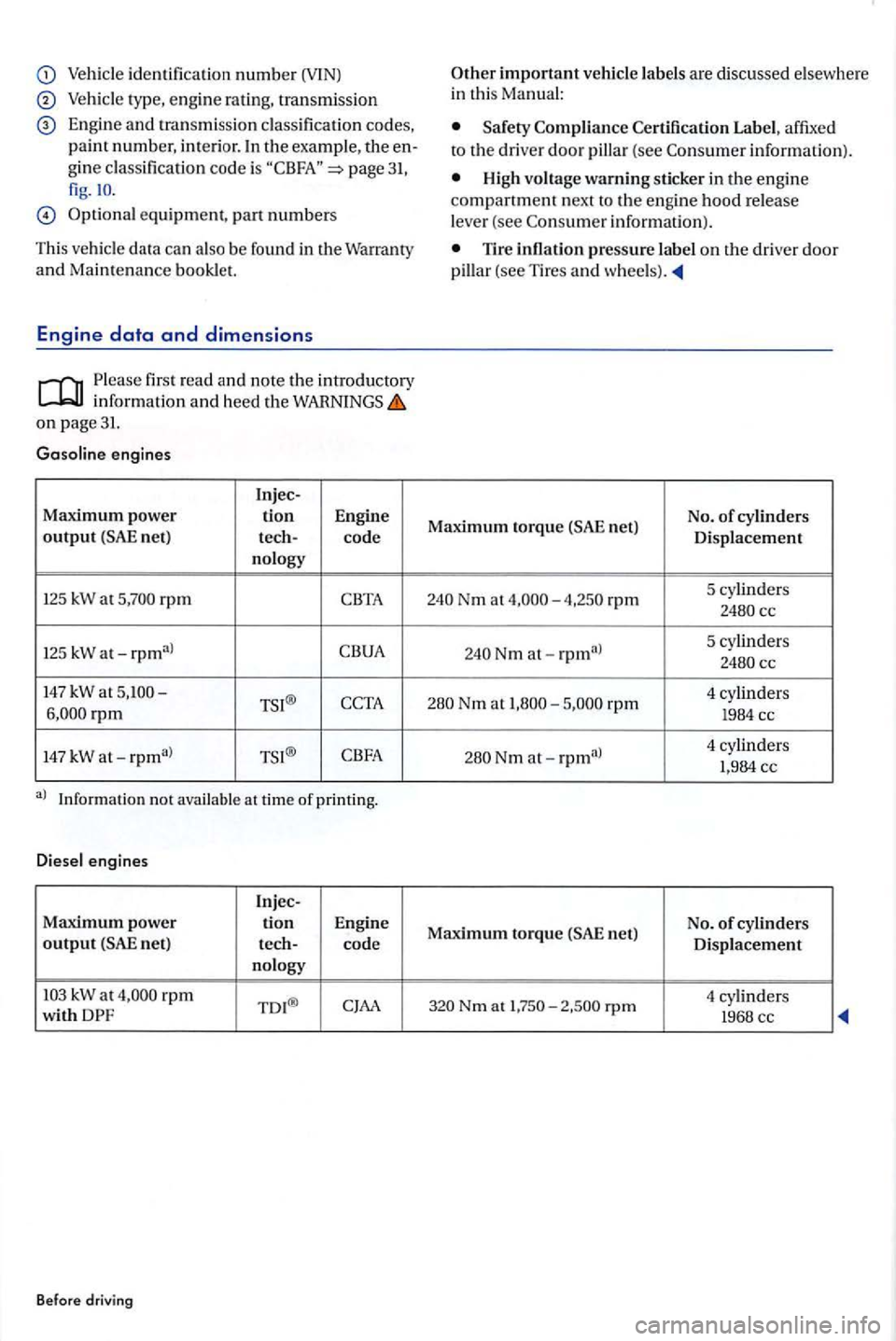
Injec -
Maxim um power
rp m
125 kW at-
147 kW at
kW at rpm T D I®
Before dri ving
Safety
i nfo rmatio n).
Hi gh vo ltage warning sticker in the en gin e compartment next to the eng ine hood r elease leve r (see in format ion) .
Tire infl ati o n pressure la b el o n th e driver door
pillar (see Tires and
Maximum torqu e net) N
o. of cy linders
Disp laceme n t
Nm at rpm 5 cy linders
5 cy linders
N m at-4 cylinders
1 ,984 cc
Max
imum torque n et) N
o. of cy lin ders
Di sp lacement
N m at rp m 4 cylinde
rs 196 8 cc
Page 70 of 541
you hear a warn ing chime. The warning light stop
when the driver and front passenger correctly fas ten their sa fety belts. If the safety belts have not been fastened when a speed of more than 15 mph is reached or if the safety be lts are unfastened
while the vehicle is moving , a warning chime for
up to seco nds. The belt warning light also
When the ignition is sw itched on, the warning
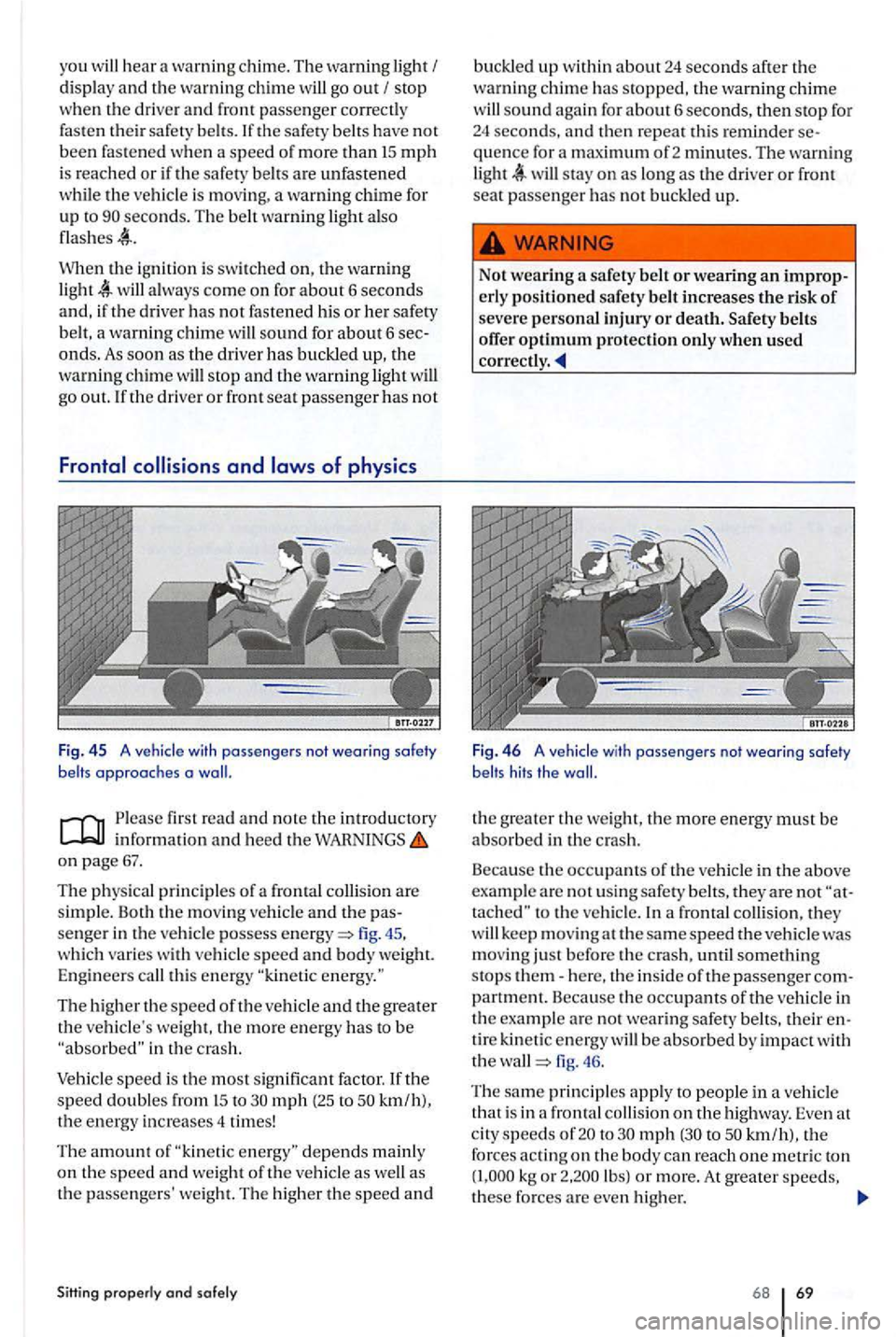
and of phy sic s
Fig. 4 5 A vehicle with passengers not wearing safety belts approaches a
on page 67.
The physical principles of a frontal
fig . 45.
which varies wit h vehicle speed and body weight.
Engineer s
The higher the speed of the ve hicle and the greater
the vehicle's weight. the more en ergy has to be in the cras h.
Vehicle speed i s th e most sig nificant factor. If the speed doubl es from to mph (25 to kmlh),
the energy increases 4 times!
The amount of as
the passengers' weight. The higher the speed an d
Sitting properly and solely
buckled up within about24 seconds after the
warn ing chim e has stopped, the warnin g chime sound again for about 6 seco nds, then stop for 24 seconds, and then rep eat this reminder sequence for a
Fig. 4 6 A vehicle with passengers not wearing safety
belts hits the
the greater the we ig ht, the more energy must be abso rbed in the crash.
Beca use the occupants of th e vehicle in the above
example a re not usi ng safety belts, they are not
kee p m oving at the same speed the vehicle was
mo vin g just before the crash, until somethin g
stops th em-here, the inside of the passenger com
partment. Because the occupants of the vehicle in
th e exa mpl e are not wearing safety belt s, th eir en
tire kine
tic energy be absorbed by impact with
the fig. 46.
Th e
same pri ncipl es app ly to p eople in a veh icle
th at is in a fron ta l
to mph to kmlh), the forces acting on th e bod y can reach one metri c ton kg o r lbs) or more. At grea te r speeds,
th ese forces are even hi ghe r.
68 69
Page 78 of 541
the colli sio n to help prot ect a n unrestrained front
sea t occ upa nt. The airba g m ay then not pro vide
e nou gh protection fo r an occ upant not wearin g a
s af ety be
lt.
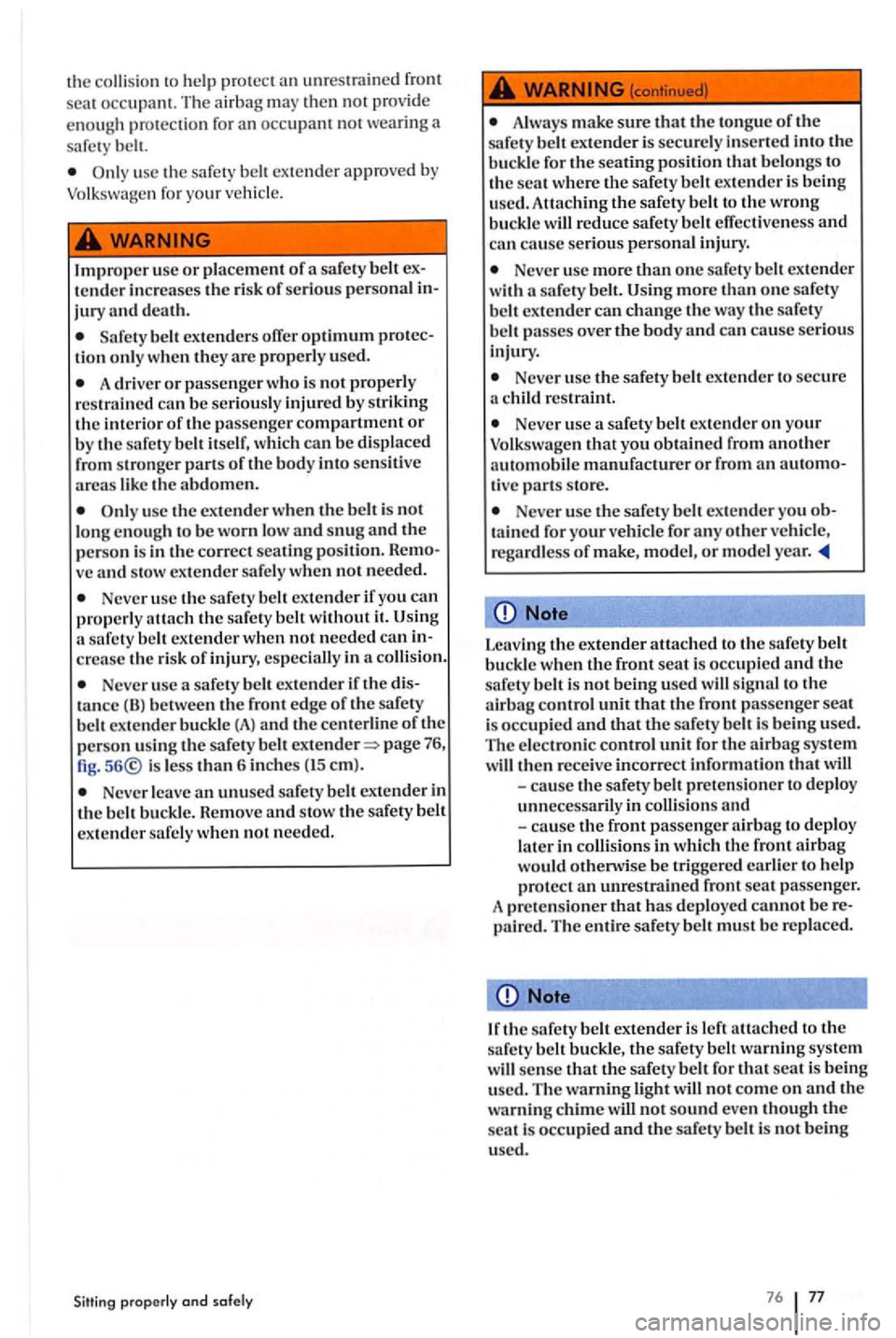
u sc th e safety belt ex te nd er ap proved by Volkswag en for you r vehicl e.
Safety belt extenders offer optimum protec
tion onl y w hen they are prop erl y used.
A driver or passe nger wh o is not properl y
re strain ed ca n be seriou sly injured by strikin g
th e interi or o f t he passe nger compartment or by the s afety be lt itse lf, w hich can be displac ed fro m stron ger parts of the body int o se nsitiv e
area s lik e the abdomen.
usc the extender when the belt is not
lon g eno ugh t o be worn low and snug and th e person is in the correct sea ting po sition . R e m o
ve an d stow extender sa fe ly w hen no t needed.
Never usc the safety belt extender if you can prop erl y attach the safe ty be lt wit hout it. safety belt ex tender when not n eeded can crease the risk of inju ry, especiall y in a co llision.
Never use safety belt ex tender if the dis
tan ce (B ) between the front ed ge of the safe ty
b elt exte nd er buckle (A) and th e ce nterlin e of the perso n using the safety belt exte nde r= page 76, fig. 56 © is less than 6 in ches (15 em ).
Never leave an unused safe ty belt exte nder in the belt bu ckl e. Remo ve and stow the sa fety belt
ex te n d er safely wh en no t n eeded.
Sitti ng p roperly and safely
Always make sur e that the tongue of the
sa fety belt extender is securely inserted into the buckle for the seating position that belongs to
th e sca t where the safety belt extende r i s being
u se d. Attaching the safety belt to th e wrong
bu ckle will reduc e safety belt effec tive ness and can cause se rious perso nal injury.
Never usc more than one sa fe ty bel t extende r
w it h a safety belt. more than on e safety
b elt extender can change the way the sa fety
belt passes over the body a nd can cause seriou s
injury.
Never use the safety be lt ex tender to secure
a child restrai nt.
Never use a sa fety belt ex tend er on your
Neve r usc the safety belt ex tender you ob
t a in ed for your vehicl e for any other ve hicle,
regardless of m ake , model , or model year.
Note
Leaving the extender attached to the s afety be lt buck le when the front seat i s occ upied an d the safe ty belt is not being used w ill sig n al t o th e
a irbag control unit that the fron t passenger sea t
i s occupied and that the saf e ty be lt is be ing used. The electron ic contro l unit for th e a ir b ag system
will the n r eceive incorrect information that will
- ca use th e sa fety belt prete n sioner to deplo y unnecessarily in colli sion s and -ca use the front passe nger airb ag to dep loy
later in colli sion s in whic h th e front airba g
wo uld otherwise be triggered earlier to help
protec t a n unrestrain ed fron t sea t passe nger.
A pre te nsioner that has deployed cannot be p aired. The e ntire safety belt must be replaced.
! Note
If the safety belt extender is left atta ch ed to the
safe ty belt buckle, the safety belt warni ng sys te m
w ill sense that the sa fe ty be lt fo r th at seat is being
used . The w arning light will not come on and th e warning chime will not sound even though the
s cat is occ upie d and the safety belt is not b eing u sed.
76 77
Page 138 of 541
Transporting
Driving tips
In this sec tion yo u'll find informatio n on th e fol
l o w ing:
obj ects in th e luggage m ent and make su re
the vehic le lo ad, as well how it is di stributed, can vehicle hand ling and
page 45
F o lding th e pa sse nger backrest forward
page
Lugg age page
pag e
Trail er pag e
Tires and 27 6
Transporting
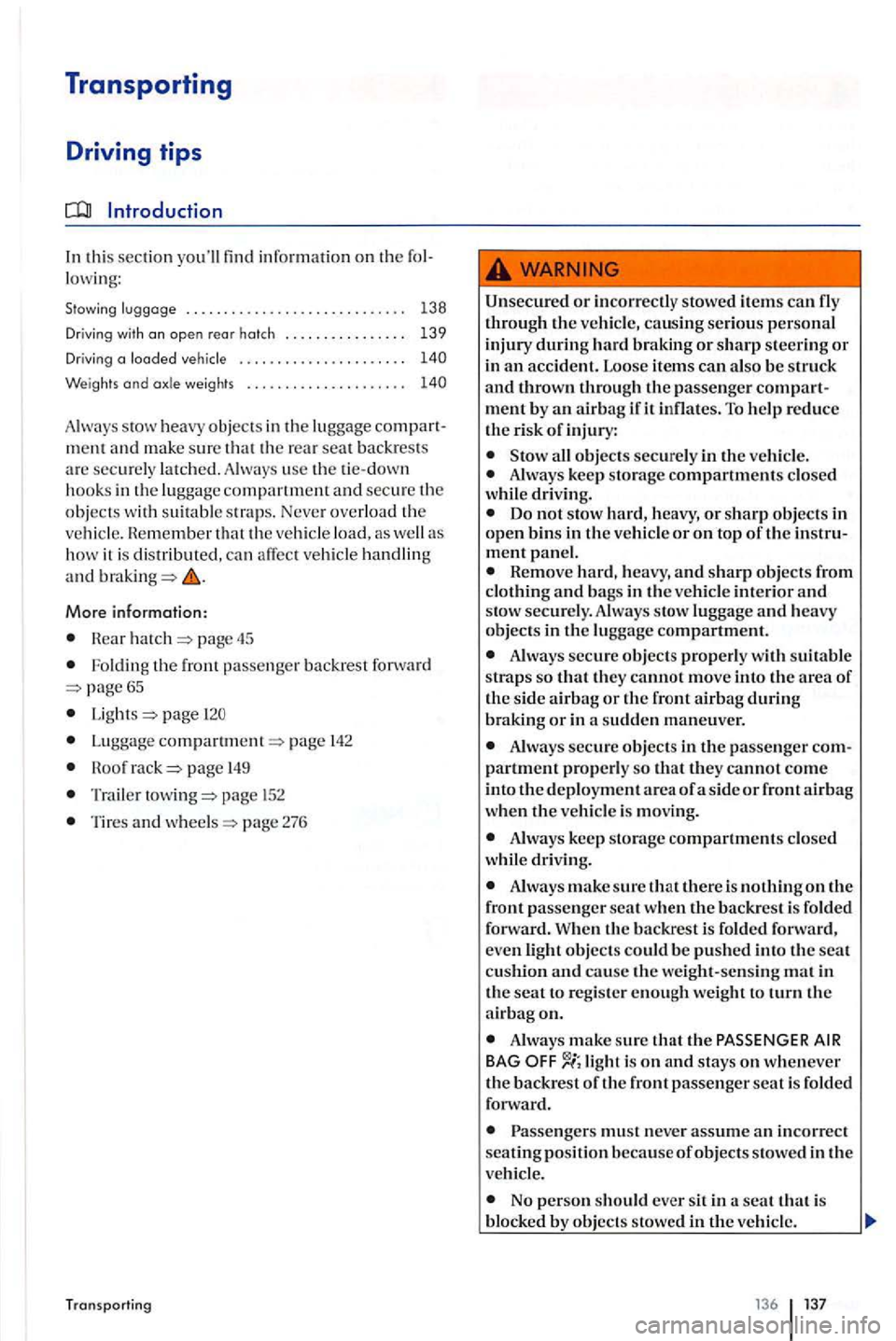
Uns ecured or in correc tly s tow ed item s can fly
through the vehicl e, causing serious personal injury during hard braking or sharp s teering or in an a cci dent. Loose items can also be s truck
a nd throw n through the passenge r compartment by an airbag if it infl ate s. To help reduce
the risk of inju ry:
all objects secure ly in the vehicl e. Always keep storage compartments closed dri vin g. Do not stow hard , heavy, or sharp objects in open bins in the ve hicl e or on top of the instrument panel.
A lways secure objects properly with s uitabl e
s traps so that th ey
Always secure objects in the passenger compartment properly so th at they cannot com e
int o the deploy ment area of a sid e or front airbag w hen the vehi cle is m ov ing.
Always keep stora ge compartments closed
w hil e dri ving.
A lways make sure th at the re is nothin g on the front passe nge r sca t w hen the backres t is fo lded forward. When the backres t is folded for ward,
eve n light objects could be pushed int o the scat
c ushion and cau se the we ight- sensin g mat in
th e seat to registe r e n o ugh weig ht to turn th e airbagon.
Always make su re that the AIR BAG
must n eve r assume an incorrec t seating positi on becaus e of objects stow ed in th e vehicle_
No person should ev er sit in a seat that is
blocked by objec ts s towe d in the vehicle.
136 137
Page 139 of 541
Heavy loads innuence th e way your vehicle handles and increa se stopping distances. Heavy
load s that arc not properly stowed or secured can cause los s of contro l and serious injury . Always remember when transporting heavy
objects that a change in the center of gravity also
changes the way your vehicle handles:
- Always dis tribute the load as evenly as
possib le. -heavy objects properly as far forward
in th e luggage compa rtme nt as possible.
- Always tie down heavy items secure ly using
th e tiedowns provided and suitable straps.
Never exceed th e Gross Axle Weight Rating or the Gross Vehicle Weight Rating on the safety compliance sticker on the left door jamb. Excee
ding permissible weight can cause the vehicle to
skid and handl e diff erentl
y.
Always adapt your speed and driving to th e
heavi er load and the we ight distribution in the
vehicl e. Take road, weathe r, and visibility
cond itions into acco unt as we ll.
Stowing
on page 137.
Always stow all luggage securely in the vehicle
Distribut e loads in the vehicle, on th e roof and the trail er as even ly as possible.
Secu re lu ggage in the luggag e compartment with suit able tightening strap s to the tie-down page 142.
Adjust the headli ght page
Before driving
Drive especia lly carefully and accelerate
gently.
Avoid sudden braking and driving maneu
ve rs.
Brake earlie r than yo u would if you were not driving a loaded
tire pressure. Heed the information on the tir e pressure page 276.
sure Monitor ing Syste m, the system may need to
be adjusted for the new page
CD Note
The heating wires in the rear window can be se
vere ly damaged by hard or sharp things on the sh elf below the rear window.
review inf ormation about loading a page 152 and a roof rack 149.
Page 143 of 541
Luggage compartment
Introduction
In this section you'll fin d info rmation on the lowi ng:
Folding the backrest of the rear seat forward and back into place . . . . . . . . . . . . . . . . . . . . . . . . . . . . . . 143
Luggage compartment cover . . . . . . . . . . . . . . . . . . 144
Luggage compartment pass-through . . . . . . . . . . 145
. . . . . . . . . 146
bag hooks . . . . . . . . . . . . . . . . . . . . . . . . . 14 7
Luggage ne t . . . . . . . . . . . . . . . . . . . . . . . . . . .
. . . . 148
A lways stow h eavy objects in the luggage ment and mak e sure tha t th e rear se at back res ts
a re sec urely la tc h ed in their u pright positio n. strap s with the ric- dow n h ooks.
Never ove rload the ve hicle . Remember th at the hi cle load, well it is di str ibu te d , ca n
More info rmation:
A irbag pag e
page
page 137
Trail er page 152
Tires and pa ge 276
An open or unlocked luggage compartment poses sp eci al risks for children. C lose and lock the rear hatch and all doors when the vehicle is not in use. First, make certain that n o one is left insid e. Neve r leave your vehi cle unattende d or l et
childre n play around the ve hicl e, especi ally with the rear h atch left open. A child could crawl into the ve hicl e and pull the hatc h shut, b ecoming trapped and unable to ge t out. Thi s could cause severe or fatal injuries. A clo sed vehicl e can becom e very ho t or very cold, dependin g on the season. tures can quickly re ac h l eve ls that can cau se unconscio usness or death, particul arl y to sm all childr en . N eve r le t childr en play in or around the
veh icle .
Neve r let anyone ride in the lu ggag e partment.
Before driving
Unsecured or incorrec tl y stowe d item s can through the ve hicle, causing seriou s personal injury during hard brakin g or sh arp steering or in an acci dent. Loose item s can als o be s truck
and thrown throug h th e pa sse nger
Always sto w all objec ts sec ure ly in the
Always secu re objec ts prope rly w ith suit abl e
rop e or tightening s traps so that th ey cannot move into the deploy ment zo ne of the side o r
front airbag during a sudden braking or other driving maneu ve r.
Always kee p storage co mpartm ents clo sed
while driving.
Do not sto w hard , h eavy or sh arp objec ts
loo se in the vehicl e in open storage ments or o n to p of the dashboard.
A lways re m ove hard, heavy, or sharp objects
fr o m clothing and ba gs in the vehicl e int erio r
a nd sto w them secure ly in the lu ggage ment.
Tra nsportin g heavy objects causes the handling
c h arac teris tics of th e vehicl e to change and creases braking dista nces. Heavy loads wh ic h are n o t properly stowed or secured in tl1e vehicl e
can l ead to a loss of ve hicle control and cau se ri ous person injury.
T ra nsporting heavy item s ca uses the d ling characteris tic s of the vehicle to change by
s hiftin g the veh icle 's cen te r of g rav ity .
Alwa ys distribute ca rgo eve nly and as lo w as possibl e within the ve hicl e. The vehicl e capacity
we ig ht figures appl y w hen the load is distribute d
even ly in th e ve hicl e (p asse ngers and lugg age).
Alwa ys sto w lugg age and h eavy it e m s in the
lu ggage compartment as far fo n va rd of tl1e rear
axl e as poss ible and secure th em with priate strap s u sin g th e tic- dow n h ooks provided .
Page 150 of 541
Roof rack
this section you'll find informatio n on th e lowin g:
Mounting the roof rock bose carrier and roof rock
mize aerod ynamics and does not have tradit io nal
rain gutters used to attach many kinds of roof
ra cks.
the rain gutte rs are m old ed into the roof to prov ide efficient ae rody nami cs, only approved base carrie r mounts and roof racks can be u se d.
When should the roof rack be removed?
it is no lo nge r need ed.
Befo re dri vin g throug h an automatic car wash.
th e ve hicl e would otherw ise be too high to achieve minimum clearance to enter, for ample, a ga rage.
More information:
page
Tran sp o rtin g=> page 137
Sav ing f uel and h e lping the en vironment 198
Tires and page 276
Parts, a ccesso ries, repa irs and modifica tio ns
Transporting heavy or bulky loads o n the roof rack will change the way the ve hicl e handles by shifting the ve hicl e's cente r of gravity and creasing the wind drag area.
Always secu re the load properly wit h suitable and undamaged straps so that the load wiH not s hift.
Cargo that is larg e, heavy, bulky, long or flat
will have a negativ e effect on the vehicle's
dling.
Always avoid sudden maneuvers and hard braking.
Always adapt your speed and driving to the heavier load and the we ight distribution in the ve hicle. Take road, weather, and vis ibili ty
conditions into account as we ll.
Note
Always remove the roof rack before driving through an automatic car wash.
vehicle is higher when the roof rack i s stalled, especially when it is loaded. Compare the ve hicl e height with ex isting clearance heights,
s u ch as underpasses and garage doors.
Always make sure that the roof rack system and anything being carried on it docs not
Make sure that the rear h atc h does not touch items on the roof rack when open ed.
a roof rack is installe d, fue l co nsumption inc reases due to in creased air resis tance.
148 149
Page 151 of 541
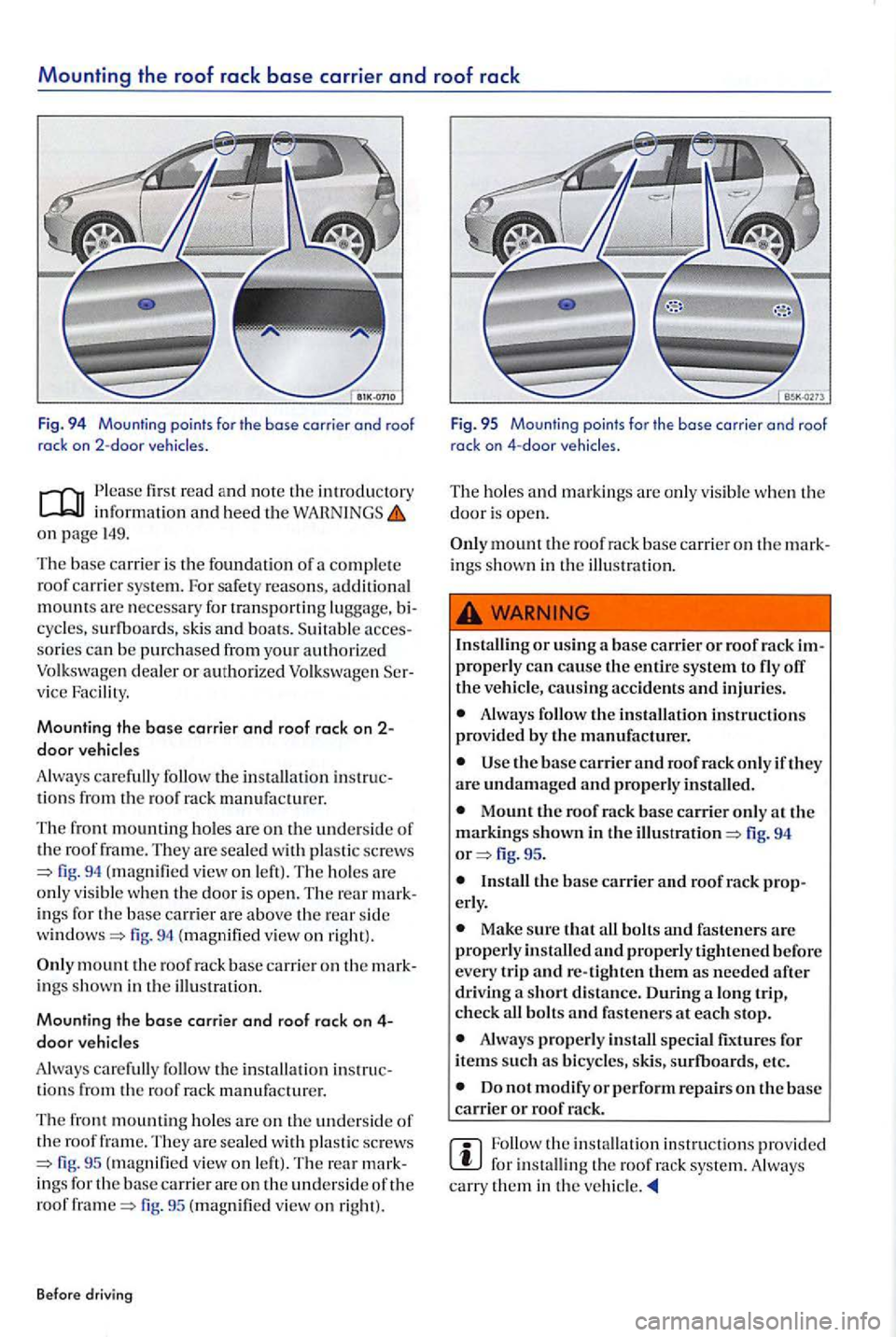
Mounting the roof rack base carrier and roof rack
Fig. 94 Mounting points for the base carrier and roof
rack on 2-door
first read and note the in troduc tory information and heed the on page 149.
Th e base carrier is the foundat i
on of a co mpl ete roof carrier syste m . For safe ty reasons, additio n al
mo unts necessary for transporting luggage, bi
cy cles, su rfb oards, skis and boats. acces
sories be purchased from your authorized Volkswage n dealer or a uthori zed Volkswagen
th e installat io n instru c
tions from the roo f rack manufa cturer.
The fr o nt mounting ho les are on th e underside of the roof frame. They are with pla stic screws (m ag nified view on le ft). The holes o nl y vis ible whe n th e door is open. The rear mark
in gs fo r th e ba se carrier are above the rear side fig. 94 (magnified view on right).
on th e undersid e of the roof fr ame. They are sea led with plastic sc rews (mag nified view on le ft). T he rea r mark
in gs for the base carrier are on the unders ide o f the roof fig. 95 (magnifi ed view on rig ht).
Before driving
Fig. 95 Mou nting points for the bose carrier and roof
rock on 4-door
The hol es markin gs onl y vis ib le whe n th e door is open.
m ount the roof rack base carrier on the mark ings shown in the illu stra tion.
or using a base ca rrier or roof rack im
p roperly can cause the entire syste m to fly off the ve hicle, causing accide nts and injuri es.
the installation instructions provid ed by th e manufacturer.
Mount the roof rack base carrier only at the markings shown in the fig. 94 fig. 95 .
Make sure that bolt s and fasteners are properly re -tighten them as needed after dri ving a short distance. Du ring a lo ng trip,
c h ec k bolts fasteners at each stop.
Always properly s pecial fixtures fo r
items such bicy cle s, skis, su rfboard s, etc.
the in stallatio n instructi ons prov ided the roof rack system. carry them in the veh icle.