2006 VOLKSWAGEN GOLF PLUS Cool
[x] Cancel search: CoolPage 228 of 541
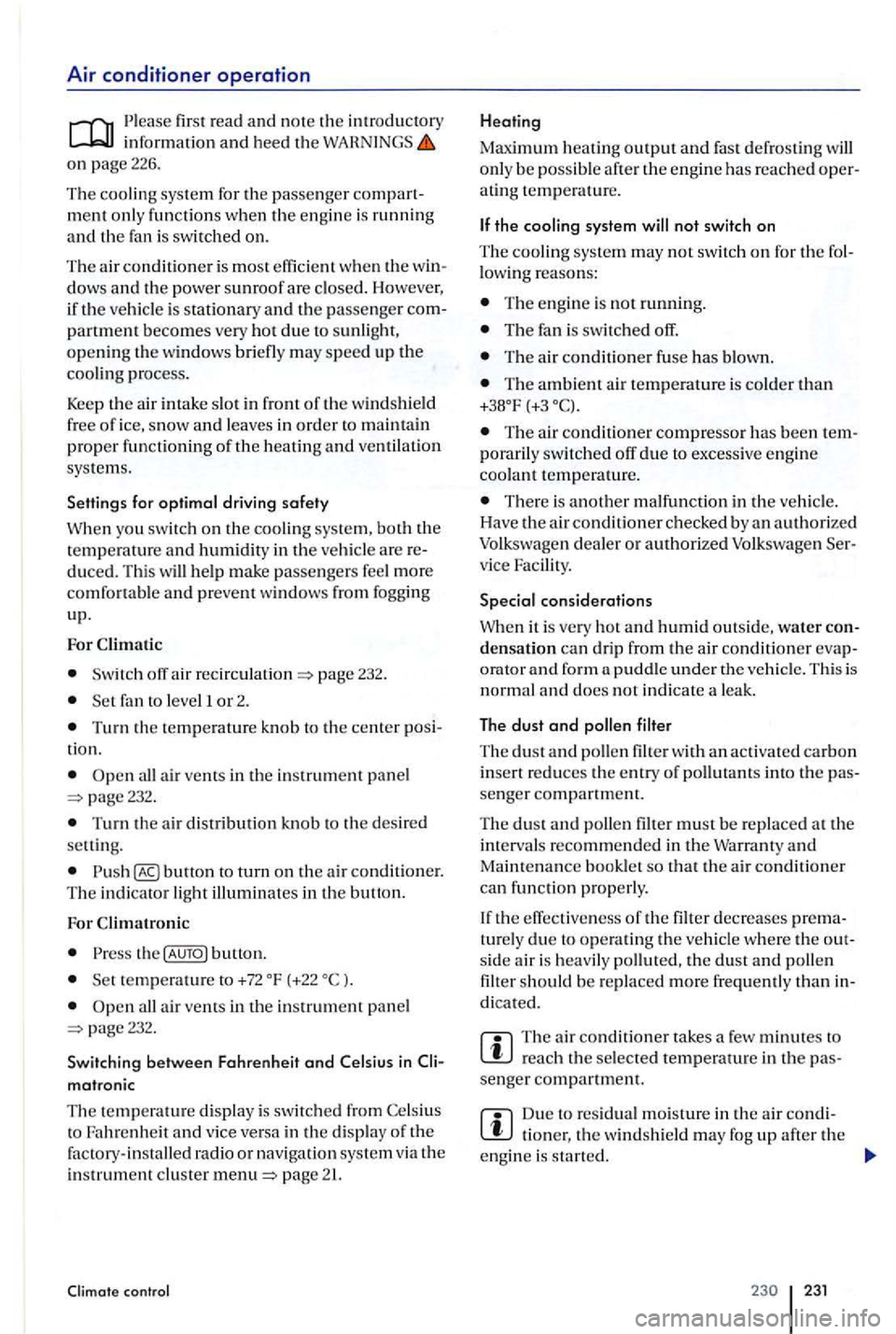
Air conditioner operation
information and heed the WAHNINGS on page 226.
The cooling syste m for the passenger compart
ment o nl y functions when the engin e is running
and the fan is switched on.
The air conditioner is most efficient when the w indows an d the power sunroof are closed. However,
if th e vehicle is sta ti o nary and the passenger compartment becomes very hot due to sunlight, opening the w indows briefly may speed up the cooling proce ss.
Keep
the a ir intake slot in front of the windshield
free of i ce, snow and lea ves in order to maintain proper funct ioning of the heating and ventilation systems.
Settings for optimal driving safety
When yo u sw itch on the cooling system, both the temperature and humidity in the vehicle are reduced. Th is will help make passengers feel more comfo rtable and prevent windows from fogging
up.
For
Sw itch off a ir page 232.
fan to Ievell or 2.
T urn the temperature knob to t he center posi
tion.
all air vents in the in strument panel page232 .
Turn the air distribution knob to the des ired settin g.
butto n to turn on the air conditioner. The indicator light illumin ate s in the button.
For
th e button.
temperature to +72
pa ge232.
Sw itching between Fahrenheit and Celsius in Cli
matronic
The t empe ratu re disp lay is switched from to Fahrenheit and vice versa in the display of the factory- in stalled radio or naviga tion system via the in strument cluster page
control
H eating
Maximum heating output and fas t defrosting will
only be possib le a fte r the e ngin e has reached operating tempe rature.
T he e ng in e is not running.
T he fan is switc hed off.
The a ir conditi one r fuse has blown.
The ambien t a ir temperature is colder than (+3
T he air condition er compresso r has been tem
porarily switched off due to excess ive engin e coolant temperature.
The re is a nother malfunction in the ve hicle.
Ha ve the ai r conditioner checked by an authorize d
Volkswage n dealer or authorized Volkswage n Ser
v ice Facility.
Special considerations
Whe n it is very hot and humid outside, water con
d ensation can drip from the air condition er evaporator and form
The air condit ioner takes a few minutes to reach the selected temperature in the passenger compartment.
Due to residual m oisture in the air condi tione r, th e windshi eld may fog up after the
engi ne is s tarted.
23 1
Page 229 of 541

Air from the air vents flow s through the e ntire passenger compartment and leaves the vehicle through air vents under the rear w ind ow.
The a ir vents s hould not be covere d by clothin g or other
Air vents
Fig. 146 Air vents in the instrument
Please fir st read and no te th e introductory informati on and heed the on page 226.
Air
vents
To e n sure s uffici ent heating, cooling and ve ntil ation in the passenger compartment, n eve r close the air vents fig. 146 .
To ope n and close the air vents. turn the thumb-wheel in the desired direction.
Use the lever on the vent grill e to adj ust the air
flo w direction.
Air recirculation
Pleas e fir st re a d and note the in trod uctory information and heed the on page 226.
General information
There are different t y p e s of air recirculati on : A
dditi onal air
vents are located in the foorwells as well as in the rear area of the passe nger compart
m ent.
Note
Do not place food, medications, or other heatsensiti ve things in front of the air vents. Food, medications, and other things that are sensitive to
heat or cold can be damaged or made unusable by the air flow from the
Ma nual air re circulati on (h eatin g sys te m ).
Manual air r e circulatio n
troni c).
Th e
right indi cato r light in the is illumin ate d : automatic air recir cul atio n
Page 230 of 541
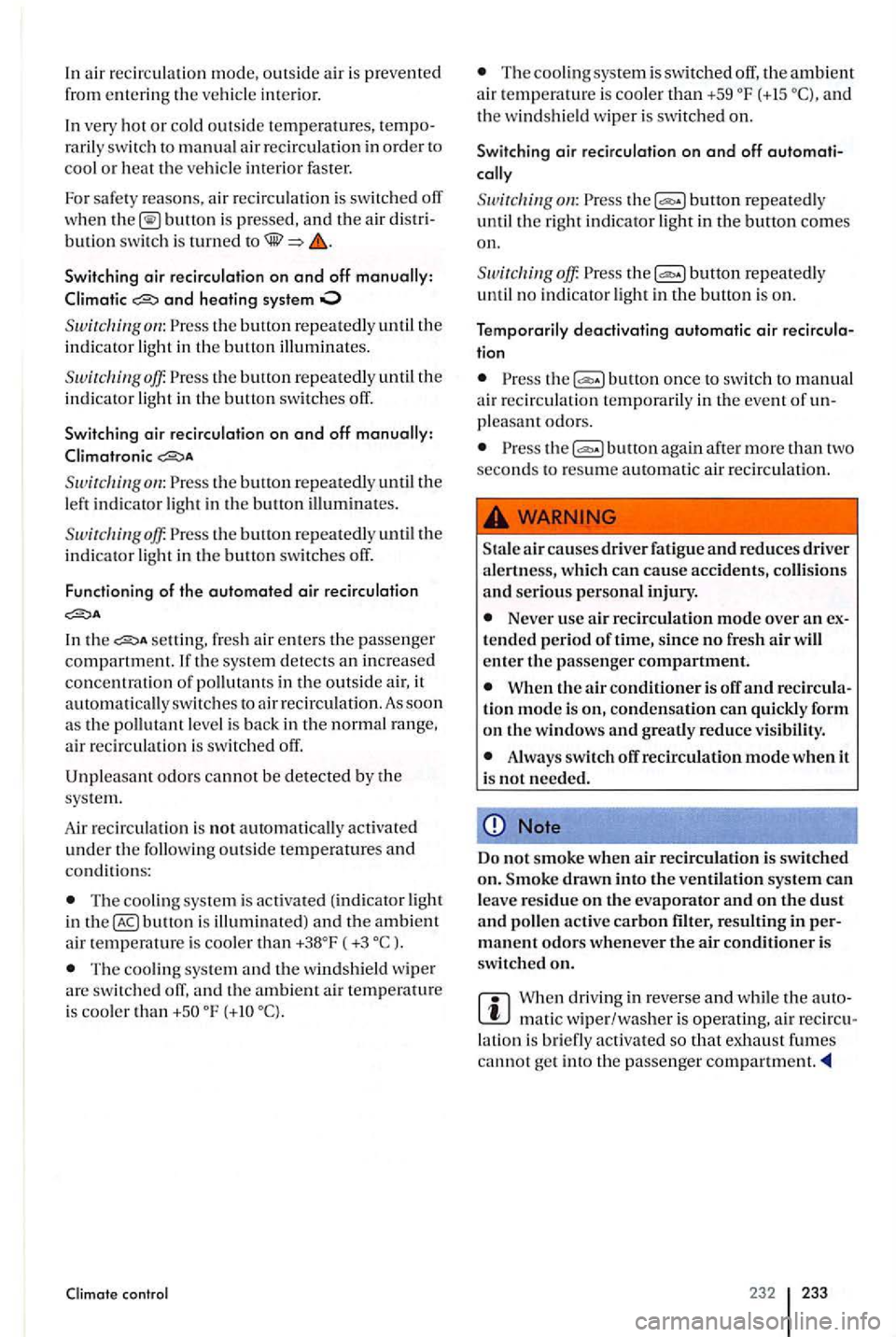
In air rec irculati on mod e, out sid e air is pre vente d
from ent
erin g the ve hicle inte rior.
In very hot or co ld out sid e t
emperature s, rarily sw itch to manual a ir recircula tion in orde r to cool o r heat th e ve hicle interior faster.
For safet y re aso ns, air recircu latio n is switch ed off when
and heating system
th e button repeated ly until the
indi cator ligh t in the button illumin ates.
the button re peatedly until the
indi cator light in the button switche s off.
Switching air recirculation on and off
the button re peatedly the left indi cato r light in the butto n iUuminates.
Swirclzin goff. the buHon repeatedly th e
i n d icato r ligh t in th e butto n swit ches off.
Functioning of the automated air recirculation
sett ing, fresh air ent ers the p assen ger compartment. If th e sys te m detects an in crease d
co ncentrat ion in the out side air, it automatically switches to air recirc ulation. As soon
a s th e po llut an t leve l is bac k in th e no rmal range,
air recirculati o n is switc h ed off .
Unpl
easa nt od ors can no t be detected by th e
sys tem.
A ir rec ir c ulati on i s n
ot automatically activated under th e followin g o utside tempe ratures and conditi ons:
The coo ling sys te m i s activa te d (indicato r light
in butt on is illum inated) an d th e ambient
air temperature is coo ler than ( +3 oc ).
The co oling sys te m and the w in dshie ld wipe r
are switc h ed off, and the ambien t a ir temperature
i s coo le r th an
Th e cooling sys te m i s switched th e am bient
a ir temperature is c oole r th a n +59 and
th e w indshi eld wip er is switched on.
Switching air recircu lation on and off
button repeatedly
until the rig ht ind icator light in th e button co mes on.
off. button re peate dl y
u ntil no indicat or light in the button is on.
Temporarily deactivating automatic air
butt on once to switch to m anual
a ir recirculatio n t emporarily in the event of
buH on aga in afte r more than two
seco nds to resume auto matic ai r recir cul atio n.
air ca uses driver fatigue and reduces dri ver
a lertness, which can cause accidents, collisions and serious personal injury.
Neve r use air recirculation mode over an tende d p eriod of lime, since no fre sh air will
e nt er the passen ge r compartment.
When the air conditioner is off and tion mode is condensat ion can quickly form on th e w indows and greatly reduce visibility.
Alwa ys sw itc h off recirculation mode when it
i s not needed.
Note
Do not smoke w hen air re circulation is switc hed draw n into the ventilation syste m can le ave residue on tl1e evaporator and on the dust and poll en acti ve carbon filter , resulting in mane nt odors wheneve r the air conditioner is switched
W hen driv in g in reverse and w hil e th e mati c wipe r/washer is op erating, air latio n is bri efly act ivate d so exh au st fumes canno t ge t into th e passenger
232 233
Page 235 of 541
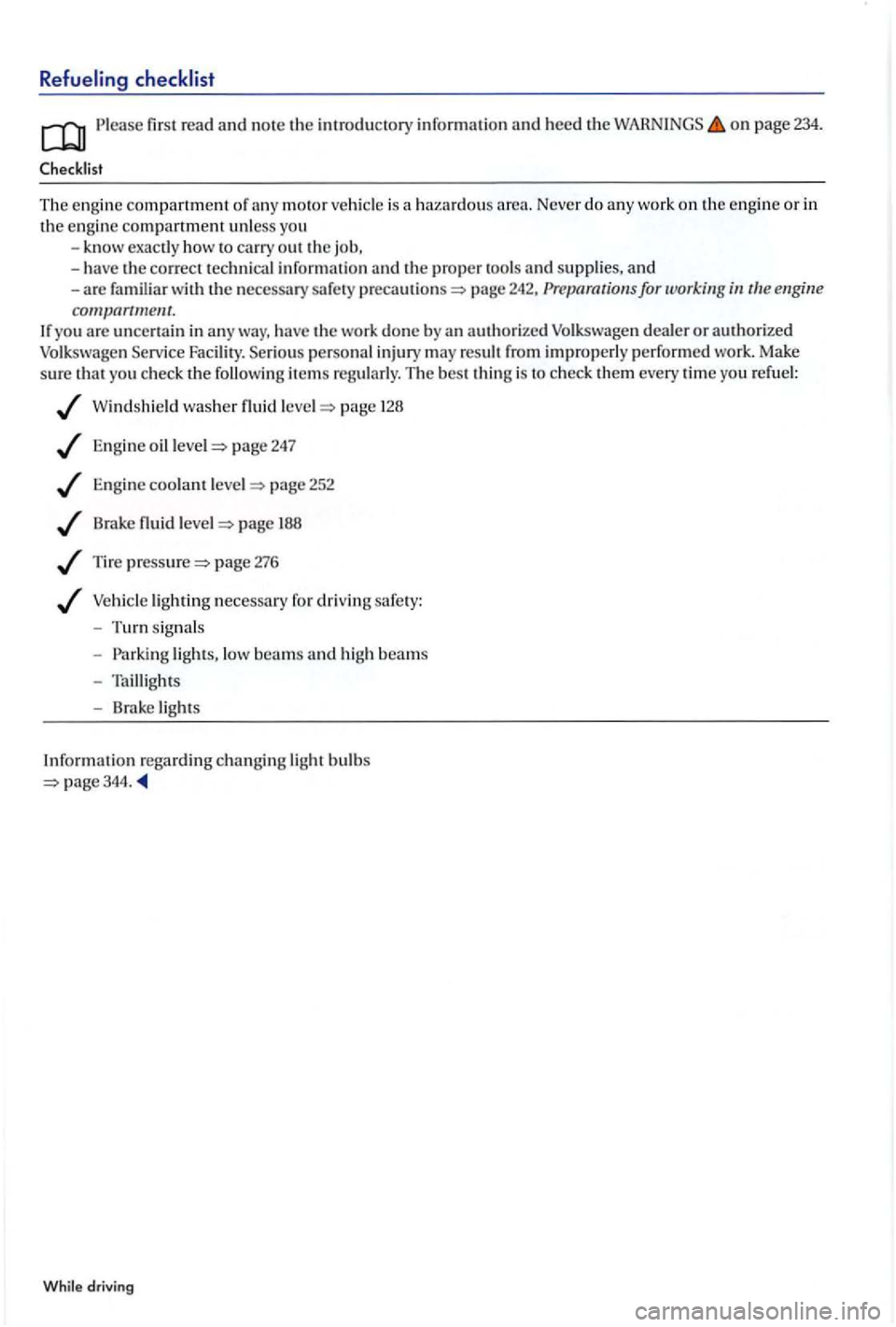
Refueling checklist
first rea d an d note the introductory information and heed the on page 234.
The engi ne compartment of moto r vehicle is a haza rdous engine or in the engin e compartment unless yo u -know exac tl y how to carry o ut the job,
-have the correct technical in formation and the proper too ls and supplies, and -ar e familiar with the necessary safety precautions page 242, Preparation s for working
have the work done by an authorized Volkswagen dealer or authorized Volkswag e n Serv ice Facility. Ser ious personal injury may result from improperly perform ed work. Make
s ure that y ou check the followin g item s re gu larly. The bes t thin g is to check them every time you refue l:
Wind sh ie ld was her fluid leve l page 128
E ng in e oil leve l page 247
Engin e coolant leve l page 252
Brake fluid level page 188
Tire pressure page 276
Vehicle lighting necessary for drivin g safe ty:
-Turn signal s
-
li ghts, low beams and high beams
- Taillights
- Brak e light s
Inf
ormat ion regard ing changing light bul bs page 344.
While dri ving
Page 240 of 541
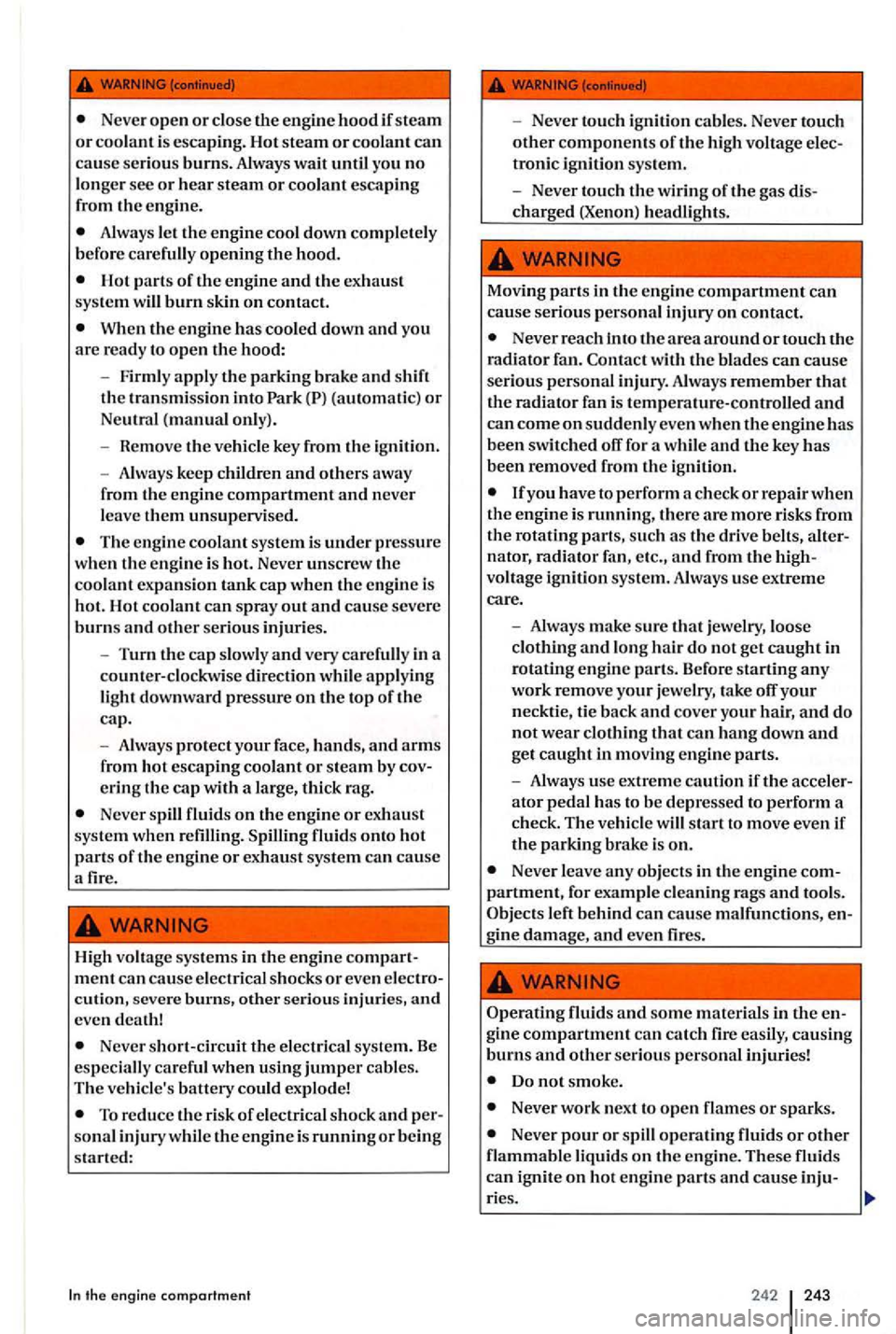
Never open or close the engine hood if steam or coolant is escaping. Hot steam or coolant can cause serious burns. Always wait until you no longer sec or hear steam or coolant escaping
from the engine.
Hot parts of the engine and the exhaust
system will burn skin on contact.
When the engine has cooled down and you are ready to open the hood:
- Firmly
apply the parking brake and shift the transmission into Park
The engine coolant system is under pressure when the engine is hot. Never unscrew the coolant expansion tank cap when the engine is
hot. Hot coolant can spray out and cause severe burns and other serious injuries.
- Turn
the cap slow ly and very carefully in a
counter-clockwise direction while applying
light downward pressure on the top of the cap.
- A
lways protect your face, hands, and arms from hot escaping coolant or steam by
Never spill fluids on the engine or exhaust
system when Spilling fluids onto hot parts of the engine or exhaust system can cause a fire.
High voltage systems in the
engine com ment can cause electrical shocks or even
Never short-circuit the electrical system. Be especially careful when using jumper cables. The vehicle's battery could explode!
To reduce the risk of electrical shock and sonal injury while the engine is running or being started:
the engine compartment
- Never touch ignition cables. Never touch other components of the high voltage tronic ignition system.
- Never touch
the wiring of the gas
Never reach into t11e area around or touch the
radia tor fan. Contact with the blades can cause serious personal injury. Always remember that the radiator fan is temperature-controlled and can come on suddenly even when the engine has been switched for a while and the key has been removed from the ignition.
lfyou have to perform a check or repair when the engi ne is running, there are more risks from tl1e rotating parts, such as the drive belts, nator, radiator fan, etc ., and from voltage ignition system. Always use extreme care.
- Always make
sure that jewelry, loose clothing and long hair do not get caught in rotating engine parts. Before starting any work remove your je welry, take
parking brake is on.
Never leave any objects in the engine
left behind can cause malfunctions,
Do not smoke.
Never work next to open flames or sparks.
Never pour or spill operating fluids or other flammable liquids on the engine. These fluids can ignite on hot en g in e parts and cause ries .
242 243
Page 242 of 541
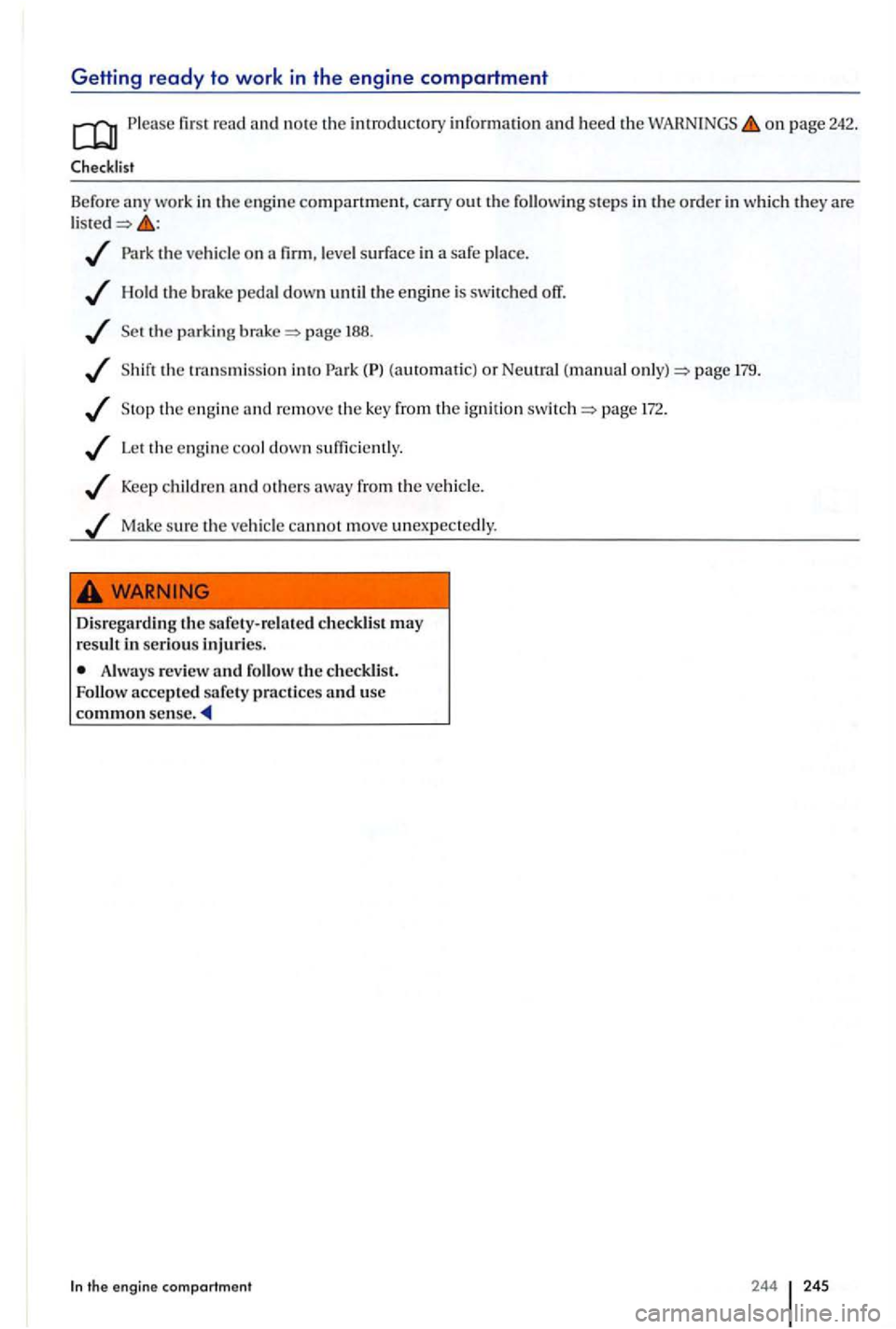
GeHing ready to work in the e ngine compartment
Please on page 242.
Checklist
Before any work in the engi ne companment, carry out the follo wing steps in the order in whi ch they are
Par k the ve hicl e on leve l surface in a safe place.
Hold the pedal down until the engin e is switched off.
page
S hift the tran smissio n into (automatic) or (manual page 179.
S top the engi ne and remove the key fro m the ignition pag e
Le t th e eng in e cool d ow n
Keep child re n and o th ers from the ve hicl e.
Make sure th e ve hicle cannot move unexpe ctedly.
Dis regardi ng the safe ty- re lated checkli st may
result in serious injuries.
Alwa ys review use common
Page 244 of 541
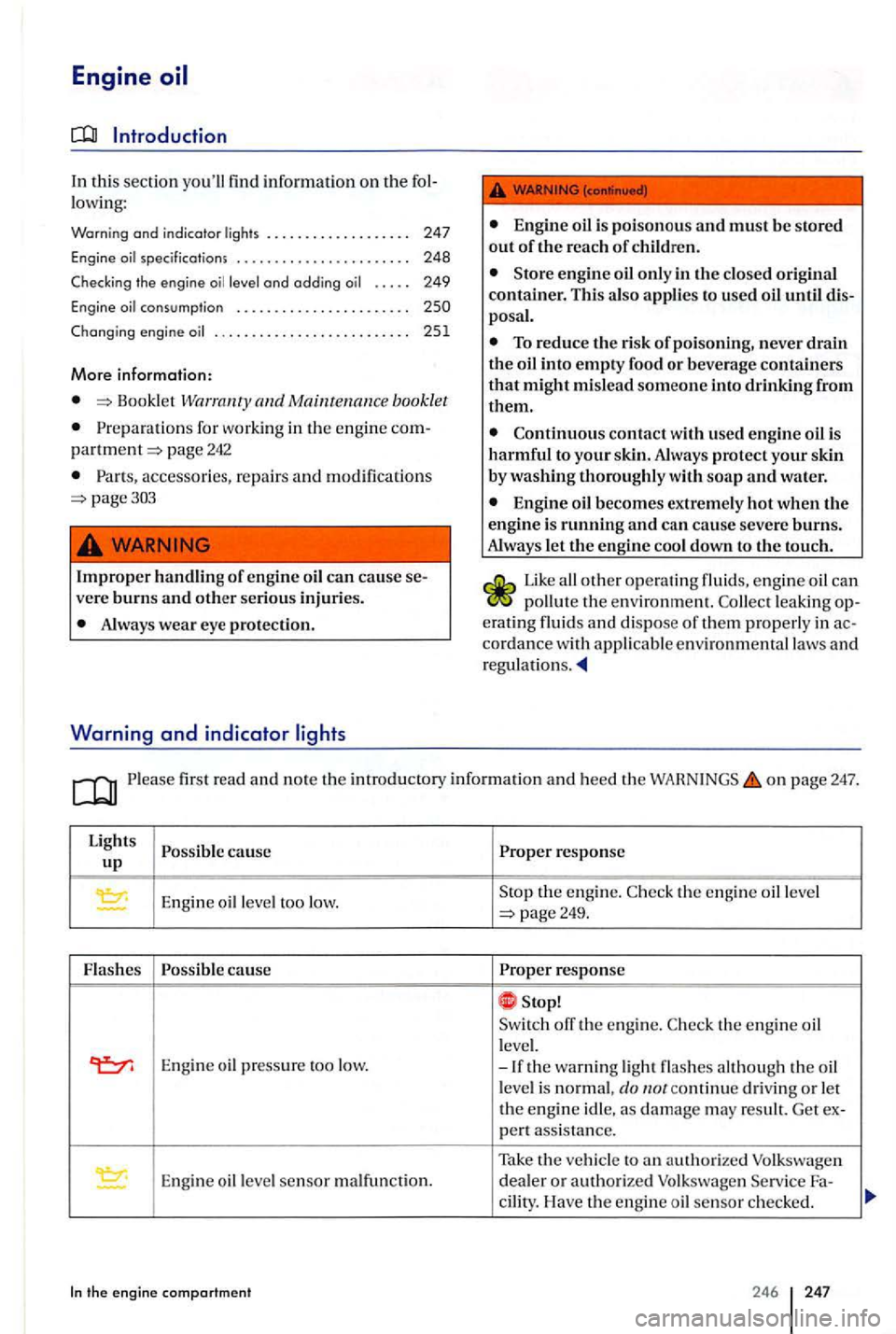
Engine oil
Introduction
In thi s sect io n you'll find inform ation on the fol
lowing:
Warning and indicator lights . . . . . . . . . . . . . . . . . . . 247
Engine
=>Boo klet Warranty
fo r wor king in the engine compartment=> page 242
accessories, repairs and modifications page303
Im
proper h andling of engin e oil can cause severe burns and other seriou s injurie s.
Always wear eye protection.
Warning and indicator light s
Engine oil is poisonous and must be stor ed out of the rea ch of children.
To reduce
Engine oil becomes ex tremely hot when the engine is running and can ca use severe burns. Alway s le t the engine cool down to the tou ch.
all othe r operat in g flui ds, engine oil can pollut e the envir o nment. leak ing op
erat ing fluid s and dispose of them properly in ac
co rdance with appl icable environmental laws and regu latio ns.
on page 247.
Light s response up
Engine oil level too low. th e engine. th e eng ine oil leve l --=>page 249.
Flashes cause respon se
Switc h off the eng ine.
Engine oil press ure too low.
-If the warning light flashes although the oil level is normal , do continue driving or let the en gine idle. as damage may result. Get ex -pert assis ta n ce.
Take the veh icle to an auth orized Volkswagen Engine oil leve l sensor malfunction. dealer or authorized Volkswagen Service Fa-cility. Have the engine oil sensor checked .
Page 247 of 541
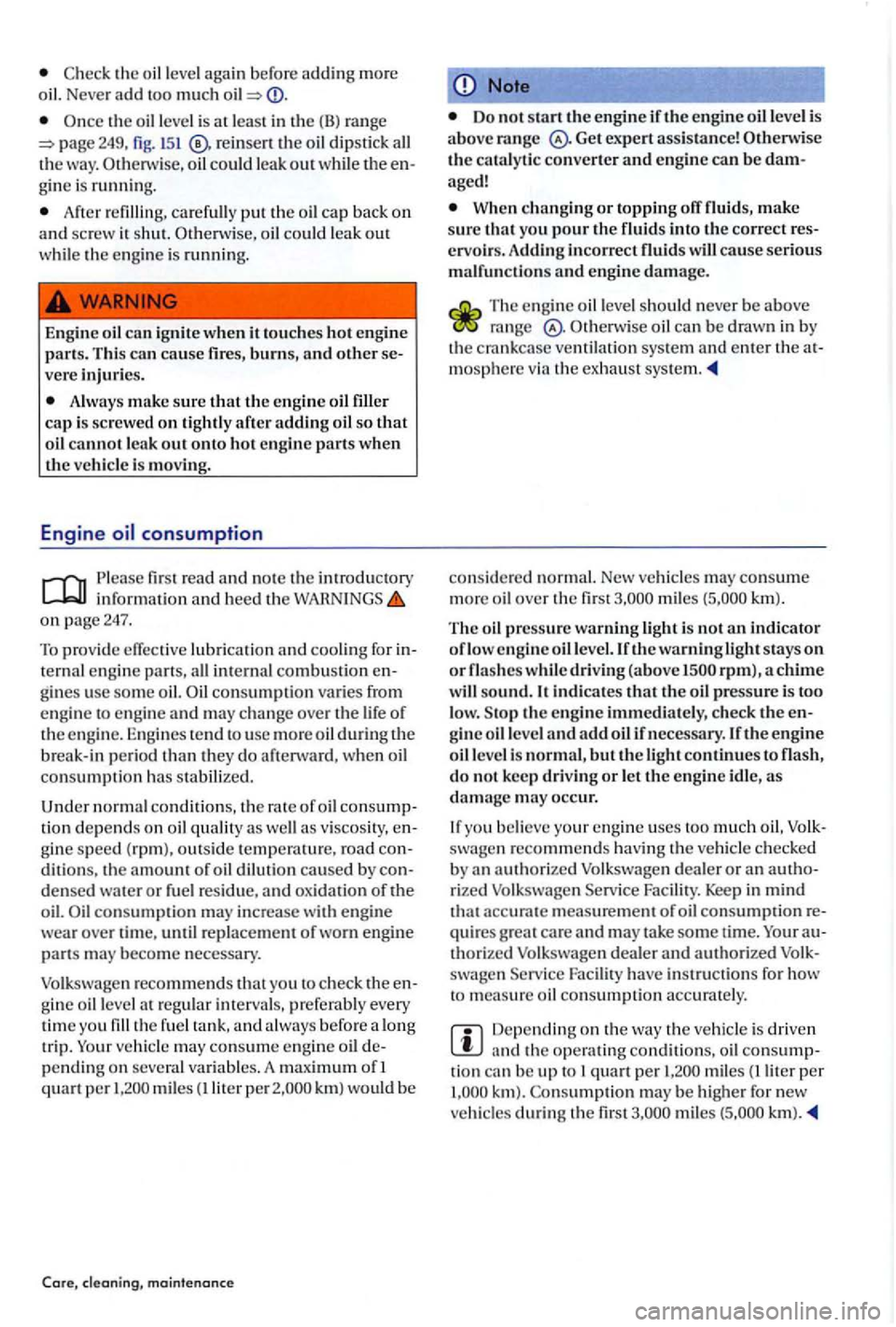
the oil leve l agai n befo re addin g more
oil. Never add much
O nce th e oil leve l is at least in the ( B) ra nge
oil dip stick all th e way. oil could le ak out while th e en
g in e is running.
Afte r r efilling, car efully put the oil ca p back on and scre w it shut. Oth erwi se, oil could leak out whi le th e e ngine is running.
E ngin e oi l ca n ignite
when it tou ches hot e n g ine parts. T hi s can ca use fires, burns, and other severe injuri es.
Always make sure that the engin e oil fill er cap is screwed on tightly afte r adding oil so that oil cannot leak out ont o hot engin e parts whe n
th e vehicle is moving .
Engine
first r ea d and no te th e introductory information and h eed o n pa ge 247.
To prov ide effective lubricatio n and coolin g for in
ternal engine parts, all internal combustio n en
g ines use some oil. consumption varies from
e ng in e to engi ne and may ch an ge ove r th e life of th e e ng in e. Engi nes te nd to use m ore oil during th e
br eak- in peri od th an they do afterwa rd, when oil
co nsumption has s ta bili zed.
rat e of oil consump
tion dep e nd s on oil quality a s well as v isc osity, e n
g in e s pee d (rpm), outs ide tempe rature, road condit io ns, the amount o f oil dilution caused b y condensed water o r fuel residue, and oxidation of th e
o il. consumptio n may in crease with eng in e
wea r ove r time, until re pla cement of worn eng ine part s may beco me necessary .
Volk swage n recommends th at yo u to c heck the engin e oil leve l
vehicl e may consum e engine oil d epending o n seve ral var iables. A maximum of I quart per miles (!lite r km ) would be
Care, maintenance
Note
D o not start the engine if lhe e ngine oil leve l is
above range expert ass is ta n ce! Otl1envise the ca talytic con verter and engine ca n be dam
aged!
W hen changin g or topping ofT make sure that you pour the into the correct reservoir s. Addi ng incorrec t
The e ngine oil leve l s h o uld never be above ran ge oil ca n be drawn in by
th e cra nkcase ventilation syste m and ent er th e at
mo sphere via th e e xh au st sys te m .
co nside red normal. New vehicles may consume
m ore oil over th e km).
T he oi l pressure warning light is not an indicator oflowe ng in e oillevel.lfthe warning light stays on or whil e d rivin g (above rpm), a chime
will sound. It indica tes that the oil pressure is too
low. th e engine immediately, check the engine oil leve l and add oil if n ecessary . If the engine oil leve l is normal , but the continues to do not kee p driving or let t11e e ngin e idl e, as damage may occur.
If you believe your en g in e uses to o much oil, Volkswagen recommends havin g th e vehicle checked b y an auth orized Volkswagen dea le r or an ri ze d Volk swagen Service Facility. Keep in mind that accurate measurem ent of oi l consumption requires great ca re and m ay take som e time. au
t h orized Volkswa gen d ea ler and a uthorized Volk
s wa gen Facility have instru ctions for how to m eas ure oi l co nsumptio n acc ura te ly.
Dep e ndin g on the wa y th e ve hicl e is dri ven an d th e ope ratin g conditions, oil consump
t ion can be up to I quart per mil es (!liter per