2006 VOLKSWAGEN GOLF PLUS Cool
[x] Cancel search: CoolPage 248 of 541
Changing engine oil
fir st read and note the introductory information and heed th e on page 247.
The engi ne must be cha nged according to the interval s specified in your Warran ty and Ma intenance booklet.
at interva ls is very important because th e lubrica tin g propertie s of during normal you arc not sure when to have the ch anged, ask your authorized Volkswagen dealer or authorized Volkswage n
Sometimes, e ng in e should be ch anged more
ofte n than sp ecified for normal u se. more freque ntly if yo u often drive short dista nces,
in dus ty areas or in stop -and-go or if you
u se your
and ch anged by an authorized Volk swage n dealer or an authorized swage n Serv ice They have th e re
qui red expertise and sp ecia l tools and dis pose of the
look dark afte r the engine h as been running a short time. This is normal and n o reaso n to change e n
gi ne
yourself, be
sure to ta ke the precautio ns:
A lways wear eye protec tion .
To reduce the risk of burns from hot engine th e engine cool down complete ly before
b eg inning.
When re m ovi ng the drain plug wit h your fingers, s tay as fa r away as possib le . A lways keep
your forea rm to th e ground to help pre
ven t hot from runnin g down your arm.
into a container desig ned fo r
t hi s purpose, one enough to ho ld at least
th e total amount of
To reduce the ri sk of poisoning, n eve r drain the into empty food or beve rage containers that mi ght mislea d someone into drinking from
th em.
Engine is poisonous and must be stor ed out of the reach of children.
Continuous contact with use d engin e is
h a rmful to your skin. Always protect your skin
b y wa shing thoroughl y wit h soap and water.
ch angin g th e first make sure you know where yo u ca n properly dispose of the old oil.
Dis pose o f the old an environmentall y-re
spons ible manner. Never dump th e old oil o n
garden soil. in wooded areas, in the street, into
s tr ea ms, rivers, or bodies of water, or d own sewage
drain s.
used by taki ng it to a fa
recomm en ds that you always have your oi l and oil filter changed by a n authorize d Volkswagen deale r or authorize d Serv ice They h ave the required ex pe rtise and sp ecia l tools a nd di spose of the old
Page 249 of 541
Engine coo la nt
Introduction
In thi s section you'll find informat ion on the following:
Warning
engine coolant and topping off . . . 255
Never do a ny wor k on the coo lant system unless
you
-know exactly ho w to carry out the job,
-have the correct tec hnical informa tion and
th e proper to ols, supplie s, and operating
fluid s, a nd
-are familiar with the necessary safet y
pr eca utions
Traile r page 152
fo r work ing in the e ngine compartment page 242
Part s, acce ssories , re pair s and modification s
Engin e coo lant is poisonous!
Always keep the coolant in its origi nal con
t ainer stored in a safe place .
To reduce the risk of poisoning, never store engine coolant in empty food or beverag e containers or in any other containers that might mislead someone into drinking from them.
Always keep engine coolant out of reach of c hildr en.
Alway s make sure there is enough of tJ1e cor
re ct coo lant additive to provid e proper anti
fr eeze protection at the cold es t temperatures that can be expected where the vehicle will be used .
At extremely cold temperatures, the coolant could freeze, causing the vehicle to break down.
The heater would also not work, and vehicle oc
cupants could be without protection at subfreezing temperatures.
leaking operat ing
fluids and dispose of t h e m properly in acco rdance
w ith applicable environmental laws and regulat ion s .
Warning light and engine coolant temperature gauge
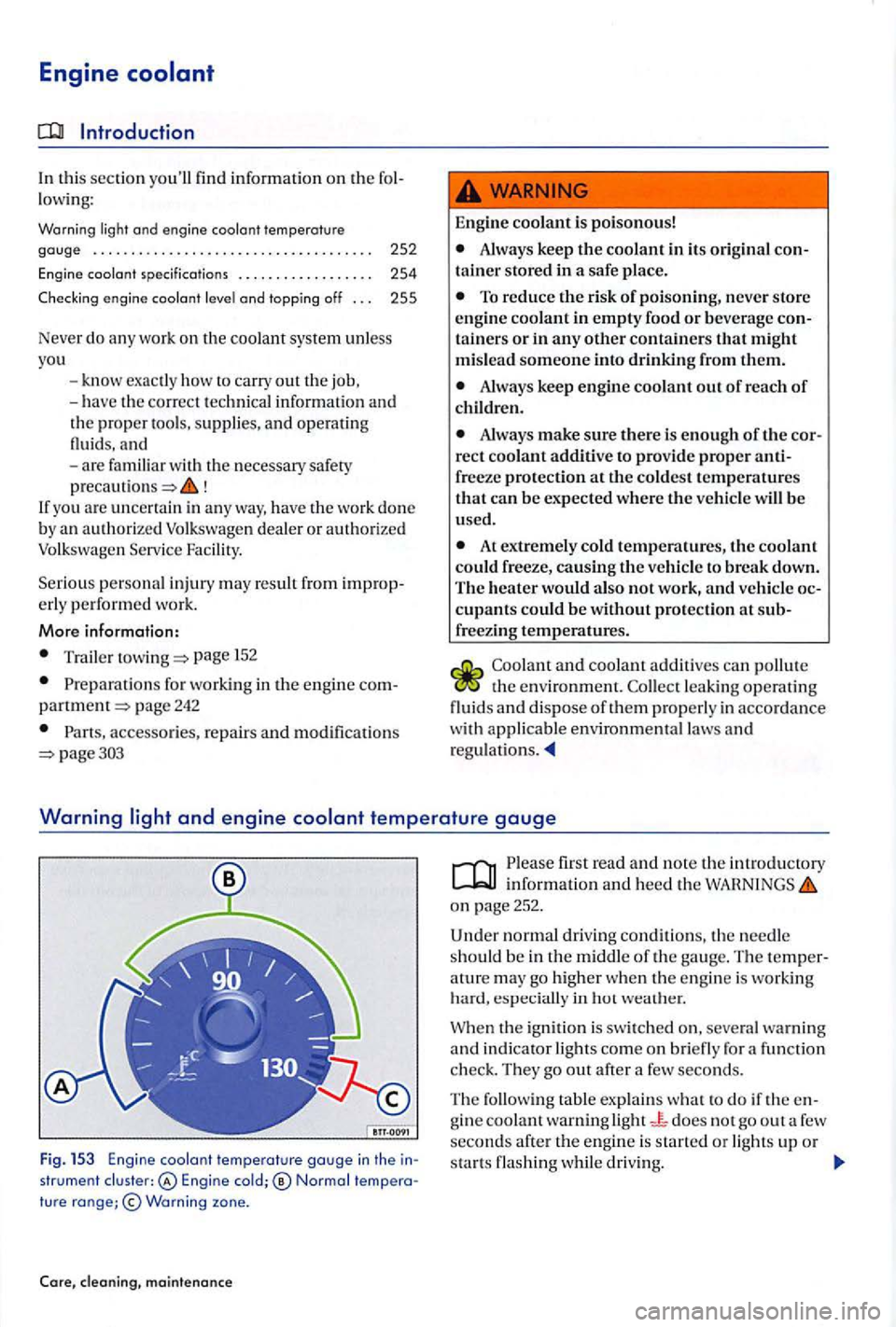
Fig . 153 E ngine coolant temperature gauge in the instr umen t Engi ne cold;® Normal temperature range;© Warn ing zone.
Core, maintenance
first read and note th e introduct ory information and heed th e on page 252.
normal driving conditi ons, th e needle
s h o uld be in the middl e of th e ga uge. The temper
ature may go high er w hen th e e ngine is w orking
h ard, espec iall y in hut
When the igni tion is sw itch ed on , seve ra l warnin g and indicator light s co me o n bri efly fo r a function
c h ec k. The y go our after a few seconds.
Th e fo
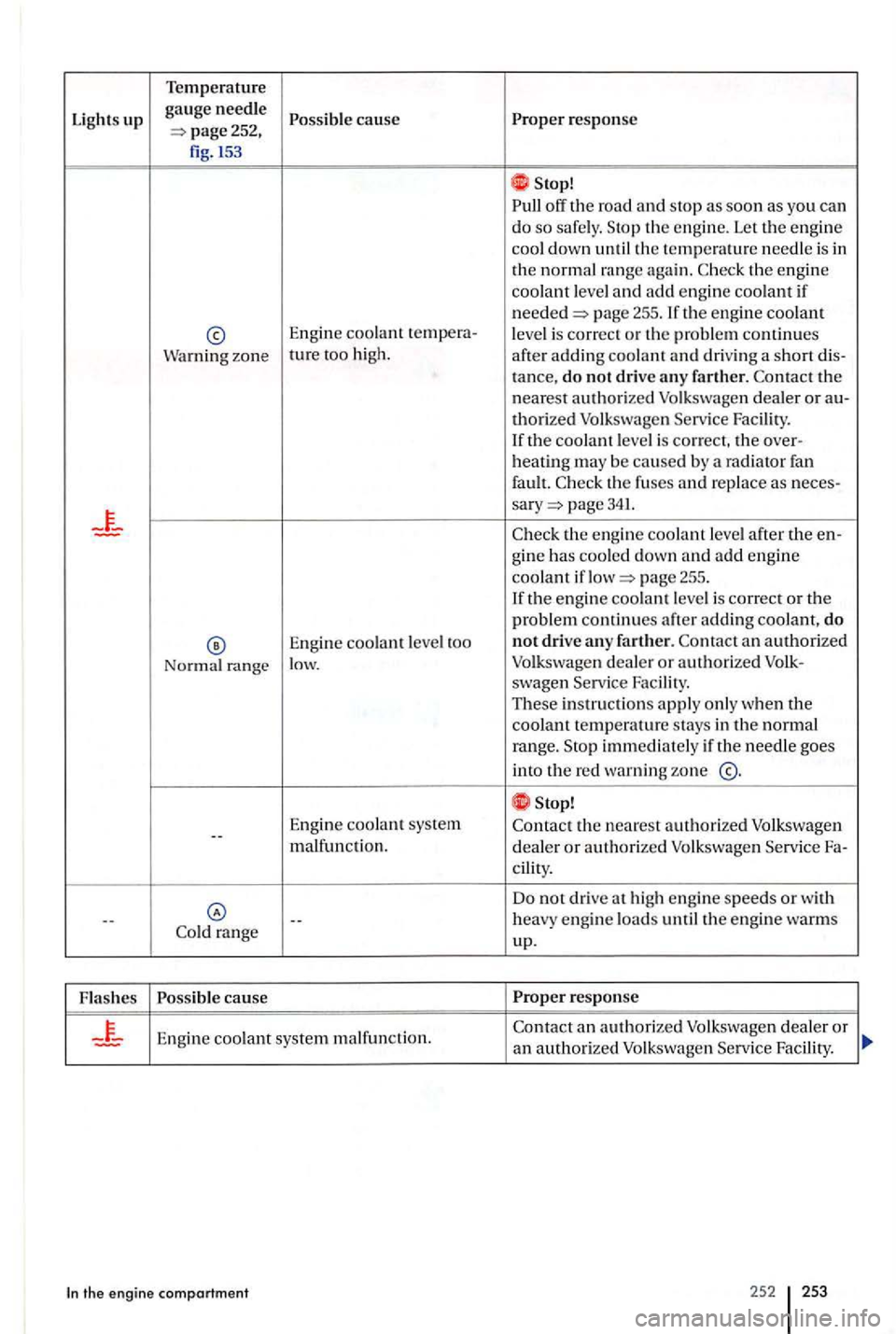
llow ing table explains w ha t t o do if th e en
gine coolant warn ing does no t go out a few secon ds after the engine is s tart ed or light s up or
s tart s fla sh ing while driving.
Page 250 of 541
Temperature
Lights up gauge needle response page252,
fig . 153
off the road and s top as soon as you can do so safely.
the engin e
coolant l eve l and add e ngine coolant if page 255. th e e ngin e coo lant E ng in e coolant tempera-
leve l is correc t o r the p roble m continues Warning zone l
u re too high. afte r addin g coo la nt and driv ing a sh ort tance, do not drive an y farther.
sary 341.
th e engin e coo la nt level after the en-
gine has coole d d own and add en gine
coolant i f page 255. the engine coo la nt leve l is correc t or tl1e problem continues after adding coolant, do
En gin e coolant leve l too not drive a ny farther.
Facility.
These in struction s apply only when the coolant temperature stays in the normal
rang e. immediately if the needle goes
in to
the red warning zone
Eng ine coo lant system the nearest authorized Volk swagen .. malfunction. dealer or authorized Volkswage n
Do not drive at hi gh en g in e s peeds or with heavy en g in e loads until the engine warm s
cause
Engi ne coo lant syste m malfun ction .
the engine compartment 252 253
Page 251 of 541
Failure to heed warnin g light s and instrument cluster text message s can cause the ve hicl e to break down in traffic and result in a and seriou s personal injury .
Never ignore warning light s or text I NGS.
Engine coolant specifications
introdu ctory information and heed th e on pag e 252.
The engi ne c ooling sys tem is fille d
p erce nt of Volk s wa gen engi ne coo lant additi ve G 12 plu s-plu s (TL-VW 774 G) o r G 12 plus (TL -VW F). Both of these engin e coola nt ti ve s are purple.
This mixtur e pro vides antif r eeze pro te ction down
to -13 a ls o he lps to pro tec t th e light
allo y pan s in th e eng in e coolin g sys te m against
corro sio n. In addit ion, the mi xture help s preve nt
c alcium dep os its and in creases the bo ilin g point of the e ng in e coola nt.
T o
protec t th e e ng in e, the mi xture must a lway s co nt ain nt le a st
mate conditions , th e perc entage of coola nt ti ve can be in cre ased. Howe ver, the coo la nt ti ve pe rc e n ta ge mu st never be m ore than oth erw ise , ant ifreeze prot ection is reduce d a nd
th e ability of the mi xture to coo l th e e ngine is als o
r educed.
Whe n addin g e ngine coolant, use a mixture of till ed water and at l ea st c o o la nt addit ive G 12 plu s- plu s for optimum co rro sion protection
Core, maintenanc e
Always stop the vehicl e as soon as it is saf e to do so.
Note
Failure to heed warning lights o r text can re s ult in veh icle damage.
Too little antifreeze protection in the en gin e coolin g syste m can cause eng in e failure and vere injuri es.
be used.
At extremely cold temperatures, the coolant could freeze, cau sin g the v ehicl e to brea k down. The heater would als o no t work, and ve hicl e cupants could be without protection at free zing temperatures.
Note
N eve r mix original Volkswagen engine coo lant additives with other additi ve s no t approved by
Volkswagen. Mixing Volkswage n coo la nt
facturers can serio usly damage th e engine and th e engi ne coolin g sys te m .
Eng in e coolant additive G 12 plus-plus can b e
m ixed with G 12 plus and G
If the fluid in th e e ngine coo lant res ervoir is any color but purple (s u ch
this is th e case, the gin e coolant mus t b e r epla ced immedi ate ly . envi se serious m alfun ction s or engine damage can occ ur!
E ng in e coolan t a nd engine c oo lant additi ves can pollute th e environm ent. le akin g opera ting a nd disp ose of th em in
acco rdance with appli cable e nvir o nm ent al la ws
a nd
Page 252 of 541
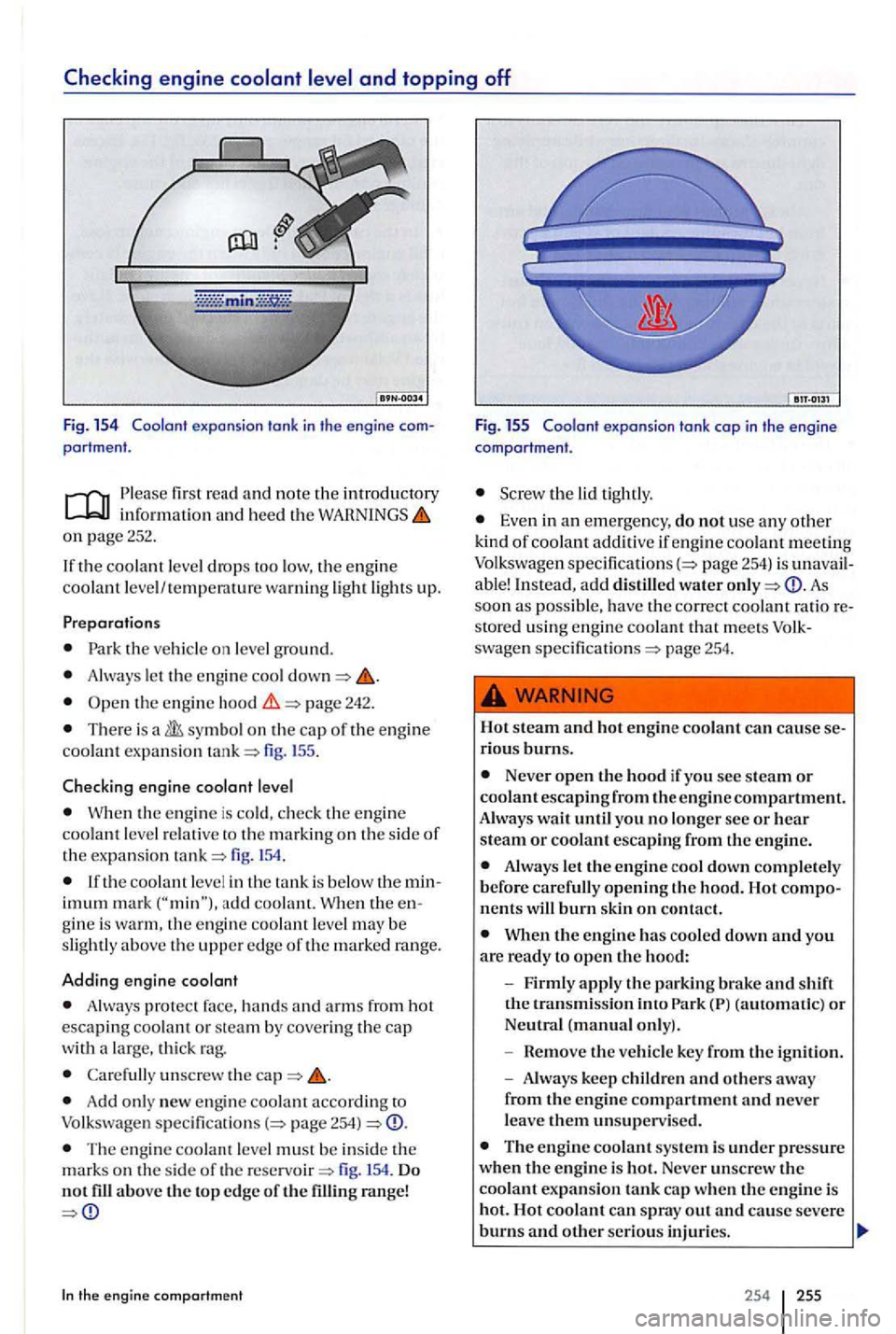
read and note the introductory
on page 252.
If th e coolant level drops too low, the engin e
coo lant level/ tempe ratur e warni ng ligh t lights up.
Park the ve hicl e on level ground.
Always let the engin e cool
th e engine hood
There is a fig.
When the eng in e is co ld, check the e ngine
coolant leve l relat ive to th e marking on th e sid e of th e expa nsio n tank fig. 154.
Always protec t face, hands and arms from h ot
escaping coo lant o r steam by cover ing the cap with a larg e, thi ck rag.
Carefully unsc rew the
Add new engine co olant ac co rding to Volkswagen specifications page 254)
Th e engi ne coo lant leve l must b e in sid e the mark s on the sid e of the 154. Do
not above top edge of the
the engine compartment
Fig. 155 Coolan t e xpans ion tank cap in the eng in e
compartment.
Screw the lid tightly.
Even in a n em erge ncy, do not use any other kind of coolant addi tive if eng ine coolant meeting
Volkswagen pa ge 254) is una v ail
able! Instead, add distilled water
page 254.
H
ot steam and hot engin e coo lant can cause se
rio us burns.
Never open the hood if yo u sec steam o r coolant esca ping from the engine compartment. Always wait until you no longer see or hear steam or coolant escapin g from the engine.
Always let the e ngin e cool down compl etel y
before carefully opening th e hood.
When the engin e has coo le d down and you are ready to open hood:
- F
irmly apply the parking brake and shift (automatic) o r Neutral (manual only).
- Hemov e
the vehicl e key from the ignition.
- Always keep c
hildren and others away from the en gin e compartment and never
leave them unsupervise d.
The engine coolant system is under pressure
w hen the engine is hot. Neve r unscrew the coolant expansion tank cap whe n the engine is hot. Hot coolant can spray out and ca use severe burns and other serious injuri es.
254 255
Page 253 of 541
-Turn the cap slowly and ve ry ca re full y in a
counte r- clo ckwise dir ect.ion whil e appl yin g light downwa rd pressure o n the top of th e cap.
-
Always prot ect your face, h ands, an d a rms
f ro m hot escaping co olant o r steam b y ering the ca p with a la rge, thick ra g.
Never spill fluid s on th e e ng in e o r exhaust
sys te m when refi lling . fluid s ont o ho t
p ar ts of the e ng ine or exhaust syste m can cause a fire. some conditio ns, the eth yle ne
g lycol in en gin e cool an t catc h fir e.
Note
di still ed wa te r onl y when adding coo lant! All othe r types of wa te r contain ch e m ica l pounds that can ca use exte nsive cor rosio n
damag e to the e ngin e. Th is can eve n lead to
ri zed Volkswa ge n deale r or an authorize d to have th e coo lant sys te m
d rai ned , flu sh ed , and refille d compl ete ly w ith the
p ro per co olant.
m aintenance
Note (co ntinue d !
Refill eng in e cool ant only up to th e to p edge o f the m arke d fill range=> p age 255, fig. 154 . Excess
e ng in e coolan t m ay be forced out of th e e ng in e
co olin g sys te m when it ge ts ho t and cau se
d am age.
engi ne coo lant o nl y wh en the e ng in e is coole d Sig n ifica nt engin e cool ant loss is a s ig n of leak s in the cooling sys te m. Have
th e e ng in e coo ling syste m ch ecke d immedi ate ly
b y a n authorize d Volkswage n deale r or an ri ze d Volkswage n
When ch an gin g o r top pin g off ope ratin g
fluid s, make sure tha t yo u pour the fluid s int o th e
correc t reservoi rs. ma lfunctio n s and gine da m age can result if yo u p ou r operating fluid s int o the wro ng
Page 294 of 541
Curb weight
The weight of a motor vehicle with
standard equipment including the
maximum capacity of fuel, oil, and
coolant, air conditioner, and addi
tional weight
of optional equip
ment.
Extra load tire
A tire designed to operate at higher
lo
ads and at higher inflation pres
sures than the corresponding stan
dard tire.
Gross Axle Weight Rating
(GAWR)
The load-carryin g capacity of a
single axle system, measured
where the tire contacts the ground.
Gross
The maximum loaded weight of
the vehicle.
Groove
The space between two adjacent
tread rib s.
Load rating (code)
The maximum load that a tir e is
rated to carry for a given inflation
pressure.
You may not find this in
formation on all tires because it is
not required by law.
Maximum load rating
The load rating for a tire at the
maximum permissible inflation
pressure for
that tire.
Maximum loaded vehicle weight
The total of:
Curb weight
Accessory weight
Vehicle capacity weight
Production options weight
Maximum (permissible) inflation
pressure
The maximum cold inflation
pressure
to whic h a tire may be
inflated.
Also ca lled
inflation
Normal occupant weight
Means 150 lbs (68 kilograms) times
the number of occupants seated in
the veh icle
up to the total seating
capacity
of your vehicle.
Occupant distribution
The placement of passengers in a
veh icle.
pounds or less.
Ply
A layer of rubber- coated parallel
cords.
Ply separation
A parting of rubber compound bet-
ween adjacent plies.
296 297
Page 318 of 541
Checklist (continued )
6. passengers exit and go to a safe locatio n
vehicl e keys with you when lea vin g yo ur ve hicl e.
8. up ale rt other m otoris ts and cycl is ts .
9. Let th e eng in e cool down and ge t ex pert ass is tance if necessary .
the emerge ncy flashers are on. use the turn sig nal lever to indicat e when the ve hicl e is bein g towe d. T his
t empo rarily interr upts th e wa rnin g fla sh ers.
Traffi c suddenl y slows down or s top s in front of you to wa rn those approaching fro m b ehind .
the of an em erge ncy.
the ve hicle brea ks dow n.
b ein g tow-s tarted or bei ng towed.
A lways obey traffic
that govern the use o f
e m erge ncy flash ers where you are driving.
th e em ergency flash e rs are not working . a fe rent method -as pe rmitt ed by law-must b e
used to alert othe r m otoris ts an d cycl is ts to the breakdown.
Di sregarding the sa fety-related ch ecklist may lead to accidents and serio us injuries.
A lway s review and th e c hecklist. safe ty prac tice s and use common sense.
Pract ical tips
Th e vehicl e ex hau st syst em and the ca tal ytic
co nverter or diesel pa rti cu late
Never park where parts of the hot ex haust sys te m or catalyti c converter could ignite mable materials, such as dry grass, brush ,
l eaves,
T he ve hicl e battery be drained if th e em ergency flas he rs are o n for a long tim e
To alert the traffi c behind you, th e brake light s o n some ve hicle s sta rt to fla sh if you
brake hard when traveling at a speed greate r about mph km /h ).
a t speeds around 6 mph
ating d eact iva tes th e e merge ncy flash ers.
To alert the tr affic behin d you, the ge ncy flashers on so me ve hicl es come on if you br ake hard w hen traveling at a speed greater than mph krn/h ). accele ratin g
o r continuing to drive at a speed above about25 mph km /h ), th e e merge ncy flashers