Page 1473 of 2000
SUSPENSION – REAR NO. 2 SUSPENSION ARMSP–47
SP
INSTALLATION
HINT:
• Use the same procedures for the RH side and LH side.
• The procedures listed below are for the LH side.
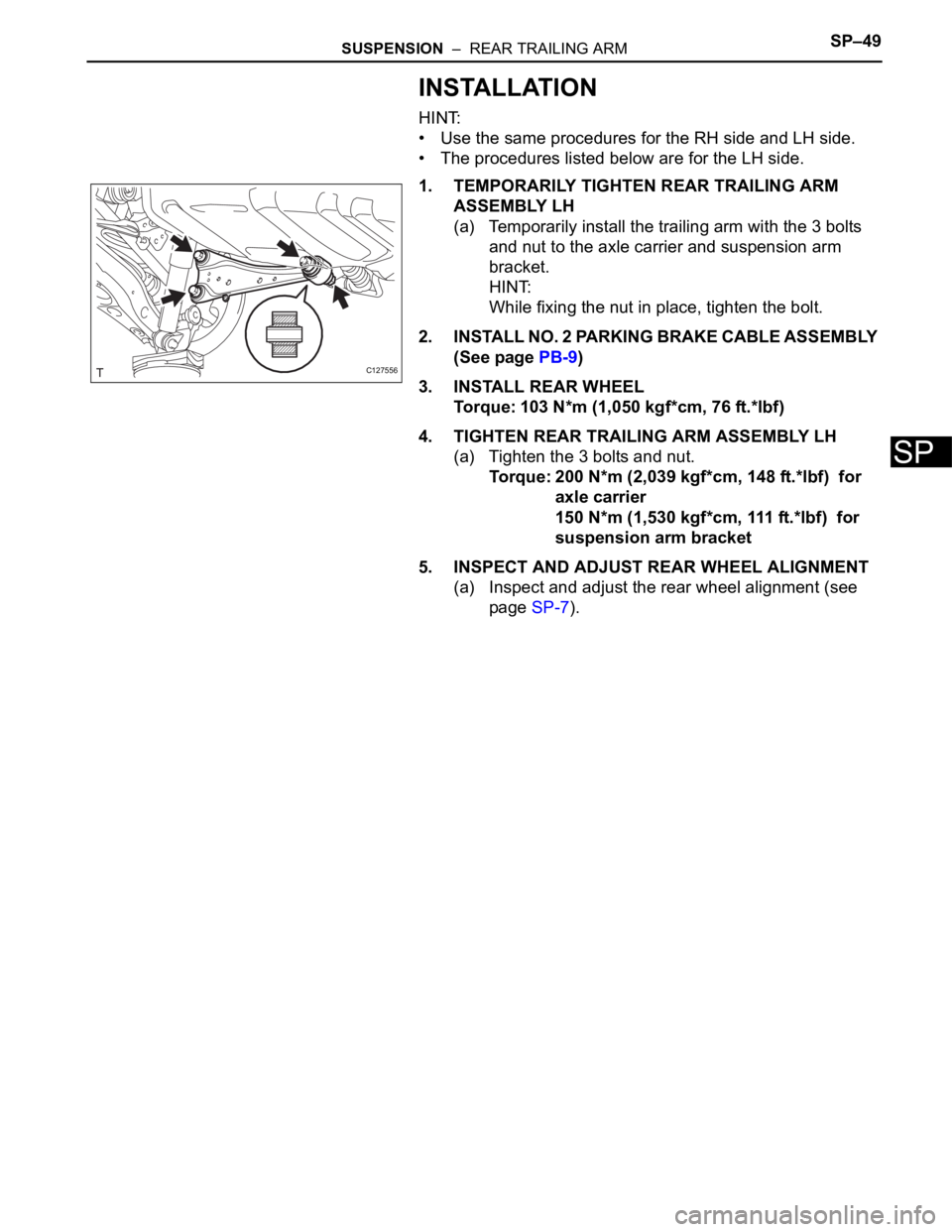
1. TEMPORARILY INSTALL REAR NO. 2 SUSPENSION
ARM ASSEMBLY LH
(a) Temporarily install the No. 2 suspension arm with
the bolt and nut to the suspension member.
2. INSTALL REAR COIL SPRING INSULATOR LOWER
LH (See page SP-34)
3. INSTALL REAR COIL SPRING LH (See page SP-34)
4. INSTALL REAR COIL SPRING INSULATOR UPPER
LH (See page SP-34)
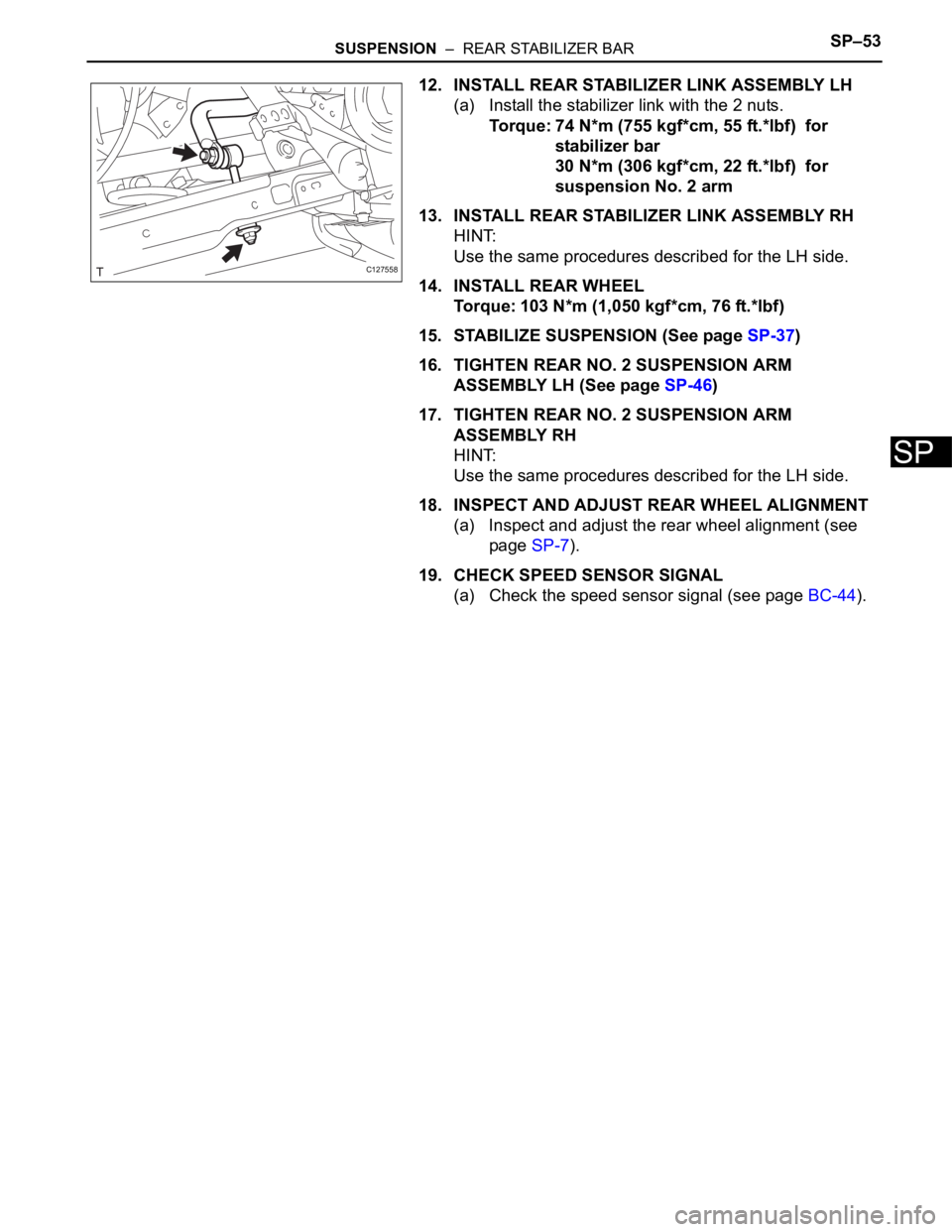
5. INSTALL REAR NO. 2 SUSPENSION ARM
ASSEMBLY LH
(a) Slowly raise the jack, and install the No. 2
suspension arm to the axle carrier.
NOTICE:
Install the arm so that the coil spring's
distinguishing mark is on the outer side of the
vehicle.
6. INSTALL REAR STABILIZER LINK ASSEMBLY LH
(See page SP-52)
7. CONNECT SKID CONTROL SENSOR WIRE (for 2WD)
(See page BC-198)
8. CONNECT REAR SPEED SENSOR LH (for 4WD) (See
page BC-205)
9. CONNECT NO. 2 PARKING BRAKE CABLE
ASSEMBLY (See page PB-8)
10. INSTALL REAR WHEEL
(a) Install the wheel.
Torque: 103 N*m (1,050 kgf*cm, 76 ft.*lbf)
11. STABILIZE SUSPENSION (See page SP-37)
12. TIGHTEN REAR NO. 2 SUSPENSION ARM
ASSEMBLY LH
(a) Install the 2 nuts and 2 bolts.
Torque: 90 N*m (918 kgf*cm, 66 ft.*lbf)
NOTICE:
Do not tighten the nuts.
13. INSPECT AND ADJUST REAR WHEEL ALIGNMENT
(a) Inspect and adjust the rear wheel alignment (see
page SP-7).
C127559
C129676E01
Page 1474 of 2000
SUSPENSION – REAR TRAILING ARMSP–49
SP
INSTALLATION
HINT:
• Use the same procedures for the RH side and LH side.
• The procedures listed below are for the LH side.
1. TEMPORARILY TIGHTEN REAR TRAILING ARM
ASSEMBLY LH
(a) Temporarily install the trailing arm with the 3 bolts
and nut to the axle carrier and suspension arm
bracket.
HINT:
While fixing the nut in place, tighten the bolt.
2. INSTALL NO. 2 PARKING BRAKE CABLE ASSEMBLY
(See page PB-9)
3. INSTALL REAR WHEEL
Torque: 103 N*m (1,050 kgf*cm, 76 ft.*lbf)
4. TIGHTEN REAR TRAILING ARM ASSEMBLY LH
(a) Tighten the 3 bolts and nut.
Torque: 200 N*m (2,039 kgf*cm, 148 ft.*lbf) for
axle carrier
150 N*m (1,530 kgf*cm, 111 ft.*lbf) for
suspension arm bracket
5. INSPECT AND ADJUST REAR WHEEL ALIGNMENT
(a) Inspect and adjust the rear wheel alignment (see
page SP-7).
C127556
Page 1477 of 2000
SUSPENSION – REAR STABILIZER BARSP–53
SP
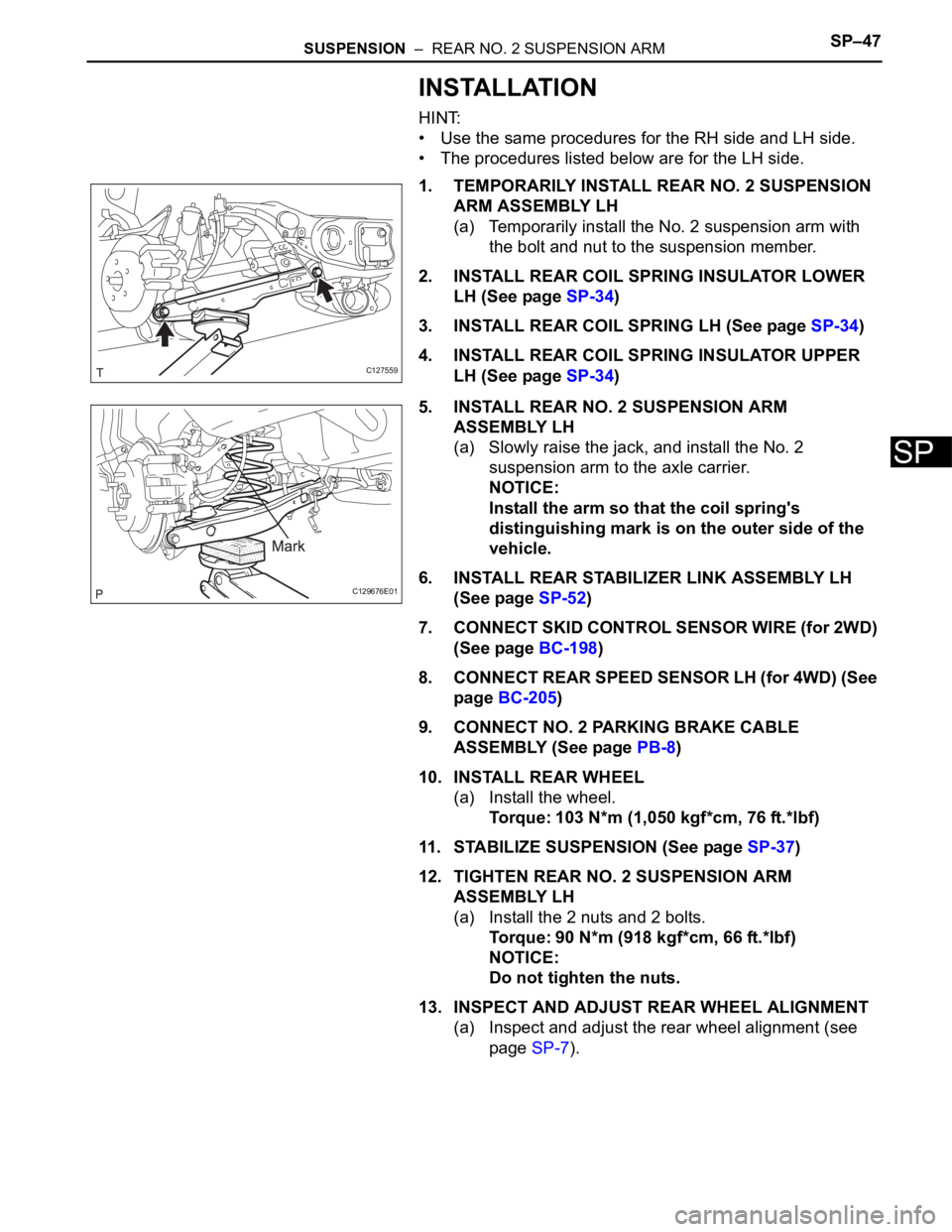
12. INSTALL REAR STABILIZER LINK ASSEMBLY LH
(a) Install the stabilizer link with the 2 nuts.
Torque: 74 N*m (755 kgf*cm, 55 ft.*lbf) for
stabilizer bar
30 N*m (306 kgf*cm, 22 ft.*lbf) for
suspension No. 2 arm
13. INSTALL REAR STABILIZER LINK ASSEMBLY RH
HINT:
Use the same procedures described for the LH side.
14. INSTALL REAR WHEEL
Torque: 103 N*m (1,050 kgf*cm, 76 ft.*lbf)
15. STABILIZE SUSPENSION (See page SP-37)
16. TIGHTEN REAR NO. 2 SUSPENSION ARM
ASSEMBLY LH (See page SP-46)
17. TIGHTEN REAR NO. 2 SUSPENSION ARM
ASSEMBLY RH
HINT:
Use the same procedures described for the LH side.
18. INSPECT AND ADJUST REAR WHEEL ALIGNMENT
(a) Inspect and adjust the rear wheel alignment (see
page SP-7).
19. CHECK SPEED SENSOR SIGNAL
(a) Check the speed sensor signal (see page BC-44).
C127558
Page 1529 of 2000
BC–26BRAKE CONTROL – VEHICLE STABILITY CONTROL SYSTEM
BC
CALIBRATION
1. DESCRIPTION
(a) After replacing components relating to the VSC or
performing "Front wheel alignment adjustment",
clear and read the sensor calibration data.
(b) Follow the chart to perform calibration.
2. CLEAR ZERO POINT CALIBRATION DATA (When
Using Intelligent Tester)
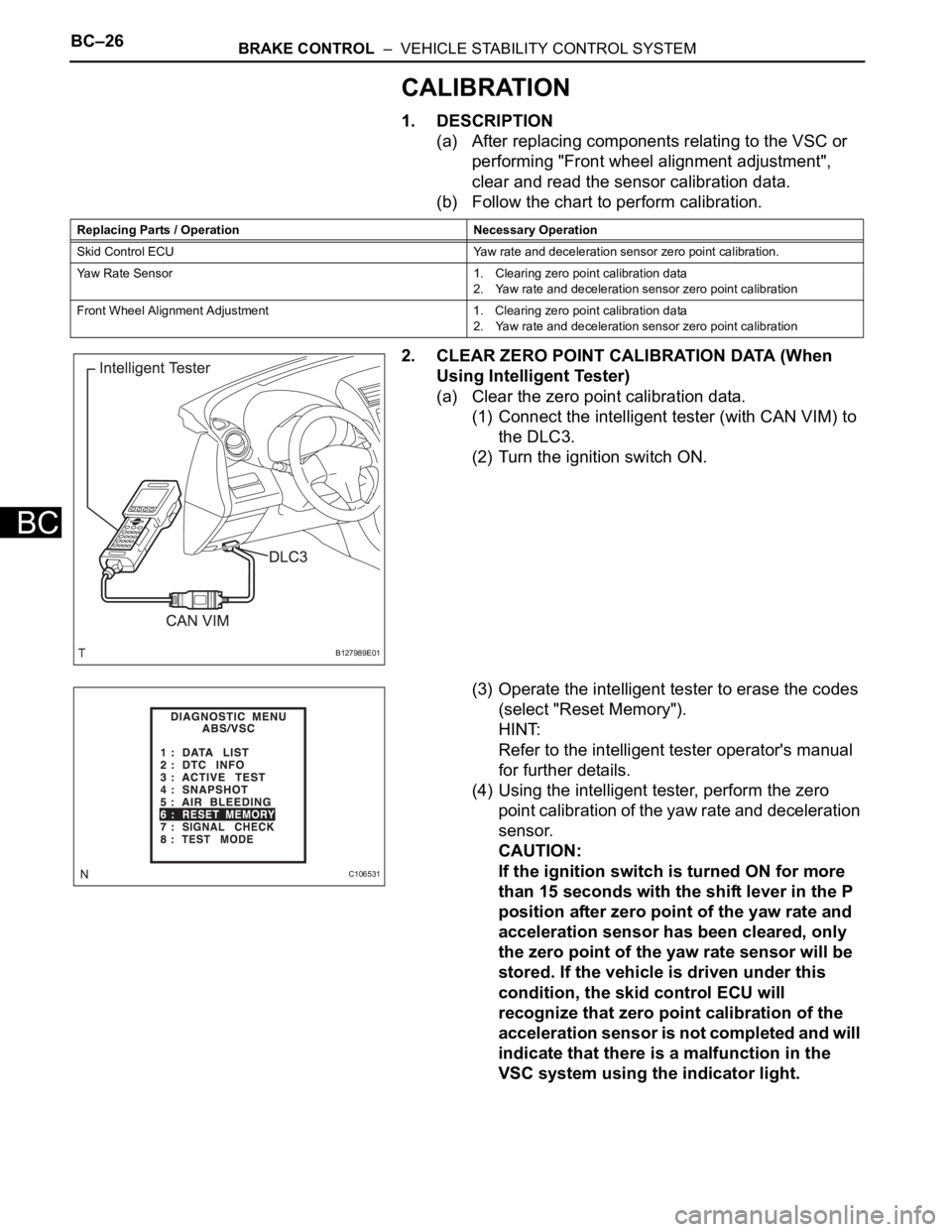
(a) Clear the zero point calibration data.
(1) Connect the intelligent tester (with CAN VIM) to
the DLC3.
(2) Turn the ignition switch ON.
(3) Operate the intelligent tester to erase the codes
(select "Reset Memory").
HINT:
Refer to the intelligent tester operator's manual
for further details.
(4) Using the intelligent tester, perform the zero
point calibration of the yaw rate and deceleration
sensor.
CAUTION:
If the ignition switch is turned ON for more
than 15 seconds with the shift lever in the P
position after zero point of the yaw rate and
acceleration sensor has been cleared, only
the zero point of the yaw rate sensor will be
stored. If the vehicle is driven under this
condition, the skid control ECU will
recognize that zero point calibration of the
acceleration sensor is not completed and will
indicate that there is a malfunction in the
VSC system using the indicator light.
Replacing Parts / Operation Necessary Operation
Skid Control ECU Yaw rate and deceleration sensor zero point calibration.
Yaw Rate Sensor 1. Clearing zero point calibration data
2. Yaw rate and deceleration sensor zero point calibration
Front Wheel Alignment Adjustment 1. Clearing zero point calibration data
2. Yaw rate and deceleration sensor zero point calibration
B127989E01
C106531
Page 1608 of 2000
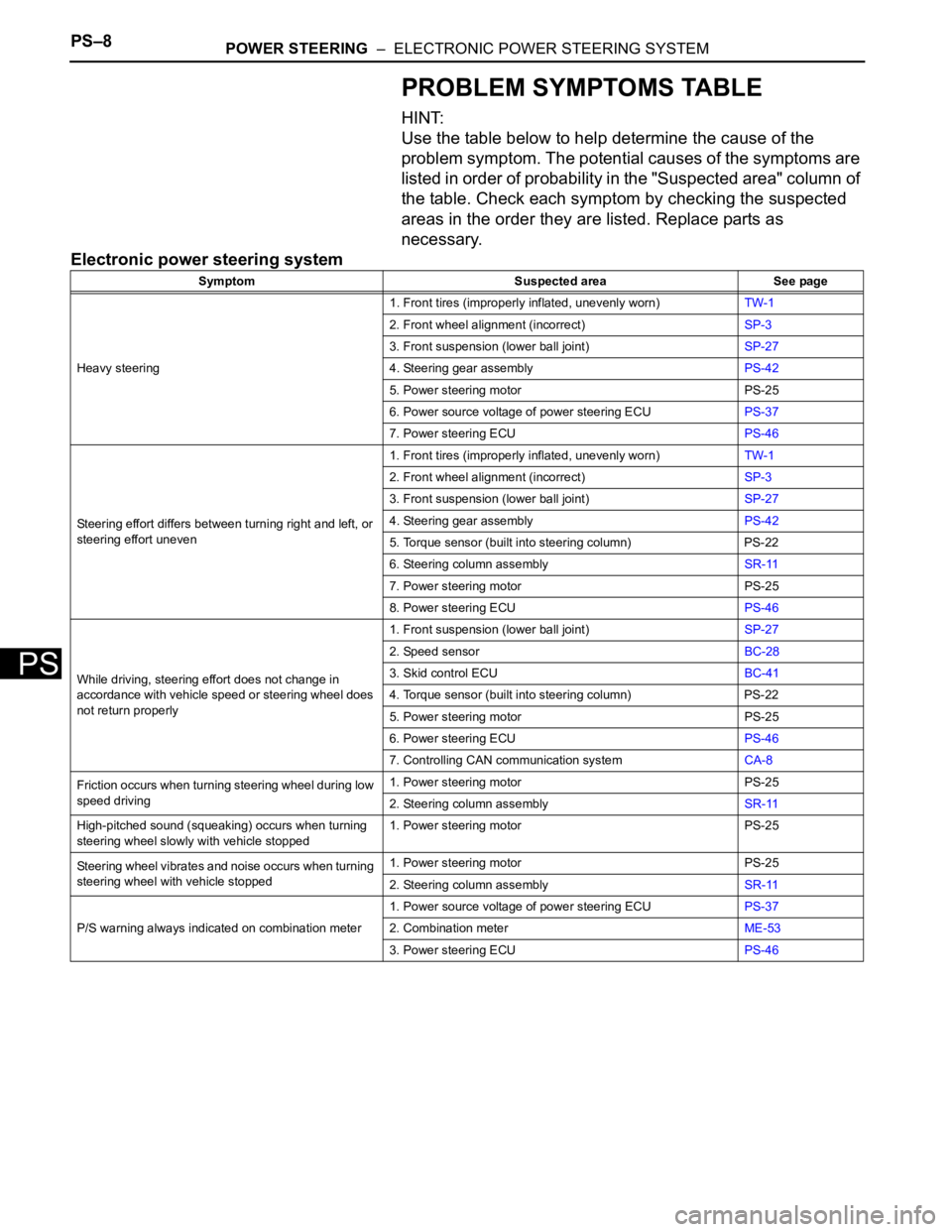
PS–8POWER STEERING – ELECTRONIC POWER STEERING SYSTEM
PS
PROBLEM SYMPTOMS TABLE
HINT:
Use the table below to help determine the cause of the
problem symptom. The potential causes of the symptoms are
listed in order of probability in the "Suspected area" column of
the table. Check each symptom by checking the suspected
areas in the order they are listed. Replace parts as
necessary.
Electronic power steering system
Symptom Suspected area See page
Heavy steering1. Front tires (improperly inflated, unevenly worn)TW-1
2. Front wheel alignment (incorrect)SP-3
3. Front suspension (lower ball joint)SP-27
4. Steering gear assemblyPS-42
5. Power steering motor PS-25
6. Power source voltage of power steering ECUPS-37
7. Power steering ECUPS-46
Steering effort differs between turning right and left, or
steering effort uneven1. Front tires (improperly inflated, unevenly worn)TW-1
2. Front wheel alignment (incorrect)SP-3
3. Front suspension (lower ball joint)SP-27
4. Steering gear assemblyPS-42
5. Torque sensor (built into steering column) PS-22
6. Steering column assemblySR-11
7. Power steering motor PS-25
8. Power steering ECUPS-46
While driving, steering effort does not change in
accordance with vehicle speed or steering wheel does
not return properly1. Front suspension (lower ball joint)SP-27
2. Speed sensorBC-28
3. Skid control ECUBC-41
4. Torque sensor (built into steering column) PS-22
5. Power steering motor PS-25
6. Power steering ECUPS-46
7. Controlling CAN communication systemCA-8
Friction occurs when turning steering wheel during low
speed driving1. Power steering motor PS-25
2. Steering column assemblySR-11
High-pitched sound (squeaking) occurs when turning
steering wheel slowly with vehicle stopped1. Power steering motor PS-25
Steering wheel vibrates and noise occurs when turning
steering wheel with vehicle stopped1. Power steering motor PS-25
2. Steering column assemblySR-11
P/S warning always indicated on combination meter1. Power source voltage of power steering ECUPS-37
2. Combination meterME-53
3. Power steering ECUPS-46
Page:
< prev 1-8 9-16 17-24