Page 711 of 2000
EM–742GR-FE ENGINE MECHANICAL – ENGINE UNIT
EM
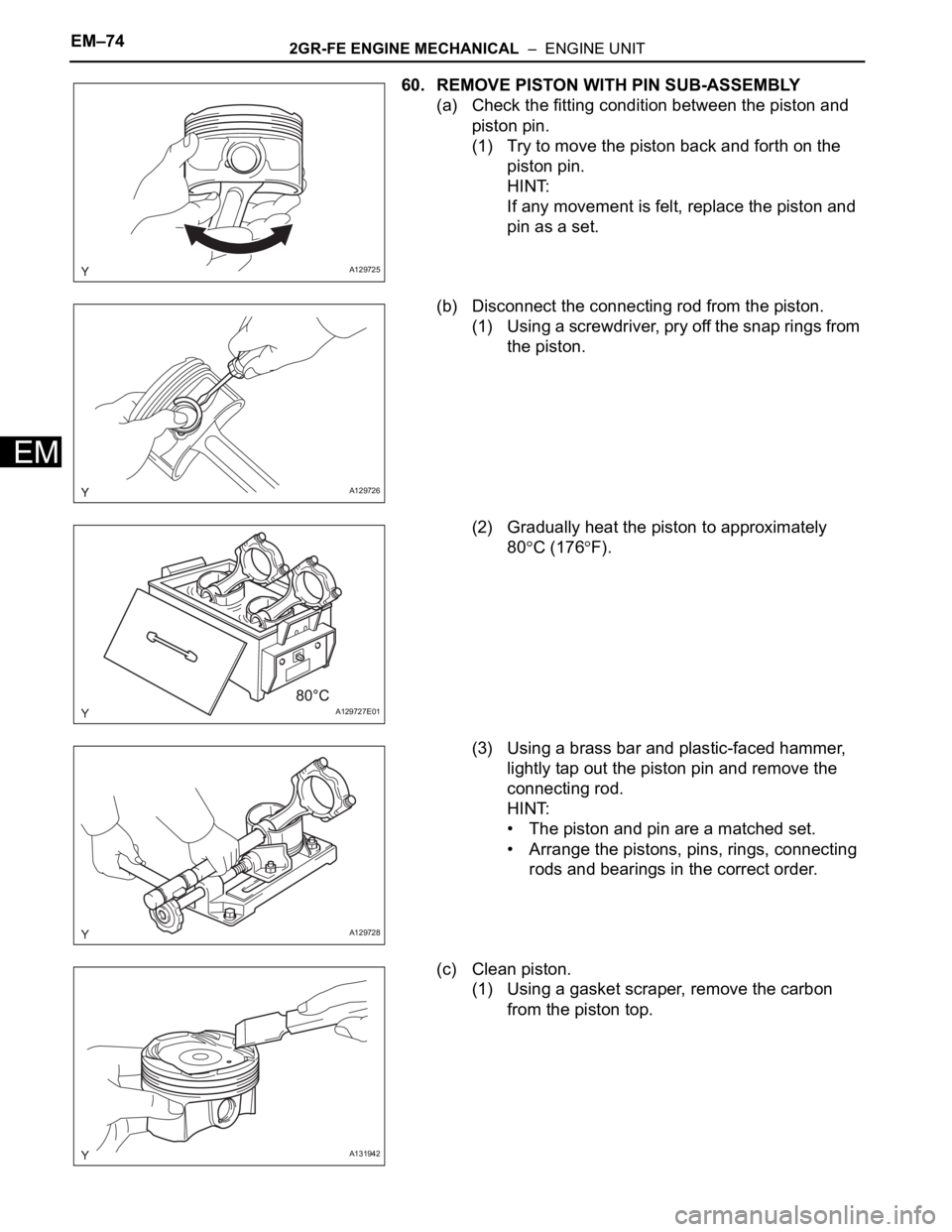
60. REMOVE PISTON WITH PIN SUB-ASSEMBLY
(a) Check the fitting condition between the piston and
piston pin.
(1) Try to move the piston back and forth on the
piston pin.
HINT:
If any movement is felt, replace the piston and
pin as a set.
(b) Disconnect the connecting rod from the piston.
(1) Using a screwdriver, pry off the snap rings from
the piston.
(2) Gradually heat the piston to approximately
80
C (176F).
(3) Using a brass bar and plastic-faced hammer,
lightly tap out the piston pin and remove the
connecting rod.
HINT:
• The piston and pin are a matched set.
• Arrange the pistons, pins, rings, connecting
rods and bearings in the correct order.
(c) Clean piston.
(1) Using a gasket scraper, remove the carbon
from the piston top.
A129725
A129726
A129727E01
A129728
A131942
Page 714 of 2000
2GR-FE ENGINE MECHANICAL – ENGINE UNITEM–77
EM
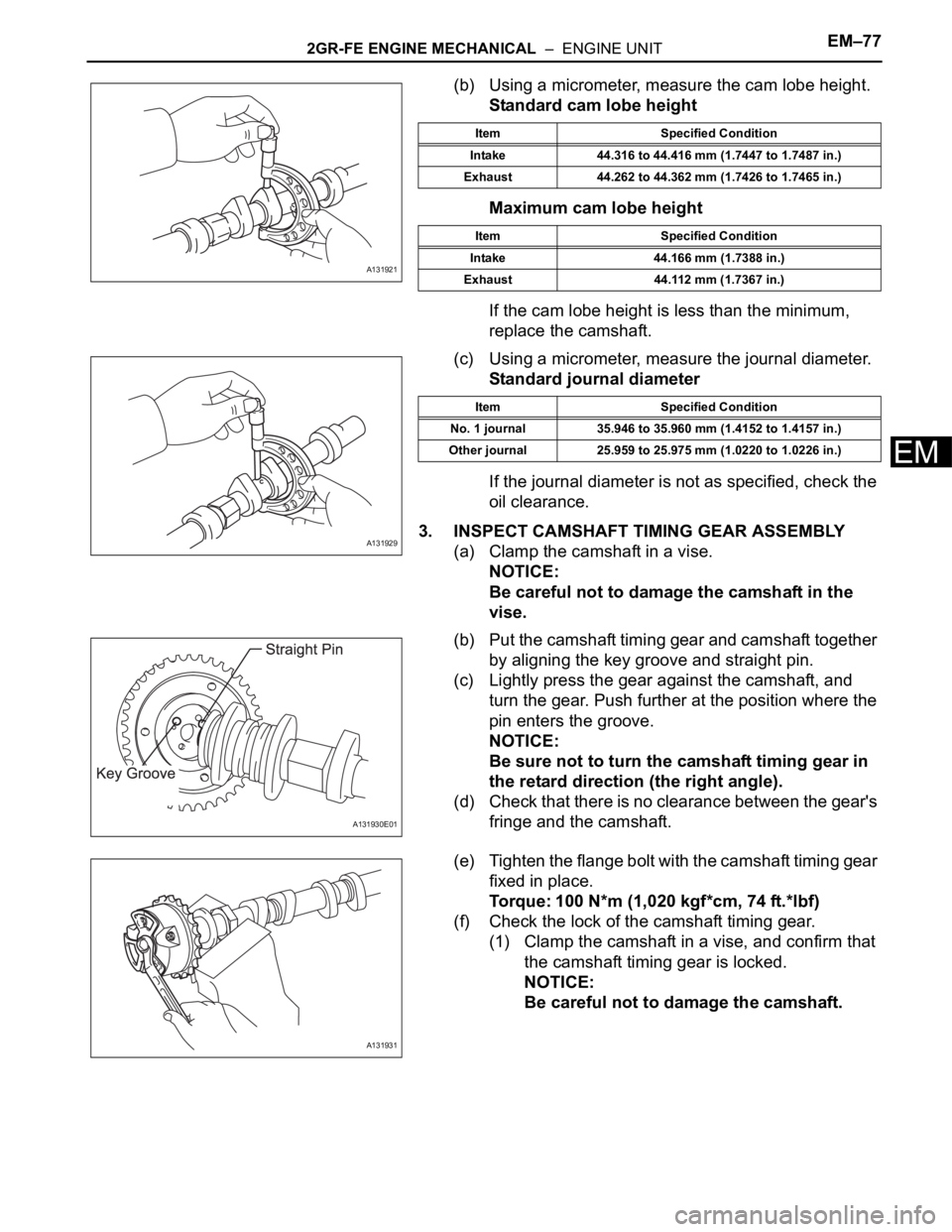
(b) Using a micrometer, measure the cam lobe height.
Standard cam lobe height
Maximum cam lobe height
If the cam lobe height is less than the minimum,
replace the camshaft.
(c) Using a micrometer, measure the journal diameter.
Standard journal diameter
If the journal diameter is not as specified, check the
oil clearance.
3. INSPECT CAMSHAFT TIMING GEAR ASSEMBLY
(a) Clamp the camshaft in a vise.
NOTICE:
Be careful not to damage the camshaft in the
vise.
(b) Put the camshaft timing gear and camshaft together
by aligning the key groove and straight pin.
(c) Lightly press the gear against the camshaft, and
turn the gear. Push further at the position where the
pin enters the groove.
NOTICE:
Be sure not to turn the camshaft timing gear in
the retard direction (the right angle).
(d) Check that there is no clearance between the gear's
fringe and the camshaft.
(e) Tighten the flange bolt with the camshaft timing gear
fixed in place.
Torque: 100 N*m (1,020 kgf*cm, 74 ft.*lbf)
(f) Check the lock of the camshaft timing gear.
(1) Clamp the camshaft in a vise, and confirm that
the camshaft timing gear is locked.
NOTICE:
Be careful not to damage the camshaft.
A131921
Item Specified Condition
Intake 44.316 to 44.416 mm (1.7447 to 1.7487 in.)
Exhaust 44.262 to 44.362 mm (1.7426 to 1.7465 in.)
Item Specified Condition
Intake 44.166 mm (1.7388 in.)
Exhaust 44.112 mm (1.7367 in.)
A131929
Item Specified Condition
No. 1 journal 35.946 to 35.960 mm (1.4152 to 1.4157 in.)
Other journal 25.959 to 25.975 mm (1.0220 to 1.0226 in.)
A131930E01
A131931
Page 716 of 2000
2GR-FE ENGINE MECHANICAL – ENGINE UNITEM–79
EM
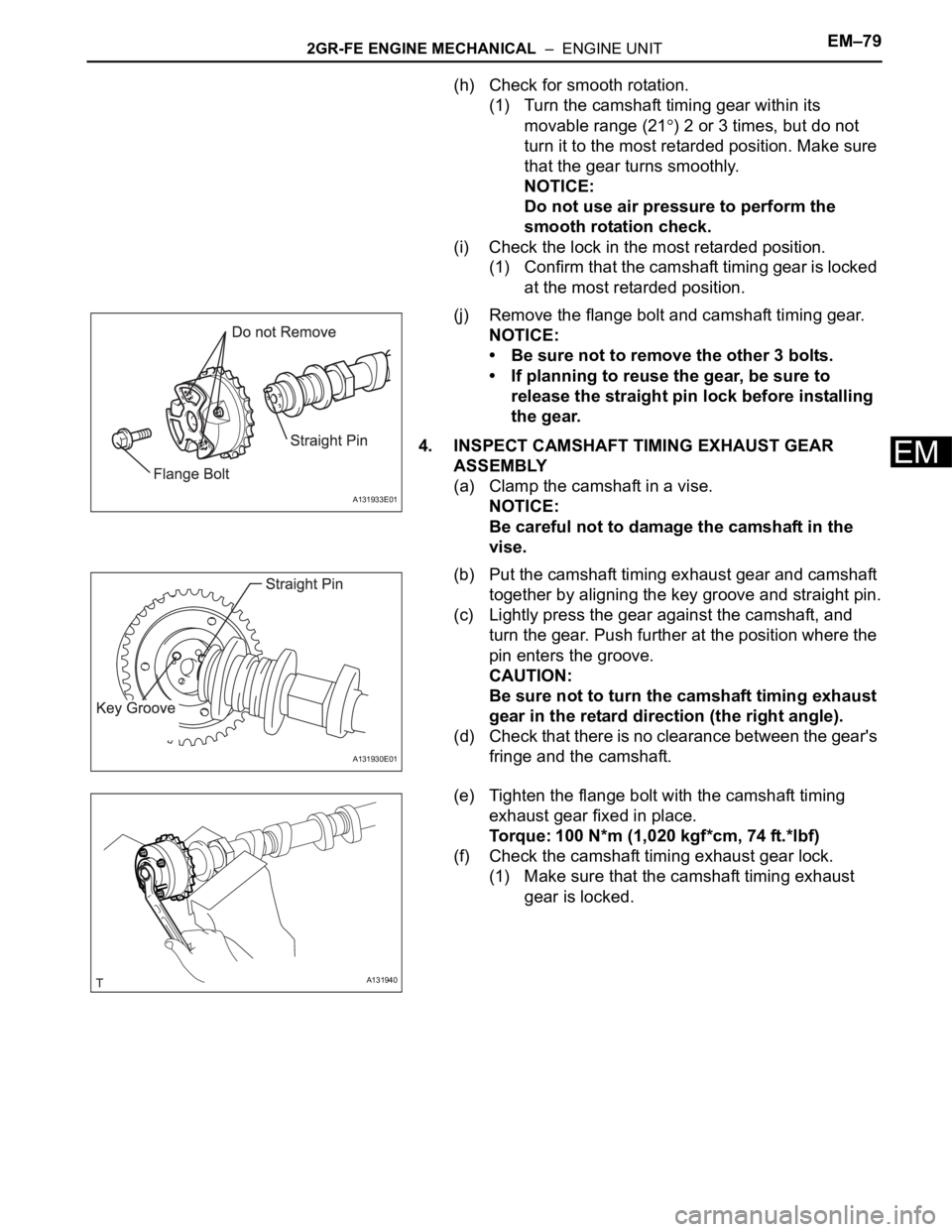
(h) Check for smooth rotation.
(1) Turn the camshaft timing gear within its
movable range (21
) 2 or 3 times, but do not
turn it to the most retarded position. Make sure
that the gear turns smoothly.
NOTICE:
Do not use air pressure to perform the
smooth rotation check.
(i) Check the lock in the most retarded position.
(1) Confirm that the camshaft timing gear is locked
at the most retarded position.
(j) Remove the flange bolt and camshaft timing gear.
NOTICE:
• Be sure not to remove the other 3 bolts.
• If planning to reuse the gear, be sure to
release the straight pin lock before installing
the gear.
4. INSPECT CAMSHAFT TIMING EXHAUST GEAR
ASSEMBLY
(a) Clamp the camshaft in a vise.
NOTICE:
Be careful not to damage the camshaft in the
vise.
(b) Put the camshaft timing exhaust gear and camshaft
together by aligning the key groove and straight pin.
(c) Lightly press the gear against the camshaft, and
turn the gear. Push further at the position where the
pin enters the groove.
CAUTION:
Be sure not to turn the camshaft timing exhaust
gear in the retard direction (the right angle).
(d) Check that there is no clearance between the gear's
fringe and the camshaft.
(e) Tighten the flange bolt with the camshaft timing
exhaust gear fixed in place.
Torque: 100 N*m (1,020 kgf*cm, 74 ft.*lbf)
(f) Check the camshaft timing exhaust gear lock.
(1) Make sure that the camshaft timing exhaust
gear is locked.
A131933E01
A131930E01
A131940
Page 724 of 2000
2GR-FE ENGINE MECHANICAL – ENGINE UNITEM–87
EM
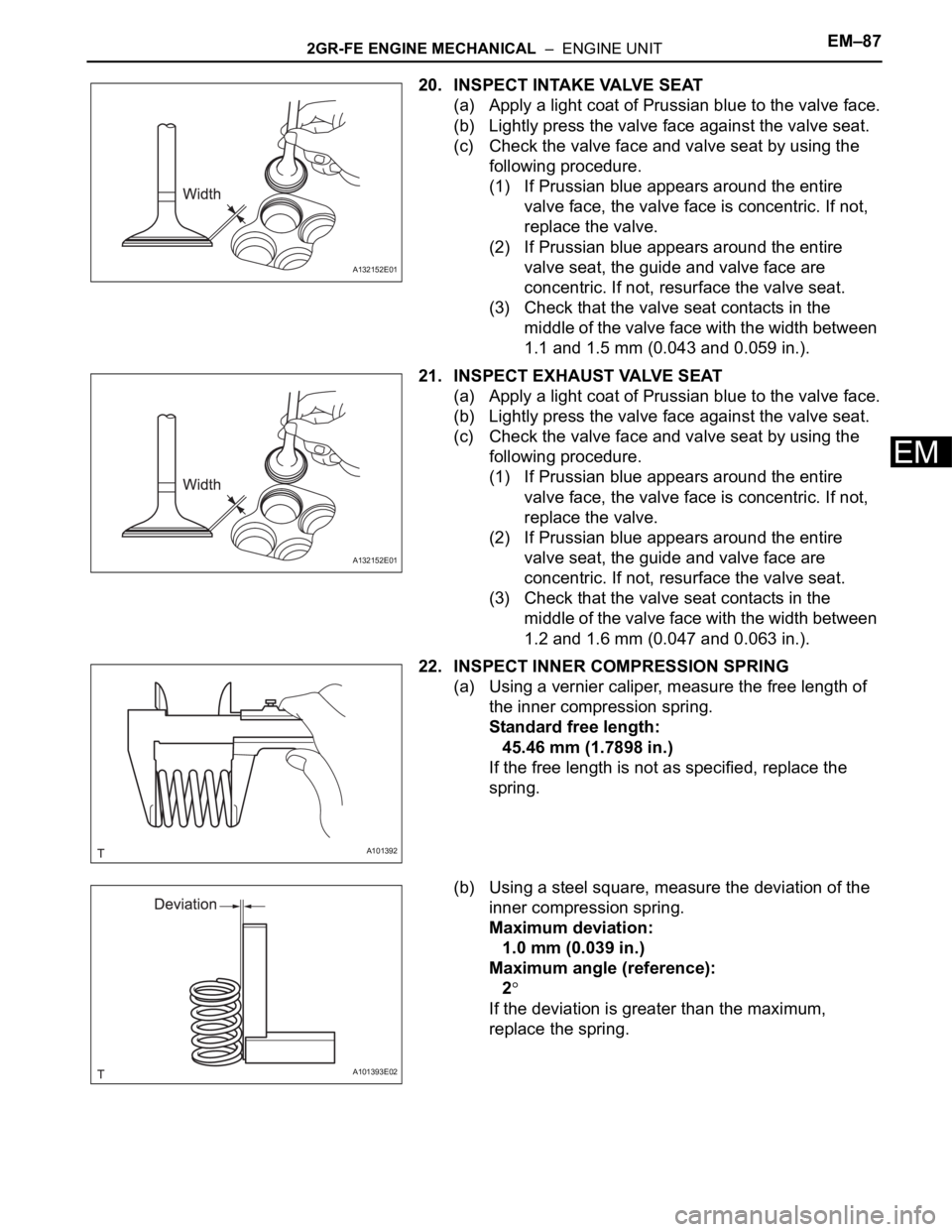
20. INSPECT INTAKE VALVE SEAT
(a) Apply a light coat of Prussian blue to the valve face.
(b) Lightly press the valve face against the valve seat.
(c) Check the valve face and valve seat by using the
following procedure.
(1) If Prussian blue appears around the entire
valve face, the valve face is concentric. If not,
replace the valve.
(2) If Prussian blue appears around the entire
valve seat, the guide and valve face are
concentric. If not, resurface the valve seat.
(3) Check that the valve seat contacts in the
middle of the valve face with the width between
1.1 and 1.5 mm (0.043 and 0.059 in.).
21. INSPECT EXHAUST VALVE SEAT
(a) Apply a light coat of Prussian blue to the valve face.
(b) Lightly press the valve face against the valve seat.
(c) Check the valve face and valve seat by using the
following procedure.
(1) If Prussian blue appears around the entire
valve face, the valve face is concentric. If not,
replace the valve.
(2) If Prussian blue appears around the entire
valve seat, the guide and valve face are
concentric. If not, resurface the valve seat.
(3) Check that the valve seat contacts in the
middle of the valve face with the width between
1.2 and 1.6 mm (0.047 and 0.063 in.).
22. INSPECT INNER COMPRESSION SPRING
(a) Using a vernier caliper, measure the free length of
the inner compression spring.
Standard free length:
45.46 mm (1.7898 in.)
If the free length is not as specified, replace the
spring.
(b) Using a steel square, measure the deviation of the
inner compression spring.
Maximum deviation:
1.0 mm (0.039 in.)
Maximum angle (reference):
2
If the deviation is greater than the maximum,
replace the spring.
A132152E01
A132152E01
A101392
A101393E02
Page 749 of 2000
EM–1122GR-FE ENGINE MECHANICAL – ENGINE UNIT
EM
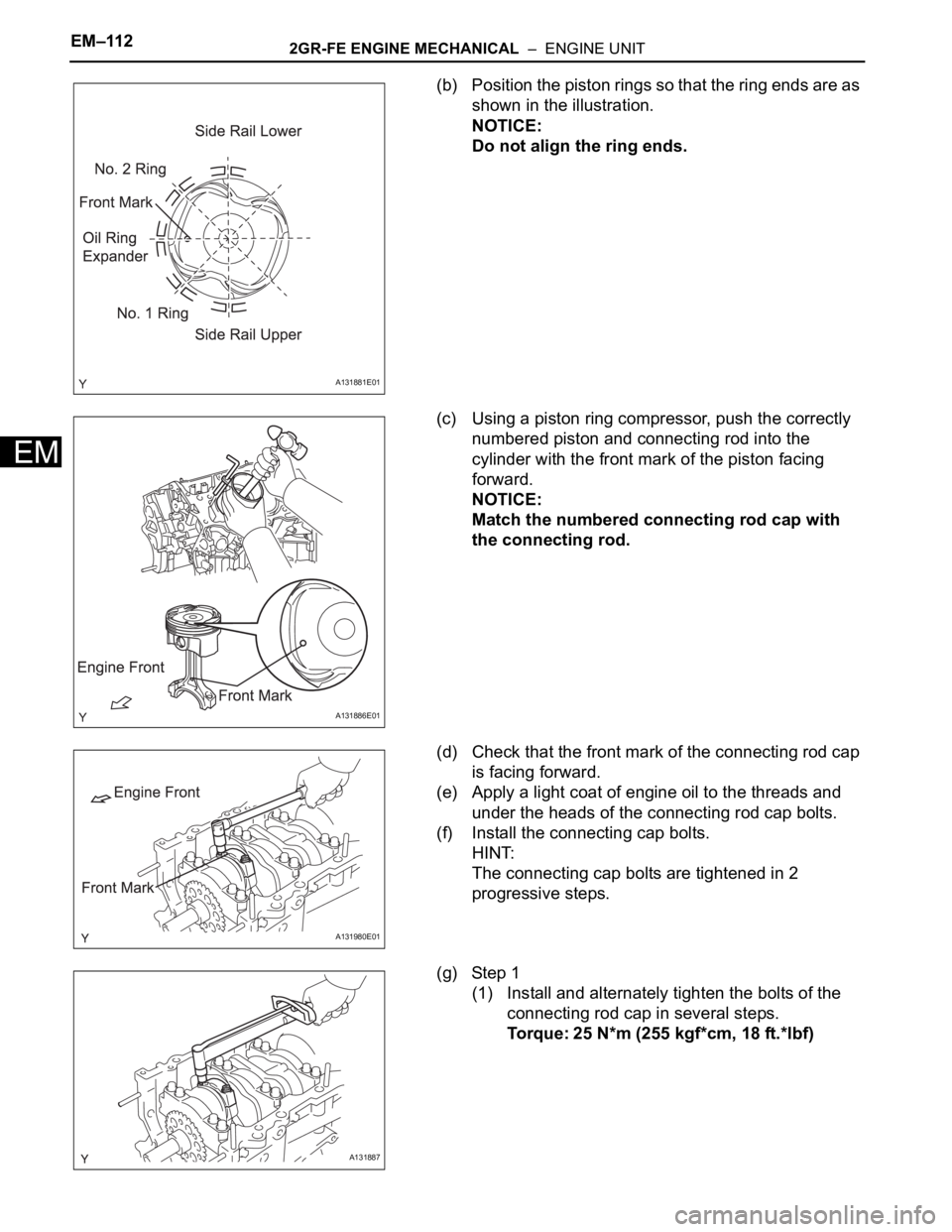
(b) Position the piston rings so that the ring ends are as
shown in the illustration.
NOTICE:
Do not align the ring ends.
(c) Using a piston ring compressor, push the correctly
numbered piston and connecting rod into the
cylinder with the front mark of the piston facing
forward.
NOTICE:
Match the numbered connecting rod cap with
the connecting rod.
(d) Check that the front mark of the connecting rod cap
is facing forward.
(e) Apply a light coat of engine oil to the threads and
under the heads of the connecting rod cap bolts.
(f) Install the connecting cap bolts.
HINT:
The connecting cap bolts are tightened in 2
progressive steps.
(g) Step 1
(1) Install and alternately tighten the bolts of the
connecting rod cap in several steps.
Torque: 25 N*m (255 kgf*cm, 18 ft.*lbf)
A131881E01
A131886E01
A131980E01
A131887
Page 753 of 2000
EM–1162GR-FE ENGINE MECHANICAL – ENGINE UNIT
EM
17. INSTALL WATER INLET PIPE
(a) Install the water inlet pipe with the 2 bolts.
Torque: 10 N*m (102 kgf*cm, 7 ft.*lbf)
(b) Install the water by-pass hose.
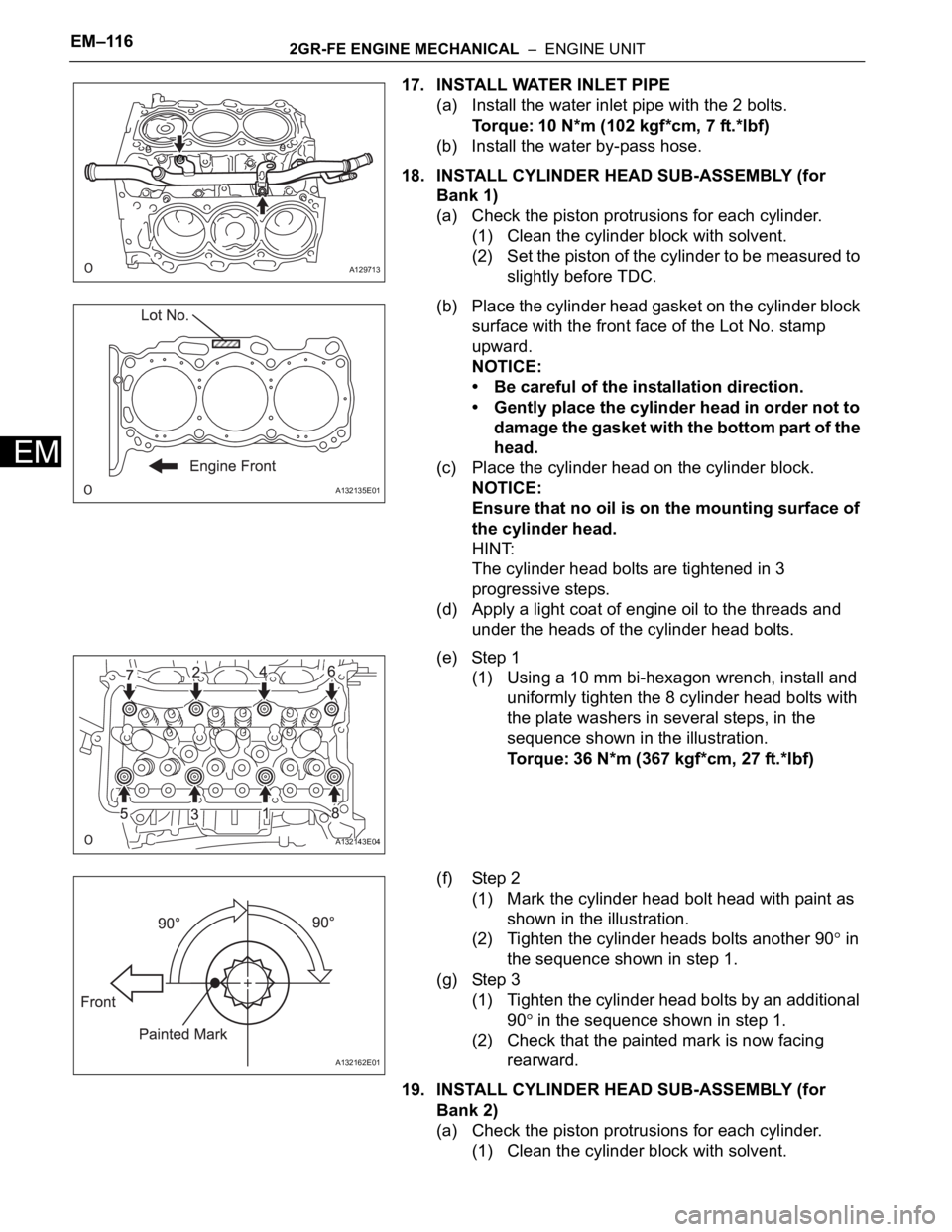
18. INSTALL CYLINDER HEAD SUB-ASSEMBLY (for
Bank 1)
(a) Check the piston protrusions for each cylinder.
(1) Clean the cylinder block with solvent.
(2) Set the piston of the cylinder to be measured to
slightly before TDC.
(b) Place the cylinder head gasket on the cylinder block
surface with the front face of the Lot No. stamp
upward.
NOTICE:
• Be careful of the installation direction.
• Gently place the cylinder head in order not to
damage the gasket with the bottom part of the
head.
(c) Place the cylinder head on the cylinder block.
NOTICE:
Ensure that no oil is on the mounting surface of
the cylinder head.
HINT:
The cylinder head bolts are tightened in 3
progressive steps.
(d) Apply a light coat of engine oil to the threads and
under the heads of the cylinder head bolts.
(e) Step 1
(1) Using a 10 mm bi-hexagon wrench, install and
uniformly tighten the 8 cylinder head bolts with
the plate washers in several steps, in the
sequence shown in the illustration.
Torque: 36 N*m (367 kgf*cm, 27 ft.*lbf)
(f) Step 2
(1) Mark the cylinder head bolt head with paint as
shown in the illustration.
(2) Tighten the cylinder heads bolts another 90
in
the sequence shown in step 1.
(g) Step 3
(1) Tighten the cylinder head bolts by an additional
90
in the sequence shown in step 1.
(2) Check that the painted mark is now facing
rearward.
19. INSTALL CYLINDER HEAD SUB-ASSEMBLY (for
Bank 2)
(a) Check the piston protrusions for each cylinder.
(1) Clean the cylinder block with solvent.
A129713
A132135E01
A132143E04
A132162E01
Page 754 of 2000
2GR-FE ENGINE MECHANICAL – ENGINE UNITEM–117
EM
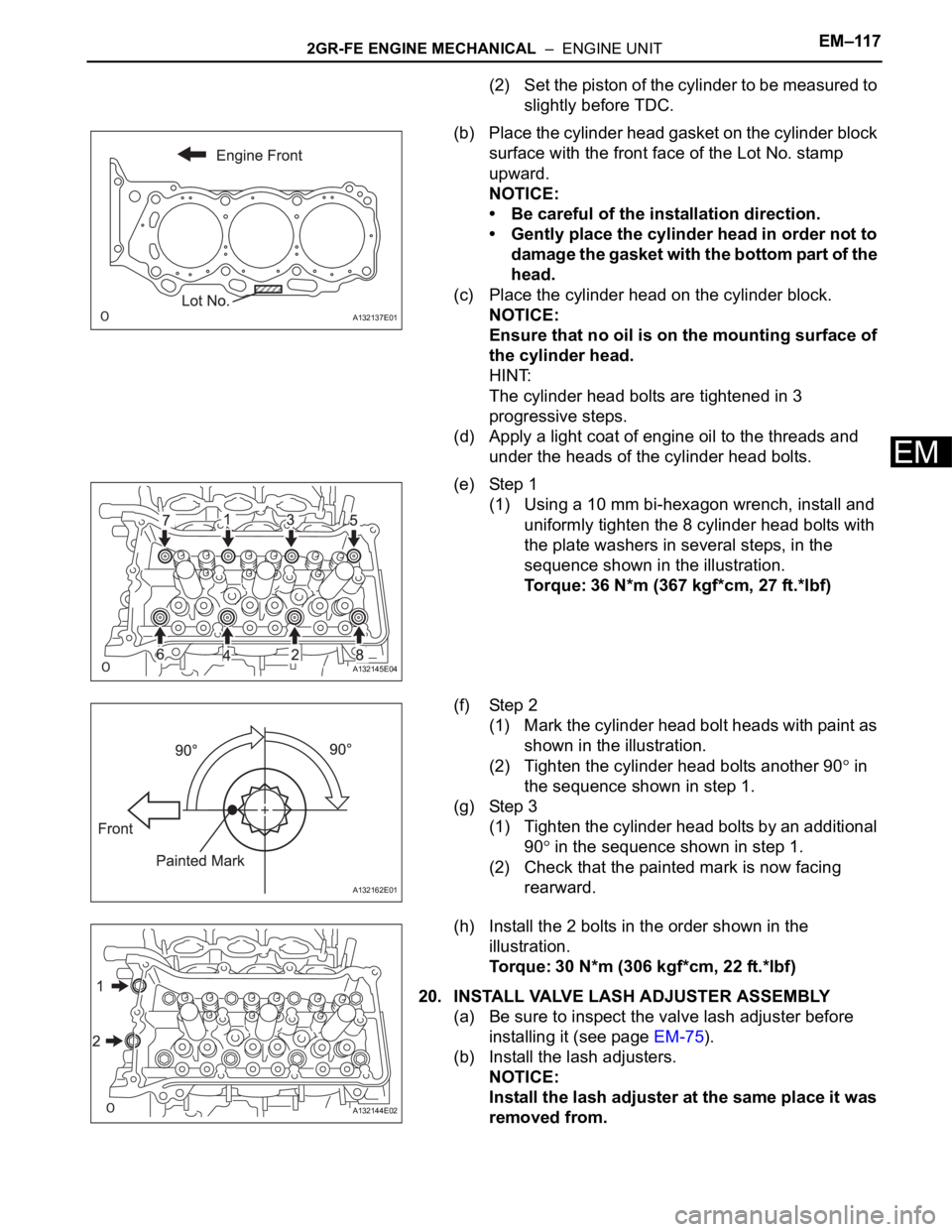
(2) Set the piston of the cylinder to be measured to
slightly before TDC.
(b) Place the cylinder head gasket on the cylinder block
surface with the front face of the Lot No. stamp
upward.
NOTICE:
• Be careful of the installation direction.
• Gently place the cylinder head in order not to
dama ge the gaske t wi th t he b ottom part of t he
head.
(c) Place the cylinder head on the cylinder block.
NOTICE:
Ensure that no oil is on the mounting surface of
the cylinder head.
HINT:
The cylinder head bolts are tightened in 3
progressive steps.
(d) Apply a light coat of engine oil to the threads and
under the heads of the cylinder head bolts.
(e) Step 1
(1) Using a 10 mm bi-hexagon wrench, install and
uniformly tighten the 8 cylinder head bolts with
the plate washers in several steps, in the
sequence shown in the illustration.
Torque: 36 N*m (367 kgf*cm, 27 ft.*lbf)
(f) Step 2
(1) Mark the cylinder head bolt heads with paint as
shown in the illustration.
(2) Tighten the cylinder head bolts another 90
in
the sequence shown in step 1.
(g) Step 3
(1) Tighten the cylinder head bolts by an additional
90
in the sequence shown in step 1.
(2) Check that the painted mark is now facing
rearward.
(h) Install the 2 bolts in the order shown in the
illustration.
Torque: 30 N*m (306 kgf*cm, 22 ft.*lbf)
20. INSTALL VALVE LASH ADJUSTER ASSEMBLY
(a) Be sure to inspect the valve lash adjuster before
installing it (see page EM-75).
(b) Install the lash adjusters.
NOTICE:
Install the lash adjuster at the same place it was
removed from.
A132137E01
A132145E04
A132162E01
A132144E02
Page 783 of 2000
2AZ-FE FUEL – FUEL PRESSURE PULSATION DAMPERFU–27
FU
REMOVAL
1. DISCHARGE FUEL SYSTEM PRESSURE (See page
FU-9)
2. DISCONNECT CABLE FROM NEGATIVE BATTERY
TERMINAL
3. REMOVE NO. 1 ENGINE COVER (See page ES-410)
4. REMOVE AIR CLEANER CAP SUB-ASSEMBLY (See
page ES-411)
5. DISCONNECT FUEL MAIN TUBE (See page FU-10)
6. REMOVE FUEL PRESSURE PULSATION DAMPER
ASSEMBLY
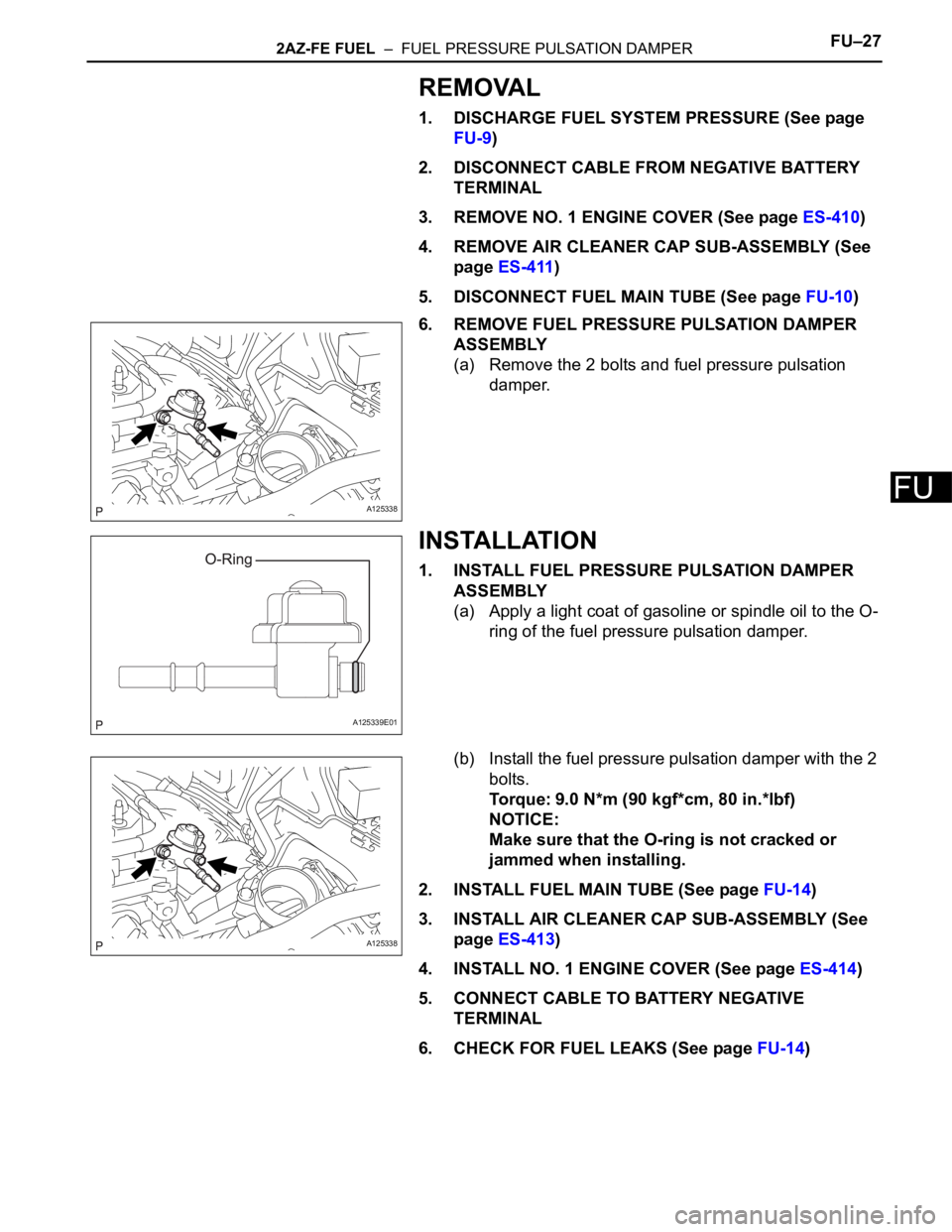
(a) Remove the 2 bolts and fuel pressure pulsation
damper.
INSTALLATION
1. INSTALL FUEL PRESSURE PULSATION DAMPER
ASSEMBLY
(a) Apply a light coat of gasoline or spindle oil to the O-
ring of the fuel pressure pulsation damper.
(b) Install the fuel pressure pulsation damper with the 2
bolts.
Torque: 9.0 N*m (90 kgf*cm, 80 in.*lbf)
NOTICE:
Make sure that the O-ring is not cracked or
jammed when installing.
2. INSTALL FUEL MAIN TUBE (See page FU-14)
3. INSTALL AIR CLEANER CAP SUB-ASSEMBLY (See
page ES-413)
4. INSTALL NO. 1 ENGINE COVER (See page ES-414)
5. CONNECT CABLE TO BATTERY NEGATIVE
TERMINAL
6. CHECK FOR FUEL LEAKS (See page FU-14)
A125338
A125339E01
A125338