Page 241 of 2000
2AZ-FE COOLING – COOLING FAN SYSTEMCO–5
CO
(c) Check that the cooling fan rotates.
If it does not, check the engine coolant temperature
sensor, cooling fan, harness or connector.
A127843
Page 245 of 2000
2AZ-FE LUBRICATION – OIL PUMPLU–13
LU
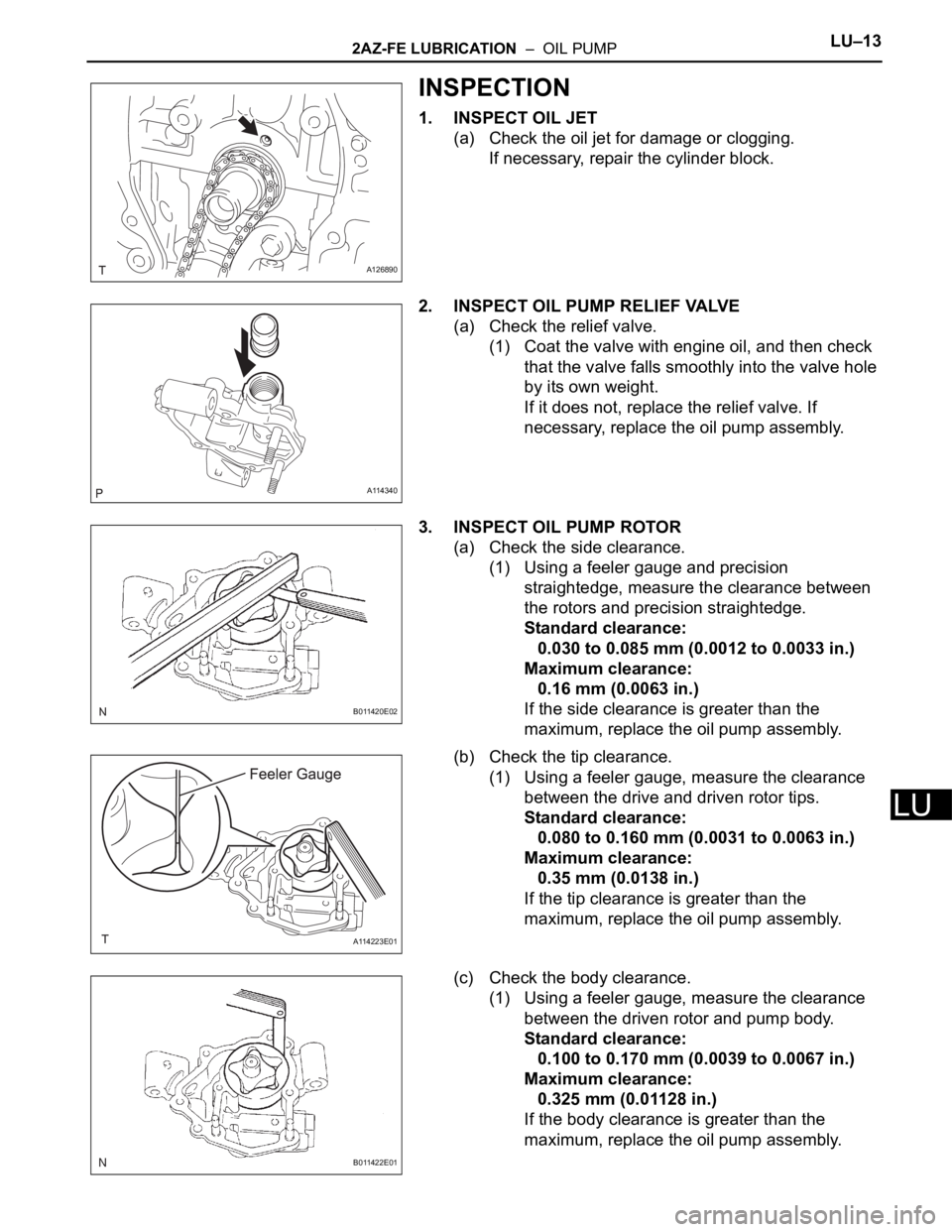
INSPECTION
1. INSPECT OIL JET
(a) Check the oil jet for damage or clogging.
If necessary, repair the cylinder block.
2. INSPECT OIL PUMP RELIEF VALVE
(a) Check the relief valve.
(1) Coat the valve with engine oil, and then check
that the valve falls smoothly into the valve hole
by its own weight.
If it does not, replace the relief valve. If
necessary, replace the oil pump assembly.
3. INSPECT OIL PUMP ROTOR
(a) Check the side clearance.
(1) Using a feeler gauge and precision
straightedge, measure the clearance between
the rotors and precision straightedge.
Standard clearance:
0.030 to 0.085 mm (0.0012 to 0.0033 in.)
Maximum clearance:
0.16 mm (0.0063 in.)
If the side clearance is greater than the
maximum, replace the oil pump assembly.
(b) Check the tip clearance.
(1) Using a feeler gauge, measure the clearance
between the drive and driven rotor tips.
Standard clearance:
0.080 to 0.160 mm (0.0031 to 0.0063 in.)
Maximum clearance:
0.35 mm (0.0138 in.)
If the tip clearance is greater than the
maximum, replace the oil pump assembly.
(c) Check the body clearance.
(1) Using a feeler gauge, measure the clearance
between the driven rotor and pump body.
Standard clearance:
0.100 to 0.170 mm (0.0039 to 0.0067 in.)
Maximum clearance:
0.325 mm (0.01128 in.)
If the body clearance is greater than the
maximum, replace the oil pump assembly.
A126890
A114340
B011420E02
A114223E01
B011422E01
Page 339 of 2000
CH–42AZ-FE CHARGING – CHARGING SYSTEM
CH
ON-VEHICLE INSPECTION
1. CHECK BATTERY CONDITION
NOTICE:
If the battery is weak or if the engine is difficult to
start, perform the following procedures.
(a) Check the battery for damage and deformation. If
severe damage, deformation or leakage is found,
replace the battery.
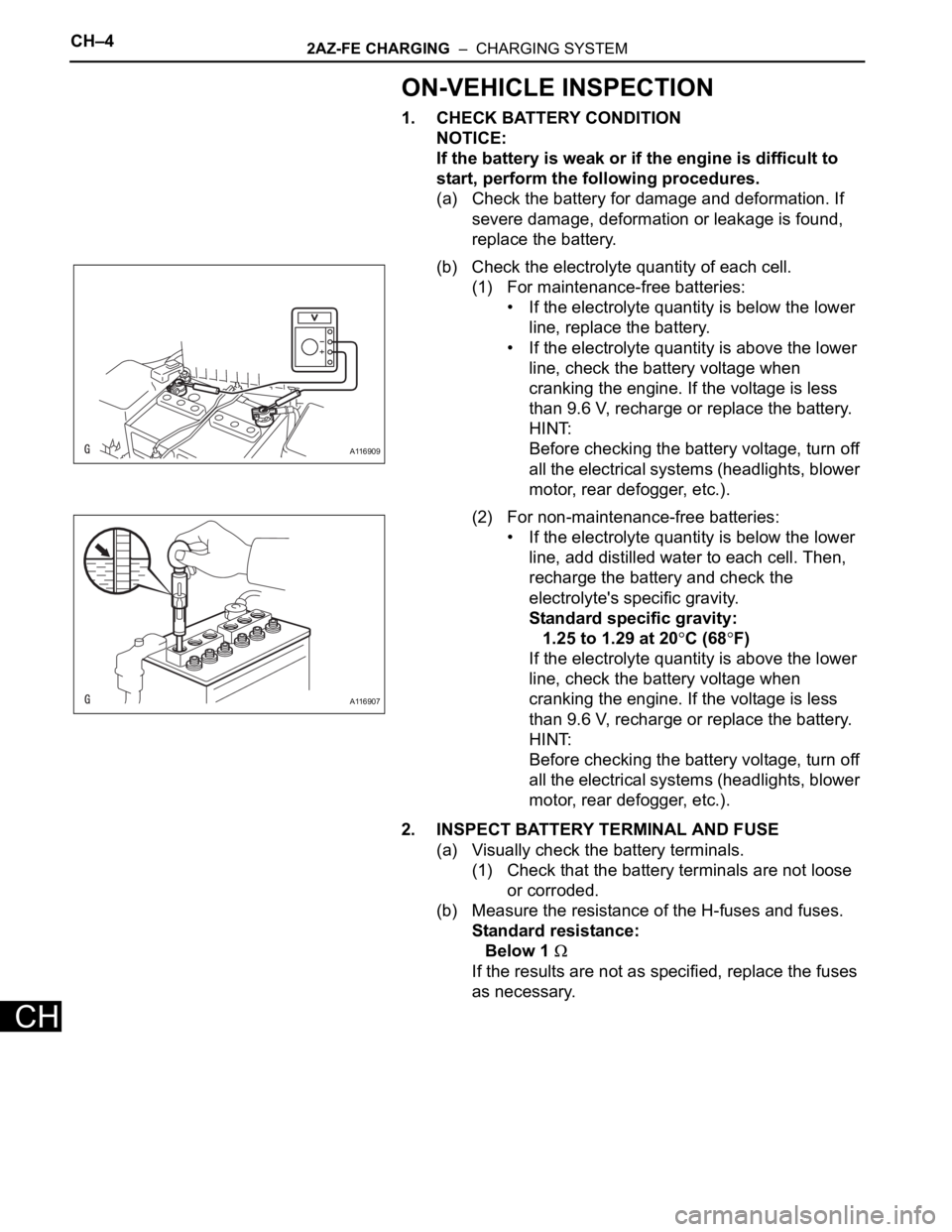
(b) Check the electrolyte quantity of each cell.
(1) For maintenance-free batteries:
• If the electrolyte quantity is below the lower
line, replace the battery.
• If the electrolyte quantity is above the lower
line, check the battery voltage when
cranking the engine. If the voltage is less
than 9.6 V, recharge or replace the battery.
HINT:
Before checking the battery voltage, turn off
all the electrical systems (headlights, blower
motor, rear defogger, etc.).
(2) For non-maintenance-free batteries:
• If the electrolyte quantity is below the lower
line, add distilled water to each cell. Then,
recharge the battery and check the
electrolyte's specific gravity.
Standard specific gravity:
1.25 to 1.29 at 20
C (68F)
If the electrolyte quantity is above the lower
line, check the battery voltage when
cranking the engine. If the voltage is less
than 9.6 V, recharge or replace the battery.
HINT:
Before checking the battery voltage, turn off
all the electrical systems (headlights, blower
motor, rear defogger, etc.).
2. INSPECT BATTERY TERMINAL AND FUSE
(a) Visually check the battery terminals.
(1) Check that the battery terminals are not loose
or corroded.
(b) Measure the resistance of the H-fuses and fuses.
Standard resistance:
Below 1
If the results are not as specified, replace the fuses
as necessary.
A116909
A116907
Page 340 of 2000
2AZ-FE CHARGING – CHARGING SYSTEMCH–5
CH
3. INSPECT V-RIBBED BELT
(a) Visually check the belt for excessive wear, frayed
cords, etc.
If any defects are found, replace the V-ribbed belt.
HINT:
Cracks on the rib side of the belt are considered
acceptable. If the belt has chunks missing from the
ribs, it should be replaced.
(b) Check that the belt fits properly in the ribbed
grooves.
HINT:
Confirm by hand that the belt has not slipped out of
the grooves on the bottom of the pulley.
4. INSPECT GENERATOR WIRING
(a) Visually check the generator wiring.
(1) Check that the wiring is in good condition.
5. CHECK FOR ABNORMAL NOISES
(a) Listen for abnormal noises from the generator.
(1) Check that no abnormal noises are heard from
the generator while the engine is running.
6. INSPECT CHARGE WARNING LIGHT CIRCUIT
(a) Turn the ignition switch ON. Check that the charge
warning light comes on.
(b) Start the engine and check that the light goes off.
If the light does not operate as specified,
troubleshoot the charge warning light circuit.
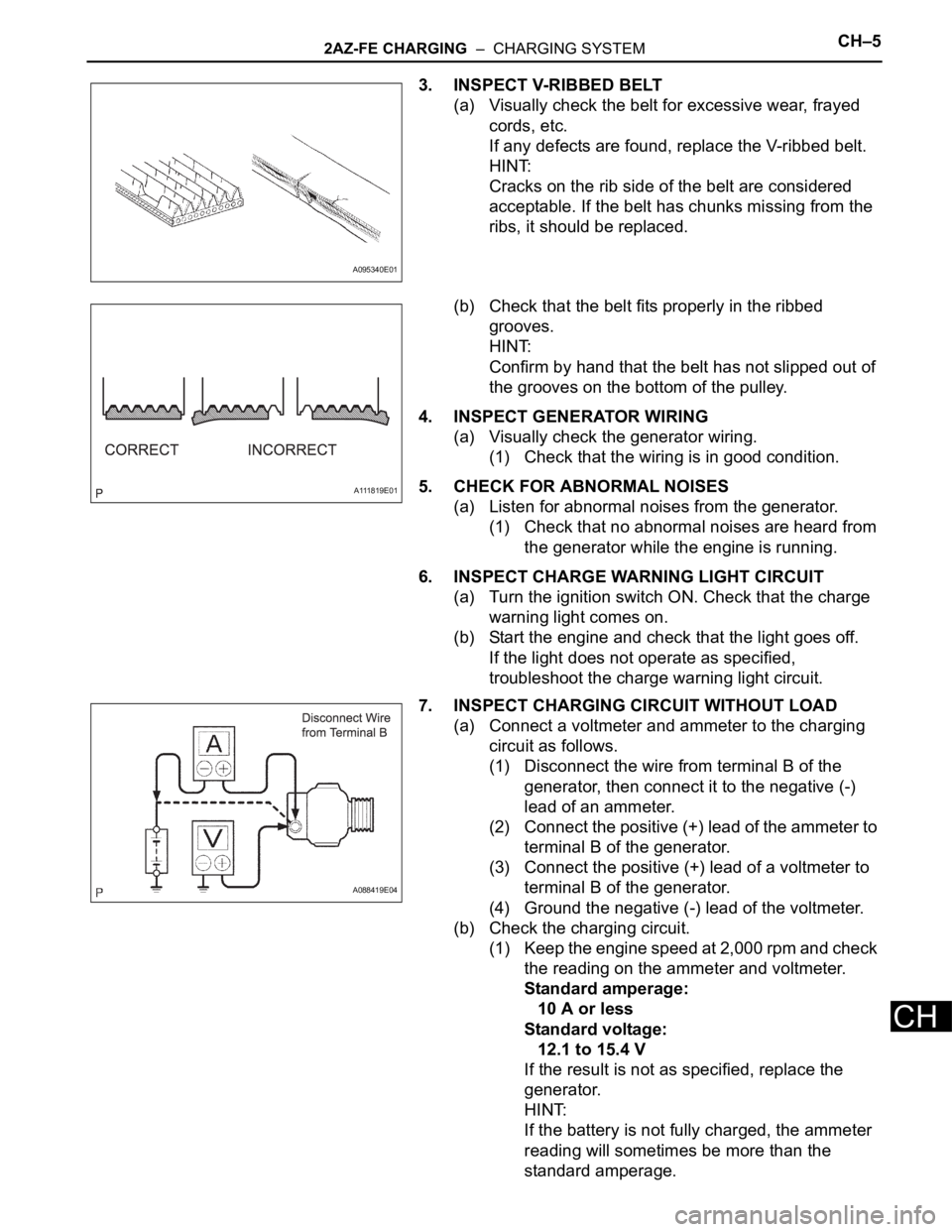
7. INSPECT CHARGING CIRCUIT WITHOUT LOAD
(a) Connect a voltmeter and ammeter to the charging
circuit as follows.
(1) Disconnect the wire from terminal B of the
generator, then connect it to the negative (-)
lead of an ammeter.
(2) Connect the positive (+) lead of the ammeter to
terminal B of the generator.
(3) Connect the positive (+) lead of a voltmeter to
terminal B of the generator.
(4) Ground the negative (-) lead of the voltmeter.
(b) Check the charging circuit.
(1) Keep the engine speed at 2,000 rpm and check
the reading on the ammeter and voltmeter.
Standard amperage:
10 A or less
Standard voltage:
12.1 to 15.4 V
If the result is not as specified, replace the
generator.
HINT:
If the battery is not fully charged, the ammeter
reading will sometimes be more than the
standard amperage.
A095340E01
A111819E01
A088419E04
Page 341 of 2000
CH–62AZ-FE CHARGING – CHARGING SYSTEM
CH
8. INSPECT CHARGING CIRCUIT WITH LOAD
(a) With the engine running at 2,000 rpm, turn the high
beam headlights ON and turn the heater blower
switch to the "HI" position.
(b) Check the reading on the ammeter.
Standard amperage:
30 A or more
If the ammeter reading is less than the standard
amperage, repair the generator.
HINT:
If the battery is fully charged, the indication will
sometimes be less than the standard amperage. If
this is the case, add more electrical load (operate
the wipers, rear window defogger, etc.) and check
the reading on the ammeter again.
Page 440 of 2000
EI–4ENGINE IMMOBILISER – ENGINE IMMOBILISER SYSTEM
EI
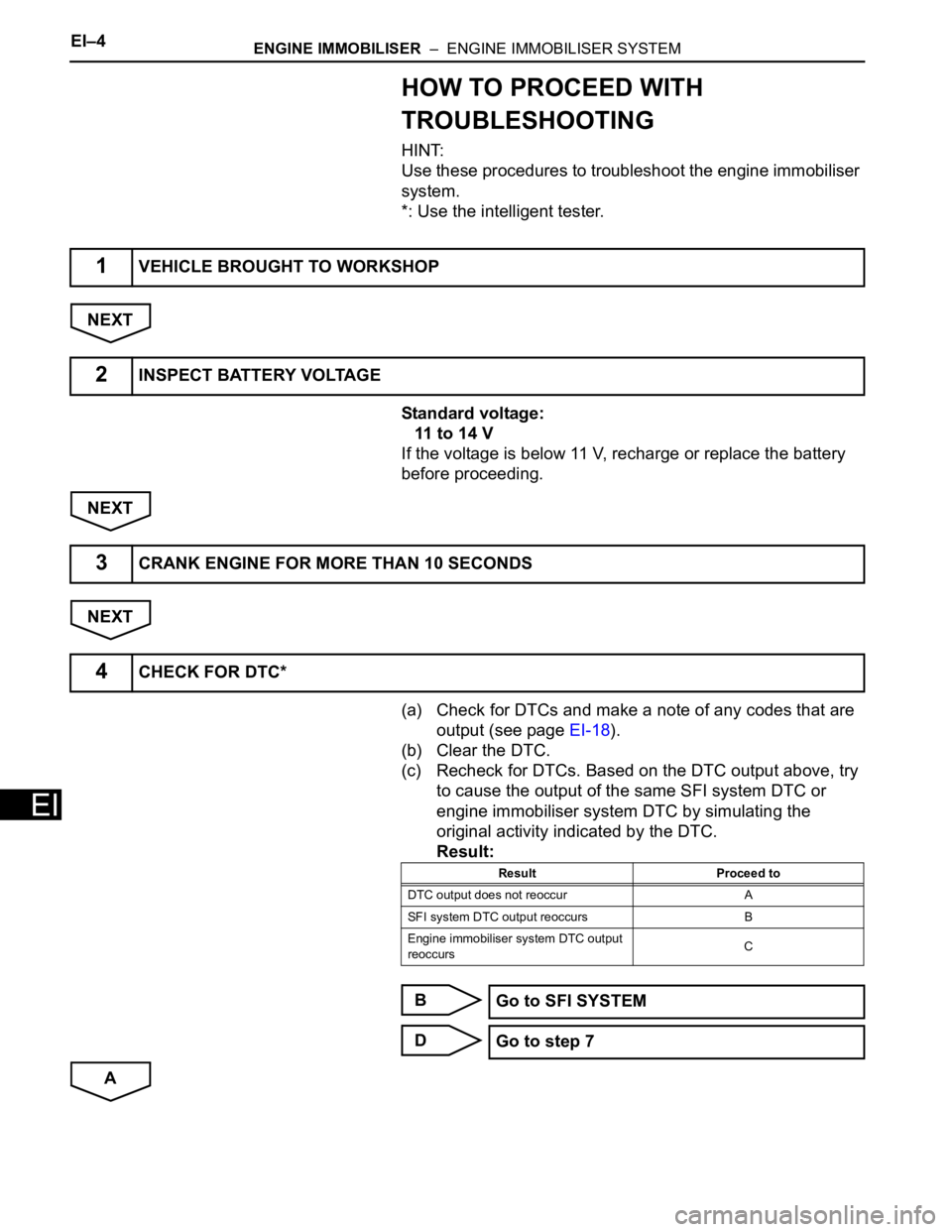
HOW TO PROCEED WITH
TROUBLESHOOTING
HINT:
Use these procedures to troubleshoot the engine immobiliser
system.
*: Use the intelligent tester.
NEXT
Standard voltage:
11 to 14 V
If the voltage is below 11 V, recharge or replace the battery
before proceeding.
NEXT
NEXT
(a) Check for DTCs and make a note of any codes that are
output (see page EI-18).
(b) Clear the DTC.
(c) Recheck for DTCs. Based on the DTC output above, try
to cause the output of the same SFI system DTC or
engine immobiliser system DTC by simulating the
original activity indicated by the DTC.
Result:
B
D
A
1VEHICLE BROUGHT TO WORKSHOP
2INSPECT BATTERY VOLTAGE
3CRANK ENGINE FOR MORE THAN 10 SECONDS
4CHECK FOR DTC*
Result Proceed to
DTC output does not reoccur A
SFI system DTC output reoccurs B
Engine immobiliser system DTC output
reoccursC
Go to SFI SYSTEM
Go to step 7
Page 463 of 2000
2AZ-FE ENGINE CONTROL SYSTEM – SFI SYSTEMES–9
ES
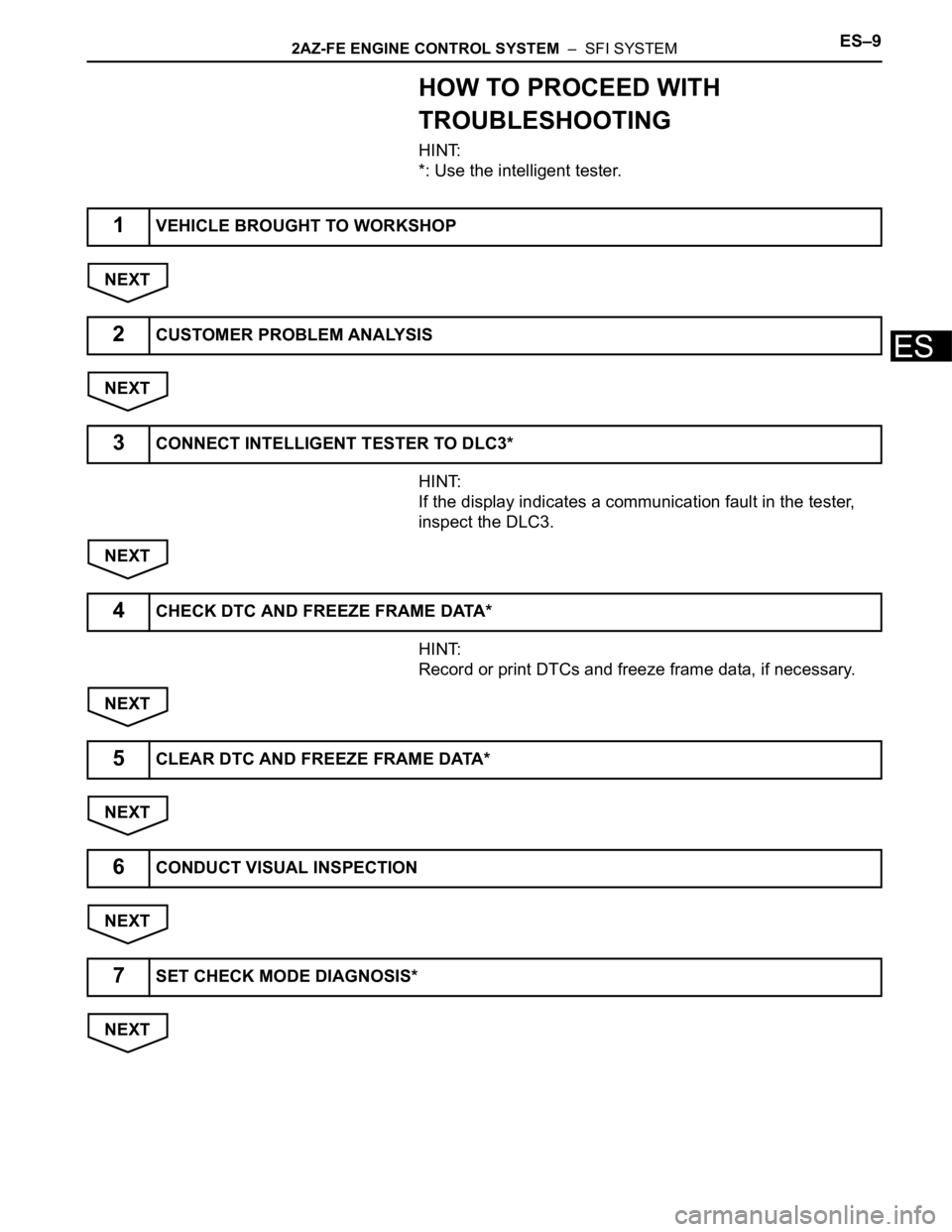
HOW TO PROCEED WITH
TROUBLESHOOTING
HINT:
*: Use the intelligent tester.
NEXT
NEXT
HINT:
If the display indicates a communication fault in the tester,
inspect the DLC3.
NEXT
HINT:
Record or print DTCs and freeze frame data, if necessary.
NEXT
NEXT
NEXT
NEXT
1VEHICLE BROUGHT TO WORKSHOP
2CUSTOMER PROBLEM ANALYSIS
3CONNECT INTELLIGENT TESTER TO DLC3*
4CHECK DTC AND FREEZE FRAME DATA*
5CLEAR DTC AND FREEZE FRAME DATA*
6CONDUCT VISUAL INSPECTION
7SET CHECK MODE DIAGNOSIS*
Page 464 of 2000
ES–102AZ-FE ENGINE CONTROL SYSTEM – SFI SYSTEM
ES
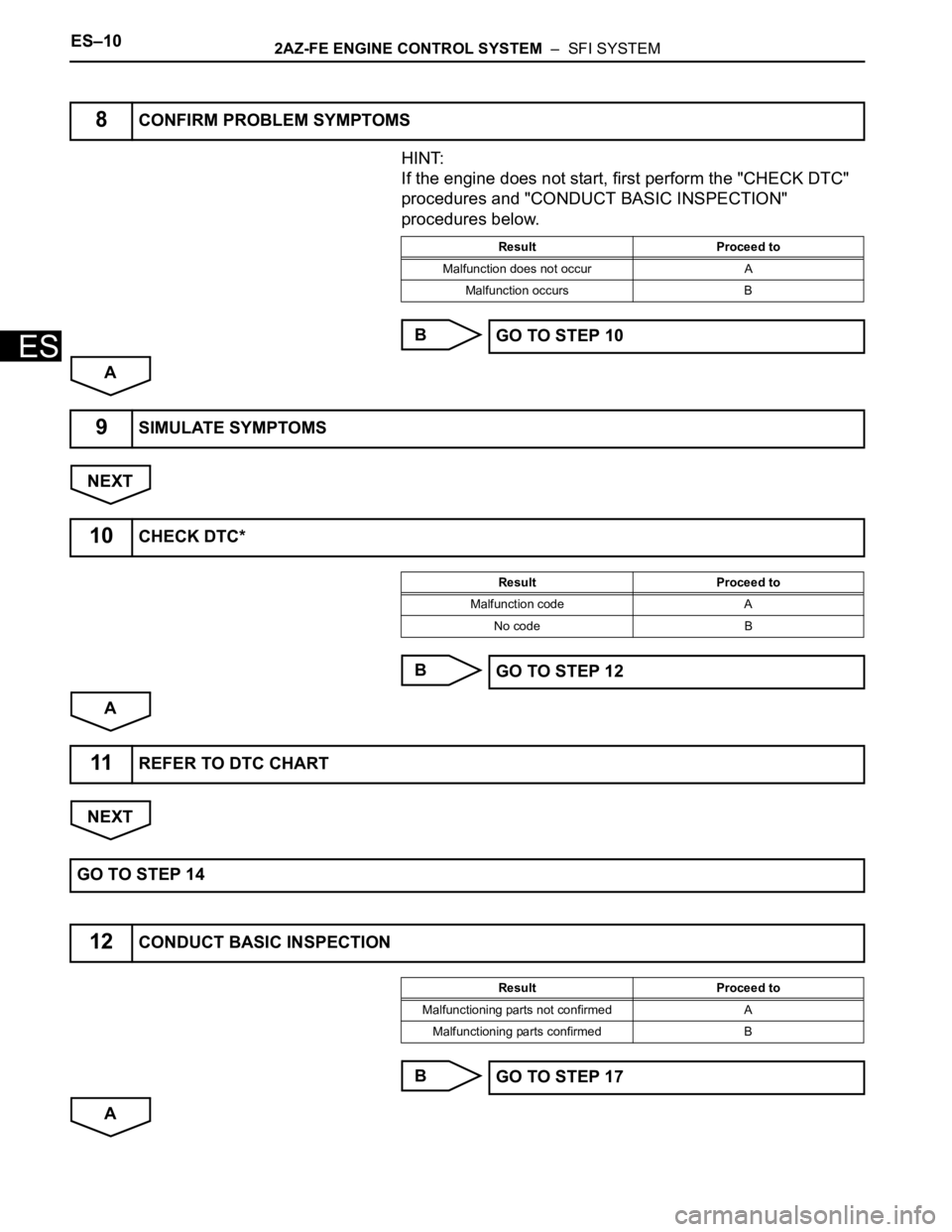
HINT:
If the engine does not start, first perform the "CHECK DTC"
procedures and "CONDUCT BASIC INSPECTION"
procedures below.
B
A
NEXT
B
A
NEXT
B
A
8CONFIRM PROBLEM SYMPTOMS
Result Proceed to
Malfunction does not occur A
Malfunction occurs B
GO TO STEP 10
9SIMULATE SYMPTOMS
10CHECK DTC*
Result Proceed to
Malfunction code A
No code B
GO TO STEP 12
11REFER TO DTC CHART
GO TO STEP 14
12CONDUCT BASIC INSPECTION
Result Proceed to
Malfunctioning parts not confirmed A
Malfunctioning parts confirmed B
GO TO STEP 17