2006 SUZUKI SX4 heat
[x] Cancel search: heatPage 429 of 1556

Downloaded from www.Manualslib.com manuals search engine Exhaust System: 1K-2
Repair Instructions
Exhaust System ComponentsS6RW0D1B06001
WARNING!
To avoid the danger of being burned, do not touch the exhaust system when the system is hot. Any
service on the exhaust system should be performed when the system is cool.
[A]
1
2
3
4
56
7
8
9
10
11
12
12
26
12
12
141515
16
26 12
17
18
18
19
19
20
21
23
22
24
25
(a)(c)
(c)
(d)
(e)
(b)
(a)
(b)(b)
(c)
(c)
(b)
(b)
14(b)
15(b)13
(e)
13
I5RW0C1B0001-01
[A]: Installing location of exhaust manifold bolt and nut. 11. Muffler 22. Exhaust pipe clamp bolt
1. Exhaust manifold gasket 12. Mounting No.1 23. Engine hook
2. Exhaust manifold 13. Heat insulator nut 24. HO2S-1 (connector color: black)
3. Exhaust manifold stiffener 14. Exhaust manifold bolt 25. Heat insulator
4. HO2S-2 (connector color: green) 15. Exhaust manifold nut 26. Mounting No.2
5. Exhaust pipe No.1 gasket 16. Exhaust No.1 pipe bolt : 45 N⋅m (4.5 kgf-m, 32.5 lb-ft)
6. No.1 seal ring 17. Exhaust manifold stiffener bolt : 50 N⋅m (5.0 kgf-m, 36.5 lb-ft)
7. No.2 seal ring 18. Exhaust No.2 pipe bolt : 43 N⋅m (4.3 kgf-m, 31.0 lb-ft)
8. Exhaust No.1 pipe 19. Exhaust center pipe bolt : 29 N⋅m (2.9 kgf-m, 21.0 lb-ft)
9. Exhaust No.2 pipe 20. Exhaust pipe No.2 gasket : 2 N⋅m (0.2 kgf-m, 1.5 lb-ft)
Page 471 of 1556

Downloaded from www.Manualslib.com manuals search engine Wheels and Tires: 2D-2
Replacement Tires
When replacement is necessary, the original equipment
type tire should be used. Refer to the Tire Placard.
Replacement tires should be of the same size, load
range and construction as those originally on the vehicle.
Use of any other size or type tire may affect ride,
handling, speedometer / odometer calibration, vehicle
ground clearance and tire or snow chain clearance to the
body and chassis.
It is recommended that new tires be installed in pairs on
the same axle. If necessary to replace only one tire, it
should be paired with the tire having the most tread, to
equalize braking traction.
WARNING!
Do not mix different types of tires on the
same vehicle such as radial, bias and bias-
belted tires except in emergencies, because
handling may be seriously affected and may
result in loss of control.
The metric term for tire inflation pressure is the kilo
pascal (kPa). Tire pressures is usually printed in both
kPa and kgf/cm
2 on the “Tire Placard”.
Metric tire gauges are available from tool suppliers.
The chart, shown in the table, converts commonly used
inflation pressures from kPa to kgf/cm
2 and psi.
Wheels DescriptionS6RW0D2401002
Wheel Maintenance
Wheel repairs that use welding, heating, or peening are
not approved. All damaged wheels should be replaced.
Replacement Wheels
Wheels must be replaced if they are bent, dented, have
excessive lateral or radial runout, air leak through welds,
have elongated bolt holes, if lug wheel bolts won’t stay
tight, or if they are heavily rusted. Wheels with greater
runout than shown in the following may cause
objectional vibrations.
Replacement wheels must be equivalent to the original
equipment wheels in load capacity, diameter, rim with
offset and mounting configuration. A wheel of improper
size or type may affect wheel and bearing life, brake
cooling, speedometer / odometer calibration, vehicle
ground clearance and tire clearance to body and
chassis.How to Measure Wheel Runout
To measure the wheel runout, it is necessary to use an
accurate dial indicator. The tire may be on or off the
wheel. The wheel should be installed to the wheel
balancer of the like for proper measurement.
Take measurements of both lateral runout “a” and radial
runout “b” at both inside and outside of the rim flange.
With the dial indicator set in place securely, turn the
wheel one full revolution slowly and record every reading
of the indicator.
When the measured runout exceeds the specification
and correction by the balancer adjustment is impossible,
replace the wheel. If the reading is affected by welding,
paint or scratch, it should be ignored.
Lateral runout limit “a”
Aluminum wheel: 0.3 mm (0.012 in.)
Steel wheel: 0.9 mm (0.035 in.)
Radial runout limit “b”
Aluminum wheel: 0.3 mm (0.012 in.)
Steel wheel: 0.7 mm (0.028 in.)
Metric Lug Nuts and Wheel Studs
All models use metric lug nuts and wheel studs.
Metric lug nuts and wheel studs size
M12 x 1.25
If a broken stud is found, see “Front Wheel Hub, Disc,
Bolt and Bearing Check in Section 2B”, “Front Wheel
Hub, Steering Knuckle and Wheel Bearing Removal and
Installation in Section 2B”, “Rear Wheel Hub Assembly
Removal and Installation in Section 2C”. kPa kgf/cm
2psi
Conversion: 1 psi =
6.895 kPa 1 kgf/cm
2 =
98.066 kPa160 1.6 23
180 1.8 26
200 2.0 29
220 2.2 32
240 2.4 35
260 2.6 38
280 2.8 41
300 3.0 44
320 3.2 47
340 3.4 50I4RS0A240001-01
I2RH01240003-01
Page 475 of 1556

Downloaded from www.Manualslib.com manuals search engine Wheels and Tires: 2D-6
Wheel (with Tire) Removal and InstallationS6RW0D2406003
Removal
CAUTION!
Never use heat to loosen tight wheel because
the application of heat to wheel causes the
wheel life shorter and the wheel bearing
damage.
1) Loosen wheel nuts by approximately 180° (half a
rotation).
2) Hoist vehicle.
3) Make sure that the vehicle will not fall off by trying to
move vehicle body in both ways.
4) Remove wheel nuts except one.
5) Support the wheel and/or tire not to drop the wheel
and then remove the nut left with the wheel.
Installation
For installation, reverse removal procedure, noting the
following.
• Wheel nuts must be tightened in sequence and to
specified torque to avoid bending wheel or brake disc
or drum as shown in the figure.
NOTE
Before installing wheels, remove any build-
up of corrosion on wheel mounting surface
and brake disc or drum mounting surface by
scraping and wire brushing. Installing wheels
without good metal-to-metal contact at
mounting surfaces can cause wheel bolts to
loosen, which can later allow a wheel to
come off while vehicle is moving.
Tightening order
“1” – “2” – “3” – “4” – “5”
Tightening torque
Wheel nut (a): 85 N·m (8.5 kgf-m, 61.5 lb-ft)
Tire Mounting and DismountingS6RW0D2406004
WARNING!
Do not stand over tire when inflating. Bead
may break when bead snaps over rim’s safety
hump and cause serious personal injury.
Do not exceed specified pressure when
inflating. If specified pressure will not seat
beads, deflate, re-lubricate and reinflate.
Over inflation may cause bead to break and
cause serious personal injury.
Use a tire changing machine to mount or dismount tires.
Follow equipment manufacturer’s instructions. Do not
use hand tools or tire irons alone to change tires as they
may damage tire beads or wheel rim.
Rim bead seats should be cleaned with a wire brush or
coarse steel wool to remove lubricants, old rubber and
light rust. Before mounting or dismounting a tire, bead
area should be well lubricated with approved tire
lubricant.
After mounting, inflate 330 kPa (47.9 psi) pressure so
that beads are completely seated. Then adjust pressure
to specified shown in the tire placard.
Tire RepairS6RW0D2406005
There are many different materials and techniques on
the market to repair tires. As not all of these work on all
types of tires, tire manufacturers have published detailed
instructions on how and when to repair tires. These
instructions can be obtained from each tire
manufacturer.
IYSQ01240008-01
Page 506 of 1556

Downloaded from www.Manualslib.com manuals search engine 3B-9 Differential:
Detail of 4WD Control System Check
Step 1. Customer complaint analysis
Record details of the problem (failure, complaint) and how it occurred as described by the customer.
For this purpose, use of such a questionnaire form as shown in the following will facilitate collecting information to the
point required for proper analysis and diagnosis.
Customer questionnaire (Example)
NOTE
The form is a standard sample. It should be modified according to conditions characteristic of each
market.
Customer’s name: Model: VIN:
Problem Symptoms
Frequency of Occurrence
Conditions for
Occurrence of Problem
Environmental Condition
Diagnostic Trouble Code
Date of Reg:
4WD position indicator abnormal: fails to turn on / fails to turn off /
flashes
Abnormal noise while vehicle running: from coupling assembly
other
No changed to “2WD” position
No changed to “4WD-lock” position
No changed to “4WD-auto” position
When starting: at initial start only / at every start / other
Vehicle speed: while accelerating / while decelerating / at stop /
while turning / while running at constant speed /
other
Road surface condition: Paved road / rough road / snow-covered road /
other
Wheather: fine / cloudy / rain / snow / other
Temperature: ( )
First check: Normal code / malfunction code ( )
Second check after test drive: Normal code / malfunction code ( ) Continuous / Intermittent ( times a day, a month) /
otherDate of problem: Mileage: Date of issue:
I5RW0A320007-02
Page 529 of 1556
Downloaded from www.Manualslib.com manuals search engine Differential: 3B-32
Coupling Air Temperature Sensor InspectionS6RW0D3206007
CAUTION!
Do not heat up coupling air temperature
sensor more than 100 °C (212 °F). Otherwise,
coupling air temperature sensor will be
damaged.
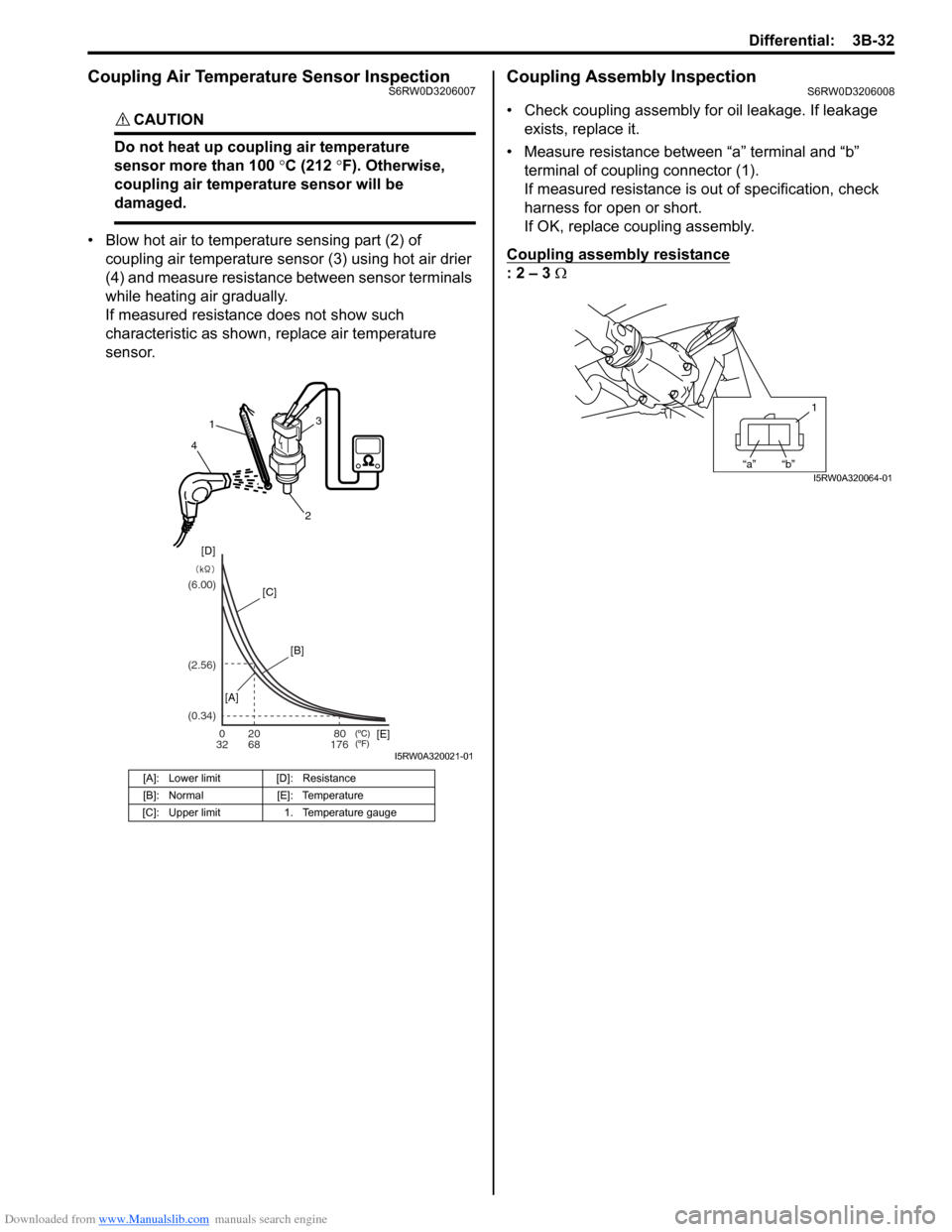
• Blow hot air to temperature sensing part (2) of
coupling air temperature sensor (3) using hot air drier
(4) and measure resistance between sensor terminals
while heating air gradually.
If measured resistance does not show such
characteristic as shown, replace air temperature
sensor.
Coupling Assembly InspectionS6RW0D3206008
• Check coupling assembly for oil leakage. If leakage
exists, replace it.
• Measure resistance between “a” terminal and “b”
terminal of coupling connector (1).
If measured resistance is out of specification, check
harness for open or short.
If OK, replace coupling assembly.
Coupling assembly resistance
: 2 – 3 Ω
[A]: Lower limit [D]: Resistance
[B]: Normal [E]: Temperature
[C]: Upper limit 1. Temperature gauge
020
32 68 17680 (6.00)
(0.34) (2.56)
1
4
23
[D]
[C]
[B]
[A]
[E]
I5RW0A320021-01
1
“a” “b”I5RW0A320064-01
Page 566 of 1556
Downloaded from www.Manualslib.com manuals search engine 3D-1 Propeller Shafts:
Driveline / Axle
Propeller Shafts
Precautions
Propeller Shaft CautionS6RW0D3400001
CAUTION!
• All propeller shaft fasteners are an important attaching part in that it could affect the performance of
vital parts and systems, and/or could result in major repair expense. They must be replaced with one
of the same part number or with an equivalent part if replacement becomes necessary. Do not use a
replacement part of lesser quality or substitute design. Torque values must be used as specified
during reassembly to assure proper retention of this part.
• Never attempt to heat, quench or straighten any propeller shaft part. Replace it with a new part, or
damage to the part may result.
General Description
Propeller Shaft ConstructionS6RW0D3401001
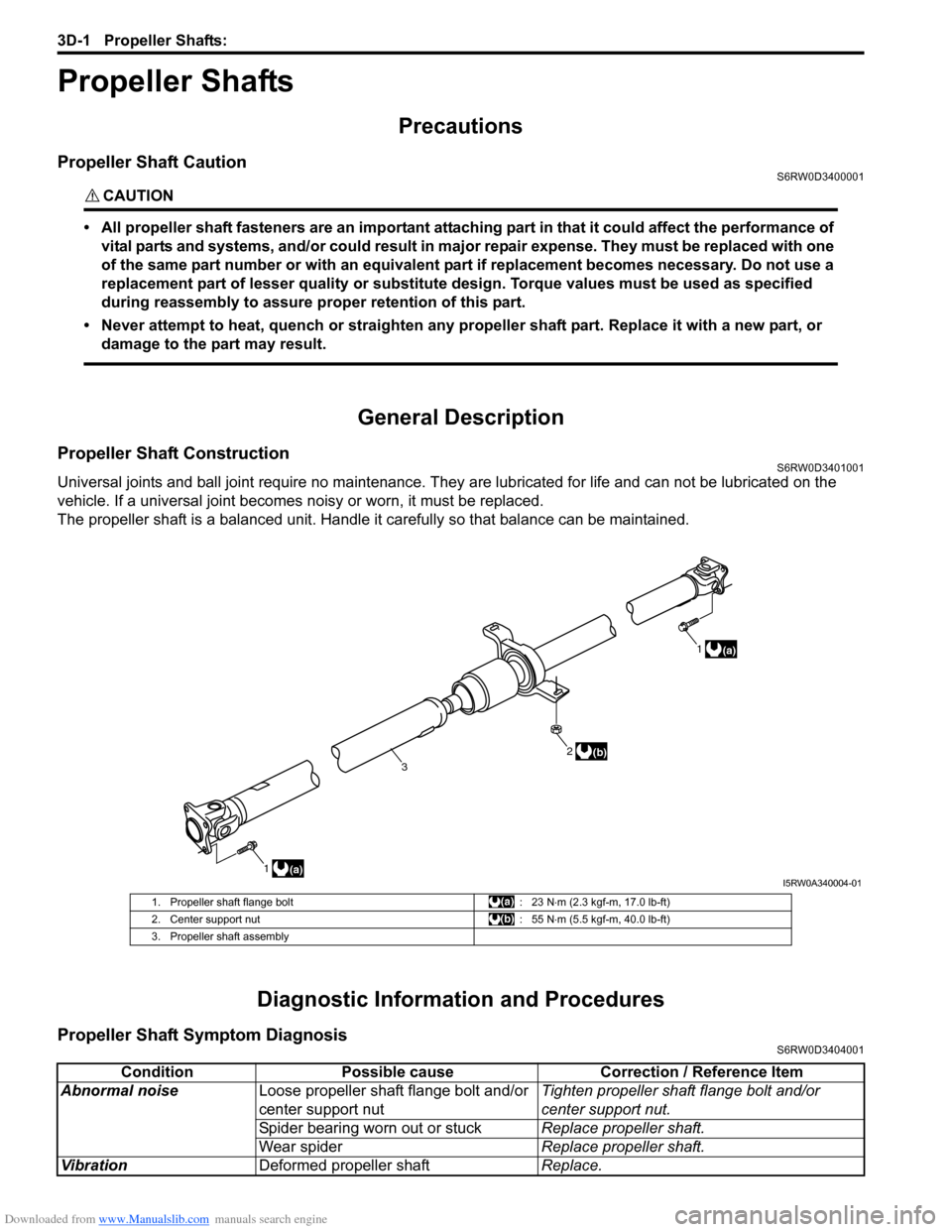
Universal joints and ball joint require no maintenance. They are lubricated for life and can not be lubricated on the
vehicle. If a universal joint becomes noisy or worn, it must be replaced.
The propeller shaft is a balanced unit. Handle it carefully so that balance can be maintained.
Diagnostic Information and Procedures
Propeller Shaft Symptom DiagnosisS6RW0D3404001
1(a)1
(a)
2
3(b)
I5RW0A340004-01
1. Propeller shaft flange bolt : 23 N⋅m (2.3 kgf-m, 17.0 lb-ft)
2. Center support nut : 55 N⋅m (5.5 kgf-m, 40.0 lb-ft)
3. Propeller shaft assembly
Condition Possible cause Correction / Reference Item
Abnormal noiseLoose propeller shaft flange bolt and/or
center support nutTighten propeller shaft flange bolt and/or
center support nut.
Spider bearing worn out or stuckReplace propeller shaft.
Wear spiderReplace propeller shaft.
VibrationDeformed propeller shaftReplace.
Page 576 of 1556

Downloaded from www.Manualslib.com manuals search engine 4A-5 Brake Control System and Diagnosis:
Brakes Symptom DiagnosisS6RW0D4104002
Condition Possible cause Correction / Reference Item
Not enough braking forceBrake oil leakage from brake linesLocate leaking point and repair.
Brake disc or pad stained with oilClean or replace.
Overheated brakesDetermine cause and repair.
Poor contact of shoes on brake drumRepair for proper contact.
Brake shoe stained with oil or wet with
waterReplace.
Badly worn brake padReplace.
Defective wheel cylindersRepair or replace.
Malfunctioning caliper assemblyRepair or replace.
Malfunctioning brake boosterCheck system and replace as necessary.
Malfunctioning brake master cylinderCheck system and replace as necessary.
Air in systemBleed system.
Malfunctioning ABSCheck system and replace as necessary.
Brake pull (Brakes not
working in unison)Pad, disc, shoe and/or drum are wet
with water or stained with oil in some
brakesClean or replace.
Drum-to-shoe clearance out of
adjustment in some brakes
(Malfunctioning auto adjusting
mechanism) Check for inoperative auto adjusting
mechanism.
Disc and/or drum are out of round in
some brakesReplace.
Tires are inflated unequallyInflate equally.
Malfunction in wheel cylinders (rear
drum brake model)Repair or replace.
Disturbed front wheel alignmentAdjust as prescribed.
Unmatched tires on same axleTires with approximately the same amount of
tread should be used on the same axle.
Restricted brake pipes or hosesCheck for soft hoses and damaged lines.
Replace with new hoses and new double-
walled steel brake tubing.
Malfunctioning caliper assemblyCheck for stuck or sluggish pistons and proper
lubrication of caliper slide pin.
Caliper should slide.
Loose suspension partsCheck all suspension mountings.
Loose calipersCheck and torque bolts to specifications.
Noise (high pitched
squeak without brake
applied)Contact wear indicator to brake discReplace brake pad.
Worn rear brake shoeReplace brake shoe.
Excessive pedal travel
(Pedal stroke too large)Partial brake system failureCheck brake systems and repair as necessary.
Brake fluid leakingRepair the leaking point, and bleed air.
Air in system (soft / spongy pedal)Bleed system.
Rear brake system not adjusted
(malfunctioning auto adjusting
mechanism)Repair auto adjusting mechanism.
Adjust rear brakes.
Bent brake shoesReplace brake shoes.
Brake locked Malfunctioning ABSCheck system referring to “ABS Check in
Section 4E”.
Page 596 of 1556

Downloaded from www.Manualslib.com manuals search engine 4C-1 Rear Brakes:
Brakes
Rear Brakes
Repair Instructions
Rear Drum Brake ComponentsS6RW0D4306001
11
2
3
4
5
6 7
12
1411310 16
19 15
17
98
18
F
(a)
(b)
(c)
(d)
I6RW0D430001-01
1. Brake drum 10. Wheel cylinder 19. Bleeder plug
2. Brake shoe 11. Brake back plate : 73 N⋅m (7.3 kgf-m, 53 lb-ft)
3. Shoe return spring 12. Rear wheel hub : 12 N⋅m (1.2 kgf-m, 9.0 lb-ft)
4. Brake adjuster 13. Nut (4WD model) : 7 N⋅m (0.7 kgf-m, 5.0 lb-ft)
5. Antirattle spring 14. Parking cable : 175 N⋅m (17.5 kgf-m, 127.0 lb-ft)
6. Hold down spring 15. Rear wheel hub mounting bolt : Heat-resistant brake grease
7. Shoe hold down pin 16. Wheel cylinder mounting bolt : Do not reuse.
8. Push nut 17. Rear axle : Apply brake fluid
9. Brake shoe lever 18. Plug