2006 SUZUKI SX4 PPL
[x] Cancel search: PPLPage 1437 of 1556
Downloaded from www.Manualslib.com manuals search engine Hood / Fenders / Doors: 9J-1
Body, Cab and Accessories
Hood / Fenders / Doors
Repair Instructions
Hood Removal and InstallationS6RW0D9A06001
Removal
CAUTION!
Place cloth to prevent body from any
damage.
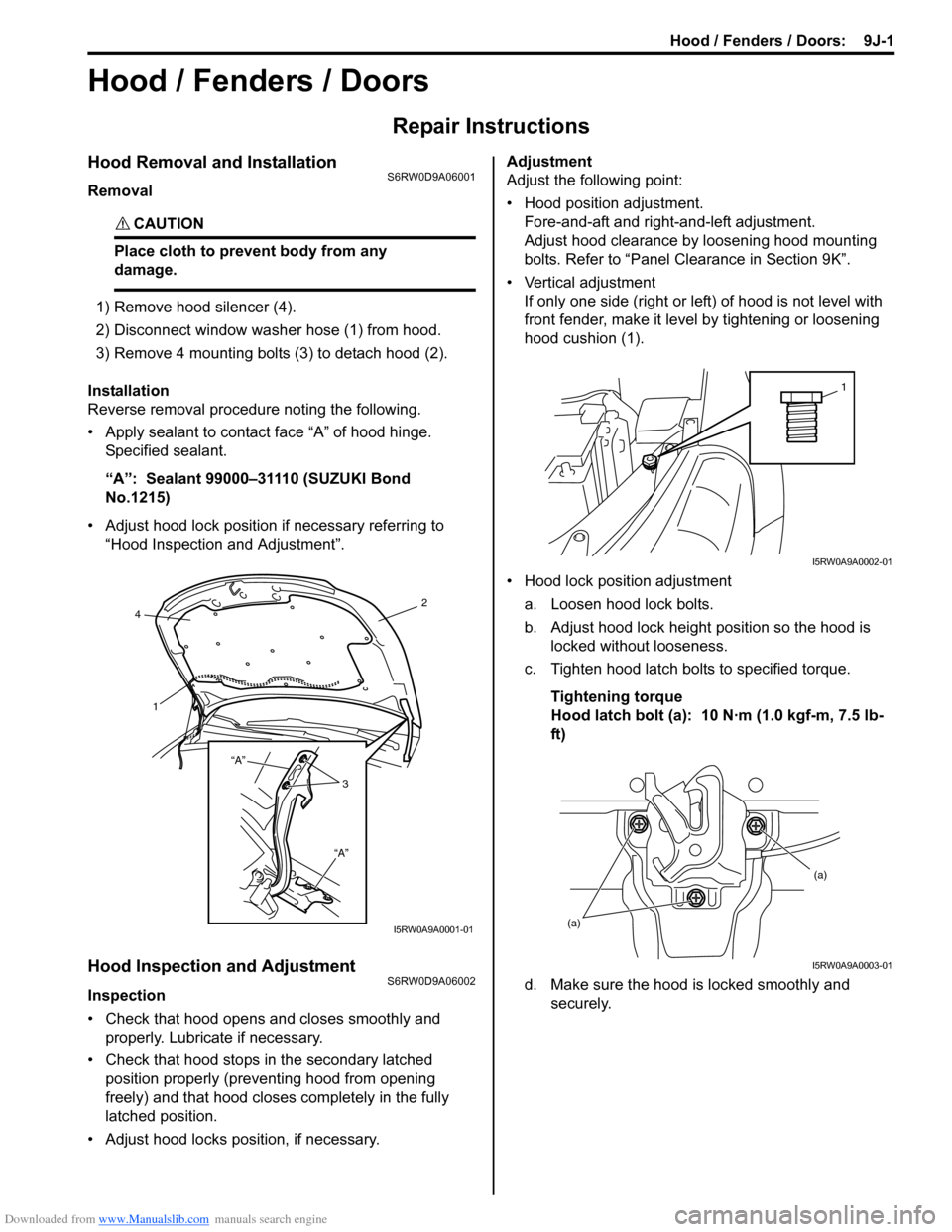
1) Remove hood silencer (4).
2) Disconnect window washer hose (1) from hood.
3) Remove 4 mounting bolts (3) to detach hood (2).
Installation
Reverse removal procedure noting the following.
• Apply sealant to contact face “A” of hood hinge.
Specified sealant.
“A”: Sealant 99000–31110 (SUZUKI Bond
No.1215)
• Adjust hood lock position if necessary referring to
“Hood Inspection and Adjustment”.
Hood Inspection and AdjustmentS6RW0D9A06002
Inspection
• Check that hood opens and closes smoothly and
properly. Lubricate if necessary.
• Check that hood stops in the secondary latched
position properly (preventing hood from opening
freely) and that hood closes completely in the fully
latched position.
• Adjust hood locks position, if necessary.Adjustment
Adjust the following point:
• Hood position adjustment.
Fore-and-aft and right-and-left adjustment.
Adjust hood clearance by loosening hood mounting
bolts. Refer to “Panel Clearance in Section 9K”.
• Vertical adjustment
If only one side (right or left) of hood is not level with
front fender, make it level by tightening or loosening
hood cushion (1).
• Hood lock position adjustment
a. Loosen hood lock bolts.
b. Adjust hood lock height position so the hood is
locked without looseness.
c. Tighten hood latch bolts to specified torque.
Tightening torque
Hood latch bolt (a): 10 N·m (1.0 kgf-m, 7.5 lb-
ft)
d. Make sure the hood is locked smoothly and
securely.
2
4
1
3 “A”
“A”
I5RW0A9A0001-01
1
I5RW0A9A0002-01
(a)(a)
I5RW0A9A0003-01
Page 1438 of 1556
Downloaded from www.Manualslib.com manuals search engine 9J-2 Hood / Fenders / Doors:
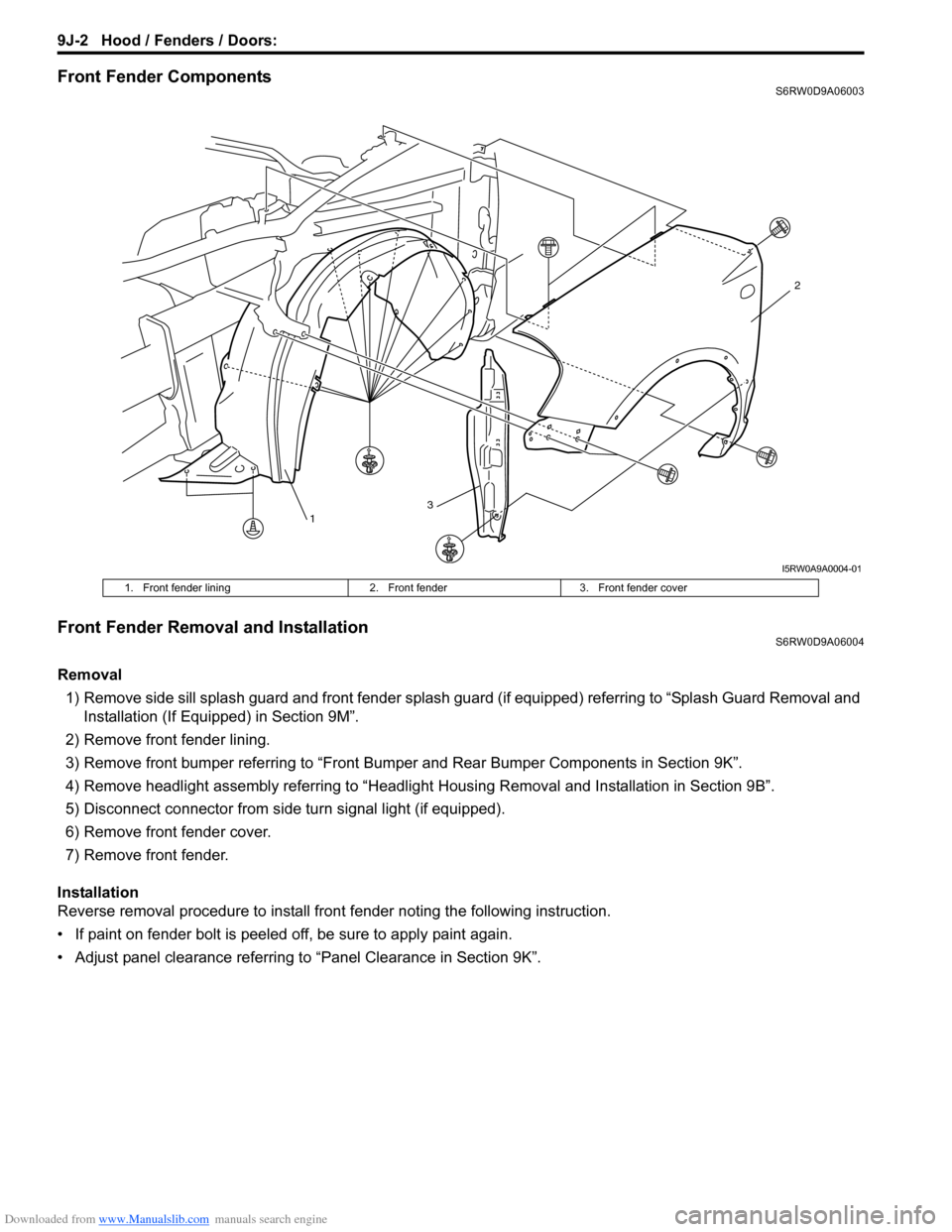
Front Fender ComponentsS6RW0D9A06003
Front Fender Removal and InstallationS6RW0D9A06004
Removal
1) Remove side sill splash guard and front fender splash guard (if equipped) referring to “Splash Guard Removal and
Installation (If Equipped) in Section 9M”.
2) Remove front fender lining.
3) Remove front bumper referring to “Front Bumper and Rear Bumper Components in Section 9K”.
4) Remove headlight assembly referring to “Headlight Housing Removal and Installation in Section 9B”.
5) Disconnect connector from side turn signal light (if equipped).
6) Remove front fender cover.
7) Remove front fender.
Installation
Reverse removal procedure to install front fender noting the following instruction.
• If paint on fender bolt is peeled off, be sure to apply paint again.
• Adjust panel clearance referring to “Panel Clearance in Section 9K”.
13
2
I5RW0A9A0004-01
1. Front fender lining 2. Front fender 3. Front fender cover
Page 1439 of 1556
Downloaded from www.Manualslib.com manuals search engine Hood / Fenders / Doors: 9J-3
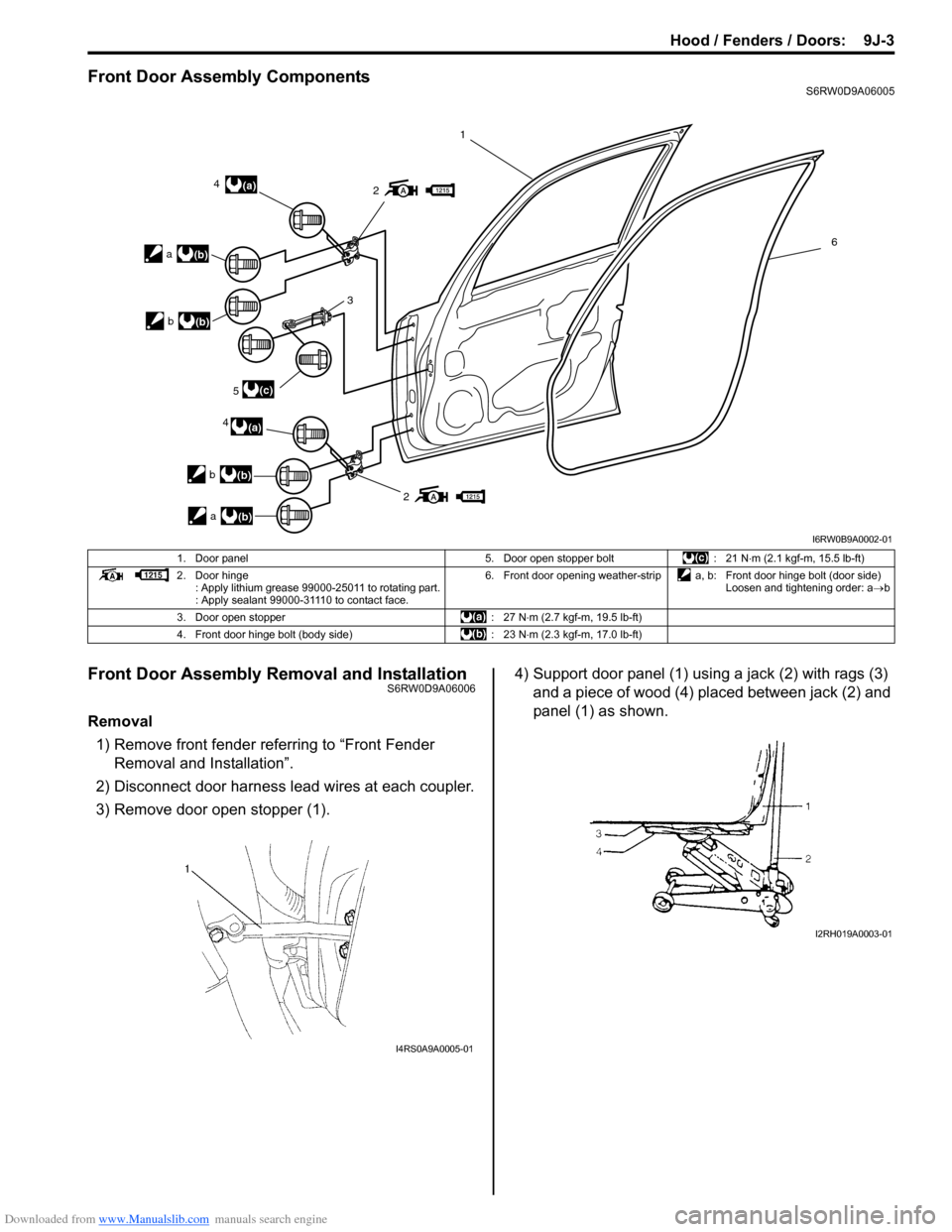
Front Door Assembly ComponentsS6RW0D9A06005
Front Door Assembly Removal and InstallationS6RW0D9A06006
Removal
1) Remove front fender referring to “Front Fender
Removal and Installation”.
2) Disconnect door harness lead wires at each coupler.
3) Remove door open stopper (1).4) Support door panel (1) using a jack (2) with rags (3)
and a piece of wood (4) placed between jack (2) and
panel (1) as shown.
2
24
45
3
1
6
(a)
(a)
(c) a
(b)
b(b)
a(b) b
(b)
I6RW0B9A0002-01
1. Door panel 5. Door open stopper bolt : 21 N⋅m (2.1 kgf-m, 15.5 lb-ft)
2. Door hinge
: Apply lithium grease 99000-25011 to rotating part.
: Apply sealant 99000-31110 to contact face.6. Front door opening weather-strip a, b: Front door hinge bolt (door side)
Loosen and tightening order: a→b
3. Door open stopper : 27 N⋅m (2.7 kgf-m, 19.5 lb-ft)
4. Front door hinge bolt (body side) : 23 N⋅m (2.3 kgf-m, 17.0 lb-ft)
I4RS0A9A0005-01
I2RH019A0003-01
Page 1440 of 1556
Downloaded from www.Manualslib.com manuals search engine 9J-4 Hood / Fenders / Doors:
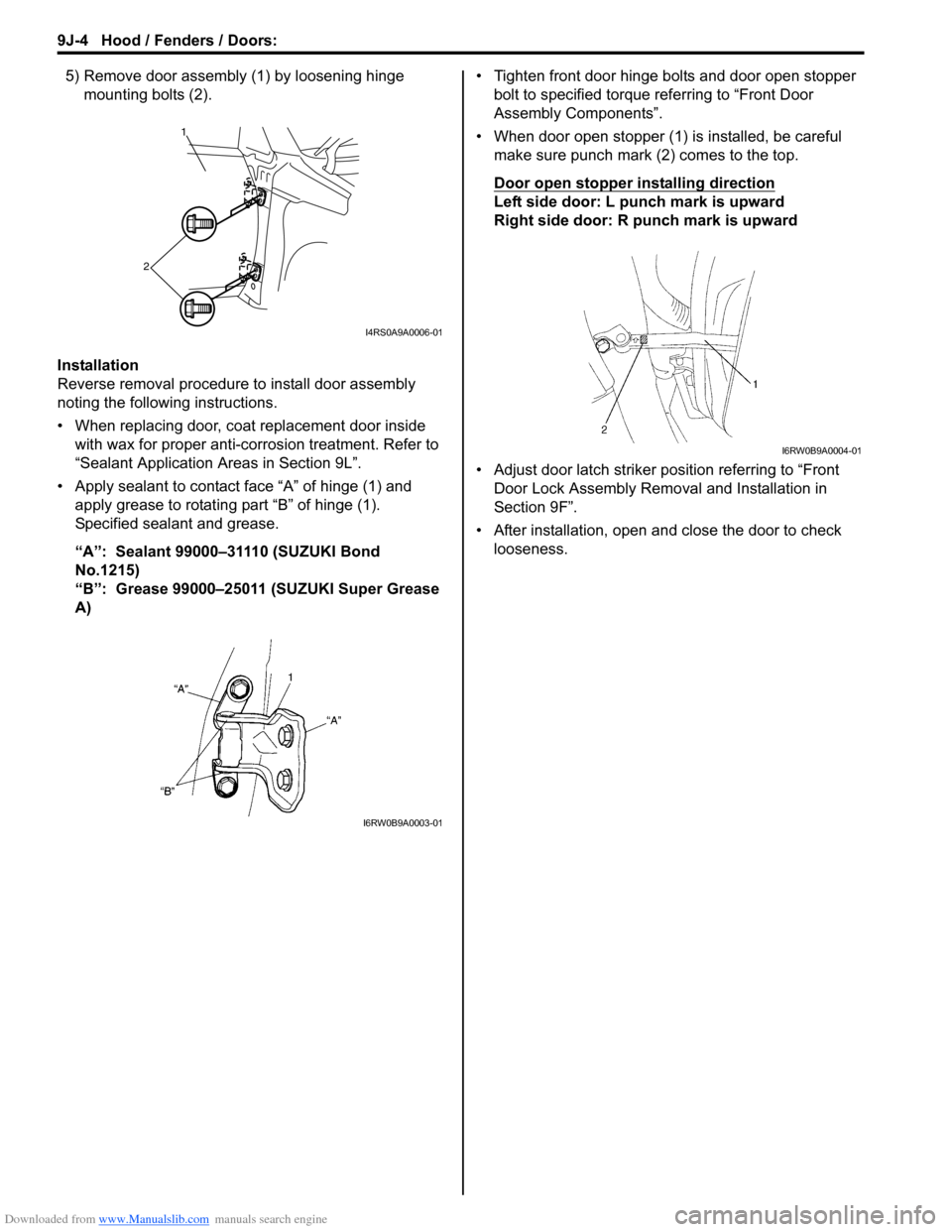
5) Remove door assembly (1) by loosening hinge
mounting bolts (2).
Installation
Reverse removal procedure to install door assembly
noting the following instructions.
• When replacing door, coat replacement door inside
with wax for proper anti-corrosion treatment. Refer to
“Sealant Application Areas in Section 9L”.
• Apply sealant to contact face “A” of hinge (1) and
apply grease to rotating part “B” of hinge (1).
Specified sealant and grease.
“A”: Sealant 99000–31110 (SUZUKI Bond
No.1215)
“B”: Grease 99000–25011 (SUZUKI Super Grease
A) • Tighten front door hinge bolts and door open stopper
bolt to specified torque referring to “Front Door
Assembly Components”.
• When door open stopper (1) is installed, be careful
make sure punch mark (2) comes to the top.
Door open stopper installing direction
Left side door: L punch mark is upward
Right side door: R punch mark is upward
• Adjust door latch striker position referring to “Front
Door Lock Assembly Removal and Installation in
Section 9F”.
• After installation, open and close the door to check
looseness.
1
2
I4RS0A9A0006-01
I6RW0B9A0003-01
I6RW0B9A0004-01
Page 1441 of 1556
Downloaded from www.Manualslib.com manuals search engine Hood / Fenders / Doors: 9J-5
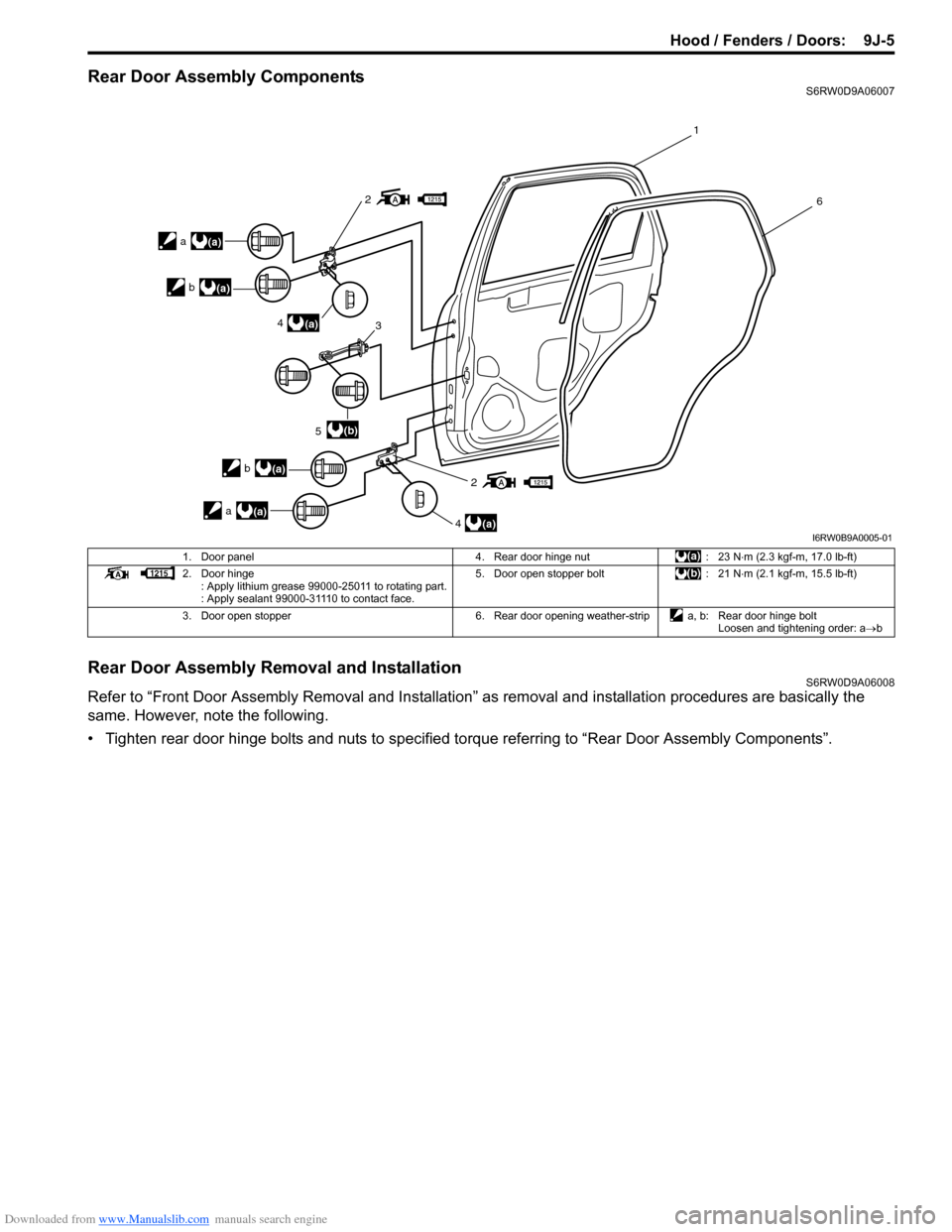
Rear Door Assembly ComponentsS6RW0D9A06007
Rear Door Assembly Removal and InstallationS6RW0D9A06008
Refer to “Front Door Assembly Removal and Installation” as removal and installation procedures are basically the
same. However, note the following.
• Tighten rear door hinge bolts and nuts to specified torque referring to “Rear Door Assembly Components”.
2
2
4
5
4 3
1
6
(a)
(a)
(b)
a(a) b
(a)
a(a)
b
(a)
I6RW0B9A0005-01
1. Door panel 4. Rear door hinge nut : 23 N⋅m (2.3 kgf-m, 17.0 lb-ft)
2. Door hinge
: Apply lithium grease 99000-25011 to rotating part.
: Apply sealant 99000-31110 to contact face.5. Door open stopper bolt : 21 N⋅m (2.1 kgf-m, 15.5 lb-ft)
3. Door open stopper 6. Rear door opening weather-strip a, b: Rear door hinge bolt
Loosen and tightening order: a→b
Page 1442 of 1556
Downloaded from www.Manualslib.com manuals search engine 9J-6 Hood / Fenders / Doors:
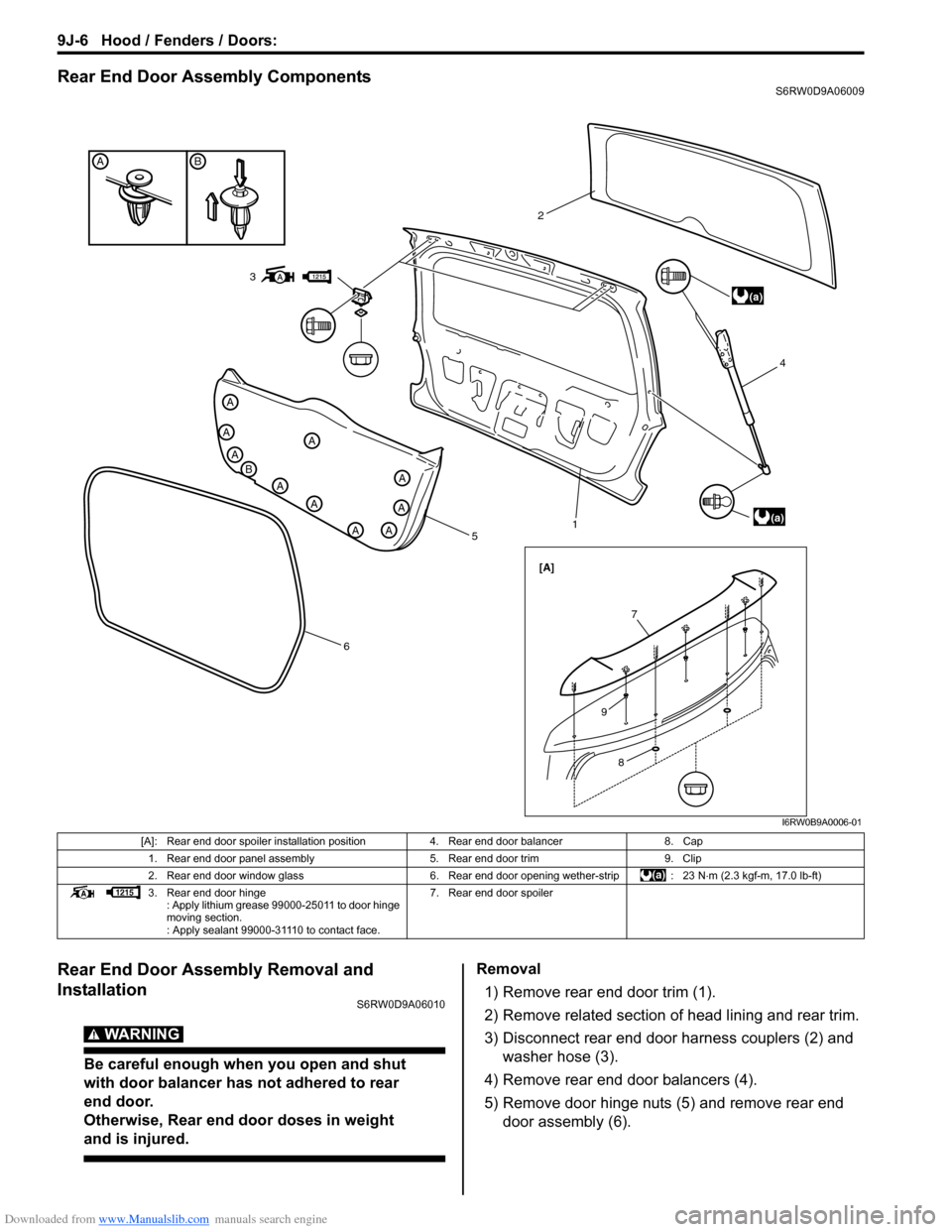
Rear End Door Assembly ComponentsS6RW0D9A06009
Rear End Door Assembly Removal and
Installation
S6RW0D9A06010
WARNING!
Be careful enough when you open and shut
with door balancer has not adhered to rear
end door.
Otherwise, Rear end door doses in weight
and is injured.
Removal
1) Remove rear end door trim (1).
2) Remove related section of head lining and rear trim.
3) Disconnect rear end door harness couplers (2) and
washer hose (3).
4) Remove rear end door balancers (4).
5) Remove door hinge nuts (5) and remove rear end
door assembly (6).
BA
A
B
A
A
A
A
A
AA
A
A
5
614 2
(a)
(a)
[A]
3
7
8
9
I6RW0B9A0006-01
[A]: Rear end door spoiler installation position 4. Rear end door balancer 8. Cap
1. Rear end door panel assembly 5. Rear end door trim 9. Clip
2. Rear end door window glass 6. Rear end door opening wether-strip : 23 N⋅m (2.3 kgf-m, 17.0 lb-ft)
3. Rear end door hinge
: Apply lithium grease 99000-25011 to door hinge
moving section.
: Apply sealant 99000-31110 to contact face.7. Rear end door spoiler
Page 1443 of 1556
Downloaded from www.Manualslib.com manuals search engine Hood / Fenders / Doors: 9J-7
WARNING!
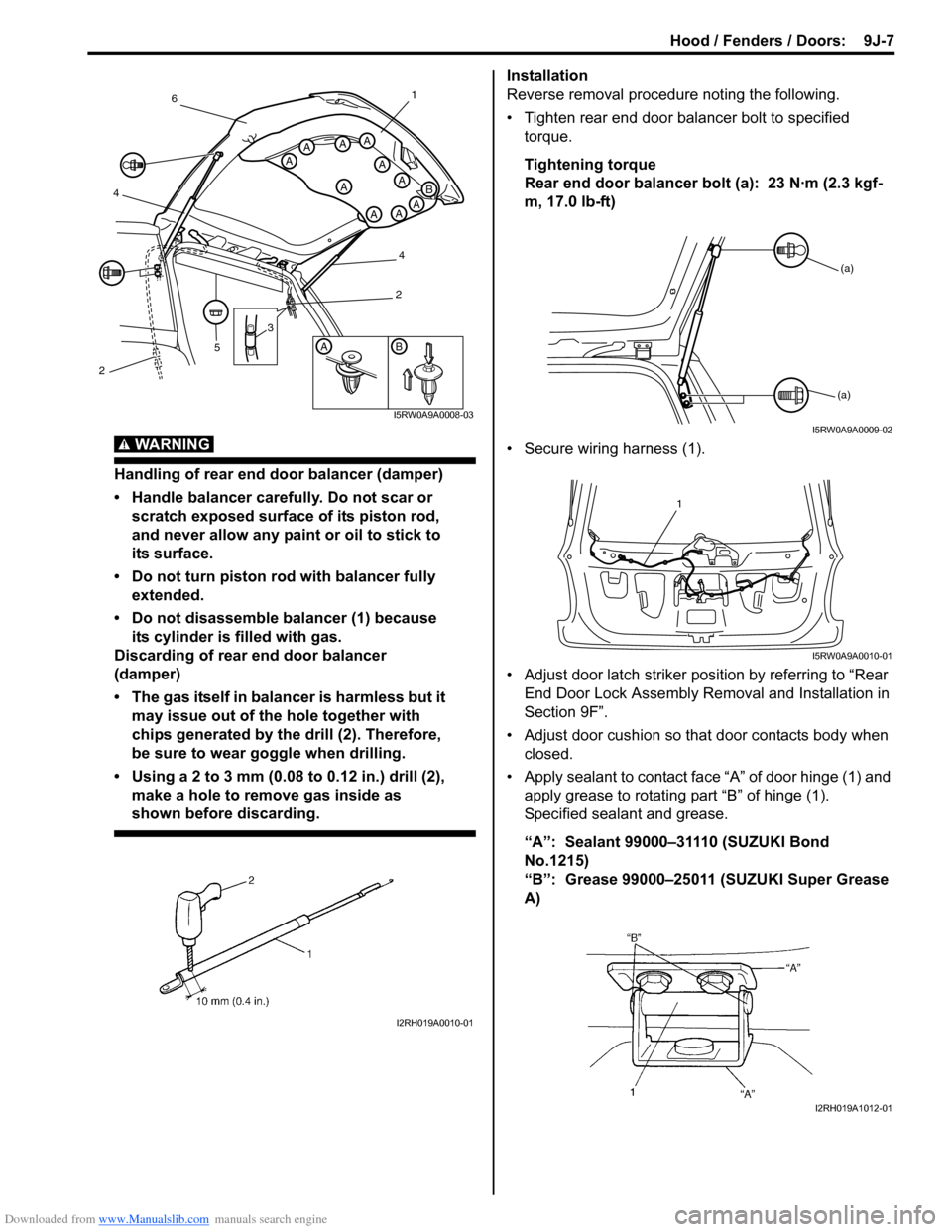
Handling of rear end door balancer (damper)
• Handle balancer carefully. Do not scar or
scratch exposed surface of its piston rod,
and never allow any paint or oil to stick to
its surface.
• Do not turn piston rod with balancer fully
extended.
• Do not disassemble balancer (1) because
its cylinder is filled with gas.
Discarding of rear end door balancer
(damper)
• The gas itself in balancer is harmless but it
may issue out of the hole together with
chips generated by the drill (2). Therefore,
be sure to wear goggle when drilling.
• Using a 2 to 3 mm (0.08 to 0.12 in.) drill (2),
make a hole to remove gas inside as
shown before discarding.
Installation
Reverse removal procedure noting the following.
• Tighten rear end door balancer bolt to specified
torque.
Tightening torque
Rear end door balancer bolt (a): 23 N·m (2.3 kgf-
m, 17.0 lb-ft)
• Secure wiring harness (1).
• Adjust door latch striker position by referring to “Rear
End Door Lock Assembly Removal and Installation in
Section 9F”.
• Adjust door cushion so that door contacts body when
closed.
• Apply sealant to contact face “A” of door hinge (1) and
apply grease to rotating part “B” of hinge (1).
Specified sealant and grease.
“A”: Sealant 99000–31110 (SUZUKI Bond
No.1215)
“B”: Grease 99000–25011 (SUZUKI Super Grease
A)
AB
A
A
A
A
AAA
AAA
B
3
5
461
4
2
2
I5RW0A9A0008-03
I2RH019A0010-01
(a)
(a)
I5RW0A9A0009-02
1
I5RW0A9A0010-01
I2RH019A1012-01
Page 1455 of 1556
Downloaded from www.Manualslib.com manuals search engine Paint / Coatings: 9L-1
Body, Cab and Accessories
Paint / Coatings
General Description
Anti-Corrosion Treatment ConstructionS6RW0D9C01001
WARNING!
Standard shop practices, particularly eye protection, should be followed during the performance of the
following operations to avoid personal injury.
As rust proof treatment, steel sheets are given corrosion resistance on the interior and/or exterior.
These corrosion resistance steel sheet materials are called one of two-side galvanized steel sheets.
It is for the sake of rust protection that these materials are selected and given a variety of treatments as described
blow.
• Steel sheets are treated with cathodic electro primer which is excellent in corrosion resistance.
• Rust proof wax coatings are applied to door and side sill insides where moisture is liable to stay.
• Vinyl coating is applied to body underside and wheel housing inside.
• Sealer is applied to door hem, engine compartment steel sheet-to-steel sheet joint, and the like portions to prevent
water penetration and resulting in rust occurrence.
In panel replacement or collision damage repair, leaving the relevant area untreated as it is in any operation which
does disturb the rust proof treatment will cause corrosion to that area. Therefore, it is the essential function of any
repair operation to correctly recoat the related surfaces of the relevant area.
All the metal panels are coated with metal conditioners and primer coating during vehicle production. Following the
repair and/or replacement parts installation, every accessible bare metal surface should be cleaned and coated with
rust proof primer. Perform this operation prior to the application of sealer and rust proof wax coating.
Sealer is applied to the specific joints of a vehicle during production. The sealer is intended to prevent dust from
entering the vehicle and serves also as an anticorrosion barrier. The sealer is applied to the door and hood hem areas
and between panels. Correct and reseal the originally sealed joints if damaged. Reseal the attaching joints of a new
replacement panel and reseal the hem area of a replacement door or hood.
Use a quality sealer to seal the flanged joints, overlap joints and seams. The sealer must have flexible characteristics
and paint ability after it’s applied to repair areas.
For the sealer to fill open joints, use caulking material. Select a sealer in conformance with the place and purpose of a
specific use. Observe the manufacturer’s label-stand instructions when using the sealer.
In many cases, repaired places require color painting. When this is required, follow the ordinary techniques specified
for the finish preparation, color painting and undercoating build-up.
Rust proof wax, a penetrative compound, is applied to the metal-to-metal surfaces (door and side sill insides) where it
is difficult to use ordinary undercoating material for coating. Therefore, when selecting the rust proof wax, it may be the
penetrative type.
During the undercoating (vinyl coating) application, care should be taken that sealer is not applied to the engine-
related parts and shock absorber mounting or rotating parts. Following the under coating, make sure that body drain
holes are kept open.
The sequence of the application steps of the anti-corrosion materials are as follows:
1) Clean and prepare the metal surface.
2) Apply primer.
3) Apply sealer (all joints sealed originally).
4) Apply color in areas where color is required such as hem flanges, exposed joints and under body components.
5) Apply anticorrosion compound (penetrative wax).
6) Apply undercoating (rust proof material).