2006 SUZUKI SX4 oil filter
[x] Cancel search: oil filterPage 105 of 1556

Downloaded from www.Manualslib.com manuals search engine Engine General Information and Diagnosis: 1A-55
DTC P0010: Camshaft Position Actuator Circuit (for engine with VVT system)S6RW0D1104013
System and Wiring Diagram
Circuit Description
Actual valve timing fails to become close to target advance level of each function although advance control function or
retarded advance control function is at work.
DTC Detecting Condition and Trouble Area
DTC Confirmation Procedure
1) Clear DTC. Refer to “DTC Clearance”.
2) Start engine and keep it at idle for 10 seconds.
3) Check DTC. Refer to “DTC Check”.
3
7
1
[A]:45
6
C01-58
C01-15
C01-30
E01-31BLK
BLK
BLK/ORN
RED
YEL
GRN/RED
GRN/WHT
C01-60
C01-59
3
2
1
E01C01
3 4
18 19 5 6 7 10 11
17 20
47 46 49 50 51 21 22
5216 259
24 14
29
55 57 54 53 59
60 582
26 27 28 15
30
56 4832 31 34 35 36 37 40 42 39 38 44
45 43 41 331 12 13
238 3 4
18 19 5 6 7 10 11
17 20
47 46 49 50 51 21 22
5216 259
24 14
29
55 57 54 53 59
60 582
26 27 28 15
30
56 4832 31 34 35 36 37 40 42 39 38 44
45 43 41 331 12 13
238
BLK
I6RW0D110019-01
[A]: Oil flow 2. ECM 4. Oil filter 6. Oil pan
1. Oil control valve 3. Camshaft timing sprocket 5. Oil pump 7. Intake camshaft
DTC detecting condition Trouble area
Monitor signal of oil control valve is different from command signal. (Circuit open or short)
(1 driving cycle detection logic)• Oil control valve
• Oil control valve circuit
•ECM
Page 252 of 1556
Downloaded from www.Manualslib.com manuals search engine 1A-202 Engine General Information and Diagnosis:
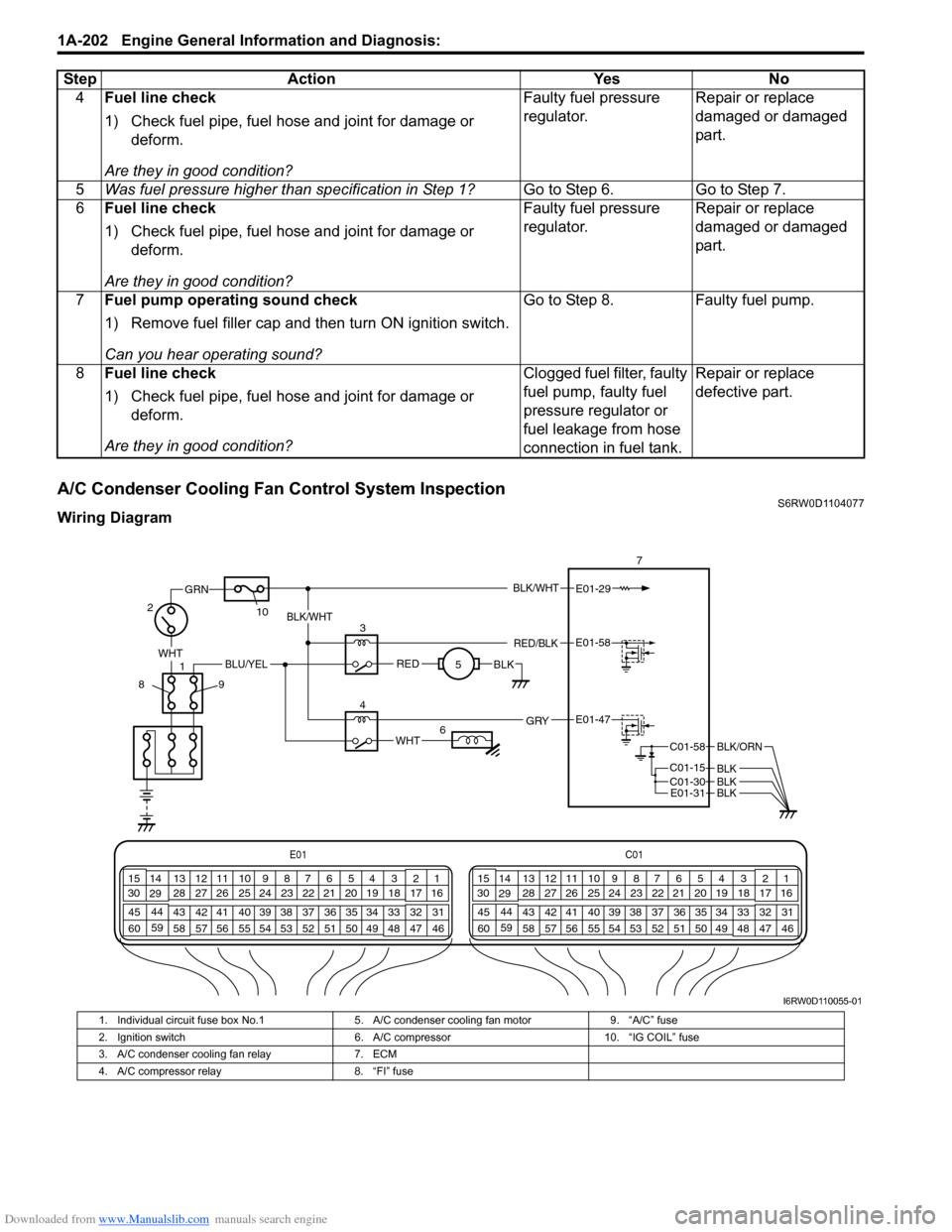
A/C Condenser Cooling Fan Control System InspectionS6RW0D1104077
Wiring Diagram4Fuel line check
1) Check fuel pipe, fuel hose and joint for damage or
deform.
Are they in good condition?Faulty fuel pressure
regulator.Repair or replace
damaged or damaged
part.
5Was fuel pressure higher than specification in Step 1?Go to Step 6. Go to Step 7.
6Fuel line check
1) Check fuel pipe, fuel hose and joint for damage or
deform.
Are they in good condition?Faulty fuel pressure
regulator.Repair or replace
damaged or damaged
part.
7Fuel pump operating sound check
1) Remove fuel filler cap and then turn ON ignition switch.
Can you hear operating sound?Go to Step 8. Faulty fuel pump.
8Fuel line check
1) Check fuel pipe, fuel hose and joint for damage or
deform.
Are they in good condition?Clogged fuel filter, faulty
fuel pump, faulty fuel
pressure regulator or
fuel leakage from hose
connection in fuel tank.Repair or replace
defective part. Step Action Yes No
E01C01
3 4
18 19 5 6 7 10 11
17 20
47 46 49 50 51 21 22
5216 259
24 14
29
55 57 54 53 59
60 582
26 27 28 15
30
56 4832 31 34 35 36 37 40 42 39 38 44
45 43 41 331 12 13
238 3 4
18 19 5 6 7 10 11
17 20
47 46 49 50 51 21 22
5216 259
24 14
29
55 57 54 53 59
60 582
26 27 28 15
30
56 4832 31 34 35 36 37 40 42 39 38 44
45 43 41 331 12 13
238
BLK/WHT
WHT
1
GRN
27
E01-29
10
89
REDBLK
3
5BLK/WHT
RED/BLKE01-58
WHT
4E01-47 GRY
BLU/YEL
6
C01-58
C01-15 C01-30
BLK/ORN
BLKBLKE01-31BLK
I6RW0D110055-01
1. Individual circuit fuse box No.1 5. A/C condenser cooling fan motor 9. “A/C” fuse
2. Ignition switch 6. A/C compressor 10. “IG COIL” fuse
3. A/C condenser cooling fan relay 7. ECM
4. A/C compressor relay 8. “FI” fuse
Page 285 of 1556

Downloaded from www.Manualslib.com manuals search engine Engine Mechanical: 1D-3
Camshaft Position Control (VVT Variable Valve Timing) System DescriptionS6RW0D1401002
System Description
The VVT system is an electronic control system which continuously vary and optimize the intake valve timing in
response to the engine operating condition.
The optimized intake valve timing produce such an air intake with high efficiency that both the higher power generation
and lower fuel consumption can be attained in the whole engine speed range from low to high. In the area of the
average engine load, low emission of nitrogen oxides (NOx) and high fuel efficiency can also be attained by making
the valve opening overlap between the intake and exhaust valves longer.
For the brief of the system operation, the intake valve timing is varied by the cam timing sprocket (1) which varies the
rotational phase between the intake camshaft (3) and sprocket. The rotor (2) in the cam timing sprocket is actuated by
switching or adjusting the hydraulic pressure applied to the chambers for the timing advancing (7) and/or retarding (6).
To switch or adjust the hydraulic pressure appropriately, ECM operates the oil control valve (12) with detecting the
engine speed, intake air value, throttle opening, engine coolant temperature and camshaft position (angle).
1
4
5
10
8
9
2
7
6
12
11
3
60˚ (variable angle)
Most retarded timing Most advanced timing
Exhaust valveIntake valve
Crank angle
Overlap of valves
Valve lift
I5RW0C140002-01
4. Oil passage to chamber for timing retarding 8. Oil filter 10. Oil pan
5. Oil passage to chamber for timing advancing 9. Oil pump 11. Control signal from ECM
Page 299 of 1556

Downloaded from www.Manualslib.com manuals search engine Engine Mechanical: 1D-17
Engine Assembly Removal and InstallationS6RW0D1406013
Removal
1) Relieve fuel pressure according to “Fuel Pressure
Relief Procedure in Section 1G”.
2) Disconnect negative and positive cable at battery.
3) Disconnect ECM connectors.
4) Remove battery and battery tray with ECM.
5) Remove right and left side engine under covers.
6) Remove A/C compressor belt by referring to
“Compressor Drive Belt Removal and Installation in
Section 7B” or “Compressor Drive Belt Removal and
Installation in Section 7B”.
7) Drain engine oil referring to “Engine Oil and Filter
Change in Section 0B”.
8) Drain transaxle oil referring to “Manual Transaxle Oil
Change in Section 5B” or “A/T Fluid Change in
Section 5A”.
9) Drain transfer oil referring to “Transfer Oil Change in
Section 3C”.
10) Drain coolant referring to “Cooling System Draining
in Section 1F”
11) Remove air cleaner assembly referring to “Air
Cleaner Assembly Removal and Installation”.
12) With hose connected, detach A/C compressor from
its bracket referring to “Compressor Assembly
Removal and Installation in Section 7B” or
“Compressor Assembly Removal and Installation in
Section 7B”.
CAUTION!
Suspend removed A/C compressor at a place
where no damage will be caused during
removal and installation of engine assembly.
13) Remove cylinder upper cover (1).14) Disconnect the following electric wires/connectors
and each clamps.
• TP sensor (1)
• MAP sensor (2)
• ECT sensor (3)
•EGR valve (4)
• CMP sensor (5)
• Ignition coil assembly (6)
• Injector (7)
•HO2S (8)
• Oil control valve (9) (for engine with VVT system)
• Engine oil pressure switch (10)
• CKP sensor (12)
• Knock sensor (13)
• Generator (14)
• Starting motor (15)
• Ground terminal (16) from cylinder block
• Battery ground cable (17) from transaxle
• Back-up light switch (18) (for M/T model)
• Torque sensor (19)
• P/S motor (20)
• Output shaft speed sensor (VSS) (29) (for A/T
model)
• Solenoid valve (30) (for A/T model)
• Transmission range sensor (31) (for A/T model)
• Input shaft speed sensor (32) (for A/T model)
15) Disconnect the following cables, and remove control
cable bracket (23)
• Gear select control cable (21) (for M/T model)
• Gear shift control cable (22) (for M/T model)
• A/T select cable (33) (for A/T model)
16) Disconnect the following hoses.
• Brake booster hose (24) from intake manifold
• Radiator inlet and outlet hoses (25) from radiator
• Heater inlet and outlet hoses (26) from heater
core
• Fuel feed hose (27) from fuel feed pipe
• Fuel vapor hose (11) from fuel vapor pipe
• Clutch hose (28) from transaxle (for M/T model)
• A/T fluid cooler hoses (for A/T model)
F: Vehicle forward 8. Engine front mounting bracket : 55 N⋅m (5.5 kgf-m, 40.0 lb-ft)
1. Engine right mounting bracket 9. Engine front mounting
: Be sure to direct yellow mark to forward.: 95 N⋅m (9.5 kgf-m, 69.0 lb-ft)
2. Engine right mounting 10. Transfer : 65 N⋅m (6.5 kgf-m, 47.0 lb-ft)
3. Engine left mounting bracket 11. Suspension frame : 25 N⋅m (2.5 kgf-m, 18.0 lb-ft)
1
I5RW0A140009-01
Page 303 of 1556

Downloaded from www.Manualslib.com manuals search engine Engine Mechanical: 1D-21
12) Install oil pressure switch bracket (1).
13) Connect right and left drive shaft joints to differential
gear referring to “Front Drive Shaft Assembly
Removal and Installation in Section 3A”.
14) Install suspension control arm referring to
“Suspension Control Arm / Bushing Removal and
Installation in Section 2B”.
15) Install cylinder upper cover (1).16) Install A/C compressor to its bracket (if equipped)
referring to “Compressor Assembly Removal and
Installation in Section 7B” or “Compressor Assembly
Removal and Installation in Section 7B”.
17) Adjust A/C compressor drive belt referring to
“Compressor Drive Belt Removal and Installation in
Section 7B” or “Compressor Drive Belt Removal and
Installation in Section 7B”.
18) Install air cleaner assembly referring to “Air Cleaner
Assembly Removal and Installation”.
19) Check to ensure that all removed parts are back in
place. Reinstall any necessary parts which have not
been reinstalled.
20) Refill cooling system with coolant referring to
“Cooling System Flush and Refill in Section 1F”.
21) Refill engine with engine oil referring to “Engine Oil
and Filter Change in Section 0B”.
22) Refill transaxle oil referring to “Manual Transaxle Oil
Change in Section 5B” or “A/T Fluid Change in
Section 5A”.
23) Refill transfer oil referring to “Transfer Oil Change in
Section 3C”.
24) Install battery and battery tray with ECM.
25) Connect ECM wire harness.
26) Connect positive and negative cable at battery.
27) Install right and left side engine under covers.
28) Verify that there is no fuel leakage, coolant leakage,
oil leakage and exhaust gas leakage at each
connection.
2. Exhaust manifold
1
2
I5RW0A140011-01
1
I5RW0A140009-01
Page 341 of 1556

Downloaded from www.Manualslib.com manuals search engine Engine Mechanical: 1D-59
Main Bearings, Crankshaft and Cylinder Block ComponentsS6RW0D1406037
I6RW0D140003-01
1. CKP sensor
: See “A”11. Rear oil seal 21. Oil filter adapter bolt
2. Knock sensor 12. Input shaft bearing 22. Spring pin
3. Cylinder block 13. Flywheel or drive plate 23. Sensor plate bolt
4. Venturi plug 14. Main bearing cap 24. Oil pressure switch
Page 342 of 1556

Downloaded from www.Manualslib.com manuals search engine 1D-60 Engine Mechanical:
Main Bearings, Crankshaft and Cylinder Block
Removal and Installation
S6RW0D1406038
Removal
1) Remove engine assembly from vehicle referring to
“Engine Assembly Removal and Installation”.
2) Remove clutch cover, clutch disc and flywheel (drive
plate for A/T) by using special tool.
Special tool
(A): 09924–178103) Remove piston and connecting rod referring to
“Pistons, Piston Rings, Connecting Rods and
Cylinders Removal and Installation”.
4) Remove rear oil seal housing (1).
5) Loosen main bearing cap No.1 and No.2 bolts in
such order as indicated in figure and remove them.
6) Remove crankshaft from cylinder block.
7) Remove sensor plate from crankshaft.
5. Main bearing
: See “B”15. Flywheel or drive plate bolt : 22 N⋅m (2.2 kgf-m, 16.0 lb-ft)
6. Sensor plate 16. Rear oil seal housing mounting bolt : 5 N⋅m (0.5 kgf-m, 4.0 lb-ft)
7. Crankshaft timing sprocket key 17. Main bearing cap No.2 bolt : 70 N⋅m (7.0 kgf-m, 51.0 lb-ft)
8. Crankshaft 18. Main bearing cap No.1 bolt
: See “D”: Tighten 25 N⋅m (2.5 kgf-m, 18.0 lb-ft) by the specified
procedure.
9. Thrust bearing 19. O-ring : Tighten 30 N⋅m (3.0 kgf-m, 22.0 lb-ft), 50 N⋅m (5.0 kgf-
m, 36.5 lb-ft) and 60° by the specified procedure.
10. Rear oil seal housing
: See “C”20. Oil filter adapter case : 11 N⋅m (1.1 kgf-m, 8.0 lb-ft)
“A”: When installing CKP sensor, use new sensor mounting bolt. : 13 N⋅m (1.3 kgf-m, 9.5 lb-ft)
“B”: Upper half of bearing has an oil groove.
Do not apply oil between connecting rod and bearing or between bearing cap and
bearing.:10 N⋅m (1.0 kgf-m, 7.5 lb-ft)
“C”: Apply sealant 99000-31250 to mating surface. : 25 N⋅m (2.5 kgf-m, 18.0 lb-ft)
“D”: Make sure main bearing cap No.1 bolt deformation when reuse it due to plastic
deformation tightening referring to “Main Bearings Inspection”.: Do not reuse.
: Apply engine oil to inside / sliding surface.
I2RH0B140125-01
I2RH0B140126-01
I2RH0B140127-01
Page 357 of 1556

Downloaded from www.Manualslib.com manuals search engine Engine Lubrication System: 1E-1
Engine
Engine Lubrication System
General Description
Engine Lubrication DescriptionS6RW0D1501001
The oil pump is of a trochoid type, and mounted on the crankshaft. Oil is drawn up through the oil pump strainer and
passed through the pump to the oil filter.
The filtered oil flows into two paths in cylinder block.
In one path, oil reaches the crankshaft journal bearings. Oil from the crankshaft journal bearings is supplied to the
connecting rod bearings by means of intersecting passages drilled in the crankshaft, and then injected from the big
end of connecting rod to lubricate piston, rings and cylinder wall.
In the other path oil goes up to the cylinder head and lubricates valves and camshafts, etc., after passing through the
internal oil way of camshafts.
An oil relief valve is provided on the oil pump. This valve starts relieving oil pressure when the pressure exceeds
specified pressure.
I5RW0C150002-01