2006 SUZUKI SX4 Cool
[x] Cancel search: CoolPage 373 of 1556

Downloaded from www.Manualslib.com manuals search engine Engine Cooling System: 1F-8
Radiator Cooling Fan Assembly On-Vehicle
Inspection
S6RW0D1606009
1) Check continuity between terminals. If there is no
continuity, replace radiator fan assembly.
2) Connect battery to radiator fan motor coupler as
shown in figure, then check that the radiator fan
motor operates smoothly. If radiator fan motor does
not operate smoothly, replace radiator fan assembly.
Reference: Fan motor specified current at 12 V
: 5.7 – 7.7 A
Radiator Cooling Fan Relay InspectionS6RW0D1606010
1) Disconnect negative (–) cable from battery.
2) Remove radiator cooling fan relay (1) from main fuse
box.
3) Check that there is no continuity between terminal
“c” and “d”. If there is continuity, replace relay.
4) Connect battery positive (+) terminal to terminal “b”
of relay and battery negative (–) terminal to terminal
“a” of relay, and then check continuity between
terminal “c” and “d”. If there is no continuity, replace
relay.
Radiator Cooling Fan Assembly Removal and
Installation
S6RW0D1606011
Removal
1) Disconnect negative (–) cable at battery.
2) Disconnect connector of cooling fan motor.
3) Drain coolant referring to “Cooling System Draining”.
4) Remove radiator inlet hose (1) and reservoir (2).
I5RW0A160004-01
I5RW0A160005-01
“d” “b”“
a”
“c”
1
I5RW0A160008-02
1
2
I6RW0B160004-02
Page 374 of 1556

Downloaded from www.Manualslib.com manuals search engine 1F-9 Engine Cooling System:
5) Remove cooling fan mounting bolts (1).
6) Remove radiator cooling fan assembly (2).
Installation
Reverse removal procedure for installation noting the
following.
• Refill cooling system referring to Step 7) to 17) of
“Cooling System Flush and Refill”.
• After installation, verify there is no coolant leakage at
each connection.
Radiator Cooling Fan Disassembly and
Reassembly
S6RW0D1606018
Disassembly
1) Remove fan (1) from cooling fan motor (2).
2) Remove fan motor (2) from cooling fan guide (3).
Reassembly
Reverse disassembly procedures for reassembly.
Radiator On-Vehicle Inspection and CleaningS6RW0D1606012
Inspection
Check radiator for leakage or damage. Straighten bent
fins, if any.
Cleaning
Clean frontal area of radiator cores.
Radiator Removal and InstallationS6RW0D1606013
Removal
1) Disconnect negative cable at battery.
2) Drain coolant referring to “Cooling System Draining”.
3) Remove front bumper referring to “Front Bumper
and Rear Bumper Components in Section 9K”.
4) Remove cooling fan assembly referring to “Radiator
Cooling Fan Assembly Removal and Installation”.
5) Remove condenser fan referring to “Condenser
Cooling Fan Removal and Installation in Section 7B”.
6) Remove radiator outlet hose from radiator.
7) Remove radiator from vehicle.
Installation
Reverse removal procedures, noting the following.
Tighten radiator support bracket bolts to specified
torque.
Tightening torque
Radiator support bracket bolt: 33 N·m (3.3 kgf-m,
24.0 lb-ft)
• Refill cooling system referring to Step 7) to 17) of
“Cooling System Flush and Refill”.
• After installation, verify there is no coolant leakage
each connection.
I5RW0C160014-01
I5RW0C160005-01
I2RH01160014-01
Page 375 of 1556

Downloaded from www.Manualslib.com manuals search engine Engine Cooling System: 1F-10
Water Pump / Generator Drive Belt Tension
Inspection and Adjustment
S6RW0D1606014
WARNING!
• Disconnect negative cable at battery
before checking and adjusting belt
tension.
• To help avoid danger of being burned, do
not remove radiator cap while engine and
radiator are still hot. Scalding fluid and
steam can be blown out under pressure if
cap is taken off too soon.
1) Inspect belt for cracks, cuts, deformation, wear and
cleanliness. If it is necessary to replace belt, refer to
“Water Pump / Generator Drive Belt Removal and
Installation”.
2) Check belt for tension. Belt is in proper tension when
it deflects the following specification under thumb
pressure (about 100 N (10kgf, 22 lbs.).
If belt tension is out of specification, go to next steps.
Water pump / generator drive belt tension
“a”: 4.5 – 5.5 mm (0.18 – 0.22 in.) as deflection /
100 N (10kgf, 22lbs)
NOTE
When replacing belt with a new one, adjust
belt tension to 4.0 – 4.5 mm (0.16 – 0.18 in.).
3) After loosening generator bracket bolts (2) and pivot
bolt (3), adjust belt tension to specification described
at step 2) by loosening / tightening generator adjust
bolt (1).
4) Tighten generator bracket bolts and pivot bolt as
specified torque.
Tightening torque
Generator bracket bolt (a): 25 N·m (2.5 kgf-m,
18.0 lb-ft)
Generator pivot bolt (b): 50 N·m (5.0 kgf-m, 36.0
lb-ft)5) Check belt tension for specification after turning
crankshaft two rotations clockwise.
6) Tighten generator adjusting bolt (1) as specified
torque.
Tightening torque
Generator adjusting bolt (c): Tighten 7.0 N⋅m
(0.7 kgf-m, 5.0 lb-ft) by the specified procedure.
7) Connect negative cable at battery.
Water Pump / Generator Drive Belt Removal and
Installation
S6RW0D1606015
Removal
1) Disconnect negative cable at battery.
2) If vehicle equipped with A/C, remove compressor
drive belt before removing water pump belt (1).
Refer to “Compressor Drive Belt Removal and
Installation in Section 7B” or “Compressor Drive Belt
Removal and Installation in Section 7B”.
3) Loosen generator bracket bolts (2) and generator
pivot bolt (3).
4) Loosen generator adjusting bolt (4), and then
remove water pump belt.
a
I5RW0C160006-01
1, (c)
2, (a)
3, (b)
I5RW0C160007-01
4
23
1
I5RW0C160008-01
Page 376 of 1556

Downloaded from www.Manualslib.com manuals search engine 1F-11 Engine Cooling System:
Installation
1) Install belt (1) to water pump pulley (2), crankshaft
pulley (3) and generator pulley (4).
2) Adjust belt tension referring to “Water Pump /
Generator Drive Belt Tension Inspection and
Adjustment”.
3) If vehicle equipped with A/C, install compressor drive
belt referring to “Compressor Drive Belt Removal
and Installation in Section 7B” or “Compressor Drive
Belt Removal and Installation in Section 7B”.
4) Connect negative cable at battery.
Water Pump Removal and InstallationS6RW0D1606016
Removal
1) Disconnect negative cable at battery.
2) Drain coolant.
3) Remove water pump / generator drive belt referring
to “Water Pump / Generator Drive Belt Removal and
Installation”.
4) Remove water pump pulley.
5) Remove water pump assembly (1).Installation
1) Apply sealant to mating surface of water pump (1) as
shown in figure.
“A”: Water tight sealant 99000–31250 (SUZUKI
Bond No.1207F)
Sealant quantity (to mating surface of water
pump)
Width “a”: 3 mm (0.12 in.)
Height “b”: 2 mm (0.08 in.)
2) Install water pump assembly (1) to cylinder block
and tighten bolts and nut to specified torque.
Tightening torque
Water pump bolt and nut (a): 25 N·m (2.5 kgf-m,
18.0 lb-ft)
3) Install water pump pulley.
4) Install water pump / generator drive belt referring to
“Water Pump / Generator Drive Belt Removal and
Installation”.
5) Install A/C compressor belt referring to “Compressor
Drive Belt Removal and Installation in Section 7B” or
“Compressor Drive Belt Removal and Installation in
Section 7B”.
6) Refill cooling system referring to Step 7) to 17) of
“Cooling System Flush and Refill”.
7) Connect negative cable at battery.
8) Check each part for leakage.
2
1
34I5RW0C160009-01
I5RW0C160011-01
I3RM0A160016-01
I5RW0C160010-01
Page 377 of 1556

Downloaded from www.Manualslib.com manuals search engine Engine Cooling System: 1F-12
Water Pump InspectionS6RW0D1606017
CAUTION!
Do not disassemble water pump.
If any repair is required on pump, replace it
as assembly.
Rotate water pump by hand to check for smooth
operation. If pump does not rotate smoothly or makes
abnormal noise, replace it.
Specifications
Tightening Torque SpecificationsS6RW0D1607001
NOTE
The specified tightening torque is also described in the following.
“Cooling System Components”
Reference:
For the tightening torque of fastener not specified in this section, refer to “Fasteners Information in Section 0A”.
Special Tools and Equipment
Recommended Service MaterialS6RW0D1608001
I2RH0B160019-01
Fastening partTightening torque
Note
N⋅mkgf-mlb-ft
Radiator support bracket bolt 33 3.3 24.0)
Generator bracket bolt 25 2.5 18.0)
Generator pivot bolt 50 5.0 36.0)
Generator adjusting bolt Tighten 7.0 N⋅m (0.7 kgf-m, 5.0 lb-ft) by the
specified procedure.)
Water pump bolt and nut 25 2.5 18.0)
Material SUZUKI recommended product or Specification Note
Water tight sealant SUZUKI Bond No.1207F P/No.: 99000–31250)
Page 407 of 1556

Downloaded from www.Manualslib.com manuals search engine Starting System: 1I-2
Condition Possible cause Correction / Reference Item
Motor not running (No
operating sound of
magnetic switch)Transmission range sensor is not in P or
N, or not adjusted (A/T model)Shift in P or N, or adjust sensor. (A/T model)
Battery run downRecharge battery.
Battery voltage too low due to battery
deteriorationReplace battery.
Poor contact in battery terminal
connectionRetighten or replace.
Loose grounding cable connectionRetighten.
Fuse set loose or blown offTighten or replace.
Poor contacting action of ignition switch
and magnetic switchReplace.
Lead wire coupler loose in placeRetighten.
Open-circuit between ignition switch and
magnetic switchRepair.
Open-circuit in pull-in coilReplace magnetic switch.
Brushes are seating poorly or worn
downRepair or replace.
Poor sliding of plunger and/or pinionRepair.
Faulty starting motor control relay“Main Relay, Fuel Pump Relay, Starting Motor
Control Relay, Throttle Actuator Control Relay
and Radiator Cooling Fan Relay Inspection in
Section 1C”.
Faulty ECM and its circuit“Inspection of ECM and Its Circuits in Section
1A”.
Motor not running
(Operating sound of
magnetic switch heard)Battery run downRecharge battery.
Battery voltage too low due to battery
deteriorationReplace battery.
Loose battery cable connectionsRetighten.
Burnt main contact point, or poor
contacting action of magnetic switchReplace magnetic switch.
Brushes are seating poorly or worn
downRepair or replace.
Weakened brush springReplace.
Burnt commutatorReplace armature.
Layer short-circuit of armatureReplace.
Crankshaft rotation obstructedRepair.
Starting motor running
but too slow (small
torque) (If battery and
wiring are satisfactory,
inspect starting motor)Insufficient contact of magnetic switch
main contactsReplace magnetic switch.
Layer short-circuit of armatureReplace.
Disconnected, burnt or worn
commutatorRepair commutator or replace armature.
Worn brushesReplace brush.
Weakened brush springsReplace spring.
Burnt or abnormally worn end bushReplace bush.
Starting motor running,
but not cranking engineWorn pinion tipReplace over-running clutch.
Poor sliding of over-running clutchRepair.
Over-running clutch slippingReplace over-running clutch.
Worn teeth of ring gearReplace flywheel (M/T model) or drive plate (A/
T model).
NoiseAbnormally worn bushReplace bush.
Worn pinion or worn teeth of ring gearReplace over-running clutch, flywheel (M/T
model) or drive plate (A/T model).
Poor sliding of pinion (failure in return
movement)Repair or replace.
Worn internal or planetary gear teethReplace.
Lack of oil in each partLubricate.
Page 428 of 1556
Downloaded from www.Manualslib.com manuals search engine 1K-1 Exhaust System:
Engine
Exhaust System
General Description
Exhaust System DescriptionS6RW0D1B01001
The exhaust system consists of an exhaust manifold, three-way catalytic converter (TWC) in catalyst case, exhaust
pipes, a muffler and seals, gasket and etc.
The three-way catalytic converter is an emission control device added to the exhaust system to lower the levels of
Hydrocarbon (HC), Carbon Monoxide (CO), and Oxides of Nitrogen (NOx) pollutants in the exhaust gas.
Diagnostic Information and Procedures
Exhaust System CheckS6RW0D1B04001
WARNING!
To avoid the danger of being burned, do not touch the exhaust system when the system is hot. Any
service on the exhaust system should be performed when the system is cool.
At every interval of periodic maintenance service, and when vehicle is raised for other service, check exhaust system
as follows:
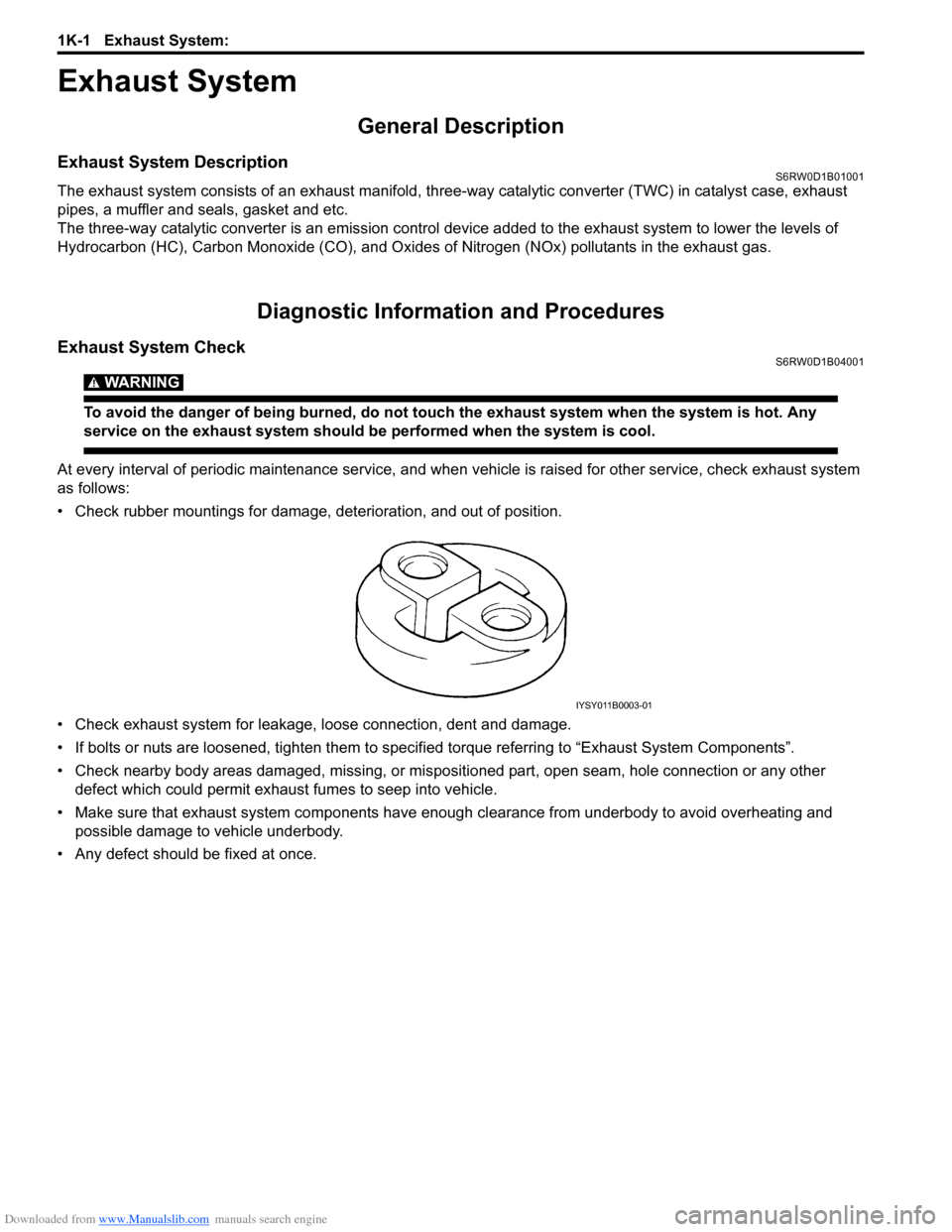
• Check rubber mountings for damage, deterioration, and out of position.
• Check exhaust system for leakage, loose connection, dent and damage.
• If bolts or nuts are loosened, tighten them to specified torque referring to “Exhaust System Components”.
• Check nearby body areas damaged, missing, or mispositioned part, open seam, hole connection or any other
defect which could permit exhaust fumes to seep into vehicle.
• Make sure that exhaust system components have enough clearance from underbody to avoid overheating and
possible damage to vehicle underbody.
• Any defect should be fixed at once.
IYSY011B0003-01
Page 429 of 1556

Downloaded from www.Manualslib.com manuals search engine Exhaust System: 1K-2
Repair Instructions
Exhaust System ComponentsS6RW0D1B06001
WARNING!
To avoid the danger of being burned, do not touch the exhaust system when the system is hot. Any
service on the exhaust system should be performed when the system is cool.
[A]
1
2
3
4
56
7
8
9
10
11
12
12
26
12
12
141515
16
26 12
17
18
18
19
19
20
21
23
22
24
25
(a)(c)
(c)
(d)
(e)
(b)
(a)
(b)(b)
(c)
(c)
(b)
(b)
14(b)
15(b)13
(e)
13
I5RW0C1B0001-01
[A]: Installing location of exhaust manifold bolt and nut. 11. Muffler 22. Exhaust pipe clamp bolt
1. Exhaust manifold gasket 12. Mounting No.1 23. Engine hook
2. Exhaust manifold 13. Heat insulator nut 24. HO2S-1 (connector color: black)
3. Exhaust manifold stiffener 14. Exhaust manifold bolt 25. Heat insulator
4. HO2S-2 (connector color: green) 15. Exhaust manifold nut 26. Mounting No.2
5. Exhaust pipe No.1 gasket 16. Exhaust No.1 pipe bolt : 45 N⋅m (4.5 kgf-m, 32.5 lb-ft)
6. No.1 seal ring 17. Exhaust manifold stiffener bolt : 50 N⋅m (5.0 kgf-m, 36.5 lb-ft)
7. No.2 seal ring 18. Exhaust No.2 pipe bolt : 43 N⋅m (4.3 kgf-m, 31.0 lb-ft)
8. Exhaust No.1 pipe 19. Exhaust center pipe bolt : 29 N⋅m (2.9 kgf-m, 21.0 lb-ft)
9. Exhaust No.2 pipe 20. Exhaust pipe No.2 gasket : 2 N⋅m (0.2 kgf-m, 1.5 lb-ft)