2006 SUBARU IMPREZA spare tire
[x] Cancel search: spare tirePage 272 of 365
In case of emergency 9-17
move the jack.
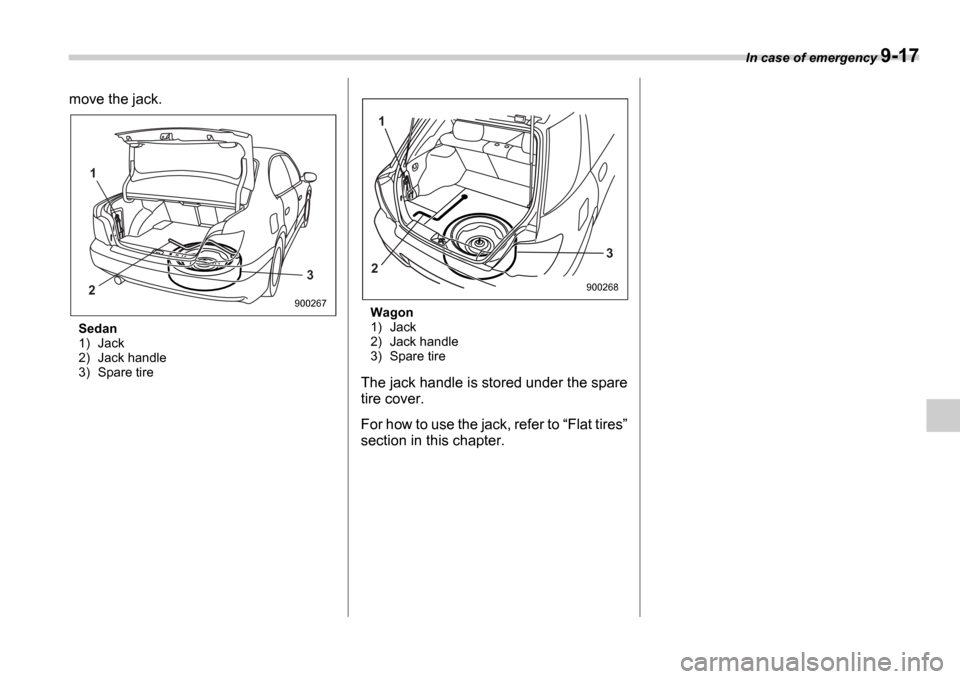
Sedan
1) Jack
2) Jack handle
3) Spare tire Wagon
1) Jack
2) Jack handle
3) Spare tire
The jack handle is stored under the spare
tire cover.
For how to use the jack, refer to
Flat tires
section in this chapter.
1
2 3
900267
3
1
2
900268
Page 309 of 365
11-30 Maintenance and service
Tires and wheels
Types of tires
You should be familiar with type of tires
present on your vehicle.
The factory-fitted 17-inch tires on the
WRX-STI are summer tires. The factory-
fitted tires on other versions are all-sea-
son tires.
All season tires
All season tires are designed to provide
an adequate measure of traction, handling
and braking performance in year-round
driving including snowy and icy road con-
ditions. However all season tires do not of-
fer as much traction performance as win-
ter (snow) tires in heavy or loose snow or
on icy roads.
All season tires are identified by ALL
SEASON and/or M+S (Mud & Snow) on
the tire sidewall.
Summer tires
Summer tires are high-speed capability
tires best suited for highway driving under
dry conditions.
Summer tires are inadequate for driving
on slippery roads such as on snow-cov-
ered or icy roads.
If you drive your vehicle on snow-covered
or icy roads, we strongly recommend the use of winter (snow) tires.
When installing winter tires, be sure to re-
place all four tires.
Winter (snow) tires
Winter tires are best suited for driving on
snow-covered and icy roads. However
winter tires do not perform as well as sum-
mer tires and all season tires on roads oth-
er than snow-covered and icy roads.
Tire inspection
Check on a daily basis that the tires are
free from serious damage, nails, and
stones. At the same time, check the tires
for abnormal wear.
Contact your SUBARU dealer immediate-
ly if you find any problem.
NOTE
When the wheels and tires strike
curbs or are subjected to harsh treat-
ment as when the vehicle is driven on a
rough surface, they can suffer damage
that cannot be seen with the naked eye.
This type of damage does not become
evident until time has passed. Try not
to drive over curbs, potholes or on oth-
er rough surfaces. If doing so is un-
avoidable, keep the vehicle s speed
down to a walking pace or less, and ap-
proach the curbs as squarely as possi- ble. Also, make sure the tires are not
pressed against the curb when you
park the vehicle.
If you feel unusual vibration while
driving or find it difficult to steer the ve-
hicle in a straight line, one of the tires
and/or wheels may be damaged. Drive
slowly to the nearest authorized
SUBARU dealer and have the vehicle
inspected.
Tire pressures and wear
Maintaining the correct tire pressures
helps to maximize the tires service lives
and is essential for good running perfor-
mance. Check and, if necessary, adjust
the pressure of each tire (including the
spare) at least once a month (for example,
during a fuel stop) and before any long
journey.
Page 335 of 365
12-4 Specifications
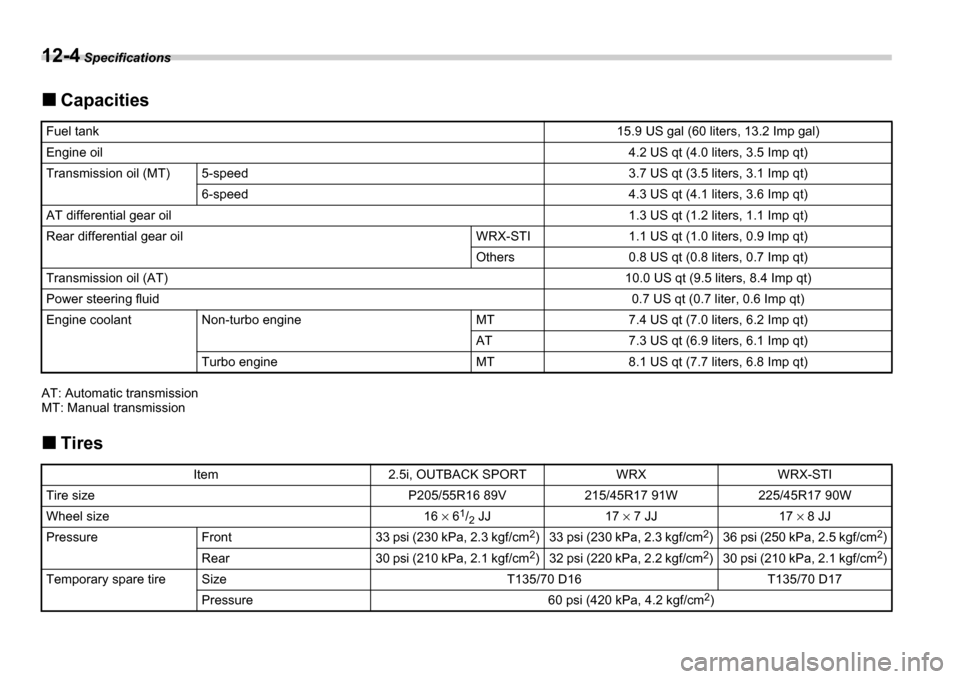
Capacities
AT: Automatic transmission
MT: Manual transmission
Tires
Fuel tank15.9 US gal (60 liters, 13.2 Imp gal)
Engine oil4.2 US qt (4.0 liters, 3.5 Imp qt)
Transmission oil (MT)5-speed3.7 US qt (3.5 liters, 3.1 Imp qt)
6-speed4.3 US qt (4.1 liters, 3.6 Imp qt)
AT differential gear oil1.3 US qt (1.2 liters, 1.1 Imp qt)
Rear differential gear oilWRX-STI1.1 US qt (1.0 liters, 0.9 Imp qt)
Others0.8 US qt (0.8 liters, 0.7 Imp qt)
Transmission oil (AT)10.0 US qt (9.5 liters, 8.4 Imp qt)
Power steering fluid0.7 US qt (0.7 liter, 0.6 Imp qt)
Engine coolantNon-turbo engineMT7.4 US qt (7.0 liters, 6.2 Imp qt)
AT7.3 US qt (6.9 liters, 6.1 Imp qt)
Turbo engineMT8.1 US qt (7.7 liters, 6.8 Imp qt)
Item2.5i, OUTBACK SPORTWRXWRX-STI
Tire sizeP205/55R16 89V215/45R17 91W225/45R17 90W
Wheel size16 6 1
/2 JJ17
7 JJ17 8 JJ
PressureFront33 psi (230 kPa, 2.3 kgf/cm 2
)33 psi (230 kPa, 2.3 kgf/cm 2
)36 psi (250 kPa, 2.5 kgf/cm 2
)
Rear30 psi (210 kPa, 2.1 kgf/cm 2
)32 psi (220 kPa, 2.2 kgf/cm 2
)30 psi (210 kPa, 2.1 kgf/cm 2
)
Temporary spare tireSizeT135/70 D16T135/70 D17
Pressure60 psi (420 kPa, 4.2 kgf/cm 2
)
Page 346 of 365
Consumer information and Reporting safety defects 13-5
CONTINUED
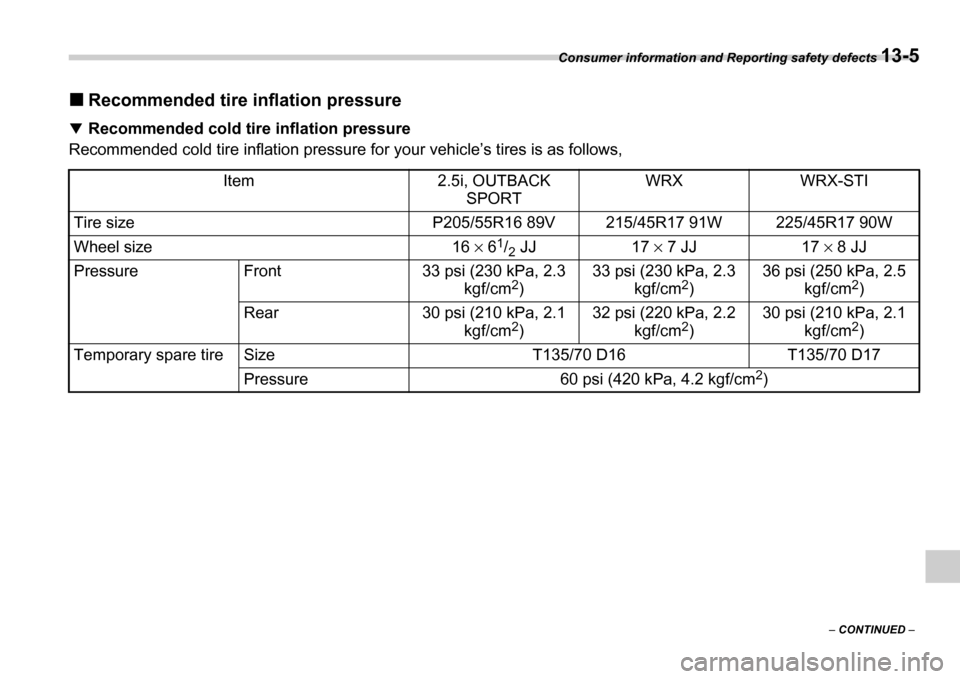
Recommended tire inflation pressure
Recommended cold tire inflation pressure
Recommended cold tire inflation pressure for your vehicle s tires is as follows,
Item2.5i, OUTBACK
SPORTWRXWRX-STI
Tire sizeP205/55R16 89V215/45R17 91W225/45R17 90W
Wheel size16 61/2 JJ17 7 JJ17 8 JJ
PressureFront33 psi (230 kPa, 2.3 kgf/cm2)
33 psi (230 kPa, 2.3 kgf/cm2)
36 psi (250 kPa, 2.5 kgf/cm2)
Rear30 psi (210 kPa, 2.1
kgf/cm2)
32 psi (220 kPa, 2.2 kgf/cm2)
30 psi (210 kPa, 2.1 kgf/cm2)
Temporary spare tireSizeT135/70 D16T135/70 D17
Pressure60 psi (420 kPa, 4.2 kgf/cm2)
Page 347 of 365
13-6 Consumer information and Reporting safety defects
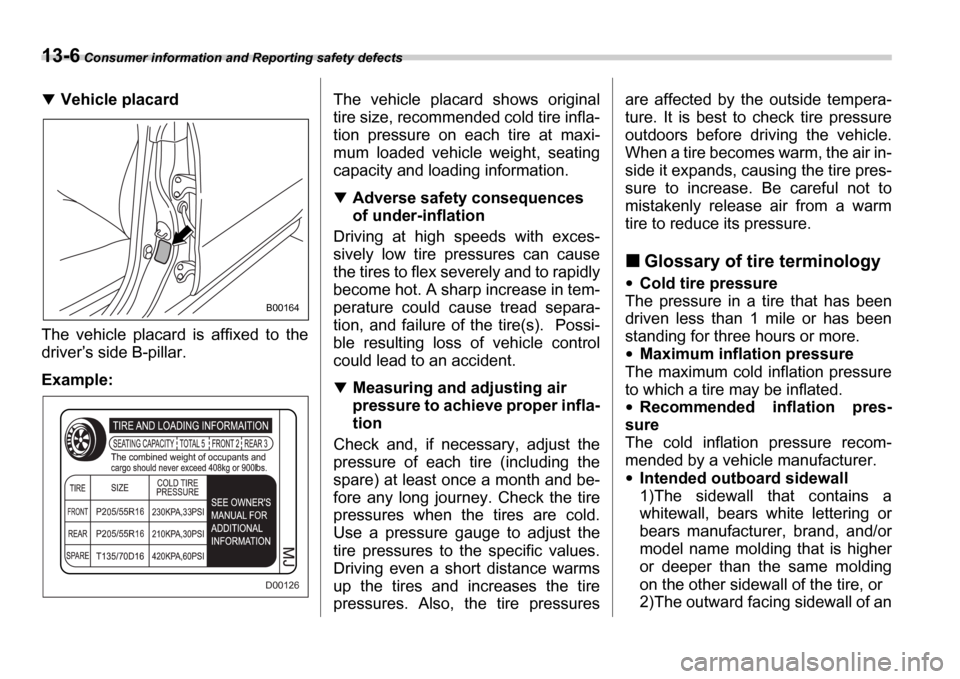
Vehicle placard
The vehicle placard is affixed to the
driver s side B-pillar.
Example: The vehicle placard shows original
tire size, recommended cold tire infla-
tion pressure on each tire at maxi-
mum loaded vehicle weight, seating
capacity and loading information.
Adverse safety consequences
of under-inflation
Driving at high speeds with exces-
sively low tire pressures can cause
the tires to flex severely and to rapidly
become hot. A sharp increase in tem-
perature could cause tread separa-
tion, and failure of the tire(s). Possi-
ble resulting loss of vehicle control
could lead to an accident.
Measuring and adjusting air
pressure to achieve proper infla-
tion
Check and, if necessary, adjust the
pressure of each tire (including the
spare) at least once a month and be-
fore any long journey. Check the tire
pressures when the tires are cold.
Use a pressure gauge to adjust the
tire pressures to the specific values.
Driving even a short distance warms
up the tires and increases the tire
pressures. Also, the tire pressures are affected by the outside tempera-
ture. It is best to check tire pressure
outdoors before driving the vehicle.
When a tire becomes warm, the air in-
side it expands, causing the tire pres-
sure to increase. Be careful not to
mistakenly release air from a warm
tire to reduce its pressure.
Glossary of tire terminology
Cold tire pressure
The pressure in a tire that has been
driven less than 1 mile or has been
standing for three hours or more.
Maximum inflation pressure
The maximum cold inflation pressure
to which a tire may be inflated.
Recommended inflation pres-
sure
The cold inflation pressure recom-
mended by a vehicle manufacturer.
Intended outboard sidewall
1)The sidewall that contains a
whitewall, bears white lettering or
bears manufacturer, brand, and/or
model name molding that is higher
or deeper than the same molding
on the other sidewall of the tire, or
2)The outward facing sidewall of an
B00164
D00126
Page 353 of 365
13-12 Consumer information and Reporting safety defects
Uniform tire quality grading
standards
This information indicates the relative
performance of passenger car tires in
the area of treadwear, traction, and
temperature resistance. This is to aid
the consumer in making an informed
choice in the purchase of tires.
Quality grades can be found where
applicable on the tire sidewall be-
tween tread shoulder and maximum
section width. For example:
Treadwear 200 Traction AA Tem-
perature A
The quality grades apply to new pneu-
matic tires for use on passenger cars.
However, they do not apply to deep
tread, winter type snow tires, space-
saver or temporary use spare tires,
tires with nominal rim diameters of 12
inches or less, or to some limited pro-
duction tires.
All passenger car tires must confirm
to Federal Safety Requirements in
addition to these grades.
Treadwear
The treadwear grade is a comparative
rating based on the wear rate of the
tire when tested under controlled con-
ditions on a specified government test
course.
For example, a tire graded 150 would
wear one and one-half (1-1/2) times
as well on the government course as
a tire graded 100. The relative perfor-
mance of tires depends upon the ac-
tual conditions of their use, however,
and may depart significantly from the
norm due to variations in driving hab-
its, service practices and differences
in road characteristics and climate.
Traction AA, A, B, C
The traction grades, from highest to
lowest, are AA, A, B and C. Those
grades represent the tire s ability to
stop on wet pavement as measured
under controlled conditions on speci-
fied government test surfaces of as-
phalt and concrete. A tire marked C
may have poor traction performance.
Temperature A, B, C
The temperature grades are A (the
highest), B, and C, representing the
tire s resistance to the generation of
heat and its ability to dissipate heat
when tested under controlled condi-
tions on a specified indoor laboratory
test wheel. Sustained high tempera-
ture can cause the material of the tire
to degenerate and reduce tire life, and
excessive temperature can lead to
sudden tire failure. The grade C corre-
sponds to a level of performance
which all passenger car tires must
meet under the Federal Motor Vehicle
Safety Standards No. 109. Grades B
and A represent higher levels of per-
formance on the laboratory test wheel
than the minimum required by law.
The traction grade assigned to
this tire is based on straight-
ahead braking traction tests,
and does not include accelera-
tion, cornering, hydroplaning, or
peak traction characteristics.
Page 362 of 365

Index 14-7
Map light ......................................... ........................... 11-50
Parking light ...................................... ......................... 11-48
Rear combination lights ............................ ................. 11-48
Trunk light ........................................ .......................... 11-51
REV indicator light and buzzer ...................... ..................... 3-9
Rocking the vehicle ................................... ....................... 8-12
Roof rail and crossbar ............................... ....................... 8-14
S
Seat Fabric ............................................ ............................... 10-5
Heater ............................................ ................................ 1-5
Seatbelt .......................................... ....................................... 4
Extender ........................................... ........................... 1-19
Maintenance ........................................ ........................ 1-18
Pretensioners ....................................... ....................... 1-20
Safety tips ......................................... ............................. 1-9
Warning light and chime ............................ ......... 1-11, 3-14
Seatbelts .......................................... .................................. 1-9
Selector lever ...................................... ............................. 7-16
Position indicator .................................. ....................... 3-20
Shift lock release ................................... ........................... 7-19
Shock sensors .......................................... ........................ 2-17
Side ventilators ................................... ................................ 4-3
Snow tires ......................................... ................................ 8-10
Sounding a panic alarm ............................. ......................... 2-8
Spark plugs ......................................... ........................... 11-17
Specifications ....................................... ............................ 12-2
Speedometer ....................................... ...................... 3-6, 3-11
SRS airbag (Supplemental Restraint System
airbag) ........................................... ............................ 4, 1-35
SRS airbag system monitors ............................ ................ 1-56SRS airbag system servicing ............................
................ 1-57
SRS airbag system warning light ..................... ................. 3-15
SRS side airbag ................................... ............................. 1-51
Starting the engine ............................... ............................... 7-7
State emission testing (U.S. only) ................. ...................... 7-5
Stopping the engine ............................... ............................. 7-8
Storage compartments ................................ ....................... 6-4
Sun shades .......................................... ............................. 2-25
Sun visors ........................................... ................................ 6-3
Supplemental Restraint System airbag (SRS) ........... ....... 1-35
Synthetic leather upholstery .......................... ................... 10-5
T
Tachometer ......................................... ....................... 3-7, 3-12
Temperature gauge ................................. .................. 3-8, 3-13
Temporary spare tire ................................ .......................... 9-2
Tilt steering wheel ................................ ............................. 3-35
Tire
Chains ............................................. ............................. 8-11
Inspection ......................................... .......................... 11-30
Pressures and wear ................................... ................ 11-30
Replacement ........................................ ...................... 11-33
Rotation .......................................... ............................ 11-33
Tires .............................................. .................................... 12-4
Types ............................................... .......................... 11-30
Tires and wheels .................................... ......................... 11-30
Top tether anchorages ............................... ....................... 1-33
Towing ............................................ .................................. 9-11
All wheels on the ground ........................... ................... 9-14
Flat-bed truck ..................................... .......................... 9-13
Trailer Hitch .............................................. ............................... 8-17
Page 365 of 365

GAS STATION REFERENCE
Fuel:
2.5-liter non-turbo models
Use only unleaded gasoline with an octane rating of 87 AKI or
higher.
WRX
Use premium unleaded gasoline with an octane rating of 91 AKI or
higher. If premium unleaded gasoline with an octane r ating of 91
AKI is not available, regular unleaded gasoline with octane rating
of 87 AKI or higher may be temporarily used. For opti mum engine
performance and driveability, it is required that you use premium
grade unleaded gasoline with an octane rating of 91 AKI or higher.
WRX-STI
Use super-premium unleaded gasoline with an octane rat ing of 93
AKI or higher. If super-premium unleaded gasoline wi th an octane
rating of 93 AKI is not available, premium unleaded g asoline with
octane rating of 91 AKI or higher may be temporarily u sed. For op-
timum engine performance and driveability, it is requir ed that you
use super-premium grade unleaded gasoline with an oct ane ratingof 93 AKI or higher.
Fuel octane rating
This octane rating is the average of the Research Octane
and Mo-
tor Octane numbers and is commonly referred to as the An ti Knock
Index (AKI). Refer to Fuel section in this manual.
Fuel capacity:
15.9 US gal (60 liters, 13.2 Imp gal)
Engine oil:
Use only API classification SM with the words ENERGY CON-
SERVING and the ILSAC certification mark (starburst mark) dis-
played on the container.
Engine oil capacity:
4.2 US qt (4.0 liters, 3.5 Imp qt)
Cold tire pressure:
Item 2.5i, OUTBACK SPORT WRX WRX-STI
Tire size P205/55R16 89V 215/45R17 91W 225/45R17 90W
Wheel size 16 6 1
/2 JJ 17
7 JJ 17 8 JJ
Pressure Front 33 psi (230 kPa, 2.3 kgf/cm 2
) 33 psi (230 kPa, 2.3 kgf/cm 2
) 36 psi (250 kPa, 2.5 kgf/cm 2
)
Rear 30 psi (210 kPa, 2.1 kgf/cm 2
) 32 psi (220 kPa, 2.2 kgf/cm 2
) 30 psi (210 kPa, 2.1 kgf/cm 2
)
Temporary spare
tire Size
T135/70 D16 T135/70 D17
Pressure 60 psi (420 kPa, 4.2 kgf/cm2
)