2006 SUBARU IMPREZA check engine light
[x] Cancel search: check engine lightPage 221 of 365
7-24 Starting and operating
Electronic Brake Force Dis-
tribution (EBD) system
The EBD system maximizes the effective-
ness of the brakes by allowing the rear
brakes to supply a greater proportion of
the braking force. It functions by adjusting
the distribution of braking force to the rear
wheels in accordance with the vehicle s
loading condition and speed.
The EBD system is an integral part of the
ABS system and uses some of the ABS
system s components to perform its func-
tion of optimizing the distribution of brak-
ing force. If any of the ABS components
used by the EBD function fails, the EBD
system also stops working.
When the EBD system is operating, you
may hear a chattering noise or feel a slight
vibration in the brake pedal. This is normal
and does not indicate a malfunction.
Steps to take if EBD system
fails
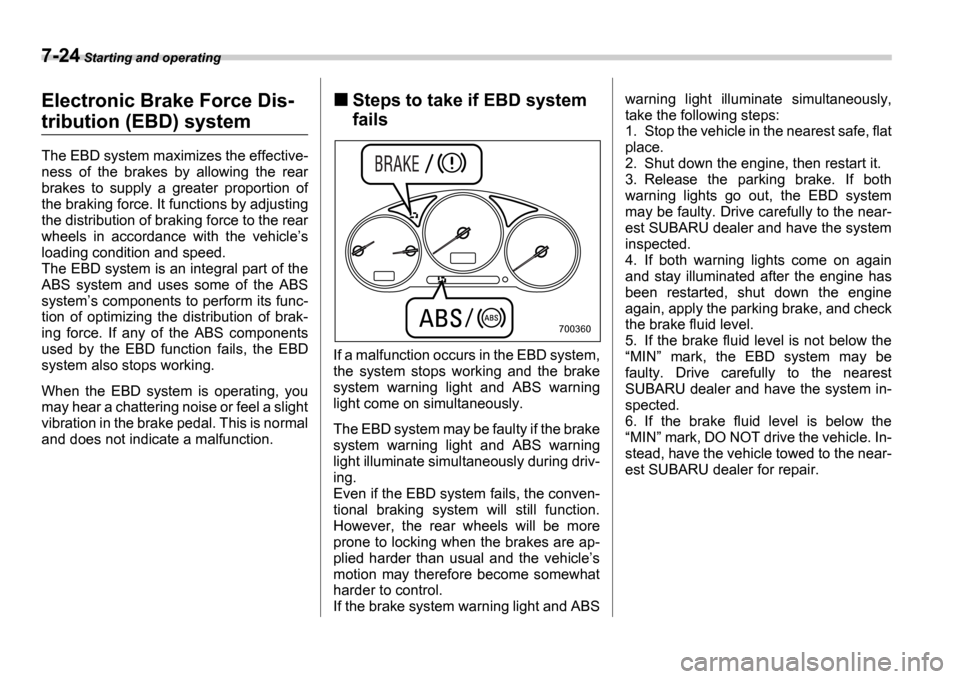
If a malfunction occurs in the EBD system,
the system stops working and the brake
system warning light and ABS warning
light come on simultaneously.
The EBD system may be faulty if the brake
system warning light and ABS warning
light illuminate simultaneously during driv-
ing.
Even if the EBD system fails, the conven-
tional braking system will still function.
However, the rear wheels will be more
prone to locking when the brakes are ap-
plied harder than usual and the vehicle s
motion may therefore become somewhat
harder to control.
If the brake system warning light and ABS warning light illuminate simultaneously,
take the following steps:
1. Stop the vehicle in the nearest safe, flat
place.
2. Shut down the engine, then restart it.
3. Release the parking brake. If both
warning lights go out, the EBD system
may be faulty. Drive carefully to the near-
est SUBARU dealer and have the system
inspected.
4. If both warning lights come on again
and stay illuminated after the engine has
been restarted, shut down the engine
again, apply the parking brake, and check
the brake fluid level.
5. If the brake fluid level is not below the
MIN mark, the EBD system may be
faulty. Drive carefully to the nearest
SUBARU dealer and have the system in-
spected.
6. If the brake fluid level is below the MIN mark, DO NOT drive the vehicle. In-
stead, have the vehicle towed to the near-
est SUBARU dealer for repair.
700360
Page 234 of 365

Driving tips 8-7
with your fingers and thumbs on the out-
side of the rim.
If driving through water, such as when
crossing shallow streams, first check the
depth of the water and the bottom of the
stream bed for firmness and ensure that
the bed of the stream is flat. Drive slowly
and completely through the stream. The
water should be shallow enough that it
does not reach the vehicle s undercar-
riage. Water entering the engine air intake
or the exhaust pipe or water splashing
onto electrical parts may damage your ve-
hicle and may cause it to stall. Never at-
tempt to drive through rushing water; re-
gardless of its depth, it can wash away the
ground from under your tires, resulting in
possible loss of traction and even vehicle
rollover.
Always check your brakes for effective-
ness immediately after driving in sand,
mud or water. Do this by driving slowly
and stepping on the brake pedal. Repeat
that process several times to dry out the
brake discs and brake pads.
Do not drive or park over or near flam-
mable materials such as dry grass or fall-
en leaves, as they may burn easily. The
exhaust system is very hot while the en-
gine is running and right after the engine
stops. This could create a fire hazard.
After driving through tall grass, mud, rocks, sand, rivers, etc., check that there
is no grass, bush, paper, rags, stones,
sand, etc. adhering to or trapped on the
underbody. Clear off any such matter from
the underbody. If the vehicle is used with
these materials trapped or adhering to the
underbody, a mechanical breakdown or
fire could occur.
Secure all cargo carried inside the vehi-
cle and make certain that it is not piled
higher than the seatbacks. During sudden
stops or jolts, unsecured cargo could be
thrown around in the vehicle and cause in-
jury. Do not pile heavy loads on the roof.
Those loads raise the vehicle s center of
gravity and make it more prone to tip over.
If you must rock the vehicle to free it
from sand or mud, depress the accelera-
tor pedal slightly and move the selector le-
ver back and forth between D and R re-
peatedly. Do not race the engine. For the
best possible traction, avoid spinning the
wheels when trying to free the vehicle.
When the road surface is extremely slip-
pery, you can obtain better traction by
starting the vehicle with the transmission
in 2nd than 1st (both for MT and AT).
Never equip your vehicle with tires larg-
er than those specified in this manual.
Frequent driving of an AWD vehicle un-
der hard-driving conditions such as rough
roads or off roads will necessitate more frequent replacement of engine oil, brake
fluid and transmission oil than that speci-
fied in the maintenance schedule de-
scribed in the
Warranty and Maintenance
Booklet .
Remember that damage done to your
Subaru while operating it off-road and not
using common sense precautions such as
those listed above is not eligible for war-
ranty coverage.
Wash the vehicle s underbody after off-
road driving. Suspension components are
particularly prone to dirt buildup, so they
need to be washed thoroughly.
Page 253 of 365
8-26 Driving tips
trailer.
Check that the vehicle sits horizontally
with the trailer attached. If the vehicle is
tipped sharply up at the front and down at
the rear, check the total trailer weight,
GVW, GAWs and tongue load again, then
confirm that the load and its distribution
are acceptable.
Check that the tire pressures are cor-
rect.
Check that the vehicle and trailer are
connected properly. Confirm that the trailer tongue is connected prop-
erly to the hitch ball. the trailer lights connector is connect-
ed properly and trailer s brake lights illu-
minate when the vehicle s brake pedal
is pressed, and that the trailer s turn sig-
nal lights flash when the vehicle s turn
signal lever is operated. the safety chains are connected prop-
erly. all cargo in the trailer is secured safe-
ty in position. the side mirrors provide a good rear-
ward field of view without a significant
blind spot.
Sufficient time should be taken to learn
the feel of the vehicle/trailer combination
before starting out on a trip. In an area free
of traffic, practice turning, stopping and
backing up.
Driving with a trailer
You should allow for considerably more
stopping distance when towing a trailer.
Avoid sudden braking because it may re-
sult in skidding or jackknifing and loss of
control.
Avoid abrupt starts and sudden acceler-
ations. If your vehicle has a manual trans-
mission, always start out in first gear and
release the clutch at moderate engine rev-
olution.
Avoid uneven steering, sharp turns and
rapid lane changes.
Slow down before turning. Make a long-
er than normal turning radius because the
trailer wheels will be closer than the vehi-
cle wheels to the inside of the turn. In a
tight turn, the trailer could hit your vehicle.
Crosswinds will adversely affect the
handling of your vehicle and trailer, caus-
ing sway. Crosswinds can be due to
weather conditions or the passing of large
tracks or buses. If swaying occurs, firmly
grip the steering wheel and slow down im-
mediately but gradually.
When passing other vehicles, consider-
able distance is required because of the
added weight and length caused by at-
taching the trailer to your vehicle.
1) Left turn
2) Right turn
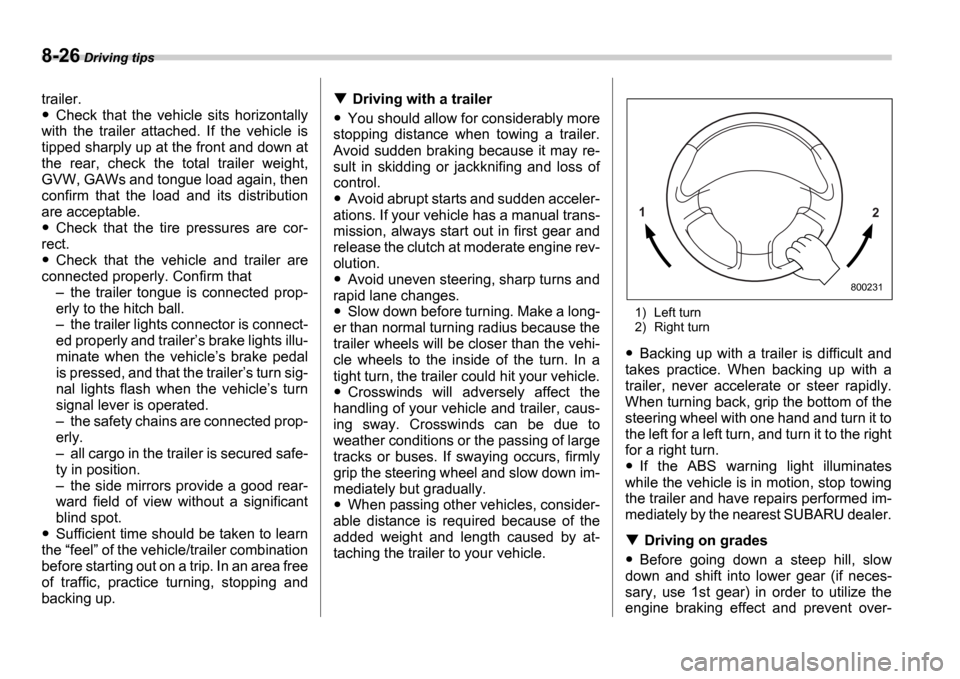
Backing up with a trailer is difficult and
takes practice. When backing up with a
trailer, never accelerate or steer rapidly.
When turning back, grip the bottom of the
steering wheel with one hand and turn it to
the left for a left turn, and turn it to the right
for a right turn.
If the ABS warning light illuminates
while the vehicle is in motion, stop towing
the trailer and have repairs performed im-
mediately by the nearest SUBARU dealer.
Driving on grades
Before going down a steep hill, slow
down and shift into lower gear (if neces-
sary, use 1st gear) in order to utilize the
engine braking effect and prevent over-
1 2
800231
Page 289 of 365
11-10 Maintenance and service
11.Reinstall under cover.
12.Pour engine oil through the filler neck.
Oil capacity (guideline):
4.2 US qt (4.0 liters, 3.5 Imp qt)
The oil quantity indicated above is only
guideline.
The necessary quantity of oil depends on
the quantity of oil that has been drained.
The quantity of drained oil differs slightly
depending on the temperature of the oil
and the time the oil is left flowing out. After refilling the engine with oil, therefore, you
must the dipstick to confirm that the level
is correct.
13.Start the engine and make sure that no
oil leaks appear around the filter
s rubber
seal and drain plug.
14.Run the engine until it reaches the nor-
mal operating temperature. Then stop the
engine and wait a few minutes to allow the
oil drain back. Check the oil level again
and if necessary, add more engine oil.
Recommended grade and
viscosity
Oil grade:
ILSAC GF-4, which can be identified
with the ILSAC certification mark
(Starburst mark)
or API classification SM with the
words ENERGY CONSERVING
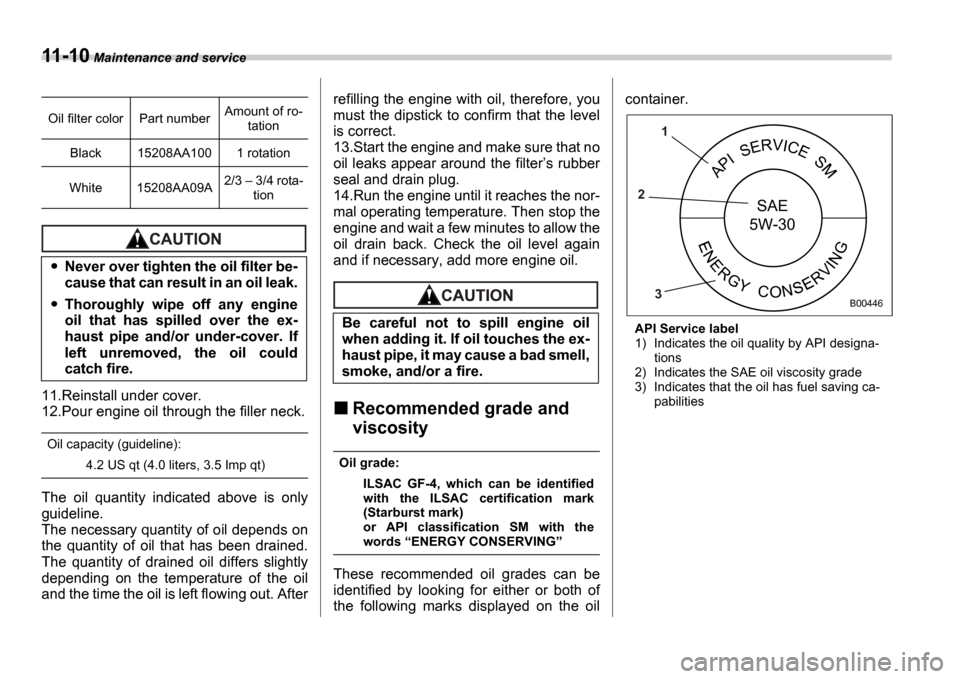
These recommended oil grades can be
identified by looking for either or both of
the following marks displayed on the oil container.
API Service label
1) Indicates the oil quality by API designa-
tions
2) Indicates the SAE oil viscosity grade
3) Indicates that the oil has fuel saving ca- pabilities
Oil filter color Part number
Amount of ro-
tation
Black 15208AA100 1 rotation
White 15208AA09A 2/3
3/4 rota-
tion
Never over tighten the oil filter be-
cause that can result in an oil leak.
Thoroughly wipe off any engine
oil that has spilled over the ex-
haust pipe and/or under-cover. If
left unremoved, the oil could
catch fire.
Be careful not to spill engine oil
when adding it. If oil touches the ex-
haust pipe, it may cause a bad smell,
smoke, and/or a fire.
APISERVICES
NERGYCONRVING
SAE
5W-30
1
2
3
B00446
Page 306 of 365
Maintenance and service 11-27
Brake booster
If the brake booster does not operate as
described in the following, have it checked
by your SUBARU dealer.
1. With the engine off, depress the brake
pedal several times, applying the same
pedal force each time. The distance the
pedal travels should not vary.
2. With the brake pedal depressed, start
the engine. The pedal should move slight-
ly down to the floor.
3. With the brake pedal depressed, stop
the engine and keep the pedal depressed
for 30 seconds. The pedal height should
not change.
4. Start the engine again and run for ap-
proximately one minute then turn it off.
Depress the brake pedal several times to
check the brake booster. The brake boost-
er operates properly if the pedal stroke de-
creases with each depression.
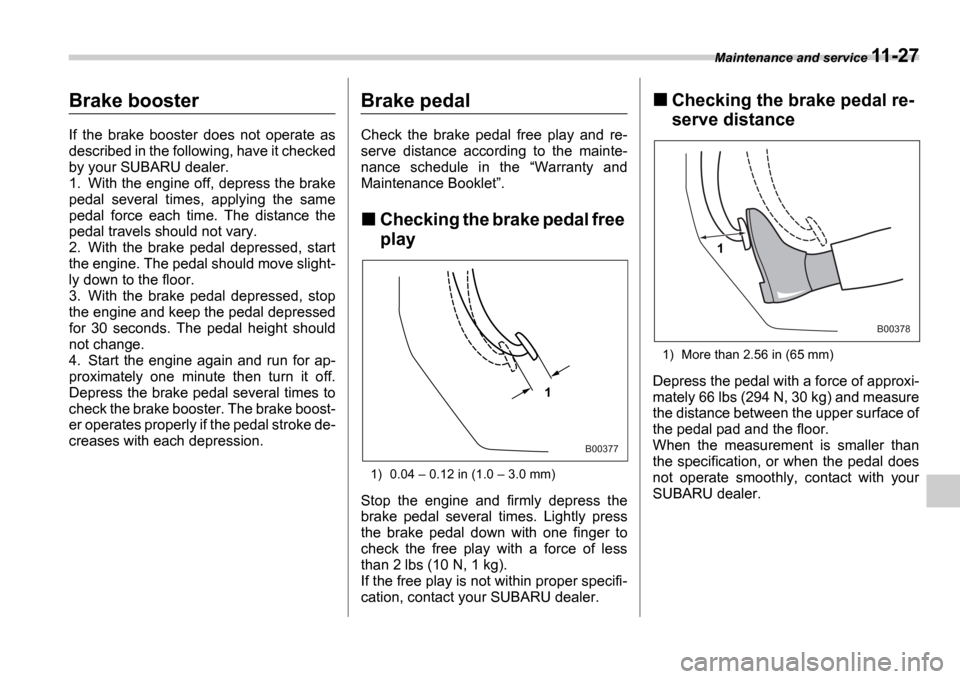
Brake pedal
Check the brake pedal free play and re-
serve distance according to the mainte-
nance schedule in the Warranty and
Maintenance Booklet .
Checking the brake pedal free
play
1) 0.04 0.12 in (1.0 3.0 mm)
Stop the engine and firmly depress the
brake pedal several times. Lightly press
the brake pedal down with one finger to
check the free play with a force of less
than 2 lbs (10 N, 1 kg).
If the free play is not within proper specifi-
cation, contact your SUBARU dealer.
Checking the brake pedal re-
serve distance
1) More than 2.56 in (65 mm)
Depress the pedal with a force of approxi-
mately 66 lbs (294 N, 30 kg) and measure
the distance between the upper surface of
the pedal pad and the floor.
When the measurement is smaller than
the specification, or when the pedal does
not operate smoothly, contact with your
SUBARU dealer.1
B00377
1
B00378
Page 307 of 365
11-28 Maintenance and service
Clutch pedal (MT vehicles)
Check the clutch pedal free play and re-
serve distance according to the mainte-
nance schedule in the Warranty and
Maintenance Booklet .
Checking the clutch function
Check the clutch engagement and disen-
gagement.
1. With the engine idling, check that there
are no abnormal noises when the clutch
pedal is depressed, and that shifting into
1st or reverse feels smooth.
2. Start the vehicle by releasing the pedal
slowly to check that the engine and trans-
mission smoothly couple without any sign
of slippage.
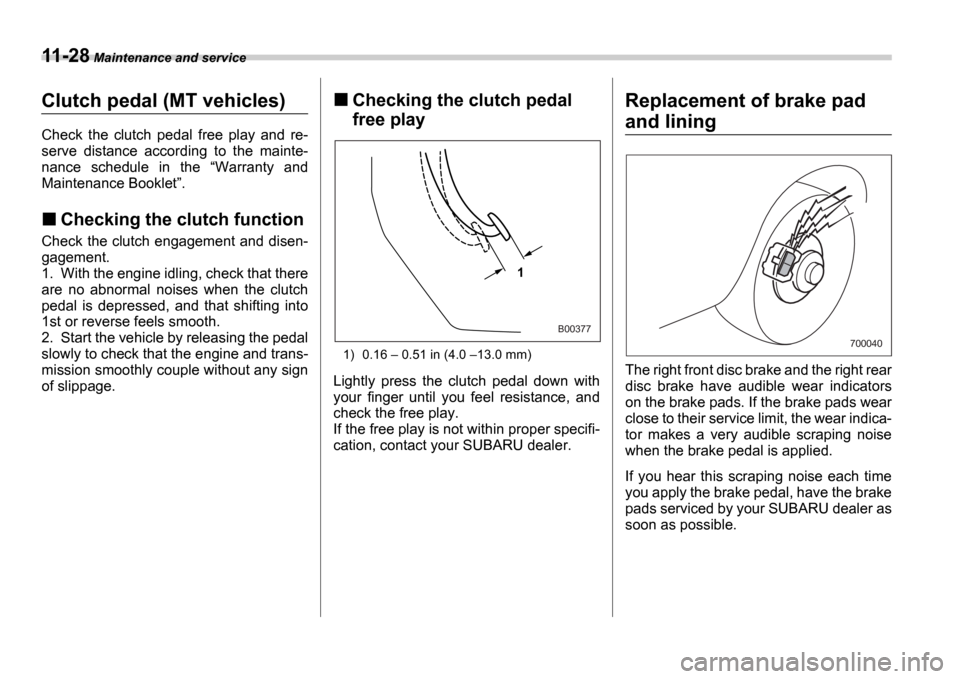
Checking the clutch pedal
free play
1) 0.16 0.51 in (4.0 13.0 mm)
Lightly press the clutch pedal down with
your finger until you feel resistance, and
check the free play.
If the free play is not within proper specifi-
cation, contact your SUBARU dealer.
Replacement of brake pad
and lining
The right front disc brake and the right rear
disc brake have audible wear indicators
on the brake pads. If the brake pads wear
close to their service limit, the wear indica-
tor makes a very audible scraping noise
when the brake pedal is applied.
If you hear this scraping noise each time
you apply the brake pedal, have the brake
pads serviced by your SUBARU dealer as
soon as possible.
1
B00377
700040
Page 358 of 365

Index 14-3
Oil and oil filter ................................ ............................. 11-8
Charge warning light .............................. .......................... 3-16
CHECK ENGINE warning light/Malfunction indicator lamp .............................................. ................................ 3-16
Checking Brake pedal free play ............................... .................. 11-27
Brake pedal reserve distance ........................... ......... 11-27
Clutch function ..................................... ...................... 11-28
Clutch pedal free play .............................. .................. 11-28
Engine oil level ................................... ......................... 11-8
Fluid level ................................. 11-20 , 11-24, 11-25, 11-26
Gear oil level ..................................... ... 11-18, 11-21, 11-22
Child restraint systems ............................... ...................... 1-23
Installation with A/ELR seatbelt ................... ................ 1-26
Lower and tether anchorages ........................ .............. 1-30
Child safety ........................................ .................................... 5
Locks ................................................ ........................... 2-18
Chime Key ................................................ ................................ 3-5
Seatbelt .......................................... .................... 1-11, 3-14
Cigarette lighter socket ............................ ........................... 6-6
Cleaning Aluminum wheels .................................... .................... 10-3
Interior .......................................... ............................... 10-5
Ventilator grille ................................. ............................ 4-11
Climate control system Automatic ......................................... .............................. 4-7
Manual ............................................ ............................... 4-3
Clock ............................................... ................................. 3-22
Clutch fluid ....................................... ............................... 11-26
Clutch pedal ....................................... ............................ 11-28
Coat hook .......................................... ................................. 6-9Coin tray ..........................................
................................... 6-4
Cooling system ....................................... ........................ 11-12
Corrosion protection ................................ ................ 8-10, 10-4
Cruise control ...................................... .............................. 7-27
Indicator light .................................... ............................ 3-20
Set indicator light ................................ ......................... 3-20
Cup holder ........................................ .................................. 6-5
D
Daytime running light system ......................... ................... 3-23
Differential gear oil Front ............................................. .............................. 11-21
Rear .............................................. ............................. 11-22
Dimensions .......................................... ............................. 12-2
Disarming the system ................................. ...................... 2-15
Disc brake pad wear warning indicators ................ ........... 7-22
Dome light ........................................ ........................ 6-2, 11-50
Door locks ......................................... .................................. 2-4
Door open warning light ........................... ......................... 3-19
Drive belts ........................................ ............................... 11-18
Driver s control center differential ....................... .............. 7-12
Drivers control center differential Auto indicator light ............................... ........................ 3-20
Indicator lights .................................... .......................... 3-21
Driving Car phone/cell phone ............................... ......................... 7
Drinking ........................................... .................................. 6
Drugs .............................................. .................................. 7
Foreign countries ................................... ........................ 8-4
Pets ............................................... .................................... 7
Snowy and icy roads ................................... ................... 8-9
Tips ............................................... .............. 7-10, 7-12, 8-5
Page 360 of 365

Index 14-5
I
Ignition switch ..................................... ................................ 3-3
Illuminated entry .................................. ............................... 2-8
Illumination brightness control .................... ...................... 3-25
Immobilizer ........................................ ................................. 2-3
Indicator light
High beam ......................................... .......................... 3-20
Selector lever position .............................. ................... 3-20
Turn signal ........................................ ........................... 3-20
Inside mirror ...................................... ............................... 3-32
Intercooler water spray .............................. ..................... 11-35
Switch ............................................. ............................. 3-31
Warning light ..................................... ........................... 3-19
Interior light .................................... ..................................... 6-2
Internal trunk lid release handle ................... .................... 2-21
J
Jack and jack handle ................................... ..................... 9-16
Jump starting ....................................... ............................... 9-9
K
Key Interlock release ................................... ......................... 3-5
Number ............................................ .............................. 2-2
Reminder chime ..................................... ....................... 3-5
Keys ............................................... .................................... 2-2
L
Leather seat materials .............................. ........................ 10-5
Light Cargo area ........................................ .................. 6-2, 11-50Dome ..............................................
.................... 6-2, 11-50
Map ............................................... ...................... 6-2, 11-50
Light control switch ................................. .......................... 3-22
Limited slip differential (LSD) ................... ......................... 7-20
Loading your vehicle ................................ ......................... 8-12
LSD (Limited slip differential) .................... ........................ 7-20
M
Main fuse .......................................... .............................. 11-43
Maintenance Precautions ......................................... ......................... 11-3
Schedule ........................................... ........................... 11-3
Seatbelt .......................................... .............................. 1-18
Tools .............................................. .............................. 9-16
Malfunction indicator lamp (Check Engine light) ....... ........ 3-16
Manual climate control system .......................... ................. 4-3
Manual transmission 5 speeds ........................................... ........................... 7-11
6 speeds ........................................... ............................. 7-9
Map light ......................................... ......................... 6-2, 11-50
Maximum load limits ................................ ......................... 8-20
Meters and gauges ................................... ................. 3-6, 3-11
Mirrors ............................................ ................................... 3-32
Moonroof .......................................... ........................ 2-24, 9-15
N
New vehicle break-in driving the first 1,000 miles (1,600 km) ......................................... .............................. 8-2
O
Odometer/Trip meter ............................... .................. 3-7, 3-11