2006 SUBARU IMPREZA fuel cap
[x] Cancel search: fuel capPage 246 of 365
Driving tips 8-19
CONTINUED
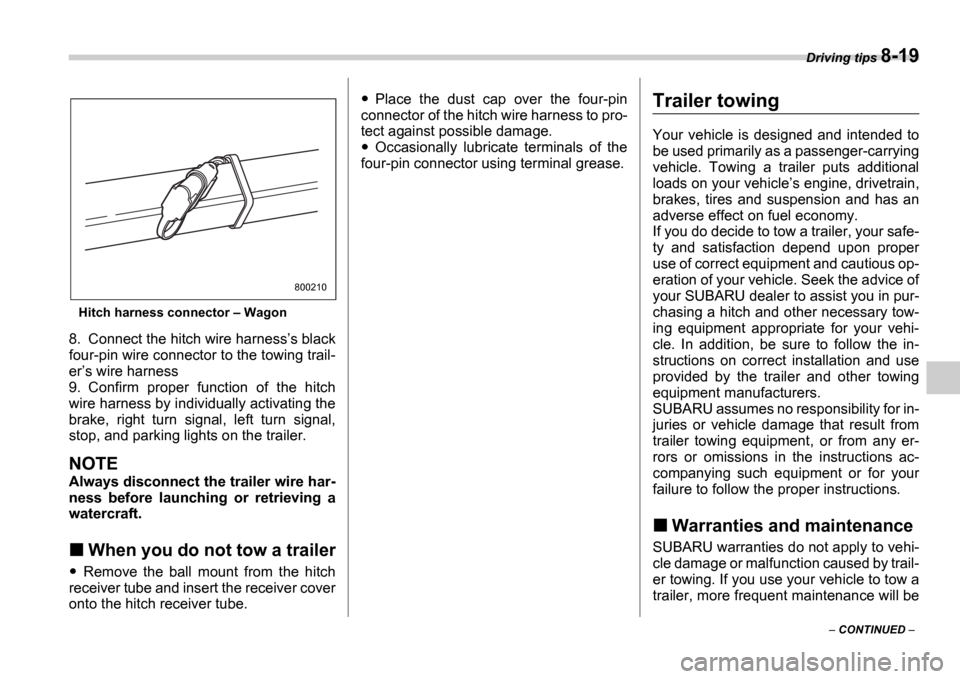
Hitch harness connector Wagon
8. Connect the hitch wire harness s black
four-pin wire connector to the towing trail-
er s wire harness
9. Confirm proper function of the hitch
wire harness by individually activating the
brake, right turn signal, left turn signal,
stop, and parking lights on the trailer.
NOTE
Always disconnect the trailer wire har-
ness before launching or retrieving a
watercraft.
When you do not tow a trailer
Remove the ball mount from the hitch
receiver tube and insert the receiver cover
onto the hitch receiver tube.
Place the dust cap over the four-pin
connector of the hitch wire harness to pro-
tect against possible damage.
Occasionally lubricate terminals of the
four-pin connector using terminal grease.
Trailer towing
Your vehicle is designed and intended to
be used primarily as a passenger-carrying
vehicle. Towing a trailer puts additional
loads on your vehicle s engine, drivetrain,
brakes, tires and suspension and has an
adverse effect on fuel economy.
If you do decide to tow a trailer, your safe-
ty and satisfaction depend upon proper
use of correct equipment and cautious op-
eration of your vehicle. Seek the advice of
your SUBARU dealer to assist you in pur-
chasing a hitch and other necessary tow-
ing equipment appropriate for your vehi-
cle. In addition, be sure to follow the in-
structions on correct installation and use
provided by the trailer and other towing
equipment manufacturers.
SUBARU assumes no responsibility for in-
juries or vehicle damage that result from
trailer towing equipment, or from any er-
rors or omissions in the instructions ac-
companying such equipment or for your
failure to follow the proper instructions.
Warranties and maintenance
SUBARU warranties do not apply to vehi-
cle damage or malfunction caused by trail-
er towing. If you use your vehicle to tow a
trailer, more frequent maintenance will be
800210
Page 287 of 365
11-8 Maintenance and service
Engine oil
Checking the oil level
Check the engine oil level at each fuel
stop.
1. Park the vehicle on a level surface and
stop the engine.
2. Pull out the dipstick, wipe it clean, and
insert it again.
3. Be sure the dipstick is correctly insert-
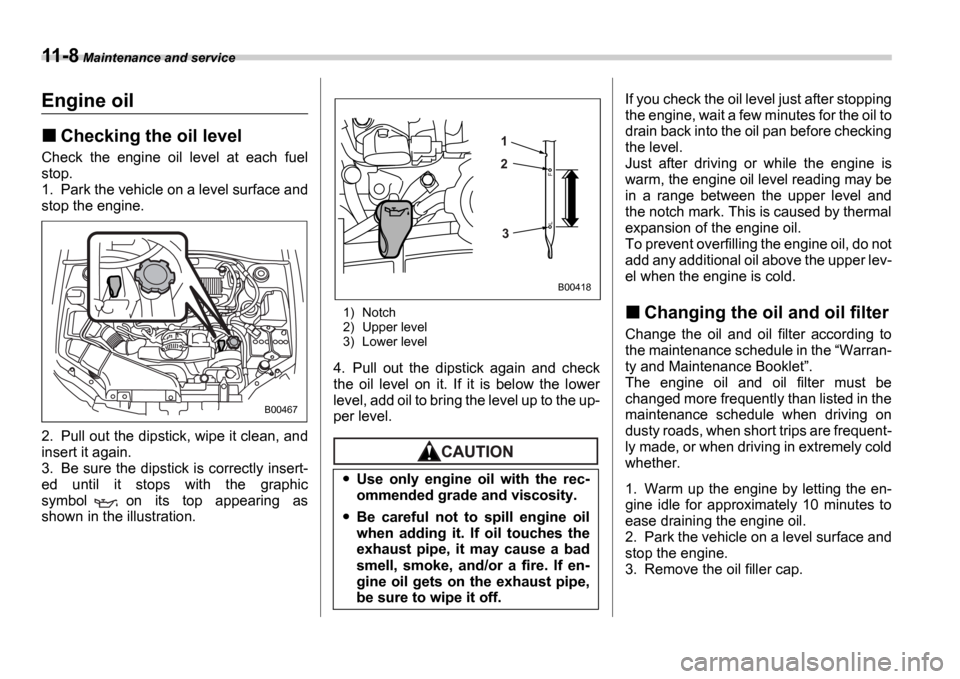
ed until it stops with the graphic
symbol on its top appearing as
shown in the illustration.
1) Notch
2) Upper level
3) Lower level
4. Pull out the dipstick again and check
the oil level on it. If it is below the lower
level, add oil to bring the level up to the up-
per level.
If you check the oil level just after stopping
the engine, wait a few minutes for the oil to
drain back into the oil pan before checking
the level.
Just after driving or while the engine is
warm, the engine oil level reading may be
in a range between the upper level and
the notch mark. This is caused by thermal
expansion of the engine oil.
To prevent overfilling the engine oil, do not
add any additional oil above the upper lev-
el when the engine is cold.
Changing the oil and oil filter
Change the oil and oil filter according to
the maintenance schedule in the Warran-
ty and Maintenance Booklet .
The engine oil and oil filter must be
changed more frequently than listed in the
maintenance schedule when driving on
dusty roads, when short trips are frequent-
ly made, or when driving in extremely cold
whether.
1. Warm up the engine by letting the en-
gine idle for approximately 10 minutes to
ease draining the engine oil.
2. Park the vehicle on a level surface and
stop the engine.
3. Remove the oil filler cap.
B00467
Use only engine oil with the rec-
ommended grade and viscosity.
Be careful not to spill engine oil
when adding it. If oil touches the
exhaust pipe, it may cause a bad
smell, smoke, and/or a fire. If en-
gine oil gets on the exhaust pipe,
be sure to wipe it off.
1 2
3
B00418
Page 289 of 365
11-10 Maintenance and service
11.Reinstall under cover.
12.Pour engine oil through the filler neck.
Oil capacity (guideline):
4.2 US qt (4.0 liters, 3.5 Imp qt)
The oil quantity indicated above is only
guideline.
The necessary quantity of oil depends on
the quantity of oil that has been drained.
The quantity of drained oil differs slightly
depending on the temperature of the oil
and the time the oil is left flowing out. After refilling the engine with oil, therefore, you
must the dipstick to confirm that the level
is correct.
13.Start the engine and make sure that no
oil leaks appear around the filter
s rubber
seal and drain plug.
14.Run the engine until it reaches the nor-
mal operating temperature. Then stop the
engine and wait a few minutes to allow the
oil drain back. Check the oil level again
and if necessary, add more engine oil.
Recommended grade and
viscosity
Oil grade:
ILSAC GF-4, which can be identified
with the ILSAC certification mark
(Starburst mark)
or API classification SM with the
words ENERGY CONSERVING
These recommended oil grades can be
identified by looking for either or both of
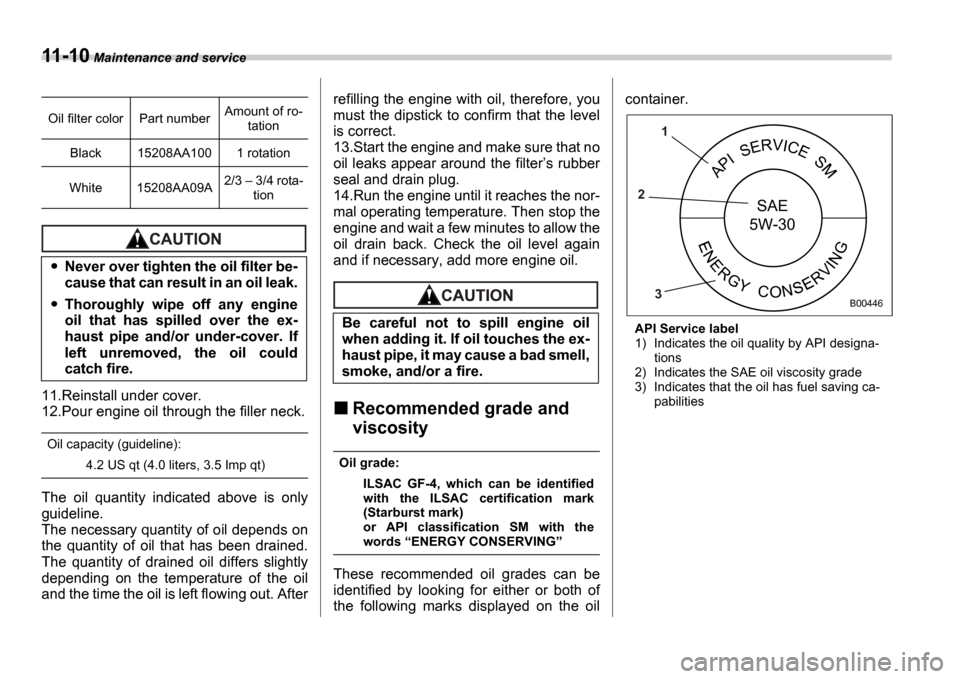
the following marks displayed on the oil container.
API Service label
1) Indicates the oil quality by API designa-
tions
2) Indicates the SAE oil viscosity grade
3) Indicates that the oil has fuel saving ca- pabilities
Oil filter color Part number
Amount of ro-
tation
Black 15208AA100 1 rotation
White 15208AA09A 2/3
3/4 rota-
tion
Never over tighten the oil filter be-
cause that can result in an oil leak.
Thoroughly wipe off any engine
oil that has spilled over the ex-
haust pipe and/or under-cover. If
left unremoved, the oil could
catch fire.
Be careful not to spill engine oil
when adding it. If oil touches the ex-
haust pipe, it may cause a bad smell,
smoke, and/or a fire.
APISERVICES
NERGYCONRVING
SAE
5W-30
1
2
3
B00446
Page 291 of 365
11-12 Maintenance and service
Cooling system
Cooling fan, hose and con-
nections
Your vehicle employs an electric cooling
fan which is thermostatically controlled to
operate when the engine coolant reaches
a specific temperature.
If the radiator cooling fan does not operate
even when the engine coolant tempera-
ture gauge exceeds the normal operating
range, the cooling fan circuit may be de-
fective. Check the fuse and replace it if
necessary. If the fuse is not blown, have
the cooling system checked by your
SUBARU dealer.
If frequent addition of coolant is neces-
sary, there may be a leak in the engine
cooling system. It is recommended that
the cooling system and connections be
checked for leaks, damage, or looseness.
Engine coolant
Checking the coolant level
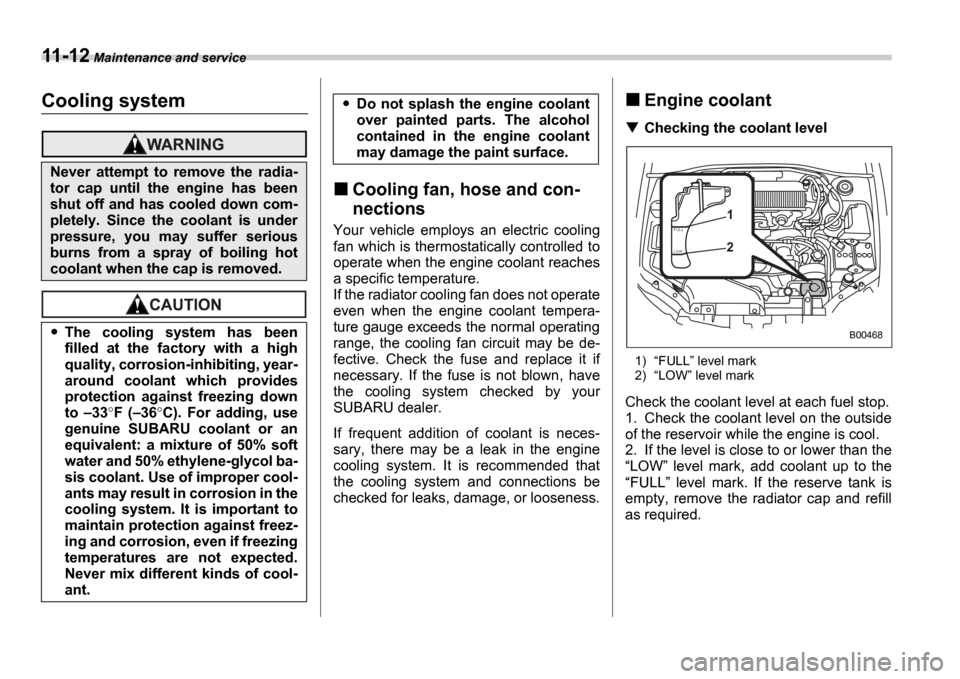
1)FULL level mark
2) LOW level mark
Check the coolant level at each fuel stop.
1. Check the coolant level on the outside
of the reservoir while the engine is cool.
2. If the level is close to or lower than the LOW level mark, add coolant up to the
FULL level mark. If the reserve tank is
empty, remove the radiator cap and refill
as required.
Never attempt to remove the radia-
tor cap until the engine has been
shut off and has cooled down com-
pletely. Since the coolant is under
pressure, you may suffer serious
burns from a spray of boiling hot
coolant when the cap is removed.
The cooling system has been
filled at the factory with a high
quality, corrosion-inhibiting, year-
around coolant which provides
protection against freezing down
to 33 F ( 36 C). For adding, use
genuine SUBARU coolant or an
equivalent: a mixture of 50% soft
water and 50% ethylene-glycol ba-
sis coolant. Use of improper cool-
ants may result in corrosion in the
cooling system. It is important to
maintain protection against freez-
ing and corrosion, even if freezing
temperatures are not expected.
Never mix different kinds of cool-
ant.
Do not splash the engine coolant
over painted parts. The alcohol
contained in the engine coolant
may damage the paint surface.
F U L L
L OW1 2
B00468
Page 309 of 365
11-30 Maintenance and service
Tires and wheels
Types of tires
You should be familiar with type of tires
present on your vehicle.
The factory-fitted 17-inch tires on the
WRX-STI are summer tires. The factory-
fitted tires on other versions are all-sea-
son tires.
All season tires
All season tires are designed to provide
an adequate measure of traction, handling
and braking performance in year-round
driving including snowy and icy road con-
ditions. However all season tires do not of-
fer as much traction performance as win-
ter (snow) tires in heavy or loose snow or
on icy roads.
All season tires are identified by ALL
SEASON and/or M+S (Mud & Snow) on
the tire sidewall.
Summer tires
Summer tires are high-speed capability
tires best suited for highway driving under
dry conditions.
Summer tires are inadequate for driving
on slippery roads such as on snow-cov-
ered or icy roads.
If you drive your vehicle on snow-covered
or icy roads, we strongly recommend the use of winter (snow) tires.
When installing winter tires, be sure to re-
place all four tires.
Winter (snow) tires
Winter tires are best suited for driving on
snow-covered and icy roads. However
winter tires do not perform as well as sum-
mer tires and all season tires on roads oth-
er than snow-covered and icy roads.
Tire inspection
Check on a daily basis that the tires are
free from serious damage, nails, and
stones. At the same time, check the tires
for abnormal wear.
Contact your SUBARU dealer immediate-
ly if you find any problem.
NOTE
When the wheels and tires strike
curbs or are subjected to harsh treat-
ment as when the vehicle is driven on a
rough surface, they can suffer damage
that cannot be seen with the naked eye.
This type of damage does not become
evident until time has passed. Try not
to drive over curbs, potholes or on oth-
er rough surfaces. If doing so is un-
avoidable, keep the vehicle s speed
down to a walking pace or less, and ap-
proach the curbs as squarely as possi- ble. Also, make sure the tires are not
pressed against the curb when you
park the vehicle.
If you feel unusual vibration while
driving or find it difficult to steer the ve-
hicle in a straight line, one of the tires
and/or wheels may be damaged. Drive
slowly to the nearest authorized
SUBARU dealer and have the vehicle
inspected.
Tire pressures and wear
Maintaining the correct tire pressures
helps to maximize the tires service lives
and is essential for good running perfor-
mance. Check and, if necessary, adjust
the pressure of each tire (including the
spare) at least once a month (for example,
during a fuel stop) and before any long
journey.
Page 335 of 365
12-4 Specifications
Capacities
AT: Automatic transmission
MT: Manual transmission
Tires
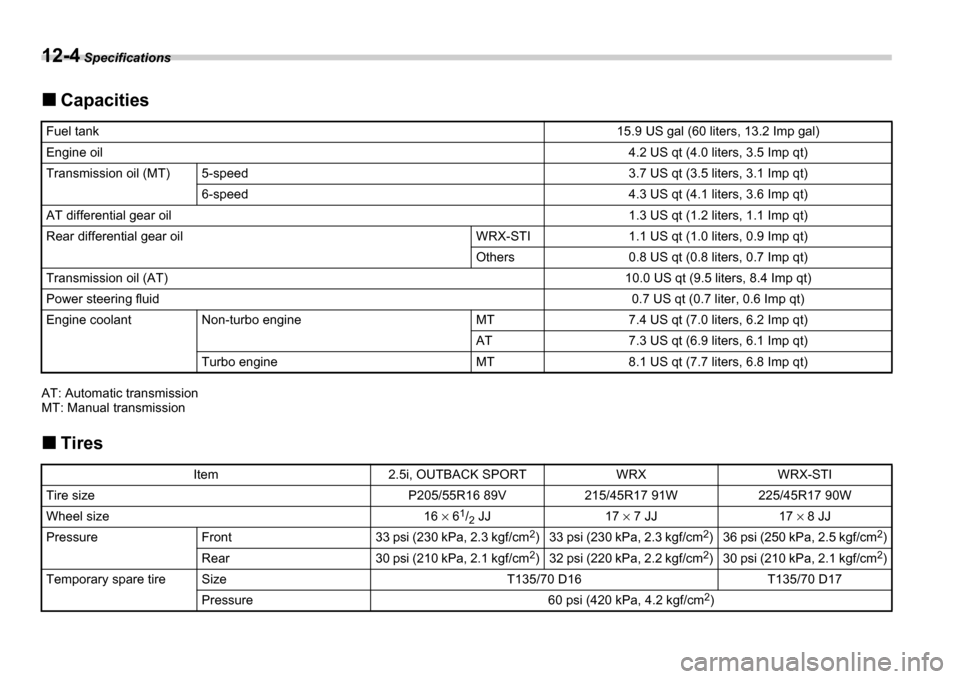
Fuel tank15.9 US gal (60 liters, 13.2 Imp gal)
Engine oil4.2 US qt (4.0 liters, 3.5 Imp qt)
Transmission oil (MT)5-speed3.7 US qt (3.5 liters, 3.1 Imp qt)
6-speed4.3 US qt (4.1 liters, 3.6 Imp qt)
AT differential gear oil1.3 US qt (1.2 liters, 1.1 Imp qt)
Rear differential gear oilWRX-STI1.1 US qt (1.0 liters, 0.9 Imp qt)
Others0.8 US qt (0.8 liters, 0.7 Imp qt)
Transmission oil (AT)10.0 US qt (9.5 liters, 8.4 Imp qt)
Power steering fluid0.7 US qt (0.7 liter, 0.6 Imp qt)
Engine coolantNon-turbo engineMT7.4 US qt (7.0 liters, 6.2 Imp qt)
AT7.3 US qt (6.9 liters, 6.1 Imp qt)
Turbo engineMT8.1 US qt (7.7 liters, 6.8 Imp qt)
Item2.5i, OUTBACK SPORTWRXWRX-STI
Tire sizeP205/55R16 89V215/45R17 91W225/45R17 90W
Wheel size16 6 1
/2 JJ17
7 JJ17 8 JJ
PressureFront33 psi (230 kPa, 2.3 kgf/cm 2
)33 psi (230 kPa, 2.3 kgf/cm 2
)36 psi (250 kPa, 2.5 kgf/cm 2
)
Rear30 psi (210 kPa, 2.1 kgf/cm 2
)32 psi (220 kPa, 2.2 kgf/cm 2
)30 psi (210 kPa, 2.1 kgf/cm 2
)
Temporary spare tireSizeT135/70 D16T135/70 D17
Pressure60 psi (420 kPa, 4.2 kgf/cm 2
)
Page 348 of 365

Consumer information and Reporting safety defects 13-7
CONTINUED
asymmetrical tire that has a particu-
lar side that must always face out-
ward when mounting on a vehicle.
Accessory weight
The combined weight (in excess of
those standard items which may be
replaced) of floor mats, leather seats
and cross bars to the extent that these
items are available as factory-in-
stalled equipment (whether installed
or not).
Curb weight
The weight of a motor vehicle with
standard equipment including the
maximum capacity of fuel, oil, and
coolant and air conditioning.
Maximum loaded vehicle weight
The sum of curb weight, accessory
weight, vehicle capacity weight and
production options weight.
Normal occupant weight
150 lbs (68 kg) times the number of
occupants (3 occupants).
Occupant distribution
Distribution of occupants in a vehicle,
2 in front, 1 in rear seat.
Production options weight
The combined weight of those in-
stalled regular production options weighing over 5.1 lbs (2.3 kg) in ex-
cess of those standards items which
they replace, not previously consid-
ered in curb weight or accessory
weight.
Vehicle capacity weight
The total weight of cargo, luggage
and occupants that can be added to
the vehicle.
Vehicle maximum load on a tire
Load on an individual tire that is deter-
mined by distributing to each axle its
share of the maximum loaded vehicle
weight and dividing by two.
Vehicle normal load on a tire
Load on an individual tire that is deter-
mined by distributing to each axle its
share of the curb weight, accessory
weight, and normal occupant weight
and dividing by two.
Tire care maintenance and
safety practices
Check on a daily basis that the tires
are free from serious damage, nails,
and stones. At the same time, check
the tires for abnormal wear.
Inspect the tire tread regularly and
replace the tires before their tread wear indicators become visible. When
a tire
s tread wear indicator becomes
visible, the tire is worn beyond the ac-
ceptable limit and must be replaced
immediately. With a tire in this condi-
tion, driving at even low speeds in wet
weather can cause the vehicle to hy-
droplane. Possible resulting loss of
vehicle control can lead to an acci-
dent.
To maximize the life of each tire and
ensure that the tires wear uniformly, it
is best to rotate the tires every 7,500
miles (12,500 km). Rotating the tires
involves switching the front and rear
tires on the right-hand side of the ve-
hicle and similarly switching the front
and rear tires on the left-hand side of
the vehicle. (Each tire must be kept on
its original side of the vehicle.) Re-
place any damaged or unevenly worn
tire at the time of rotation. After tire ro-
tation, adjust the tire pressures and
make sure the wheel nuts are correct-
ly tightened. A tightening torque spec-
ification and a tightening sequence
specification for the wheel nuts can be
found Flat tires section in chapter 9.
Page 359 of 365

14-4 Index
Tired or sleepy .................................... ............................... 7
E
EBD (Electronic brake force distribution) system ........ ..... 7-24
Electrical system ..................................... ......................... 12-3
Electronic Brake Force Distribution (EBD) system ......... .. 7-24
Emergency Locking Retractor (ELR) .................... ............ 1-11
Engine Compartment overview ................................ ................ 11-6
Coolant ........................................... ........................... 11-12
Exhaust gas (Carbon monoxide) ....................... ........ 6, 8-2
Hood .............................................. .............................. 11-4
Oil ............................................... ................................. 11-8
Overheating ........................................ ......................... 9-11
Starting .......................................... ................................ 7-7
Stopping .......................................... .............................. 7-8
Exterior care ....................................... .............................. 10-2
F
Flat tires ......................................... .................................... 9-4
Floor mat ......................................... ................................... 6-9
Fluid level
Automatic transmission ............................... .............. 11-20
Brake .............................................. ........................... 11-25
Clutch ............................................. ........................... 11-26
Power steering ..................................... ...................... 11-24
Folding down the rear seat ......................... ........................ 1-8
Front
Differential gear oil ............................. ........................ 11-21
Fog light ......................................... ............................ 11-48
Fog light button .................................. .......................... 3-26Seatbelt pretensioners ..............................
................... 1-20
Seats .............................................. ................................ 1-2
Turn signal light .................................. ....................... 11-48
Fuel .............................................. ....................................... 7-2
Economy hints ........................................ ....................... 8-2
Filler lid and cap ................................. ............................ 7-4
Gauge ............................................. ...................... 3-8, 3-12
Requirements ...................................... .......................... 7-2
Fuses .............................................. ................................ 11-41
Fuses and circuits ..................................... ........................ 12-6
G
GAWR (Gross Axle Weight Rating) ..................... ............. 8-14
Glove box ........................................... ................................ 6-4
GVWR (Gross Vehicle Weight Rating) ................... .......... 8-14
H
Hazard warning flasher ............................. .......................... 3-6
Head restraint adjustment (Front) ................... .................... 1-4
Head restraint adjustment (Wagon) .................. .................. 1-7
Headlight beam leveler ............................ ......................... 3-25
Headlight flasher .................................. ............................. 3-23
Headlight indicator light .......................... .......................... 3-21
Headlights ......................................... ..................... 3-22, 11-45
Heater operation .................................. ............................... 4-5
High beam indicator light .......................... ........................ 3-20
High mount stop light .............................. ........................ 11-51
Horn .............................................. .................................... 3-35
Hose and connections .................................. .................. 11-12