2006 SUBARU IMPREZA air condition
[x] Cancel search: air conditionPage 90 of 365
Keys and doors 2-3
CONTINUED
Immobilizer (Turbo models)
The immobilizer system is designed to
prevent an unauthorized person from
starting the engine. Only keys registered
with your vehicle s immobilizer system
can be used to operate your vehicle. Even
if an unregistered key fits into the ignition
switch and can be turned to the START
position, the engine will automatically stop
after several seconds.
Each immobilizer key contains a tran-
sponder in which the key s ID code is
stored. When a key is inserted into the ig-
nition switch and turned to the ON posi-
tion, the transponder transmits the key s
ID code to the immobilizer system s re-
ceiver. If the transmitted ID code matches
the ID code registered in the immobilizer
system, the system allows the engine to
be started. Since the ID code is transmit-
ted and acted upon almost instantly, the
immobilizer system does not impede nor-
mal starting of the engine.
If the engine fails to start, pull out the key
once before trying again. (Refer to the Ig-
nition switch section [chapter 3].)
This device complies with Part 15 of
the FCC Rules and with RSS-210 of In-
dustry Canada. Operation is subject to
the following two conditions: (1) This device may not cause harmful interfer-
ence, and (2) this device must accept
any interference received, including in-
terference that may cause undesired
operation.
Changes or modifications not express-
ly approved by the party responsible
for compliance could void the user
s
authority to operate the equipment.
NOTE
To protect your vehicle from theft,
please pay close attention to the fol-
lowing security precautions:
Never leave your vehicle unattended
with its keys inside.
Before leaving your vehicle, close all
windows and lock the doors and rear
gate.
Do not leave spare keys or any
record of your key number in the vehi-
cle.
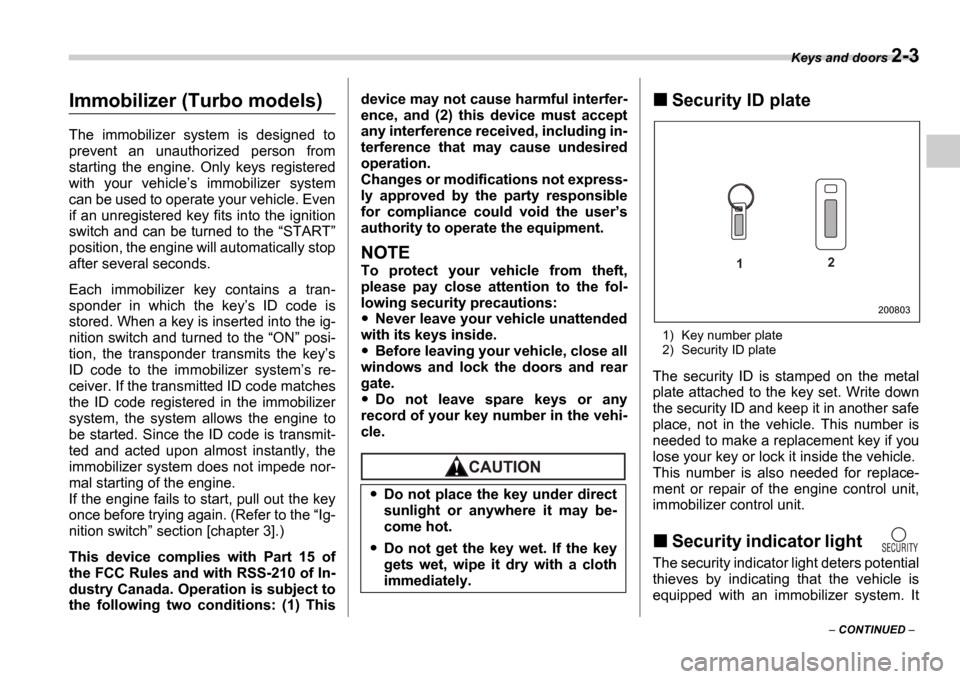
Security ID plate
1) Key number plate
2) Security ID plate
The security ID is stamped on the metal
plate attached to the key set. Write down
the security ID and keep it in another safe
place, not in the vehicle. This number is
needed to make a replacement key if you
lose your key or lock it inside the vehicle.
This number is also needed for replace-
ment or repair of the engine control unit,
immobilizer control unit.
Security indicator light
The security indicator light deters potential
thieves by indicating that the vehicle is
equipped with an immobilizer system. It
Do not place the key under direct
sunlight or anywhere it may be-
come hot.
Do not get the key wet. If the key
gets wet, wipe it dry with a cloth
immediately.
1 2
200803
Page 128 of 365
Instruments and controls 3-15
CONTINUED
SRS airbag system
warning light
When the ignition switch is turned to the ON position, the SRS airbag system
warning light will come on for approxi-
mately six seconds and go out. This
shows the SRS airbag and SRS side air-
bag (if equipped) and seatbelt pretension-
ers are in normal operation.
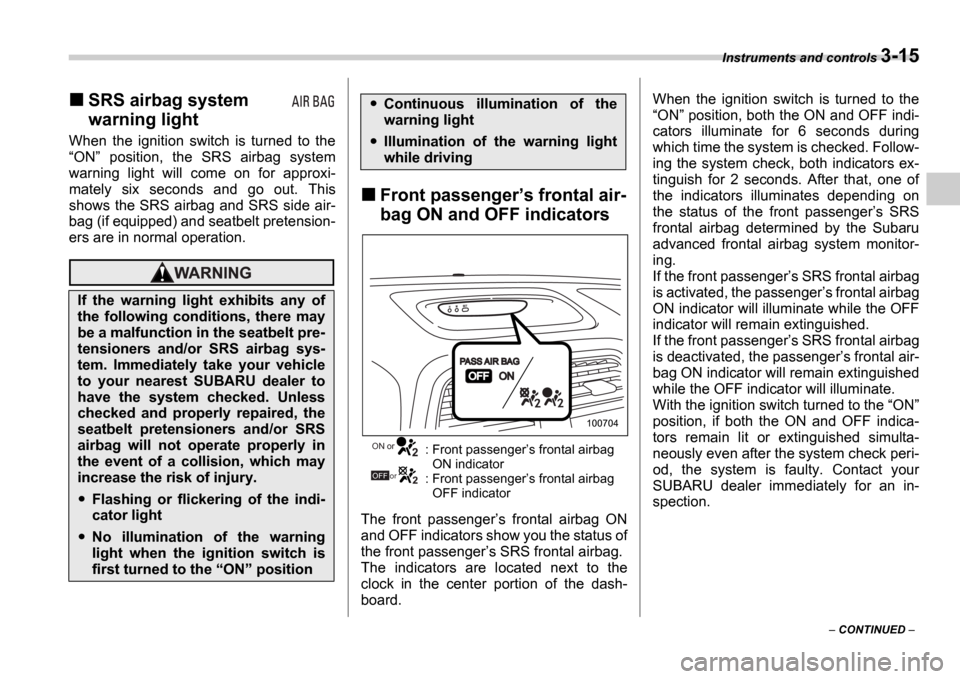
Front passenger s frontal air-
bag ON and OFF indicators
: Front passenger s frontal airbag
ON indicator
: Front passenger s frontal airbag
OFF indicator
The front passenger s frontal airbag ON
and OFF indicators show you the status of
the front passenger s SRS frontal airbag.
The indicators are located next to the
clock in the center portion of the dash-
board. When the ignition switch is turned to the
ON position, both the ON and OFF indi-
cators illuminate for 6 seconds during
which time the system is checked. Follow-
ing the system check, both indicators ex-
tinguish for 2 seconds. After that, one of
the indicators illuminates depending on
the status of the front passenger s SRS
frontal airbag determined by the Subaru
advanced frontal airbag system monitor-
ing.
If the front passenger s SRS frontal airbag
is activated, the passenger s frontal airbag
ON indicator will illuminate while the OFF
indicator will remain extinguished.
If the front passenger s SRS frontal airbag
is deactivated, the passenger s frontal air-
bag ON indicator will remain extinguished
while the OFF indicator will illuminate.
With the ignition switch turned to the ON
position, if both the ON and OFF indica-
tors remain lit or extinguished simulta-
neously even after the system check peri-
od, the system is faulty. Contact your
SUBARU dealer immediately for an in-
spection.
If the warning light exhibits any of
the following conditions, there may
be a malfunction in the seatbelt pre-
tensioners and/or SRS airbag sys-
tem. Immediately take your vehicle
to your nearest SUBARU dealer to
have the system checked. Unless
checked and properly repaired, the
seatbelt pretensioners and/or SRS
airbag will not operate properly in
the event of a collision, which may
increase the risk of injury.
Flashing or flickering of the indi-
cator light
No illumination of the warning
light when the ignition switch is
first turned to the ON position
Continuous illumination of the
warning light
Illumination of the warning light
while driving
100704
ON or
OFF or
Page 129 of 365
3-16 Instruments and controls
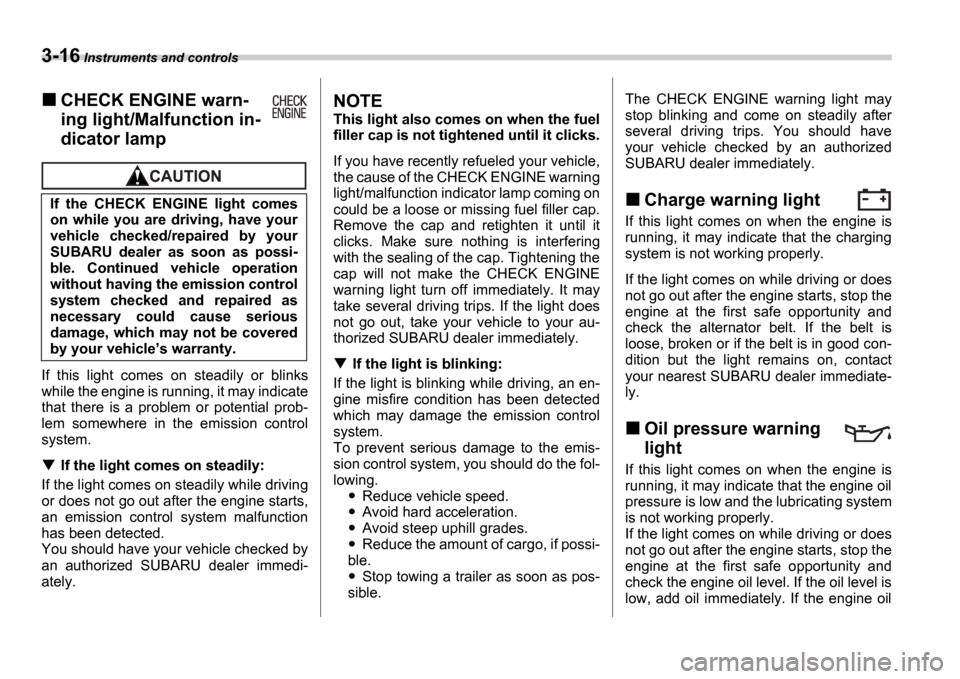
CHECK ENGINE warn-
ing light/Malfunction in-
dicator lamp
If this light comes on steadily or blinks
while the engine is running, it may indicate
that there is a problem or potential prob-
lem somewhere in the emission control
system.
If the light comes on steadily:
If the light comes on steadily while driving
or does not go out after the engine starts,
an emission control system malfunction
has been detected.
You should have your vehicle checked by
an authorized SUBARU dealer immedi-
ately.
NOTE
This light also comes on when the fuel
filler cap is not tightened until it clicks.
If you have recently refueled your vehicle,
the cause of the CHECK ENGINE warning
light/malfunction indicator lamp coming on
could be a loose or missing fuel filler cap.
Remove the cap and retighten it until it
clicks. Make sure nothing is interfering
with the sealing of the cap. Tightening the
cap will not make the CHECK ENGINE
warning light turn off immediately. It may
take several driving trips. If the light does
not go out, take your vehicle to your au-
thorized SUBARU dealer immediately.
If the light is blinking:
If the light is blinking while driving, an en-
gine misfire condition has been detected
which may damage the emission control
system.
To prevent serious damage to the emis-
sion control system, you should do the fol-
lowing.
Reduce vehicle speed.
Avoid hard acceleration.
Avoid steep uphill grades.
Reduce the amount of cargo, if possi-
ble.
Stop towing a trailer as soon as pos-
sible. The CHECK ENGINE warning light may
stop blinking and come on steadily after
several driving trips. You should have
your vehicle checked by an authorized
SUBARU dealer immediately.
Charge warning light
If this light comes on when the engine is
running, it may indicate that the charging
system is not working properly.
If the light comes on while driving or does
not go out after the engine starts, stop the
engine at the first safe opportunity and
check the alternator belt. If the belt is
loose, broken or if the belt is in good con-
dition but the light remains on, contact
your nearest SUBARU dealer immediate-
ly.
Oil pressure warning
light
If this light comes on when the engine is
running, it may indicate that the engine oil
pressure is low and the lubricating system
is not working properly.
If the light comes on while driving or does
not go out after the engine starts, stop the
engine at the first safe opportunity and
check the engine oil level. If the oil level is
low, add oil immediately. If the engine oil
If the CHECK ENGINE light comes
on while you are driving, have your
vehicle checked/repaired by your
SUBARU dealer as soon as possi-
ble. Continued vehicle operation
without having the emission control
system checked and repaired as
necessary could cause serious
damage, which may not be covered
by your vehicle
s warranty.
Page 131 of 365
3-18 Instruments and controls
With a vehicle equipped with an EBD sys-
tem, the ABS warning light comes on to-
gether with the brake system warning light
if the EBD system becomes faulty. For fur-
ther details of the EBD system fault warn-
ing, refer to Brake system warning light .
NOTE
If the warning light behavior is as de-
scribed in the following, the ABS sys-
tem may be considered normal.
The warning light comes on right af-
ter the engine is started but goes out
immediately, remaining off.
The warning light remains on after the engine has been started, but it goes
out when the vehicle speed reaches
approximately 8 mph (12 km/h).
The warning light comes on during
driving, but it goes out immediately
and remains off.
When driving with an insufficient battery
voltage such as when the engine is jump
started, the ABS warning light may come
on. This is due to the low battery voltage
and does not indicate a malfunction.
When the battery becomes fully charged,
the light will go out.
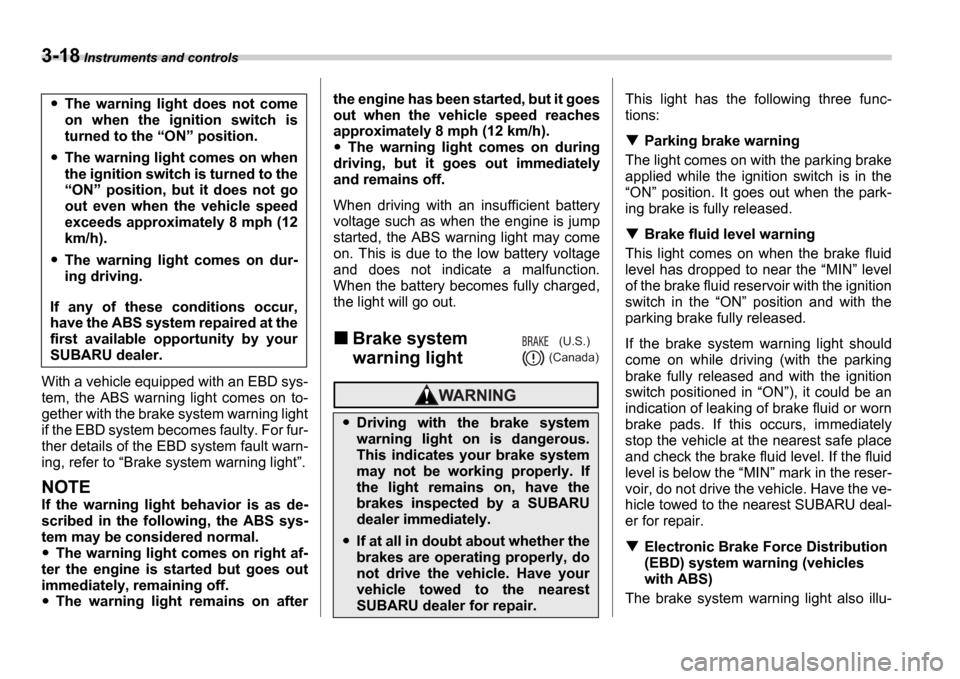
Brake system
warning light
This light has the following three func-
tions:
Parking brake warning
The light comes on with the parking brake
applied while the ignition switch is in the ON position. It goes out when the park-
ing brake is fully released.
Brake fluid level warning
This light comes on when the brake fluid
level has dropped to near the MIN level
of the brake fluid reservoir with the ignition
switch in the ON position and with the
parking brake fully released.
If the brake system warning light should
come on while driving (with the parking
brake fully released and with the ignition
switch positioned in ON ), it could be an
indication of leaking of brake fluid or worn
brake pads. If this occurs, immediately
stop the vehicle at the nearest safe place
and check the brake fluid level. If the fluid
level is below the MIN mark in the reser-
voir, do not drive the vehicle. Have the ve-
hicle towed to the nearest SUBARU deal-
er for repair.
Electronic Brake Force Distribution
(EBD) system warning (vehicles
with ABS)
The brake system warning light also illu-
The warning light does not come
on when the ignition switch is
turned to the ON position.
The warning light comes on when
the ignition switch is turned to the ON position, but it does not go
out even when the vehicle speed
exceeds approximately 8 mph (12
km/h).
The warning light comes on dur-
ing driving.
If any of these conditions occur,
have the ABS system repaired at the
first available opportunity by your
SUBARU dealer.
Driving with the brake system
warning light on is dangerous.
This indicates your brake system
may not be working properly. If
the light remains on, have the
brakes inspected by a SUBARU
dealer immediately.
If at all in doubt about whether the
brakes are operating properly, do
not drive the vehicle. Have your
vehicle towed to the nearest
SUBARU dealer for repair.
(U.S.)
(Canada)
Page 146 of 365
Instruments and controls 3-33
CONTINUED
cover the sensors with stickers, or other
similar items. Periodically wipe the sen-
sors clean using a piece of dry soft cotton
cloth or an applicator.
Compass calibration
1. For optimum calibration, switch off all
nonessential electrical accessories (rear
window defogger, heater/air conditioning
system, spotlight, etc.) and ensure all
doors are shut.
2. Drive to an open, level area away from
large metallic objects or structures and
make certain the ignition switch is in the ON position.
3. Press and hold the left button for 3 sec-
onds then release, and the compass will
enter the calibration mode. CAL and di-
rection will be displayed.
4. Drive slowly in a circle until CAL dis-
appears from the display (approximately
two or three circles). The compass is now
calibrated.
5. Further calibration may be necessary
should outside. Influences cause the mir-
ror to read inaccurately. You will know that
this has occurred if your compass begins
to read in only limited directions. Should
you encounter this situation, return to step
one of the above procedure and recali-
brate the mirror.
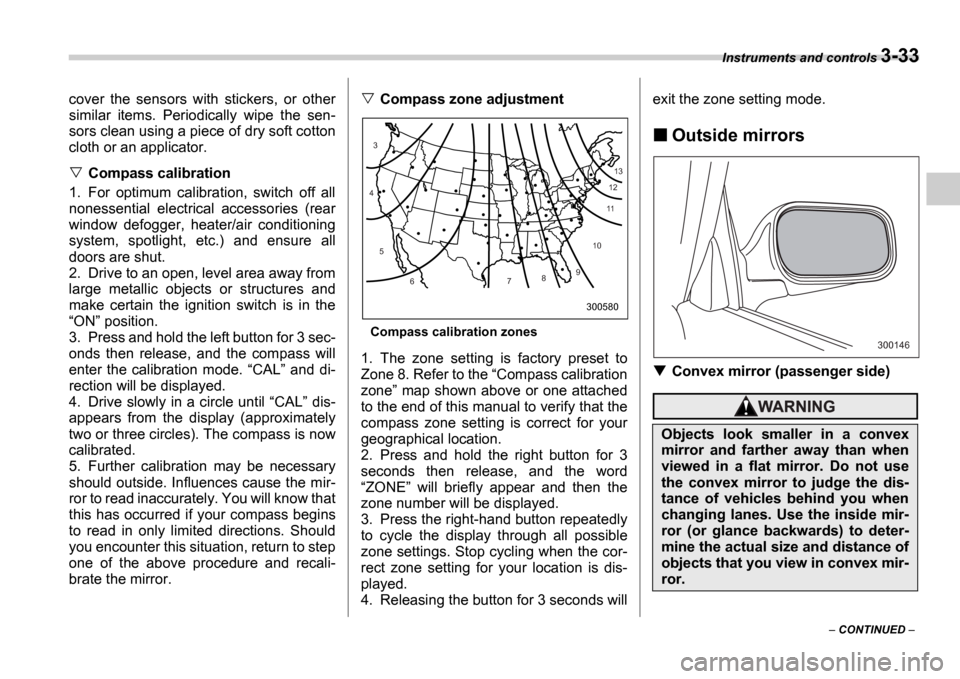
Compass zone adjustment
Compass calibration zones
1. The zone setting is factory preset to
Zone 8. Refer to the Compass calibration
zone map shown above or one attached
to the end of this manual to verify that the
compass zone setting is correct for your
geographical location.
2. Press and hold the right button for 3
seconds then release, and the word ZONE will briefly appear and then the
zone number will be displayed.
3. Press the right-hand button repeatedly
to cycle the display through all possible
zone settings. Stop cycling when the cor-
rect zone setting for your location is dis-
played.
4. Releasing the button for 3 seconds will exit the zone setting mode.
Outside mirrors
Convex mirror (passenger side)
10
9
8
7
6
5
4
3
1112
13
300580
Objects look smaller in a convex
mirror and farther away than when
viewed in a flat mirror. Do not use
the convex mirror to judge the dis-
tance of vehicles behind you when
changing lanes. Use the inside mir-
ror (or glance backwards) to deter-
mine the actual size and distance of
objects that you view in convex mir-
ror.
300146
Page 150 of 365

4
Climate control
Ventilator ............................................................. 4-2
Air flow selection ................................ .................... 4-2
Center and side ventilators ....................... ............. 4-3
Manual climate control system (if equipped) ..................................... ............... 4-3
Control panel ..................................... ..................... 4-3
Heater operation .................................. ................... 4-5
Air conditioner operation (if equipped) ........... ..... 4-7
Automatic climate control system (if equipped) ..................................... ............... 4-7
Control panel ..................................... ..................... 4-8
To use as full-automatic climate control
system ............................................ ....................... 4-8
To use as semi-automatic climate control system ............................................ ....................... 4-8
Fan speed control dial ............................ ............... 4-8
Temperature control dial .......................... .............. 4-9
Air flow control dial ............................. ................... 4-9
Air inlet selection button ........................ ................ 4-9
Air conditioner button ............................ ................ 4-10
Temperature sensors ............................... .............. 4-10
Operating tips for heater and air conditioner ....................................... ............... 4-11
Cleaning ventilation grille ....................... ............... 4-11
Efficient cooling after parking in direct sunlight .......................................... ....................... 4-11
Lubrication oil circulation in the refrigerant
circuit ........................................... ......................... 4-11Checking air conditioning system before
summer season ..................................... ............... 4-11
Cooling and dehumidifying in high humidity and
low temperature weather conditions ................ .. 4-11
Air conditioner compressor shut-off when engine is heavily loaded .......................... ............ 4-12
Refrigerant for your climate control system ....... . 4-12
Air filtration system ............................. ............... 4-12
Replacing an air filter ........................... .................. 4-12
Page 152 of 365
Climate control 4-3
CONTINUED
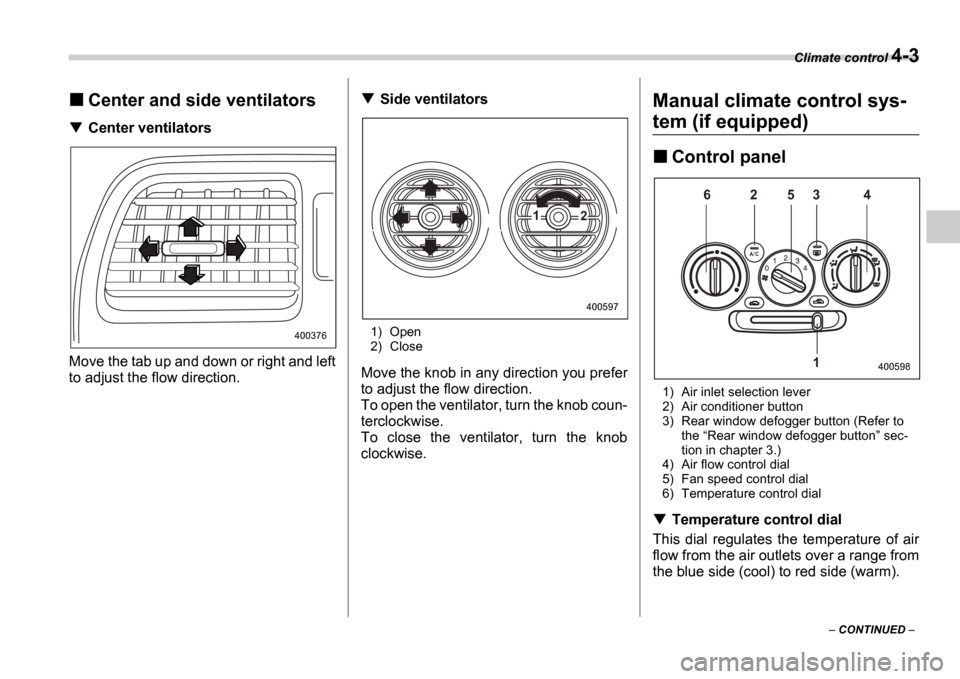
Center and side ventilators
Center ventilators
Move the tab up and down or right and left
to adjust the flow direction.
Side ventilators
1) Open
2) Close
Move the knob in any direction you prefer
to adjust the flow direction.
To open the ventilator, turn the knob coun-
terclockwise.
To close the ventilator, turn the knob
clockwise.
Manual climate control sys-
tem (if equipped)
Control panel
1) Air inlet selection lever
2) Air conditioner button
3) Rear window defogger button (Refer to the Rear window defogger button sec-
tion in chapter 3.)
4) Air flow control dial
5) Fan speed control dial
6) Temperature control dial
Temperature control dial
This dial regulates the temperature of air
flow from the air outlets over a range from
the blue side (cool) to red side (warm).
400376
1 2
400597
6 2 5 3 4
1
400598
Page 153 of 365
4-4 Climate control
Fan speed control dial
The fan operates only when the ignition
switch is turned to the ON position. The
fan speed control dial is used to select four
fan speeds.
Air flow control dial
This dial has the following five positions:
: Air flows through the instrument pan-
el outlets.
: Air flows through the instrument pan-
el outlets and the foot outlets.
: Air flows through the foot outlets and
some through the windshield defroster
outlets.
: Air flows through the windshield de-
froster outlets and foot outlets.
: Air flows through the windshield de-
froster outlets.
NOTE
You will find the notation USE
WITH on the air flow control
dial plate.
This is intended to remind you to set
the air inlet selection lever in the
position when defogging the
windshield.
Defogging with the air inlet selection
lever set in the position pro-
vides better defogging performance
than in the position.
When the dial is placed in the
or position, the air conditioner
compressor operates automatically re-
gardless of the position of the air con-
ditioner button to defog the windshield
quickly.
However the indicator on the air condi-
tioner button will not come on.
Also, you cannot stop the air condi-
tioner compressor by pressing the air
conditioner button.
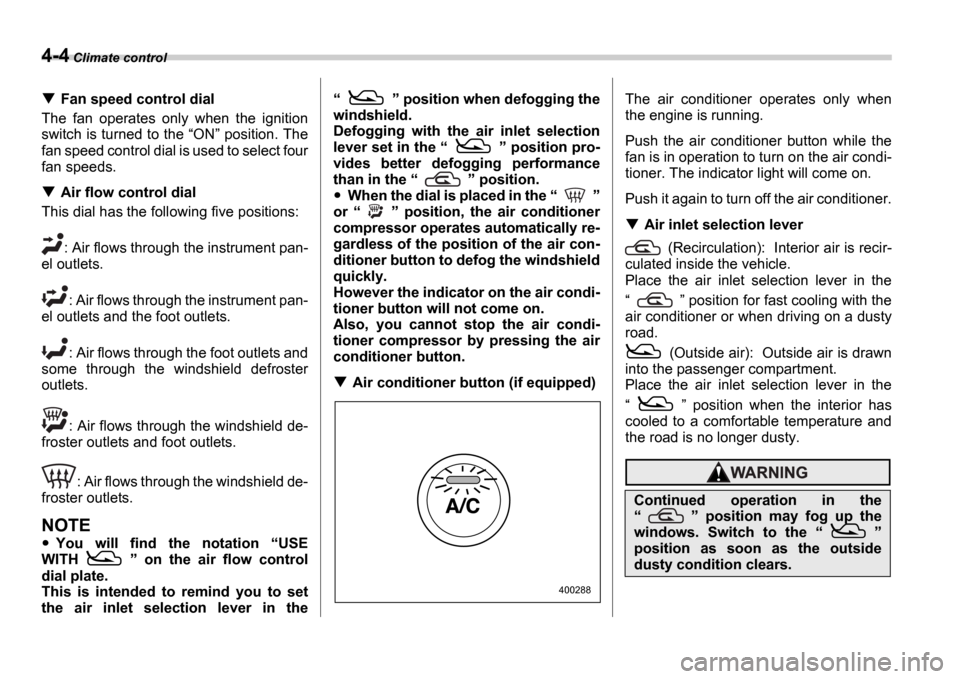
Air conditioner button (if equipped) The air conditioner operates only when
the engine is running.
Push the air conditioner button while the
fan is in operation to turn on the air condi-
tioner. The indicator light will come on.
Push it again to turn off the air conditioner.
Air inlet selection lever
(Recirculation): Interior air is recir-
culated inside the vehicle.
Place the air inlet selection lever in the
position for fast cooling with the
air conditioner or when driving on a dusty
road.
(Outside air): Outside air is drawn
into the passenger compartment.
Place the air inlet selection lever in the
position when the interior has
cooled to a comfortable temperature and
the road is no longer dusty.
400288
Continued operation in the
position may fog up the
windows. Switch to the
position as soon as the outside
dusty condition clears.