2006 SUBARU BAJA steering
[x] Cancel search: steeringPage 162 of 487
3-35
Instruments and controls
– CONTINUED –
place.
5. Make sure that the steering wheel is securely
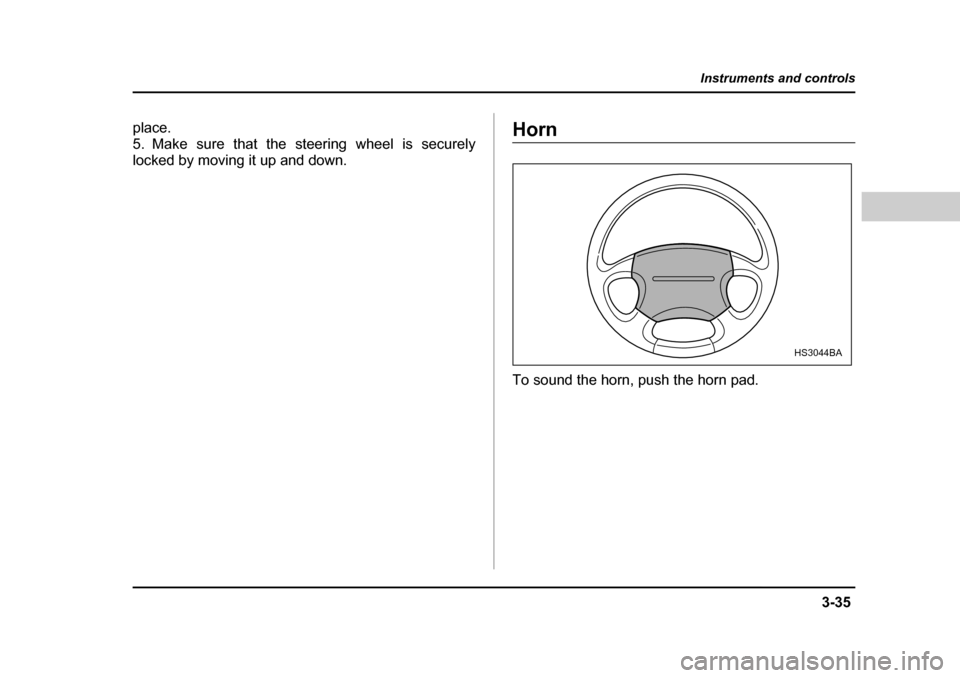
locked by moving it up and down.HornHorn
To sound the horn, push the horn pad.
HS3044BA
Page 254 of 487

7-1
7
Starting and operating
Fuel ................................................................ 7-2 Fuel requirements ............................................. 7-2
Fuel filler door and cap .................................... 7-4
State emission testing (U.S. only) ............... 7-6
Preparing to drive ......................................... 7-8
Starting the engine ....................................... 7-9 Manual transmission vehicle ........................... 7-9
Automatic transmission vehicle ...................... 7-10
Stopping the engine ..................................... 7-11
Manual transmission .................................... 7-12 Shifting speeds ................................................. 7-13
Driving tips ........................................................ 7-14
Automatic transmi ssion (Non-turbo
models) ...................................................... 7-14 Selector lever .................................................... 7-15
Driving tips ........................................................ 7-19
Shift lock release .............................................. 7-19
Automatic transmission (Turbo models) ... 7-21
Selector lever .................................................... 7-22
Selector lever reverse inhibiting function ...... 7-25
Selection of SPORTSHIFT mode (manual mode) ................................................ 7-26
Driving tips ........................................................ 7-29
Shift lock release .............................................. 7-29
Limited slip differential (LSD) ...................... 7-30
Power steering .............................................. 7-31
Braking .......................................................... 7-31 Braking tips ....................................................... 7-31
Brake system ..................................................... 7-32 Disc brake pad wear warning indicators ........ 7-32
ABS (Anti-lock Brake System) ..................... 7-33 ABS system self-check .................................... 7-33
ABS warning light ............................................. 7-34
Parking your vehicle ..................................... 7-35
Cruise control ................................................ 7-37 To set cruise control ........................................ 7-38
To temporarily cancel the cruise control ....... 7-39
To turn off the cruise control ........................... 7-39
To change the cruising speed ......................... 7-39
Cruise control set indicator light .................... 7-40
Page 264 of 487
7-11
Starting and operating
– CONTINUED –
While the engine is warming up, make sure that the
selector lever is at the “P” or “N” position and that the
parking brake is applied.
NOTE (Turbo models)
The engine may be difficult to start when the bat-
tery has been disconnected and reconnected (for
maintenance or other purposes). This difficulty is
caused by the electronically controlled throttle’s
self-diagnosis function. To overcome it, keep the
ignition switch in the “O N” position for approxi-
mately 10 seconds before starting the engine.
Stopping the engine
Do not stop the engine when the vehicle is mov-
ing. This will cause loss of power to the power
steering and the brake booster, making steer-
ing and braking more difficult. It could also re-
sult in accidental activation of the “LOCK” po-
sition on the ignition switch, causing the steer-
ing wheel to lock.
The ignition switch should be turned off only when the
vehicle is stopped and the engine is idling.
Page 284 of 487
7-31
Starting and operating
– CONTINUED –
Power steering
Do not hold the steering wheel at the fully
locked position left or right for more than five
seconds. This may damage the power steering
pump.
The power steering system operates only when the
engine is running.
If you lose power steering assist because the engine
stops or the system fails to function, you can steer but
it will take much more effort.
NOTE
Right after the engine has been started and before
it has warmed up, you may hear a noise coming
from areas adjacent to the power steering pump
which is located at the right-front area of the en-
gine compartment. This noise is normal. It does
not indicate power steering system trouble.
Braking „Braking tips
Never rest your foot on the brake pedal while
driving. This can cause dangerous overheating
of the brakes and needless wear on the brake
pads and linings.
T When the brakes get wet
When driving in rain or after washing the vehicle, the
brakes may get wet. As a result, brake stopping dis-
tance will be longer. To dry the brakes, drive the vehi-
cle at a safe speed while lightly depressing the brake
pedal to heat up the brakes. T Use of engine braking
Remember to make use of engine braking in addition
to foot braking. When descending a grade, if only the
foot brake is used, the brakes may start working im-
properly because of brake fluid overheating, caused
by overheated brake pads. To help prevent this, shift
into a lower gear to get stronger engine braking.
Page 286 of 487
7-33
Starting and operating
– CONTINUED –
ABS (Anti-lock Brake System)
Always use the utmost care in driving – over-
confidence because you are driving with an
ABS equipped vehicle could easily lead to a se-
rious accident.
yThe ABS system does not always decrease
stopping distance. You should always maintain
a safe following distance from other vehicles. y When driving on badly surfaced roads, gravel
roads, icy road, or over deep newly fallen snow,
stopping distances may be longer for a vehicle
with the ABS system than one without. When
driving under these conditions, therefore, re-
duce your speed and leave ample distance from
other vehicles. y When you feel the ABS system operating,
you should maintain constant brake pedal pres-
sure. Do not pump the brake pedal since doing
so may defeat the operation of the ABS system. The ABS system prevents the lock-up of wheels which
may occur during sudden braking or braking on slip-
pery road surfaces. This helps prevent the loss of
steering control and directional stability caused by
wheel lock-up.
When the ABS system is operating, you may hear a
chattering noise or feel a slight vibration in the brake
pedal. This is normal when the ABS operates. The ABS system will not ope
rate when the vehicle
speed is below approximately 6 mph (10 km/h). „ ABS system self-check
You may feel a slight shock in the brake pedal and hear the opera ting sound of ABS from the engine com-
partment just after the vehi cle is started. This is
caused by an automatic functional test of the ABS sys-
tem being carried out and does not indicate any abnor-
mal condition.
Page 289 of 487
7-36
Starting and operating
make sure that the parking brake has been fully
released.
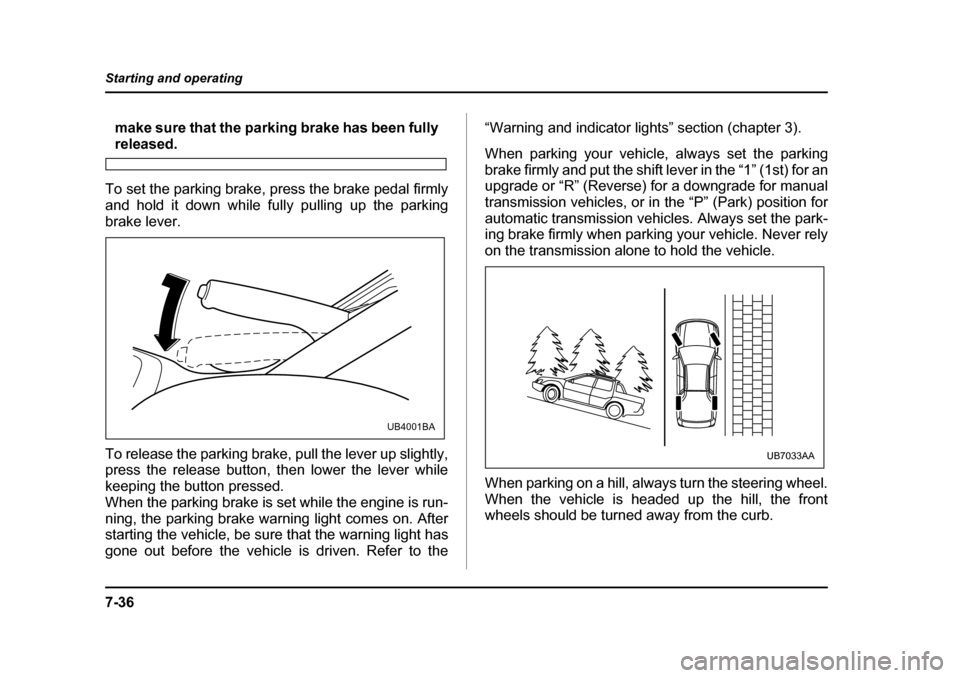
To set the parking brake, press the brake pedal firmly
and hold it down while fully pulling up the parking
brake lever.
To release the parking brake, pull the lever up slightly,
press the release button, then lower the lever while
keeping the button pressed.
When the parking brake is set while the engine is run-
ning, the parking brake warning light comes on. After
starting the vehicle, be sure that the warning light has
gone out before the vehicle is driven. Refer to the “Warning and indicator lights” section (chapter 3).
When parking your vehicl
e, always set the parking
brake firmly and put the shift lever in the “1” (1st) for an
upgrade or “R” (Reverse) for a downgrade for manual
transmission vehicles, or in the “P” (Park) position for
automatic transmission vehicles. Always set the park-
ing brake firmly when parking your vehicle. Never rely
on the transmission alone to hold the vehicle.
When parking on a hill, always turn the steering wheel.
When the vehicle is headed up the hill, the front
wheels should be turned away from the curb.
UB4001BA
UB7033AA
Page 302 of 487

8-9
Driving tips
– CONTINUED –
Off road driving
yAlways maintain a safe driving speed accord-
ing to the road and weather conditions in order
to avoid having an accident on a sharp turn,
during sudden braking or under other similar
conditions.y Always use the utmost care in driving – over-
confidence because you are driving an All-
Wheel Drive vehicle could easily lead to a seri-
ous accident.
Because of the AWD feature and higher ground clear-
ance, your SUBARU can be driven on ordinary roads
or off-road. But please keep in mind that an AWD
SUBARU is neither a conventional off-road vehicle nor
an all-terrain vehicle. If you do take your SUBARU off-
road, certain common sense precautions such as the
following should be taken: y Make certain that you and all of your passengers
are wearing seatbelts. y Carry some emergency equipment, such as a tow-
ing rope or chain, a shovel, wheel blocks, first aid kit
and cell phone or citizens band radio. y
Drive carefully. Do not take unnecessary risks by
driving in dangerous areas or over rough terrain.y Slow down and employ extra caution at all times.
When driving off-road, you will not have the benefit of
marked traffic lanes, banked curves, traffic signs and
the like. y Do not drive across steep slopes. Instead, drive ei-
ther straight up or straight down the slopes. A vehicle
can much more easily tip over sideways than it can
end over end. Avoid driving straight up or down slopes
that are too steep.y Avoid sharp turning maneuvers, especially at higher
speeds. y Do not grip the inside or spokes of the steering
wheel. A bad bump could jerk the wheel and injure
your hands. Instead dr ive with your fingers and
thumbs on the outside of the rim. y If driving through water, such as when crossing
shallow streams, first check the depth of the water and
the bottom of the stream bed for firmness and ensure
that the bed of the stream is flat. Drive slowly and com-
pletely through the stream. The water should be shal-
low enough that it does not reach the vehicle’s under-
carriage. Water entering the engine air intake or the
exhaust pipe or water splashing onto electrical parts
may damage your vehicle and may cause it to stall.
Never attempt to drive through rushing water; regard-
Page 305 of 487
8-12
Driving tips
starting.
Keep the door locks from freezing by squirting them
with deicer or glycerin.
Forcing a frozen door open
may damage or separate
the rubber weather strips around the door. If the door
is frozen, use hot water to melt the ice, and afterwards
thoroughly wipe the water away.
Use a windshield washer fluid that contains an anti-
freeze solution. Do not us e engine antifreeze or other
substitutes because they may damage the paint of the
vehicle.
SUBARU Windshield Washer Fluid contains 58.5%
methyl alcohol and 41.5% surfactant, by volume. Its
freezing temperature varies according to how much it
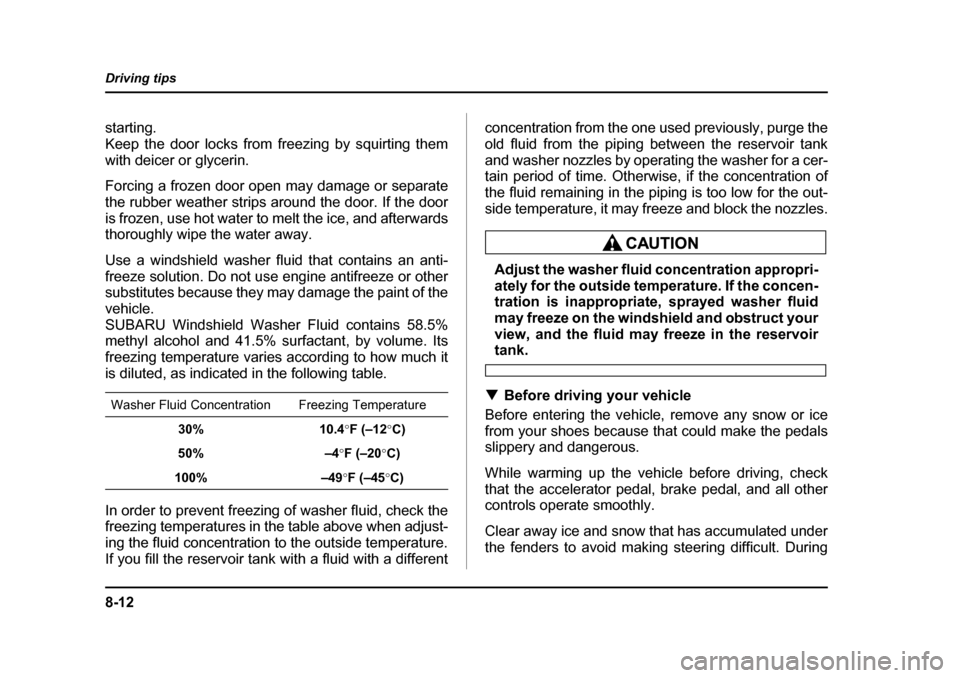
is diluted, as indicated in the following table.
In order to prevent freezing of washer fluid, check the
freezing temperatures in the table above when adjust-
ing the fluid concentration to the outside temperature.
If you fill the reservoir tank with a fluid with a different concentration from the one us
ed previously, purge the
old fluid from the piping between the reservoir tank
and washer nozzles by operating the washer for a cer-
tain period of time. Otherwise, if the concentration of
the fluid remaining in the piping is too low for the out-
side temperature, it may freeze and block the nozzles.
Adjust the washer fluid concentration appropri-
ately for the outside temperature. If the concen-
tration is inappropriate, sprayed washer fluid
may freeze on the windshield and obstruct your
view, and the fluid may freeze in the reservoir
tank.
T Before driving your vehicle
Before entering the vehicle, remove any snow or ice
from your shoes because that could make the pedals
slippery and dangerous.
While warming up the vehicle before driving, check
that the accelerator pedal, brake pedal, and all other
controls operate smoothly.
Clear away ice and snow that has accumulated under
the fenders to avoid making steering difficult. During
Washer Fluid Concentration Freezing Temperature
30% 10.4 °F (–12 °C)
50% –4 °F (–20 °C)
100% –49 °F (–45 °C)