2006 SUBARU BAJA steering
[x] Cancel search: steeringPage 326 of 487
8-33
Driving tips
– CONTINUED –
tire is used. The temporary spare tire is not de-
signed to sustain the towing load. Use of the
temporary spare tire when towing can result in
failure of the spare tire and/or less stability of
the vehicle.
Make sure that all the tire s on your vehicle are properly
inflated.
The recommended cold tire pressure is shown on the
vehicle placard attached to the driver’s side door jamb.
Trailer tire condition, size, load rating and proper infla-
tion pressure should be in accordance with the trailer
manufacturer’s specifications.
In the event your vehicle gets a flat tire when towing a
trailer, ask a commercial road service to repair the flat tire.
If you carry a regular size spare tire in your vehicle or
trailer as a precaution against getting a flat tire, be
sure that the spare ti re is firmly secured. „
Trailer towing tipsyNever exceed 45 mph (72 km/h) when towing
a trailer in hilly country on hot days. y When towing a trailer, steering, stability,
stopping distance and braking performance
will be different from normal operation. For
safety’s sake, you should employ extra caution
when towing a trailer and you should never
speed. You should also keep the following tips
in mind:
T Before starting out on a trip
y Check that the vehicle and vehicle-to-hitch mount-
ing are in good condition. If any problems are appar-
ent, do not tow the trailer. y Check that the vehicle sits horizontally with the trail-
er attached. If t he vehicle is tipped sharply up at the
front and down at the rear, check the total trailer
weight, GVW, GAWs and t ongue load again, then con-
firm that the load and its distribution are acceptable. y Check that the tire pressures are correct.
y Check that the vehicle and trailer are connected
properly. Confirm that.
Page 327 of 487
8-34
Driving tips
– the trailer tongue is connected properly to the
hitch ball.
– the trailer lights connector is connected properly
and trailer’s brake lights illuminate when the vehi-
cle’s brake pedal is pressed, and that the trailer’s
turn signal lights flash when the vehicle’s turn signal
lever is operated.
– the safety chains are connected properly.
– all cargo in the trailer is secured safety in position.
– the side mirrors provide a good rearward field of
view without a significant blind spot.
y Sufficient time should be taken to learn the “feel” of
the vehicle/trailer combination before starting out on a
trip. In an area free of traffic, practice turning, stopping
and backing up. T Driving with a trailer
y You should allow for considerably more stopping
distance when towing a trailer. Avoid sudden braking
because it may result in skidding or jackknifing and
loss of control. y Avoid abrupt starts and sudden accelerations. If
your vehicle has a manual transmission, always start
out in first gear and release the clutch at moderate en-
gine revolution.y Avoid uneven steering, sharp turns and rapid lane
changes.y Slow down before turning. Make a longer than nor- mal turning radius because the trailer wheels will be
closer than the vehicle wheels to the inside of the turn.
In a tight turn, the trailer could hit your vehicle. y
Crosswinds will adversely affect the handling of
your vehicle and trailer, causing sway. Crosswinds
can be due to weather conditions or the passing of large trucks or buses. If sway ing occurs, firmly grip the
steering wheel and slow down immediately but gradu-
ally. y When passing other vehicles, considerable dis-
tance is required because of the added weight and
length caused by attaching the trailer to your vehicle.
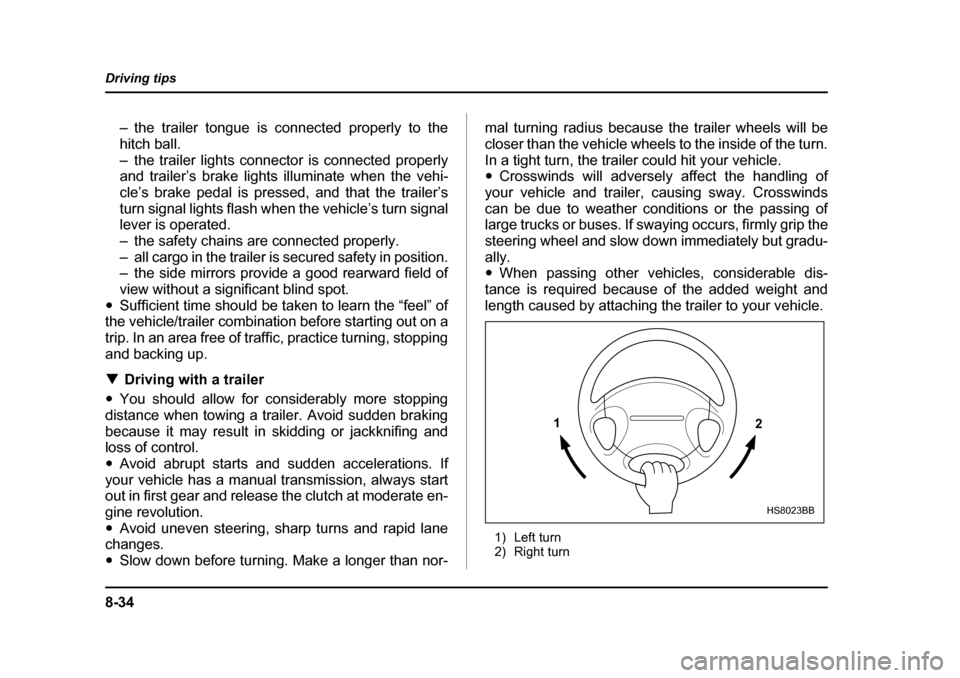
1) Left turn
2) Right turn
1 2
HS8023BB
Page 328 of 487

8-35
Driving tips
– CONTINUED –
yBacking up with a trailer is difficult and takes prac-
tice. When backing up with a trailer, never accelerate
or steer rapidly. When turning back, grip the bottom of
the steering wheel with one hand and turn it to the left
for a left turn, and turn it to the right for a right turn.
y If the ABS warning li ght illuminates while the vehicle
is in motion, stop towing the trailer and have repairs
performed immediately by the nearest SUBARU deal-er. T Driving on grades
y Before going down a steep hill, slow down and shift
into lower gear (if necessary, use 1st gear) in order to
utilize the engine braking ef fect and prevent overheat-
ing of your vehicle’s brakes. Do not make sudden
downshifts.y When driving uphill in hot weather, the air condition-
er may turn off automatically to protect the engine from
overheating.y When driving uphill in hot weather, pay attention to
the water temperature gauge pointer (for all vehicles)
and AT OIL TEMP warning light (for AT vehicles) since
the engine and transmission are relatively prone to
overheating under these conditions. If the water tem-
perature gauge pointer approaches the OVERHEAT
zone or the AT OIL TEMP warning light illuminates,
immediately switch off the ai r conditioner and stop the
vehicle at the nearest safe place. Refer to the “Engine overheating” section in chapter 9, and “Warning and indicator lights” se
ction in chapter 3.
NOTE (Turbo models only)
In a vehicle that has an automatic transmission,
the engine is less likely to overheat with the “D”
range selected than it is with the manual mode se-
lected. y If your vehicle has an autom atic transmission, avoid
using the accelerator pedal to stay stationary on an
uphill slope instead of using the parking brake or foot
brake. That may cause the transmission fluid to over-
heat. y Non-turbo models only: If your vehicle has an auto-
matic transmission, place the selector lever as follows:
Uphill slopes: “D” position
Downhill slopes: A low-speed gear position to use en-
gine braking T Parking on a grade
Always block the wheels under both vehicle and trailer
when parking. Apply the parking brake firmly. You
should not park on a hill or slope. But if parking on a
hill or slope cannot be avoided, you should take the
following steps:
1. Apply the brakes and hold the pedal down.
2. Have someone place wheel blocks under both the
Page 356 of 487

9-27
In case of emergency
– CONTINUED –
„Using a flat-bed truck
This is the best way to transport your vehicle. Use the
following procedures to ensure safe transportation.
1. Shift the selector lever into the “P” position for au-
tomatic transmission vehi cles or “1st” for manual
transmission vehicles.
2. Pull up the parking brake lever firmly.
3. Secure the vehicle onto the carrier properly with
safety chains. Each safety chain should be equally
tightened and care must be taken not to pull the chains
so tightly that the suspension bottoms out. „
Towing with all wheels on the ground
yNever turn the ignition switch to the “LOCK”
position while the vehicle is being towed be-
cause the steering wheel and the direction of
the wheels will be locked.y Remember that the brake booster and power
steering do not function when the engine is not
running. Because the engine is turned off, it will
take greater effort to operate the brake pedal
and steering wheel.
UB9072AAUB9071AA
Page 359 of 487
10-2
Appearance care
Appearance careExterior care „
Washing
yWhen washing the vehicle, the brakes may
get wet. As a result, the brake stopping dis-
tance will be longer. To dry the brakes, drive the
vehicle at a safe speed while lightly pressing
the brake pedal to heat up the brakes. y Do not wash the engine compartment and ar-
eas adjacent to it. If water enters the engine air
intake, electrical parts or the power steering flu-
id reservoir, it will cause engine trouble or
faulty power steering respectively.
NOTE y Before having your vehicle washed in an auto-
matic car wash, retract the pillar mounted antenna
or remove the roof mounted antenna to prevent it
from being damaged.y When having your vehicle washed in an auto-
matic car wash, make sure beforehand that the car
wash is of suitable type.
The best way to preserve your vehicle’s beauty is fre- quent washing. Wash the vehicle at least once a
month to avoid contamination by road grime.
Wash dirt off with a wet sponge and plenty of luke-
warm or cold water. Do not wash the vehicle with hot
water and in direct sunlight.
Salt, chemicals, insects, tar, soot, tree sap, and bird
droppings should be washed of
f by using a light deter-
gent, as required. If you use a light detergent, make
certain that it is a neutra l detergent. Do not use strong
soap or chemical detergents. All cleaning agents
should be promptly flushed from the surface and not
allowed to dry there. Rinse the vehicle thoroughly with
plenty of lukewarm water. Wipe the remaining water
off with a chamois or soft cloth. T Washing the underbody
Chemicals, salts and gravel used for deicing road sur-
faces are extremely corrosive , accelerating the corro-
sion of underbody components, such as the exhaust
system, fuel and br ake lines, brake cables, floor pan
and fenders, and suspension.
Thoroughly flush the underbody and inside of the
fenders with lukewarm or cold water at frequent inter-
vals to reduce the harmful effects of such agents.
Mud and sand adhering to the underbody components may accelerate their corrosion.
Page 366 of 487

11 - 1
11
Maintenance and service
Maintenance schedule ................................. 11-3
Maintenance precautions ............................ 11-3 Before checking or servicing in the engine compartment .................................................. 11-4
When you do checking or servicing in the engine compartment while the engine is
running ............................................................ 11-5
Engine hood .................................................. 11-5
Engine compartment overview ................... 11-8 Non-turbo models ............................................. 11-8
Turbo models .................................................... 11-9
Engine oil ...................................................... 11-10 Checking the oil level ....................................... 11-10
Changing the oil and oil filter .......................... 11-12
Recommended grade and viscosity ................ 11-15
Recommended grade and viscosity under severe driving conditions .............................. 11-16
Cooling system .... ....................................... .. 11-17
Hose and connections ...................................... 11-18
Engine coolant .................................................. 11-18
Air cleaner element ...................................... 11-23 Replacing the air cleaner element ................... 11-23
Spark plugs ................................................... 11-25 Recommended spark plugs ............................. 11-26
Drive belts ..................................................... 11-26
Manual transmission oil ............................... 11-27 Checking the oil level ....................................... 11-27
Recommended grade and viscosity ................ 11-29
Automatic transmission fluid ...................... 11-29 Checking the fluid level .................................... 11-29
Recommended fluid ......................................... 11-31
Front differential gear oil (AT vehicles) ...... 11-32
Checking the oil level ....................................... 11-32
Recommended grade and viscosity ............... 11-33
Rear differential gear oil . .............................. 11-33
Checking the gear oil level .............................. 11-33
Recommended grade and viscosity ............... 11-35
Power steering fluid ...................................... 11-36 Checking the fluid level .................................... 11-36
Recommended fluid ......................................... 11-38
Brake fluid ..................................................... 11-38 Checking the fluid level .................................... 11-38
Recommended brake fluid ............................... 11-39
Clutch fluid (MT vehicles) ............................ 11-40 Checking the fluid level .................................... 11-40
Recommended clutch fluid .............................. 11-41
Brake booster ................................................ 11-42
Brake pedal .................................................... 11-42 Checking the brake pedal free play ................ 11-42
Checking the brake pedal reserve distance ... 11-43
Clutch pedal (Manual transmission vehicles) ..................................................... 11-43Checking the clutch function .......................... 11-43
Checking the clutch pedal free play ............... 11-44
Replacement of brake pad and lining ......... 11-44 Breaking-in of new brake pads and linings .... 11-45
Parking brake stroke ......... ........................... 11-46
Tires and wheels ............. .............................. 11-46
Page 373 of 487
11 - 8
Maintenance and service
Engine compartment overviewEngine
Compartment overview
„ Non-turbo models
12 3 4567
8
9
10
11
12
13
UBB106BB
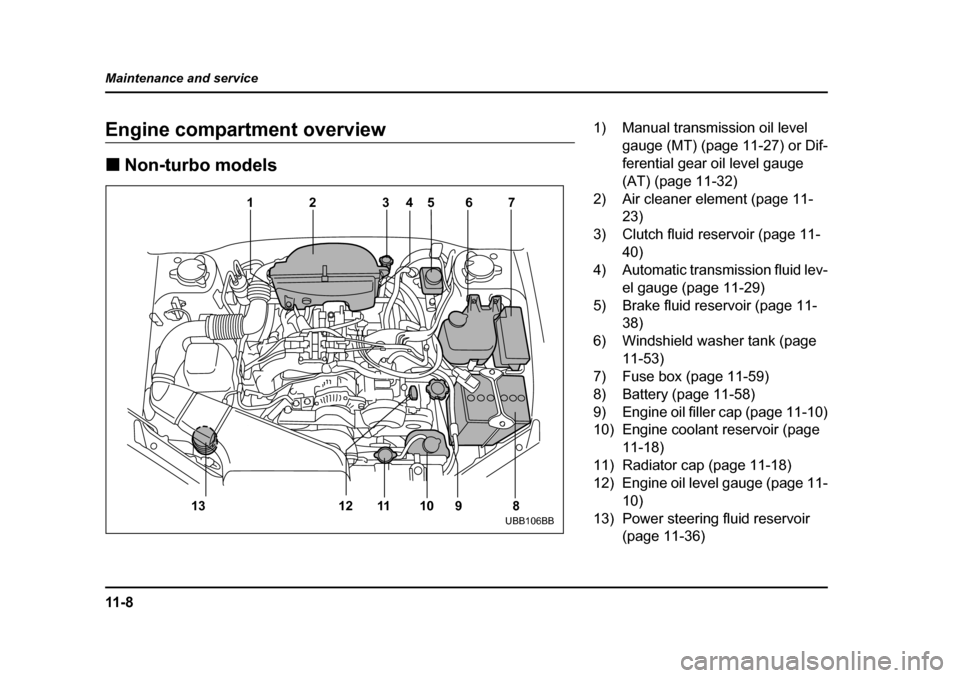
1) Manual transmission oil level
gauge (MT) (page 11-27) or Dif-
ferential gear oil level gauge
(AT) (page 11-32)
2) Air cleaner element (page 11- 23)
3) Clutch fluid reservoir (page 11-
40)
4) Automatic transmission fluid lev- el gauge (page 11-29)
5) Brake fluid reservoir (page 11- 38)
6) Windshield washer tank (page
11-53)
7) Fuse box (page 11-59)
8) Battery (page 11-58)
9) Engine oil filler cap (page 11-10)
10) Engine coolant reservoir (page 11-18)
11) Radiator cap (page 11-18)
12) Engine oil level gauge (page 11- 10)
13) Power steering fluid reservoir (page 11-36)
Page 374 of 487
11 - 9
Maintenance and service
– CONTINUED –
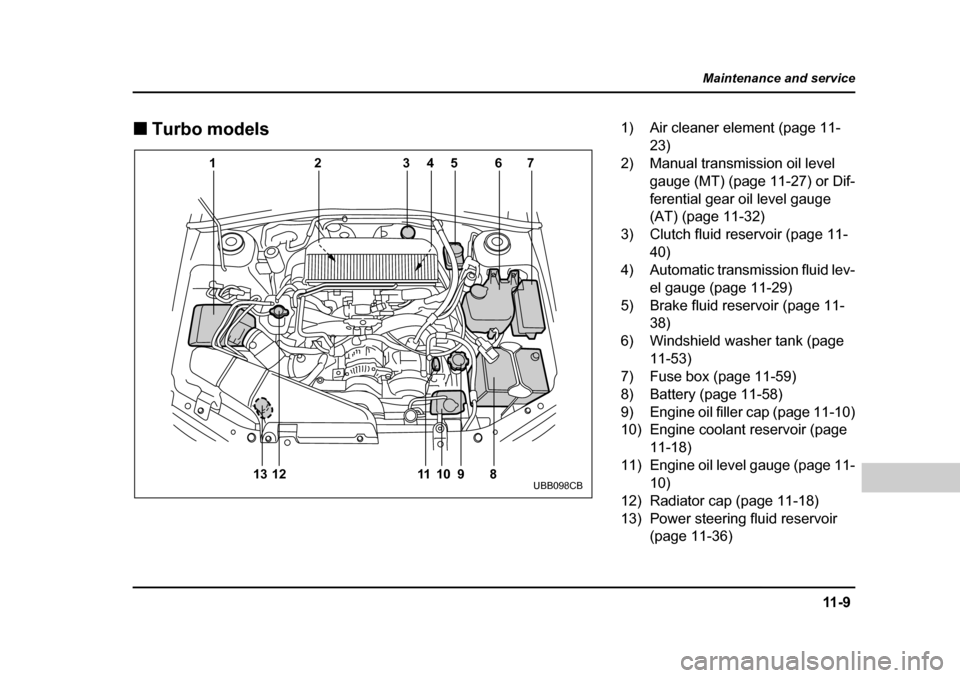
„Turbo models
1
11 1 0 9 8
12
13 23
45 67
UBB098CB
1) Air cleaner element (page 11-
23)
2) Manual transmission oil level gauge (MT) (page 11-27) or Dif-
ferential gear oil level gauge
(AT) (page 11-32)
3) Clutch fluid reservoir (page 11-
40)
4) Automatic transmission fluid lev- el gauge (page 11-29)
5) Brake fluid reservoir (page 11- 38)
6) Windshield washer tank (page
11-53)
7) Fuse box (page 11-59)
8) Battery (page 11-58)
9) Engine oil filler cap (page 11-10)
10) Engine coolant reservoir (page 11-18)
11) Engine oil level gauge (page 11- 10)
12) Radiator cap (page 11-18)
13) Power steering fluid reservoir (page 11-36)