2006 SUBARU BAJA light
[x] Cancel search: lightPage 276 of 487

7-23
Starting and operating
– CONTINUED –
locked to prevent the vehicle from rolling freely.
When you park the vehicle, first set the parking brake
fully, then shift into the “P” position. Do not hold the ve-
hicle with only the transmission.
A shift interlock function is employed in the automatic
transmission system to ensure safe starting of the ve-
hicle.
To shift the selector lever from the “P” to any other po-
sition, you have to depress the brake pedal fully then
push the release button on the selector lever when the
ignition switch is in the “ON” position. This prevents
the vehicle from lurching when it is started.
If the shift lever does not move from the “P” position
with the brake pedal depressed, the release button
pushed in, and the ignition switch in the ON position,
refer to the “Shift lock release” section in this chapter. T R (Reverse)
This position is for backing the vehicle.To shift from the “N” to “R” position, first stop the vehi-
cle completely then move the lever to the “R” position
while pressing the release button. T
N (Neutral)
Do not drive the vehicle with the selector lever
in the “N” (neutral) position. Engine braking
has no effect in this condition and the risk of an
accident is consequently increased.
This position is for restarting a stalled engine.
In this position the wheels and transmission are not
locked. In this position, the transmission is neutral; the
vehicle will roll freely, even on the slightest incline un-
less the parking brake or foot brake is on.
Avoid coasting with the transmission neutral.
During coasting, there is no engine braking effect.
NOTE
If the selector lever is in the “N” position when you
stop the engine for parking, you may not subse-
quently be able to move it to the “R” and “P” posi-
tions. If this happens, tu rn the ignition switch to
the “ON” position. You wi ll then be able to move
the selector lever to the “P” position.
T D (Drive)
This position is for normal driving.
Page 284 of 487
7-31
Starting and operating
– CONTINUED –
Power steering
Do not hold the steering wheel at the fully
locked position left or right for more than five
seconds. This may damage the power steering
pump.
The power steering system operates only when the
engine is running.
If you lose power steering assist because the engine
stops or the system fails to function, you can steer but
it will take much more effort.
NOTE
Right after the engine has been started and before
it has warmed up, you may hear a noise coming
from areas adjacent to the power steering pump
which is located at the right-front area of the en-
gine compartment. This noise is normal. It does
not indicate power steering system trouble.
Braking „Braking tips
Never rest your foot on the brake pedal while
driving. This can cause dangerous overheating
of the brakes and needless wear on the brake
pads and linings.
T When the brakes get wet
When driving in rain or after washing the vehicle, the
brakes may get wet. As a result, brake stopping dis-
tance will be longer. To dry the brakes, drive the vehi-
cle at a safe speed while lightly depressing the brake
pedal to heat up the brakes. T Use of engine braking
Remember to make use of engine braking in addition
to foot braking. When descending a grade, if only the
foot brake is used, the brakes may start working im-
properly because of brake fluid overheating, caused
by overheated brake pads. To help prevent this, shift
into a lower gear to get stronger engine braking.
Page 286 of 487
7-33
Starting and operating
– CONTINUED –
ABS (Anti-lock Brake System)
Always use the utmost care in driving – over-
confidence because you are driving with an
ABS equipped vehicle could easily lead to a se-
rious accident.
yThe ABS system does not always decrease
stopping distance. You should always maintain
a safe following distance from other vehicles. y When driving on badly surfaced roads, gravel
roads, icy road, or over deep newly fallen snow,
stopping distances may be longer for a vehicle
with the ABS system than one without. When
driving under these conditions, therefore, re-
duce your speed and leave ample distance from
other vehicles. y When you feel the ABS system operating,
you should maintain constant brake pedal pres-
sure. Do not pump the brake pedal since doing
so may defeat the operation of the ABS system. The ABS system prevents the lock-up of wheels which
may occur during sudden braking or braking on slip-
pery road surfaces. This helps prevent the loss of
steering control and directional stability caused by
wheel lock-up.
When the ABS system is operating, you may hear a
chattering noise or feel a slight vibration in the brake
pedal. This is normal when the ABS operates. The ABS system will not ope
rate when the vehicle
speed is below approximately 6 mph (10 km/h). „ ABS system self-check
You may feel a slight shock in the brake pedal and hear the opera ting sound of ABS from the engine com-
partment just after the vehi cle is started. This is
caused by an automatic functional test of the ABS sys-
tem being carried out and does not indicate any abnor-
mal condition.
Page 287 of 487
7-34
Starting and operating
„
ABS warning light
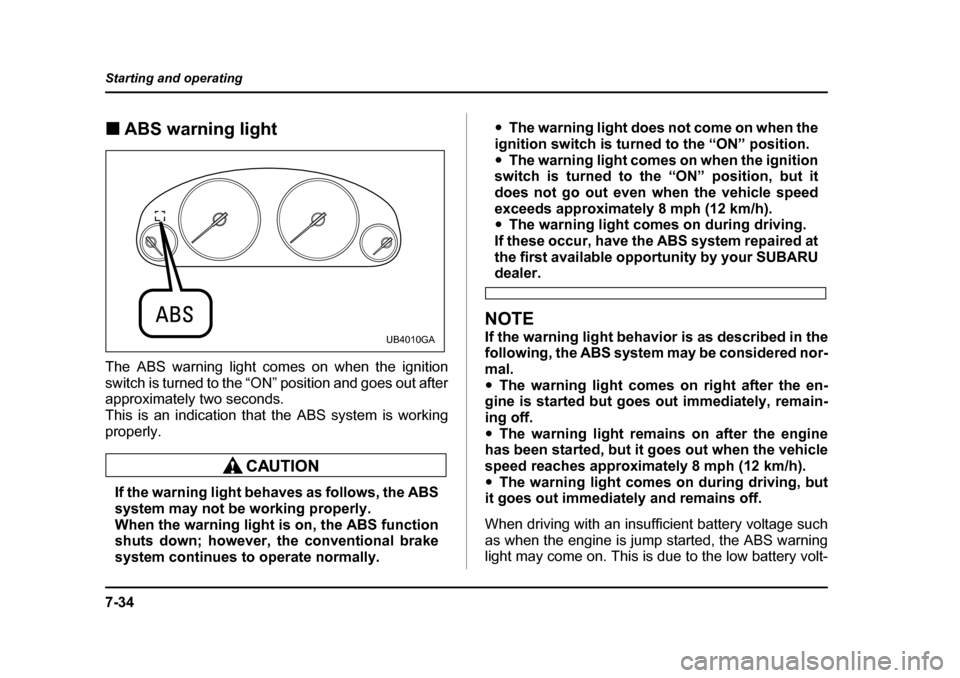
The ABS warning light comes on when the ignition
switch is turned to the “ON” position and goes out after
approximately two seconds.This is an indication that the ABS system is working
properly.
If the warning light behaves as follows, the ABS
system may not be working properly.
When the warning light is on, the ABS function
shuts down; however, the conventional brake
system continues to operate normally. y
The warning light does not come on when the
ignition switch is turned to the “ON” position.
y The warning light comes on when the ignition
switch is turned to th e “ON” position, but it
does not go out even when the vehicle speed
exceeds approximately 8 mph (12 km/h). y The warning light comes on during driving.
If these occur, have the ABS system repaired at
the first available opportunity by your SUBARU
dealer.
NOTE
If the warning light behavior is as described in the
following, the ABS system may be considered nor-
mal. y The warning light comes on right after the en-
gine is started but goes out immediately, remain-
ing off. y The warning light remains on after the engine
has been started, but it goes out when the vehicle
speed reaches approximately 8 mph (12 km/h). y The warning light comes on during driving, but
it goes out immediately and remains off.
When driving with an insufficient battery voltage such
as when the engine is jump started, the ABS warning
light may come on. This is due to the low battery volt-
UB4010GA
Page 288 of 487
7-35
Starting and operating
– CONTINUED –
age and does not indicate a malfunction. When the
battery becomes fully charged, the light will go out.Parking your vehicle
yNever leave unattended children or pets in
the vehicle. They could accidentally injure
themselves or others through inadvertent oper-
ation of the vehicle. Also, on hot or sunny days,
the temperature in a closed vehicle could
quickly become high enough to cause severe
or possibly fatal injuries to them. y Do not park the vehicle over flammable mate-
rials such as dry grass, waste paper or rags, as
they may burn easily if they come near hot en-
gine or exhaust system parts.y Be sure to stop the engine if you take a nap in
the vehicle. If engine exhaust gas enters the
passenger compartment, occupants in the ve-
hicle could die from carbon monoxide (CO)
contained in the exhaust gas.
Never drive while the parking brake is set be-
cause this will cause unnecessary wear on the
brake linings. Before starting to drive, always
Page 289 of 487
7-36
Starting and operating
make sure that the parking brake has been fully
released.
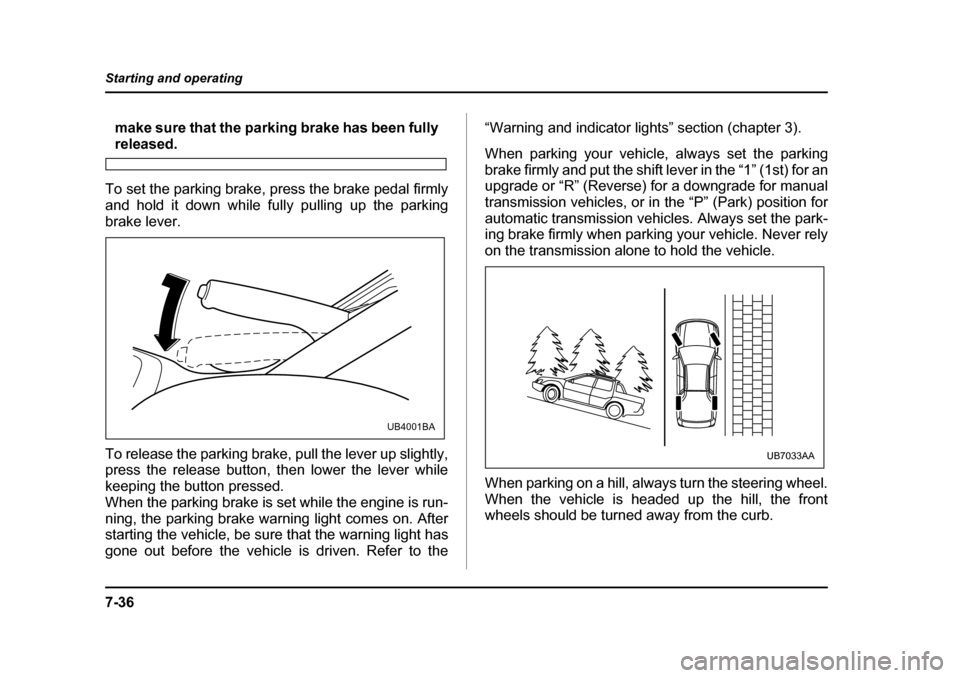
To set the parking brake, press the brake pedal firmly
and hold it down while fully pulling up the parking
brake lever.
To release the parking brake, pull the lever up slightly,
press the release button, then lower the lever while
keeping the button pressed.
When the parking brake is set while the engine is run-
ning, the parking brake warning light comes on. After
starting the vehicle, be sure that the warning light has
gone out before the vehicle is driven. Refer to the “Warning and indicator lights” section (chapter 3).
When parking your vehicl
e, always set the parking
brake firmly and put the shift lever in the “1” (1st) for an
upgrade or “R” (Reverse) for a downgrade for manual
transmission vehicles, or in the “P” (Park) position for
automatic transmission vehicles. Always set the park-
ing brake firmly when parking your vehicle. Never rely
on the transmission alone to hold the vehicle.
When parking on a hill, always turn the steering wheel.
When the vehicle is headed up the hill, the front
wheels should be turned away from the curb.
UB4001BA
UB7033AA
Page 291 of 487
7-38
Starting and operating
„
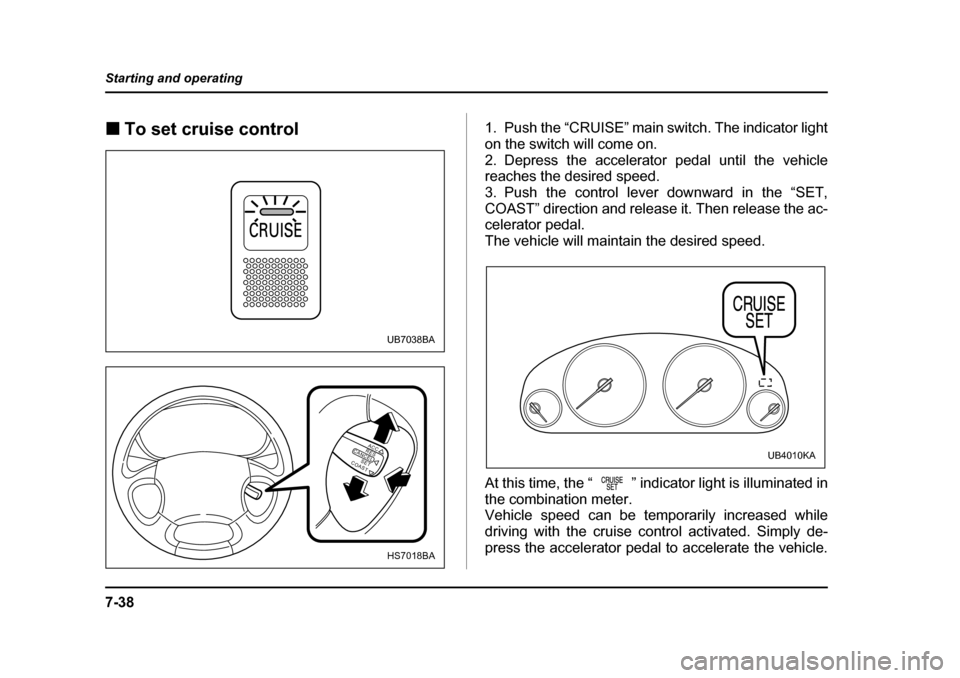
To set cruise control01. Push the “CRUISE” main switch. The indicator light
on the switch will come on.
2. Depress the accelerator pedal until the vehicle
reaches the desired speed.
3. Push the control lever downward in the “SET,
COAST” direction and release it. Then release the ac-
celerator pedal.
The vehicle will maintain the desired speed.
At this time, the “ ” indicator light is illuminated in the combination meter.
Vehicle speed can be temporarily increased while
driving with the cruise control activated. Simply de-
press the accelerator pedal to accelerate the vehicle.
UB7038BA
ACC
RES
CANCEL SET
COAST
HS7018BA
UB4010KA
Page 292 of 487

7-39
Starting and operating
– CONTINUED –
When the accelerator pedal is released, the vehicle
will return to and maintain the previous cruising speed. „To temporarily cancel the cruise con- trol
There are five ways to cancel the cruise control tem-
porarily: y Depress the brake pedal.
y Pull the control lever in the “CANCEL” direction.
y Depress the clutch pedal (manual transmission ve-
hicles only). y Shift the selector lever into the “N” position (auto-
matic transmission vehicles only). y Shift the shift lever into neutral position (manual
transmission vehicles only).
The “ ” indicator light in the combination meter
goes off when the cruise control is cancelled.
To resume the cruise control after it has been tempo-
rarily canceled and with vehicle speed of approximate-
ly 20 mph (32 km/h) or more , push the control lever up-
ward in the “ACCEL, RESUME ” direction to return to
the original cruising speed automatically.
The “ ” indicator light in the combination meter
will automatically come on at this time. „
To turn off the cruise control
There are two ways to turn off the cruise control: y Push the main switch again.
y Turn the ignition switch to the “ACC” position (but
only when the vehicle is completely stopped). „ To change the cruising speed
T To increase the speed (by control lever)
Push the control lever upward in the “ACCEL, RE-
SUME” direction and hold it until the vehicle reaches
the desired speed. Then, release the control lever.
The vehicle speed at that moment will be memorized
and treated as the new set speed.
When the difference between the actual vehicle speed
and the set speed is less than 4 mph (6.8 km/h), the
set speed can be increased 1 mph (1.6 km/h) each
time by pressing the control lever upward in the “AC-
CEL, RESUME” direction quickly. T To increase the speed (by accelerator pedal)
1. Depress the accelerator pedal to accelerate the ve-
hicle to the desired speed.
2. Push the control lever downward in the “SET,
COAST” direction once. Now the desired speed is set
and the vehicle will keep running at that speed without