2006 SKODA ROOMSTER tow
[x] Cancel search: towPage 52 of 274
Unlocking and locking51
Using the systemSafetyDriving TipsGeneral MaintenanceBreakdown assistanceTechnical Data
The interior monitor and the towing protection are operated with
the button
. You can switch the interior monitor and the towing
protection off if there is a possibility that movements from (e.g.
children or animals) inside the vehicle interior or if the vehicle
must be transported (e.g. by train or ship) or towed, might trigger
the alarm.
Switch off the interior monitor and towing protection
– Switch off the ignition.
– Press the button
on the driver door ⇒page 50, fig. 28 .
– Lock the vehicle within 30 seconds. The interior monitor and the towing protection are switched off.
The interior monitor and the towing protection are switched on again auto-
matically the next time the car is locked.
Note
•You can also switch off the interior monitor and the towing protection,
by deactivating the safe securing system ⇒page 43.
•When the ignition key is removed or a door is opened, the symbol in
the button lights up red.
•Lighting up of the symbol in the button does not confirm that the interior
monitor and the towing protection are switched on.
Power windows*
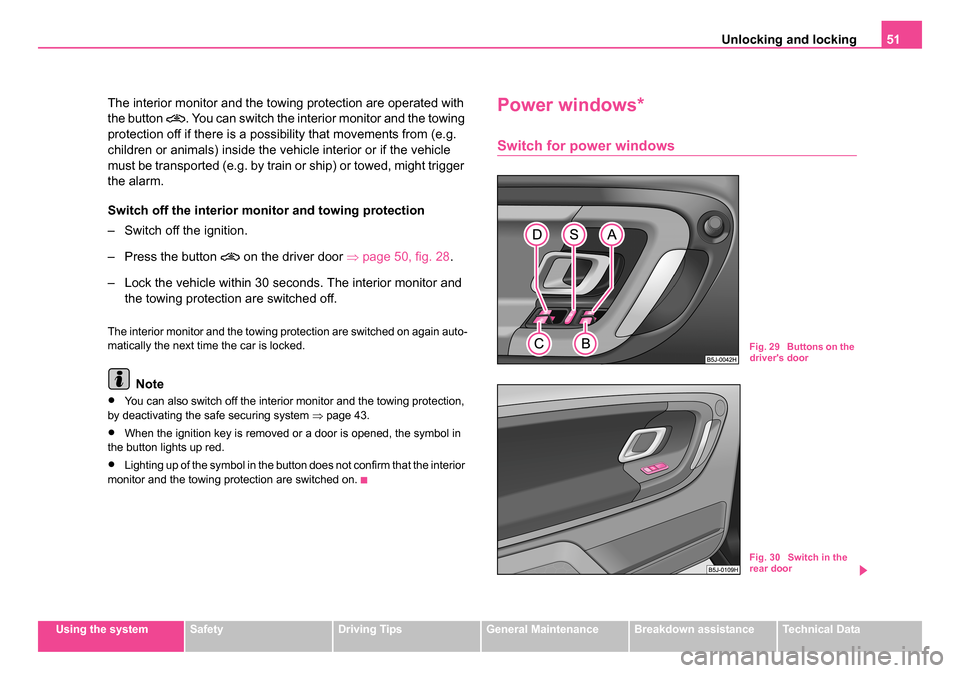
Switch for power windows
Fig. 29 Buttons on the
driver's door
Fig. 30 Switch in the
rear door
NKO 20 A05.book Page 51 Wednesday, June 21, 2006 1:42 PM
Page 59 of 274
Lights and Visibility
58
– Pull the light switch out to the second detent . The fog
lights* light up at the same time.
If the vehicle is not fitted with fog lights*, the rear fog light is switched on
by turning the light switch to the position and is pulled out directly to
the position . This switch does not have two positions, but only one
position.
The rear fog light warning light
⇒ page 27 lights up in the instrument
cluster when the fog light is switched off.
Only the rear fog light of the trailer lights up if the vehicle is fitted with a
towing device from Škoda original accessories and when you are
towing a trailer which is fitted with the rear fog light.
Caution
The rear fog light should only be switched on if visibility is particularly poor
(conform with any varying legal provisions) to avoid dazzling vehicles
behind your vehicle.
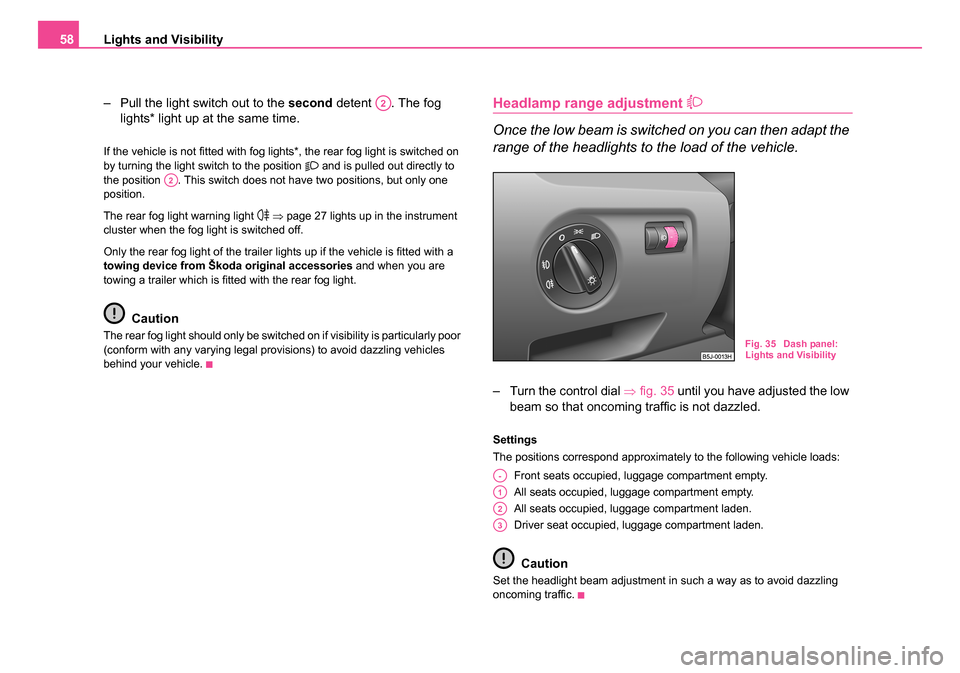
Headlamp range adjustment
Once the low beam is switched on you can then adapt the
range of the headlights to the load of the vehicle.
– Turn the control dial ⇒fig. 35 until you have adjusted the low
beam so that oncoming traffic is not dazzled.
Settings
The positions correspond approximately to the following vehicle loads:
Front seats occupied, luggage compartment empty.
All seats occupied, luggage compartment empty.
All seats occupied, luggage compartment laden.
Driver seat occupied, luggage compartment laden.
Caution
Set the headlight beam adjustment in such a way as to avoid dazzling
oncoming traffic.
A2
A2
Fig. 35 Dash panel:
Lights and Visibility
A-
A1
A2
A3
NKO 20 A05.book Page 58 Wednesday, June 21, 2006 1:42 PM
Page 64 of 274

Lights and Visibility63
Using the systemSafetyDriving TipsGeneral MaintenanceBreakdown assistanceTechnical Data
You can pull the sun visor for the driver or front passenger out of the fixture
and swivel it toward the door in the direction of the arrow
⇒page 62,
fig. 41 .
A vanity mirror*, which is provided with a cover, is located in the sun visor
on the front passenger side. Push the cover in direction of arrow .
WARNING
The sun visors must not be swivelled to the side windows into the
deployment area of the head airbags if any objects, such as ball-
point pens etc. are attached to them. This might result in injuries to
the occupants if the head airbag is deployed.
Windshield wiper and wash system
Windshield wiper
You can operate the windscreen wipers and automatic
wipe/wash using the windscreen wiper lever.
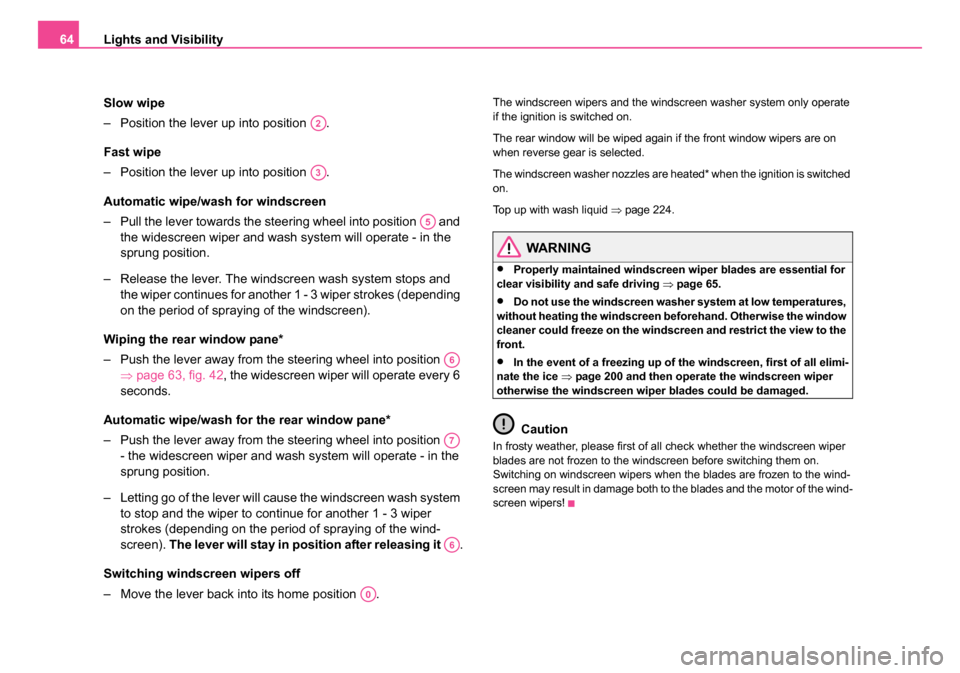
The windscreen wiper lever ⇒fig. 42 has the following positions:
Finger-operated wiping
– Position the lever down into position if you wish to wipe the windscreen only for a single wipe - spring-tensioned position.
Intermittent wiping
– Position the lever up into position .
– Set with the switch the desired break between the indi- vidual wiper strokes
A1
A2
Fig. 42 Windscreen
wiper lever
A4
A1
AA
NKO 20 A05.book Page 63 Wednesday, June 21, 2006 1:42 PM
Page 65 of 274
Lights and Visibility
64
Slow wipe
– Position the lever up into position .
Fast wipe
– Position the lever up into position .
Automatic wipe/wash for windscreen
– Pull the lever towards the steering wheel into position and the widescreen wiper and wash system will operate - in the
sprung position.
– Release the lever. The winds creen wash system stops and
the wiper continues for another 1 - 3 wiper strokes (depending
on the period of spraying of the windscreen).
Wiping the rear window pane*
– Push the lever away from the steering wheel into position ⇒page 63, fig. 42 , the widescreen wiper will operate every 6
seconds.
Automatic wipe/wash for the rear window pane*
– Push the lever away from the steering wheel into position - the widescreen wiper and wash system will operate - in the
sprung position.
– Letting go of the lever will cause the windscreen wash system to stop and the wiper to continue for another 1 - 3 wiper
strokes (depending on the period of spraying of the wind-
screen). The lever will stay in position after releasing it .
Switching windscreen wipers off
– Move the lever back into its home position .
The windscreen wipers and the windscreen washer system only operate
if the ignition is switched on.
The rear window will be wiped again if the front window wipers are on
when reverse gear is selected.
The windscreen washer nozzles are heated* when the ignition is switched
on.
Top up with wash liquid ⇒page 224.
WARNING
•Properly maintained windscreen wiper blades are essential for
clear visibility and safe driving ⇒page 65.
•Do not use the windscreen washer system at low temperatures,
without heating the windscreen beforehand. Otherwise the window
cleaner could freeze on the windscreen and restrict the view to the
front.
•In the event of a freezing up of the windscreen, first of all elimi-
nate the ice ⇒page 200 and then operate the windscreen wiper
otherwise the windscreen wiper blades could be damaged.
Caution
In frosty weather, please first of all check whether the windscreen wiper
blades are not frozen to the windscreen before switching them on.
Switching on windscreen wipers when the blades are frozen to the wind-
screen may result in damage both to the blades and the motor of the wind-
screen wipers!
A2
A3
A5
A6
A7
A6
A0
NKO 20 A05.book Page 64 Wednesday, June 21, 2006 1:42 PM
Page 67 of 274
Lights and Visibility
66
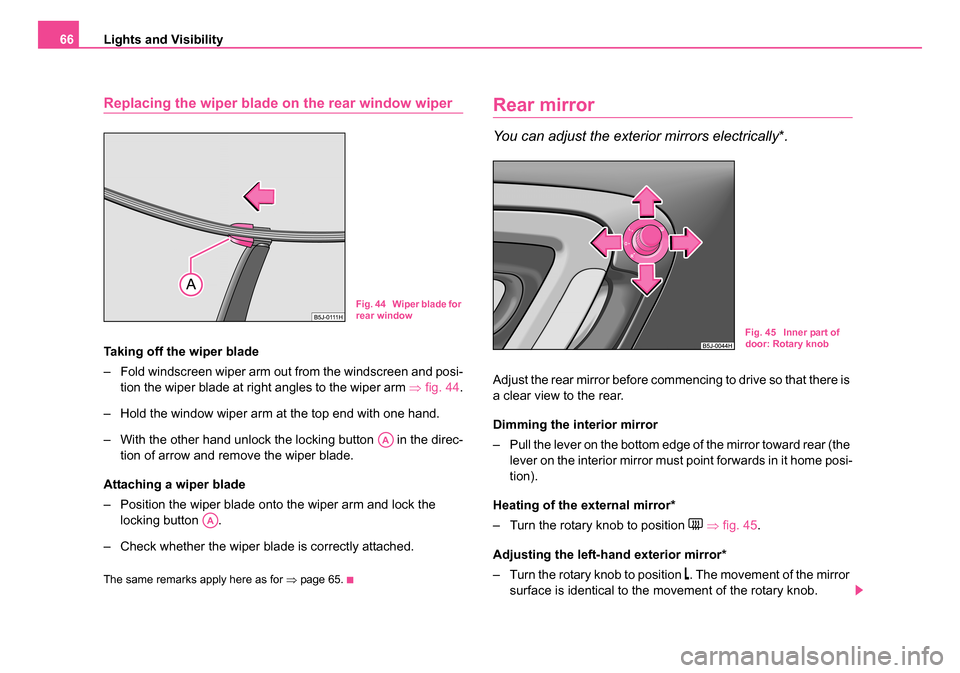
Replacing the wiper blade on the rear window wiper
Taking off the wiper blade
– Fold windscreen wiper arm out from the windscreen and posi-
tion the wiper blade at right angles to the wiper arm ⇒fig. 44 .
– Hold the window wiper arm at the top end with one hand.
– With the other hand unlock the locking button in the direc- tion of arrow and remove the wiper blade.
Attaching a wiper blade
– Position the wiper blade onto the wiper arm and lock the locking button .
– Check whether the wiper blade is correctly attached.
The same remarks apply here as for ⇒page 65.
Rear mirror
You can adjust the exterior mirrors electrically*.
Adjust the rear mirror before commencing to drive so that there is
a clear view to the rear.
Dimming the interior mirror
– Pull the lever on the bottom edge of the mirror toward rear (the
lever on the interior mirror must point forwards in it home posi-
tion).
Heating of the external mirror*
– Turn the rotary knob to position
⇒ fig. 45 .
Adjusting the left-h and exterior mirror*
– Turn the rotary knob to position
. The movement of the mirror
surface is identical to the movement of the rotary knob.
Fig. 44 Wiper blade for
rear window
AA
AA
Fig. 45 Inner part of
door: Rotary knob
NKO 20 A05.book Page 66 Wednesday, June 21, 2006 1:42 PM
Page 69 of 274
Seats and Stowage
68
Seats and Stowage
Front seats
Basic information
The front seats have a wide range of different settings and can thus be
matched to the physical characteristics of the driver and front passenger.
Correct adjustment of the seats is particularly important for
•safely and quickly reaching the controls,
•a relaxed, fatigue-free body position,
•achieving the maximum protection offered by the seat belts and
the airbag system.
The chapters which follow describe the procedure which you should adopt
for adjusting the seats.
WARNING
•Never transport more occupants than the maximum seating in
the vehicle.
•Each occupant must correctly fasten the seat belt belonging to
the seat. Children must be fastened ⇒page 166, “Transporting
children safely” with a suitable restraint system.
•The front seats and the head restraints must always be adjusted
to match the body size of the seat occupant as well as the seat belts
must always be correctly fastened in order to provide an optimal
protection for you and your occupants.
•Always keep your feet in the footwell when the car is being
driven - never place your feet on the instrument panel, out of the
window or on the surfaces of the seats. This is particularly impor- tant for the front seat passenger. You will be exposed to increased
risk of injury if it becomes nece
ssary to apply the brake or in the
event of an accident. If an airbag is deployed, you may suffer fatal
injuries when adopting an incorrect seated position!
•It is important for the driver and front passenger to maintain a
distance of at least 25 cm from the steering wheel or dash panel.
Not maintaining this minimum distance will mean that the airbag
system will not be able to properly protect you - hazard! The front
seats and the head restraints must always also be correctly
adjusted to match the body size of the occupant.
•Ensure that there are no objects in the footwell as any objects
may get behind the pedals during a driving or braking manoeuvre.
You would then no longer be able to operate the clutch, to brake or
accelerate.
WARNING (continued)
NKO 20 A05.book Page 68 Wednesday, June 21, 2006 1:42 PM
Page 70 of 274

Seats and Stowage69
Using the systemSafetyDriving TipsGeneral MaintenanceBreakdown assistanceTechnical Data
Adjusting the front seats
Adjusting a seat in a forward/back direction
– Pull the lever ⇒fig. 46 up and push the seat into the
desired position.
– Release the lever and push the seat further until the lock is heard to engage.
Adjusting height of seat*
– Lift the seat if required by pulling or pumping lever upwards.
– Lower the seat if required by pushing or pumping lever downwards. Adjust the angle of
the seat backrest
– Relieve any pressure on the backrest (do not lean on it) and turn the handwheel to adjust the angle of the backrest.
The driver's seat should be adjusted in such a way that the pedals can be
pressed to the floor with slightly bent legs.
The backrest on the driver's seat should be adjusted in such a way that
the upper point of the steering wheel can be easily reached with slightly
bent arms.
WARNING
•Only adjust the driver seat when the vehicle is stationary - risk
of injury!
•Take care when adjusting the sea t! Adjusting the seat without
care can lead to bruises or injuries.
•The backrests must not be angled too far back when driving
otherwise this will affect proper operation of the seat belts and of
the airbag system - risk of injury!
Fig. 46 Controls at
seat
A1
A1
A2
A2
A3
NKO 20 A05.book Page 69 Wednesday, June 21, 2006 1:42 PM
Page 71 of 274
Seats and Stowage
70
Head restraints
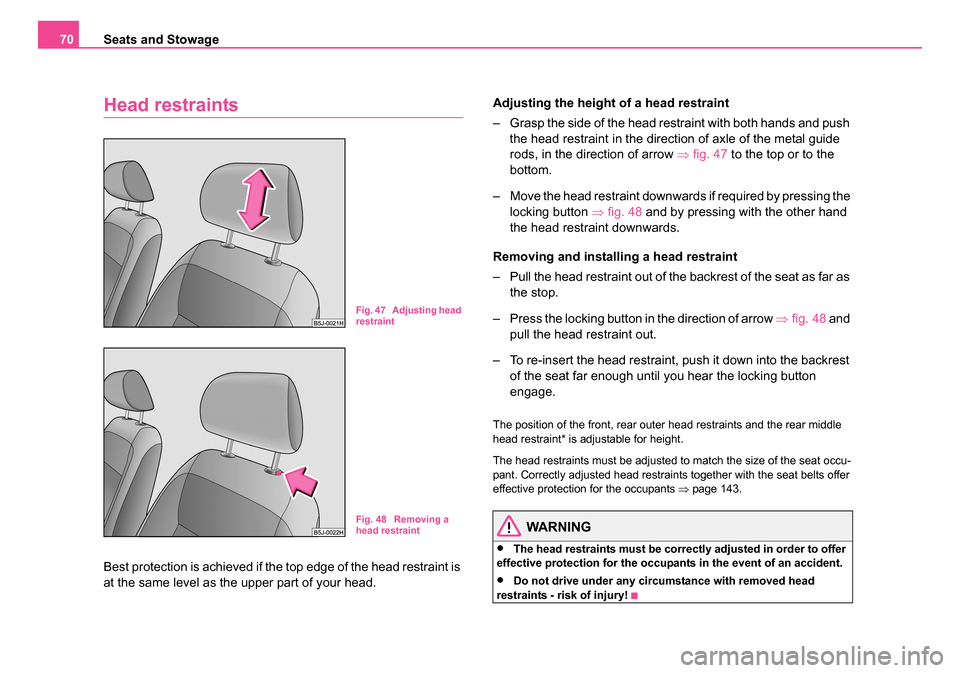
Best protection is achieved if the top edge of the head restraint is
at the same level as the upper part of your head. Adjusting the height of a head restraint
– Grasp the side of the head restraint with both hands and push
the head restraint in the direction of axle of the metal guide
rods, in the direction of arrow ⇒fig. 47 to the top or to the
bottom.
– Move the head restraint downwards if required by pressing the locking button ⇒fig. 48 and by pressing with the other hand
the head restraint downwards.
Removing and installing a head restraint
– Pull the head restraint out of the backrest of the seat as far as the stop.
– Press the locking button in the direction of arrow ⇒fig. 48 and
pull the head restraint out.
– To re-insert the head restraint, push it down into the backrest of the seat far enough until you hear the locking button
engage.
The position of the front, rear outer head restraints and the rear middle
head restraint* is adjustable for height.
The head restraints must be adjusted to match the size of the seat occu-
pant. Correctly adjusted head restraints together with the seat belts offer
effective protection for the occupants ⇒page 143.
WARNING
•The head restraints must be correctly adjusted in order to offer
effective protection for the occupants in the event of an accident.
•Do not drive under any circumstance with removed head
restraints - risk of injury!
Fig. 47 Adjusting head
restraint
Fig. 48 Removing a
head restraint
NKO 20 A05.book Page 70 Wednesday, June 21, 2006 1:42 PM