Page 202 of 318

202 Starting and drivingDriving with a roof rack
loadThe maximum permissible roof load is
220 lbs. (100 kg). Note that the roof load
must be included in the car’s maximum per-
missible payload and axle load.
Strong, sturdy roof carriers designed spe-
cially for your car are available from your
Saab dealer. Always secure roof loads
securely.
Fitting roof carriers3Sport Sedan and SportCombi without
roof rails
1 Open the four covers on the roof of the
car.
2 Insert a screw with washer into each roof
carrier foot. Fit a seal onto each screw.
3 The roof carriers are marked front and
back.
4 Bolt the roof carriers to the brackets in
the roof.
5 Check that the roof carriers are firmly
mounted.
WARNING
A roof load will affect the car’s center
of gravity and aerodynamics. Be
aware of this when cornering and driv-
ing in crosswinds.
Adjust your speed to the prevailing
conditions.
Due to higher aerodynamics drag, fuel
economy may suffer when driving with
a roof rack.
Mounting holes for roof carrier
93U S M 06.book Page 202 Friday, February 18, 2005 1:15 PM
ProCarManuals.com
Page 203 of 318
203 Starting and driving
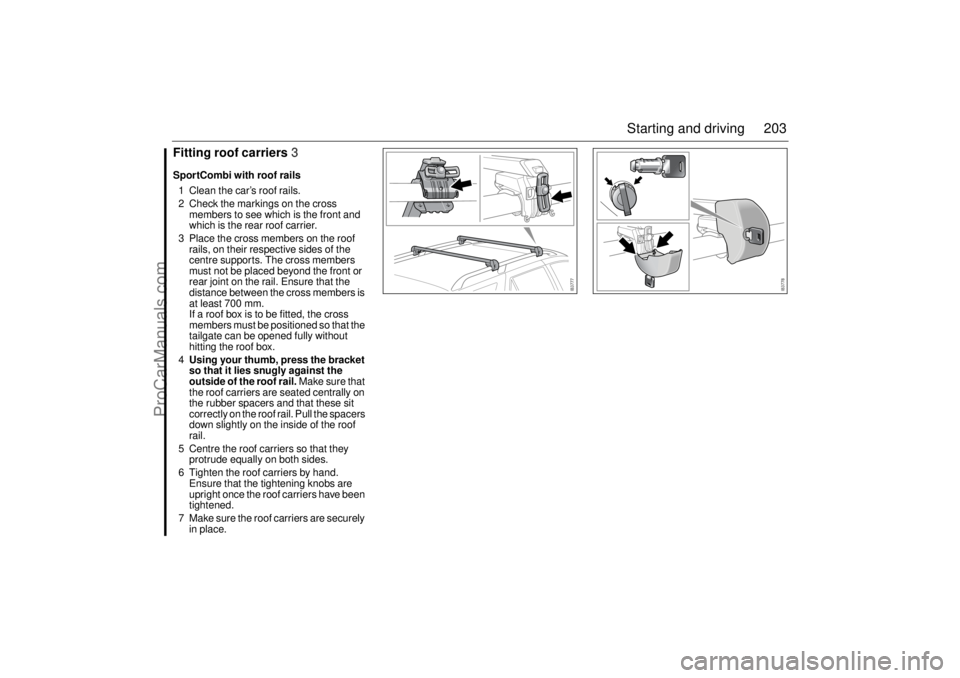
Fitting roof carriers3SportCombi with roof rails
1 Clean the car’s roof rails.
2 Check the markings on the cross
members to see which is the front and
which is the rear roof carrier.
3 Place the cross members on the roof
rails, on their respective sides of the
centre supports. The cross members
must not be placed beyond the front or
rear joint on the rail. Ensure that the
distance between the cross members is
at least 700 mm.
If a roof box is to be fitted, the cross
members must be positioned so that the
tailgate can be opened fully without
hitting the roof box.
4Using your thumb, press the bracket
so that it lies snugly against the
outside of the roof rail. M a k e s u r e t h a t
the roof carriers are seated centrally on
the rubber spacers and that these sit
correctly on the roof rail. Pull the spacers
down slightly on the inside of the roof
rail.
5 Centre the roof carriers so that they
protrude equally on both sides.
6 Tighten the roof carriers by hand.
Ensure that the tightening knobs are
upright once the roof carriers have been
tightened.
7 Make sure the roof carriers are securely
in place.93U S M 06.book Page 203 Friday, February 18, 2005 1:15 PM
ProCarManuals.com
Page 204 of 318

204 Starting and drivingDriving with a loadThe handling characteristics are affected by
how the car is loaded.
Driving with the trunk lid
openIf you must drive with the trunk lid open,
close all windows and the sunroof (if
equipped) and set the cabin fan to its high-
est speed setting.
Driving in deep water
NOTICE Place the heaviest load as far forward
and as low as possible in the trunk.
Secure the load to the lashing eyes
(see page 149).
Heavy loads mean that the car’s
center of gravity is further back. As a
result, the car will sway more during
evasive steering.
Never exceed the permissible load of
the roof box, even if there is room for
more.
Ensure that the tire pressure is correct
– slight overinflation is preferable to
underinflation.
The braking distance of a loaded car is
always greater. Keep your distance
from the vehicle in front.
Do not exceed the car’s permissible
gross vehicle weight or axle load (see
page 294).
Roof loads can negatively affect tele-
communication.
For further information on tires see
page 256.
WARNING
Avoid driving with the trunk lid partly or
fully open, since exhaust fumes can be
drawn into the cabin.
NOTICEDo not drive in puddles or water deeper
than 7 in. (20 cm) and do not drive faster
than 3–4 mph. Water can otherwise be
sucked into the engine. The engine will be
seriously damaged if water enters the
intake system.
93U S M 06.book Page 204 Friday, February 18, 2005 1:15 PM
ProCarManuals.com
Page 207 of 318

207 Starting and driving
Always try to keep the towrope taut by
gently applying the brake of the car on tow,
as necessary. This will avoid the towrope
being jerked violently.
Cars with automatic transmission:
Always observe the speed limit for vehicles
on tow. Whatever the speed limit, the car
must not be towed at speeds exceeding
30 mph (50 km/h) nor for a distance of more
than 30 miles (50 km). If the car needs to be
transported over a longer distance, a tow
truck or flatbed truck must be called out.
The engine cannot be started by towing or
pushing the car. In an emergency, the
engine can be started as described under
"Jump starting" on page 208.
Vehicle recoveryIf the car has to be transported on a flatbed
truck, or similar, it must be securely
strapped down. There are attachment
points for this purpose on the underside of
the car. The attachment points are oblong
hole that have been reinforced to cope with
the stresses that arise during this type of
transport.
Transporting the car
NOTICE The car must be towed front first.
If the car is to be towed with the front
wheels off the ground, make sure the
parking brake is off, as this acts on the
rear wheels.
NOTICEIf a car with sports (lowered) chassis is
transported, for example on a flat bed
truck, take extra care not to damage the
spoiler and/or underbody.
Attachment points for anchorage straps
93U S M 06.book Page 207 Friday, February 18, 2005 1:15 PM
ProCarManuals.com
Page 208 of 318

208 Starting and drivingDriving with the
compact spare tireObserve the following when the compact
spare tire is fitted:
The compact spare is light and easy to
handle when changing a tire.
Do not drive further than necessary with
the compact spare fitted - the maximum
life of the tire is only just over 2,000 miles
(approx. 3,500 km).
Refit the standard tire as soon as possi-
ble.Important considerations when driving with
a compact spare tire:
The car’s ground clearance is reduced.
The car must not be driven with more than
one compact spare tire at a time.
Avoid driving against the curb.
Do not use snow chains.
Do not fit the wheel cover - this would
conceal the warning text.
Jump starting
WARNING
Do not exceed 50 mph (80 km/h). The
tire can overheat affecting the car’s
roadholding.
Tire pressure: refer to page 304.
The spare tire or punctured tire must
be stowed under the trunk floor, and
secured in place with the retaining nut.
NOTICETo avoid damaging a alloy wheel of a
punctured tire, this can be temporarily
placed outside up in the spare wheel well
but only while driving to the closest work-
shop.
As a general rule, all heavy loads must be
well secured in the trunk (see page 149).
WARNING
When working on the battery, highly
explosive gas can build up. A spark
could ignite this gas that collects
around the battery. Therefore, always
avoid sparks and open flames in the
vicinity of the battery.
The battery contains corrosive sulphu-
ric acid. Always wear a face mask or
goggles when working on the battery.
If battery acid gets into the eyes or
splashes onto skin or clothing, wash
the affected area liberally with water. If
acid gets into the eyes or a large quan-
tity makes contact with the skin, seek
medical help.
93U S M 06.book Page 208 Friday, February 18, 2005 1:15 PM
ProCarManuals.com
Page 238 of 318
238 Car careFront fog lights3
1 Undo one screw in the wheel housing.
Lower the air shield.
2 Remove the protective cover. Release
the two spring clips securing the bulb.
3 Unplug the connector.
4 Change the bulb. Try not to touch the
glass part of the bulb with your fingers.
The height of the beam can be adjusted
using a screwdriver inserted through the
hole in the lower grille adjacent to the lens.
Side marker lights1 Slide the lens rearward so that its front
part can be pulled out.
2 Fit the new bulb.
3 When refitting, make sure that the
groove in the spring engages the plastic
edge of the bumper trim.
WARNING
Never crawl under a car that is
supported only by a jack. Always use
axle stands.
Refer to the information on jacks on
pages 273 and 274.93U S M 06.book Page 238 Friday, February 18, 2005 1:15 PM
ProCarManuals.com
Page 240 of 318

240 Car careStop lights, taillights and turn
signal bulbs, Sport Sedan1 Lower the cover in the trim behind the
lights.
Right-hand side: Unlock the plastic rivet
by depressing the centre no more than
3 mm. Take hold of the collar of the rivet
and pull it out. Refer also to page 241.
2 Lift the plastic lug on the lamp housing
that secures the bulb holder.
3 Carefully remove the entire bulb holder
unit from the lamp housing. Change the
bulb.
4 Refit the bulb holder. Press the bulb
holder home so that the plastic lug
snaps into place.
Stop lights, taillights and turn
signal bulbs, Convertible1 Remove the cover.
2 Carefully remove the bulb holder with
the broken bulb.The bulb holder has a
bayonet fitting.
3 Change the bulb.
4 Refit the bulb holder and cover.
Turn signals, reversing light and
rear fog light, SportCombi1 Remove the cover.
2 Remove the bulb holder with the broken
bulb. The bulb holder has a bayonet
fitting.
3 Fit the new bulb.
4 Refit the bulb holder and the cover.
93U S M 06.book Page 240 Friday, February 18, 2005 1:15 PM
ProCarManuals.com
Page 241 of 318

241 Car care
Reversing lights and rear fog
light, Sport SedanRemoving the trunk lid trim
1 Remove the two screws securing the
grab handle to the inside of the trunk lid.
2 Unlock the plastic rivets by pressing in
the center of each rivet. Pull out the
rivets by taking hold of the rivet’s collar.
You can use the button on the handle of the
screwdriver supplied with the car to unlock
the rivets.Changing bulbs
1 Press down the plastic lug on the bulb
holder.
2 Carefully remove the entire bulb holder
unit from the lamp housing. Change the
bulb.
3 Refit the bulb holder. Press the lug so
that it snaps into place.
To refit the trunk lid trim
1 Withdraw the center of the rivets.
2 Fit the trim in place on the trunk lid.
3 Fit the rivets. Lock the rivets in place by
pressing the center buttons in until flush
with the collar.
Reversing lights and rear fog
lights, ConvertibleRemoving the trunk lid trim
1 Remove the two screws securing the
grab handle to the inside of the trunklid.
2 Unlock the plastic rivets by pressing in
the centre of each rivet no more than
3 mm. Pull out the rivets by taking hold
of the rivet’s collar.
You can use the button on the handle of the
screwdriver supplied with the car to unlock
the rivets.
93U S M 06.book Page 241 Friday, February 18, 2005 1:15 PM
ProCarManuals.com
