Page 153 of 318
153 Interior equipment
Load-through hatch, SportCombiA load-through hatch is incorporated in the rear seat backrest to
enable long, narrow items to be carried inside the car.
Before loading or unloading long items, switch off the engine and
apply the parking brake. This avoids the danger of the car moving
off if a long item were to knock the gear or selector lever into gear.
Fold down the armrest and open the hatch by lifting the handle.
WARNING
Always secure the load firmly, for example using the middle
safety belt. This reduces the danger of personal injury result-
ing from the displacement of the load on hard braking or in the
event of a crash.
Do not exceed the load capacity of the car, as this will alter its
handling characteristics (see page 294).
TEMPORARY
FILE
TEMPORARY
FILE
93U S M 06.book Page 153 Friday, February 18, 2005 1:15 PM
ProCarManuals.com
Page 154 of 318
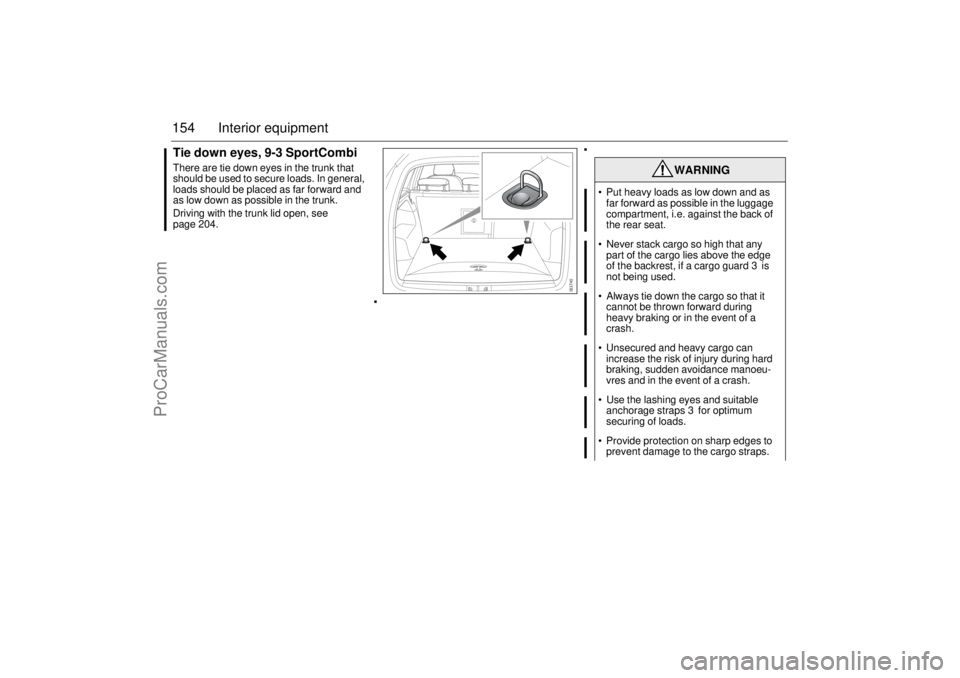
154 Interior equipmentTie down eyes, 9-3 SportCombiThere are tie down eyes in the trunk that
should be used to secure loads. In general,
loads should be placed as far forward and
as low down as possible in the trunk.
Driving with the trunk lid open, see
page 204.
WARNING
Put heavy loads as low down and as
far forward as possible in the luggage
compartment, i.e. against the back of
the rear seat.
Never stack cargo so high that any
part of the cargo lies above the edge
of the backrest, if a cargo guard3 is
not being used.
Always tie down the cargo so that it
cannot be thrown forward during
heavy braking or in the event of a
crash.
Unsecured and heavy cargo can
increase the risk of injury during hard
braking, sudden avoidance manoeu-
vres and in the event of a crash.
Use the lashing eyes and suitable
anchorage straps3 for optimum
securing of loads.
Provide protection on sharp edges to
prevent damage to the cargo straps.
93U S M 06.book Page 154 Friday, February 18, 2005 1:15 PM
ProCarManuals.com
Page 155 of 318
155 Interior equipment
Cargo net3
If possible, avoid having the rear seat
folded down when driving with a heavy
load, because the anchoring possibili-
ties are restricted when the rear seat
is in this position. That the rear seat
is in the upright is a basic require-
ment for protection against cargo
displacement in the event of a
crash.
Improve safety by fastening the outer
seatbelts. Check that the red "indica-
tor-flag" next to the opening handles is
not visible. If the red "indicator-flag" is
visible the backrest is not locked.
Match your speed and driving style to
how the car is loaded. The handling
characteristics of the car can be
affected since a load in the trunk will
alter the car’s center of gravity.
An object weighing 55 lbs. (25 kg)
corresponds to a weight of 2200 lbs.
(1,000 kg) in a front-end collision at
32 mph (50 km/h).
Adjust the car’s load (passengers and
luggage) so that the gross vehicle
weight and the axle weight are not
exceeded, see page 294.
WARNING
Never overload the cargo net3. If the
elastic breaks this may cause
personal injury. Do not use a cargo net
that shows signs of wear.
Never use the elastic floor net3 and
elastic side net3 when the rear seat is
folded down. These nets are only
intended to keep light objects tidy, not
for the anchoring of loads.
Secure the load in the luggage
compartment firmly. Using a cargo net
is not considered as load securing.
The only purpose of a cargo net is to
prevent light objects from being
thrown forward into the cabin during
heavy breaking.
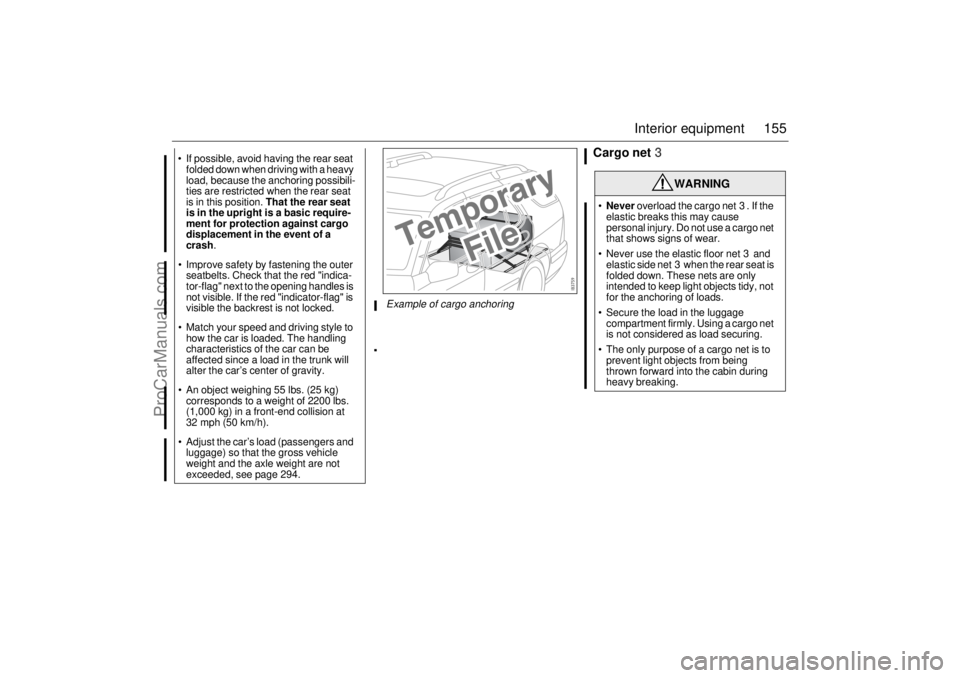
Example of cargo anchoring
93U S M 06.book Page 155 Friday, February 18, 2005 1:15 PM
ProCarManuals.com
Page 156 of 318
156 Interior equipmentCargo net, vertical3, SportCombi
Fit the net behind the rear seat backrest.
1 Remove the rear cover panels in the
roof.
2 Fit the net’s upper fasteners into the two
rear attachment points in the roof.
3 Secure the net’s hooks in the two
anchorage eyes closest to the rear seat.
Tension the straps.
The cargo net can also be fitted behind the
front seats when the whole rear seat is
folded.
1 Remove the front cover panels in the
roof.
2 Snap the net’s upper fasteners into the
two front attachment points in the roof.
3 Secure the net’s hooks in the two outer
eyes furthest back on the front seats’
rails down by the floor. Tension the
straps.
Attaching the cargo net to the roof
Cargo net fitted in front anchorage eye
93U S M 06.book Page 156 Friday, February 18, 2005 1:15 PM
ProCarManuals.com
Page 157 of 318
157 Interior equipment
Cargo net, floor mounted3, SportCombi
1 Fold up the floor. Position the edges of
the floor in the slots in the side pieces.
2 Fit the bag/carrier on the lower floor and
secure the net’s hooks in the folded-up
floor.
Cargo net, floor mounted, SportCombi1 Upper bracket. Make sure that the rubber
bands are not twisted
2 Lower anchorage point
Cargo net, floor mounted, SportCombi
with subwoofer1 Upper bracket. Make sure that the rubber
bands are not twisted
2 Lower anchorage point
93U S M 06.book Page 157 Friday, February 18, 2005 1:15 PM
ProCarManuals.com
Page 174 of 318

174 Starting and drivingPark Brake Shift LockThe transmission has a security function
known as Park Brake Shift Lock. To move
the gear selector lever out of the P or N posi-
tion, the gear selector lever detent (catch)
must be pressed in at the same time as the
brake pedal is held depressed.
The detent button on the selector lever has
to be pressed in before the lever can be
moved between certain positions.
Temporary override of Park Brake Shift
Lock, see page 176.
Adaptive gear change patternsThe adaptive gear change pattern function
adapts gear changing to the prevailing driv-
ing conditions. The transmission control
module senses the engine load, vehicle
speed and temperature of the transmission.
A suitable gear change pattern is then
selected automatically to avoid unneces-
sary gear changes and undesired increases
in transmission temperature.
Certain variants use a special change pat-
tern for the first few minutes after a cold start
so that the catalytic converter reaches its
working temperature more quickly.
Thermal transmission protectionThe transmission has built-in protection
against overheating. This protection is pro-
vided by the control module, which changes
gear change patterns.
1 If the temperature of the transmission
fluid exceeds 257°F (125°C), the gear
change pattern is changed.
2 If the temperature of the transmission
fluid exceeds 275°F (135°C), the gear
change pattern is again changed.
3 If the temperature of the transmission
fluid exceeds 302°F (150°C), engine
torque will be limited to 147 ft.lbs.
(200 Nm).
The following message is shown on the SID:
If this message appears, stop the car as
soon as it is safe to do so and allow the
engine to idle until the message has gone
out. The selector lever should be in
position P.Gearbox too hot.
Make a safe stop.
Open hood to cool down.
Selector lever detent93U S M 06.book Page 174 Friday, February 18, 2005 1:15 PM
ProCarManuals.com
Page 198 of 318

198 Starting and drivingTowing a trailer3Make sure you are familiar with the legal
requirements regarding speed limits for
towing, maximum trailer weights, trailer
braking requirements, and also any spe-
cial driving licence provisions.
Trailer hitch attachment3Trailer hitch attachments are available as
accessories. These are designed for a max-
imum trailer weight of 3500 lbs (1588 kg),
with trailer brakes.
An electrical connection3 for the towbar
and an electrical unit are provided in the
electrical centre on the left-hand side of the
luggage compartment.
The Saab genuine electrical socket enables
a battery in the trailer on tow to be charged
while driving. Also, if the car has SPA, this
is deactivated automatically if a trailer is
hitched up and correctly connected to the
Saab genuine trailer socket.
Saab recommendations:
Use a genuine Saab trailer hitch that is
designed and tested for your Saab.
Contact your Saab dealer for advice on
which trailer hitch is designed for your car.
WARNING
Do not drive with a trailer on inclines
steeper than 15 %. The load on the
drive (front) wheels will be so low that
the wheels can start to spin and
prevent further progress.
In addition, the car’s parking brake
may not always be sufficient to hold
the car and trailer securely, as the
wheels may start to slide.
Always apply the trailer’s parking
brake when unhitching it. There is
otherwise a risk of personal injury or
damage to the bumper should the
trailer start to roll.
When you hitch up the trailer be sure
to attach its safety chains to the holes
by the hitch.93U S M 06.book Page 198 Friday, February 18, 2005 1:15 PM
ProCarManuals.com
Page 201 of 318

201 Starting and driving
Checks before drivingMake sure that the car and trailer are in
good working order. This is essential since
towing a trailer increases the strain on the
car.
Check and if necessary adjust the tire
pressure of the car and trailer.
Make sure all wheel bolts are properly
tightened.
Make sure that the equipment joining the
car and trailer is properly secured and
adjusted.
Make sure the trailer’s electrical cable is
properly connected and is not so long that
it drags along the ground. Also, make sure
the cable is not too short and risks break-
ing when turning a corner.
Check all bulbs.
Check the car and trailer brakes.
Make sure that all items on or in the
camper or trailer are properly secured.
Make sure that the trailer’s jockey wheel is
raised and locked.
Check the distribution of the load so that
the car and trailer are well balanced.
Check that the rearview mirrors provide
the best possible rearward vision.
Make sure the trailer’s safety cable is
correctly attached.
Driving considerationsAlways take extra care when towing a
trailer, as the car’s handling will be different
and its braking performance reduced. The
trailer’s braking system and suspension
also have a considerable effect on these
characteristics. See also "Driving with a
load" on page 204.
Drive carefully:
descending hills
on uneven roads
over railway crossings
when meeting large vehicles
If the car has automatic transmission, select
gear M1 when ascending or descending
steep hills.
ReversingGet someone to help you keep an eye out
behind the trailer as the door mirrors do not
always provide sufficient rearward vision
when reversing.
93U S M 06.book Page 201 Friday, February 18, 2005 1:15 PM
ProCarManuals.com


