2006 PORSCHE CAYMAN wheel bolts
[x] Cancel search: wheel boltsPage 11 of 280

Controls, Instruments
11 Controls, Instruments
Before driving off... ...................................... 12
Break in hints for the first
2,000 miles/3,000 kilometers ...................... 14
Keys ........................................................... 17
Security Wheel Bolts .................................... 17
Doors ......................................................... 23
Alarm System,
Passenger Compartment Monitoring ............. 24
Power Windows ........................................... 26
Inside mirror ................................................ 28
Automatic Anti-Glare
Interior Mirror and Door Mirrors .................... 28
Door Mirrors ................................................ 29
Seat Adjustment .......................................... 32
Seat Memory ............................................... 34
Heated Seats .............................................. 36
Steering Wheel Adjustment ........................... 37
Multi-functional steering wheel ....................... 38
Sun Visors ................................................... 39
Safety Belts ................................................. 40
Airbag Systems ........................................... 42
Child Restraint Systems ................................ 49
LATCH System
Child seat bracket on the passenger’s seat .... 53
Child Restraint Anchorage ............................ 54
Clutch Pedal ................................................ 55
Parking Brake .............................................. 55
Brakes ........................................................ 56
ABS Brake System
(Antilock Brake System) ................................ 59
Sport Mode ................................................. 61
Porsche Stability Management (PSM) ............. 62Porsche Active Suspension Management
(PASM) ........................................................ 65
Retractable Rear Spoiler ............................... 66
Parking Aids ................................................ 68
Interior Lights .............................................. 70
Operation, Instruments ................................. 72
Ignition/Starter Switch with anti-theft Steering
Lock ........................................................... 74
Starting Procedures ..................................... 76
Stopping engine ........................................... 77
Instrument Panel USA Models ....................... 79
Automatic Speed Control Indicator light ......... 82
Instrument Illumination .................................. 82
Trip Odometer ............................................. 83
Speedometer .............................................. 84
Changing over between Miles / Kilometers .... 84
Tachometer ................................................. 85
Turn Signal Indicator Light ............................. 85
High Beam .................................................. 85
Cooling System ........................................... 86
Tiptronic ...................................................... 87
Fuel ............................................................ 88
Clock .......................................................... 89
Outside temperature .................................... 89
Check Engine Warning Light .......................... 90
Central warning light .................................... 91
Brake warning light USA ............................... 91
Brake warning light Canada .......................... 91
On-Board Computer (BC) .............................. 92
Light Switch .............................................. 122
Welcome Home Lighting ............................. 123
Automatic Headlight Beam Adjustment ........ 123Turn Signal/ Headlight Dimmer/Parking light /
Flasher Lever ............................................. 124
Windshield Wiper / Washer Lever ................ 125
Automatic Speed Control ............................ 128
Air conditioning .......................................... 130
Automatic air conditioning system ...............133
Central and side vents ................................ 136
Fresh-air intake .......................................... 136
Emergency Flasher Switch .......................... 137
Ashtray ..................................................... 138
Cigarette Lighter ........................................139
Sockets .................................................... 140
Storage in the passenger compartment ....... 141
Cupholder
(holder for drinks cans and cups) ...............143
Fire extinguisher ........................................145
Trunk Entrapment ....................................... 146
Front Luggage Compartment lid .................. 147
Front Luggage Compartment ...................... 149
Rear Lid .................................................... 150
Rear Luggage Compartment ....................... 151
Porsche Communication Management
(PCM) ........................................................ 155
Car Audio Operation/Tips ........................... 156
HomeLink .................................................. 159
Roof Transport System ............................... 162
Page 12 of 280

12
Controls, Instruments
Dear Porsche Owner A lot has gone into the manufacture of your
Porsche, including advanced engineering, rigid
quality control and demanding inspections.
These engineering and safety features will be
enhanced by you... the safe driver... – who knows his car and all controls,
– who maintains the vehicle properly,
– who uses driving skills wisely, and always
drives within her/his own capabilities and the
level of familiarity with the vehicle.
You will find helpful hints in this manual on how to
perform most of the checks listed on the following
pages.
If in doubt, have these checks performed by your
authorized Porsche dealer.
Before driving off... Check the following items first fTurn the engine off before you attempt any
checks or repairs on the vehicle.
fBe sure the tires are inflated correctly.
Check tires for damage and tire wear.
fSee that wheel bolts are properly tightened
and not loose or missing.
fCheck engine oil level, add if necessary.
Make it a habit to have engine oil checked with
every fuel filling.
fCheck all fluid levels such as windshield wash-
er and brake fluid levels.
fBe sure the vehicle battery is well charged and
cranks the engine properly.
fCheck all doors and lids for proper operation
and latch them properly.
fCheck and if necessary replace worn or
cracked wiper blades.
fSee that all windows are clear and unobstruct-
ed.
fCheck air intake slots and area between front
lid and windshield are free of snow and ice, so
the heater and the windshield wipers work
properly. fIf a child will be riding in the vehicle, check
child seat/child seat restraint system to ensure
that restraints are properly adjusted.
fCheck all exterior and interior lights for opera-
tion and that the lenses are clean.
fCheck the headlights for proper aim, and if
necessary, have them adjusted.
fCheck under the vehicle for leaks.
fBe sure all luggage is stowed securely.
Emergency equipment It is good practice to carry emergency equipment
in your vehicle.
Some of the items you should have are:
window scraper, snow brush, container or bag of
sand or salt, emergency light, small shovel, first-
aid kit, etc.
Page 17 of 280

Controls, Instruments
17
Keys fPlease observe the chapter “CENTRAL LO-
CKING” on Page 19.
Two main keys and one spare key are supplied
with your Porsche.
These keys operate all the locks on your vehicle.
fBe careful with your car keys: do not part with
them except under exceptional circumstances.
fTo avoid battery run-down, always remove the
ignition key from the ignition lock.
Replacement keys Replacement car keys can be obtained only from
your authorized Porsche dealer, and this can
sometimes be very time-consuming.
You should therefore always keep the spare key on
your person.
Keep it in a safe place (e.g. wallet), but under no
circumstances in or on the vehicle.
The key codes of new keys have to be “reported”
to the car control unit by your authorized Porsche
dealer.
A total of 6 car keys can be taught.
Disabling key codes
If a key is lost, the key codes can be disabled by
an authorized Porsche dealer.
All the remaining car keys are required for this pur-
pose.
Disabling the code ensures that the car can be
started only using authorized keys.
Note
fPlease note that the other locks can still be
opened with the disabled key.
Immobilizer There is a transponder (an electronic component)
in the key grip, containing a stored code.
When the ignition is switched on, the ignition lock
checks the code.
The immobilizer can be deactivated and the en-
gine started only using an authorized ignition key.
Switching off the immobilizer
fInsert the ignition key into the ignition lock.
If the ignition is left on for more than 2 minutes
without starting the engine, the immobilizer is re-
activated.
fIf this happens, turn the ignition key back to the
3 position before starting the engine.
Please observe the chapter “0 - INITIAL POSITI-
ON 1 - IGNITION ON 2 - START ENGINE 3 - IG-
NITION OFF” on Page 74.
Switching on the immobilizer
fRemove ignition key.Security Wheel Bolts fIf wheels have to be removed during a repair-
shop visit, do not forget to hand over the sock-
et for the security wheel bolts along with the
car key.
Page 149 of 280
Controls, Instruments
149
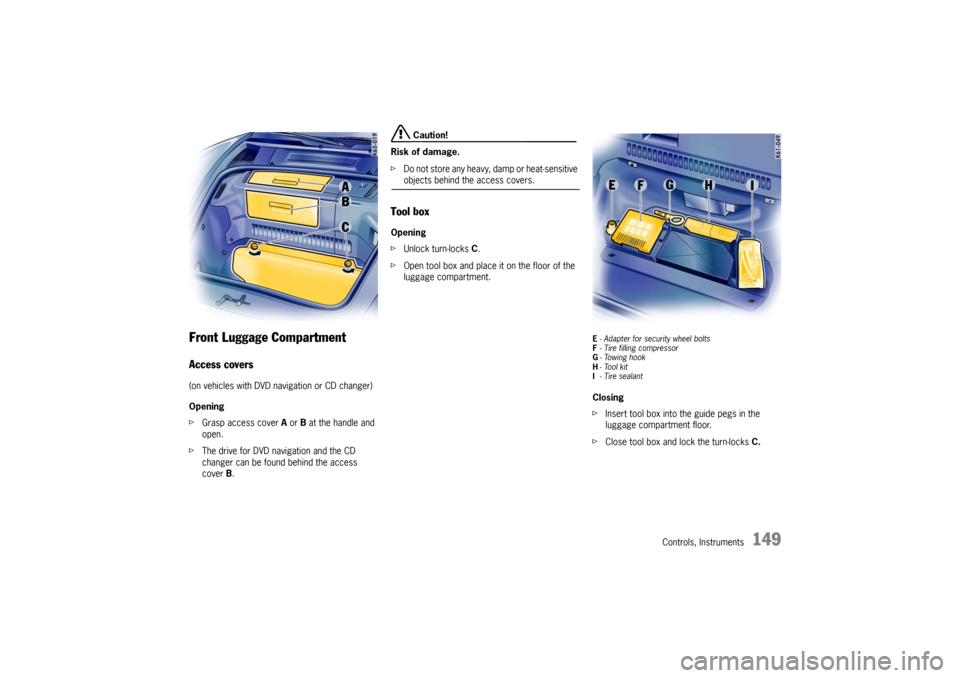
Front Luggage Compartment Access covers(on vehicles with DVD navigation or CD changer)
Opening
fGrasp access cover A or B at the handle and
open.
fThe drive for DVD navigation and the CD
changer can be found behind the access
cover B.
Caution!
Risk of damage.
fDo not store any heavy, damp or heat-sensitive objects behind the access covers.
Tool boxOpening
fUnlock turn-locks C.
fOpen tool box and place it on the floor of the
luggage compartment.
E- Adapter for security wheel bolts
F- Tire filling compressor
G-Towing hook
H-Tool kit
I-Tire sealantClosing
fInsert tool box into the guide pegs in the
luggage compartment floor.
fClose tool box and lock the turn-locks C.
Page 205 of 280

Practical Tips, Emergency Service
205 Practical Tips, Emergency Service
Exercise Extreme Caution when
Working on your Vehicle ............................. 206
Tires/Wheels ............................................ 207
Loading Information ................................... 221
Lifting the Vehicle with a Lifting
Platform or Garage Lift .............................. 223
Flat Tire .................................................... 224
Wheel Bolts .............................................. 227
Spacers ................................................... 230
Electrical System ....................................... 232
Battery ..................................................... 235
Jump lead starting .................................... 242
Replacing bulbs ......................................... 244
Headlights ................................................ 246
Turn signal light ......................................... 250
Side marker light ....................................... 253
Additional Brake Light ................................ 254
Tail light .................................................... 255
Luggage compartment/rear lid/
footwell lights ........................................... 257
Adjusting Headlights ................................. 258
Towing .................................................... 260
Page 207 of 280

Practical Tips, Emergency Service
207
Tires/Wheels The original equipment tires and wheel rims on
your Porsche comply with all applicable Federal
Motor Vehicle Safety Standards.
For your safety remember the following:
– Wheel rims and wheel bolts are matched to fit
your Porsche.
– If you intend to use other than original equip-
ment wheels, be sure that they conform to
Porsche specifications for your model.
Only tires with the same make and with the
same specification code (e.g. “N0”, “N1”...)
can be mounted.
– The use of wheel rims and wheel bolts that do
not meet specifications of the original factory
installed equipment will affect the safe opera-
tion of your vehicle.
– Before you plan on exchanging wheels, or
snow tires already mounted on the wheel rims,
consult your authorized Porsche dealer. Your
dealer has the technical information necessary
to advise you which wheel rims and wheel bolts
are compatible with the original factory instal-
lations.
Danger!
Risk of loss of control and serious personal
injury or death.
fIf while driving, your vehicle experiences a sud-
den vibration or ride disturbance, and/or you
suspect that possible damage to your tires or
vehicle has occurred, you should immediately
reduce your speed without excessive use of
the brakes.
fStop the vehicle as soon as possible, and in-
spect the tires.
If you cannot determine the cause for the dis-
turbance, have your vehicle towed to the near-
est Porsche or tire dealer to have your vehicle
or tire(s) inspected.
fContinuing to operate the vehicle without cor-
rection could result in a loss of control and se-rious personal injury.
Page 216 of 280

216
Practical Tips, Emergency Service
Wheel alignment, wheel balancing As a precaution, have wheels with summer tires
balanced in the spring, and those with mud and
snow tires before winter.
Unbalanced wheels may affect car handling and
tire life.
Only the specified weights may be used for wheel
balancing.
Self-adhesive weights must not come into contact
with cleaning agents, since they could drop off.
Uneven tread wear indicates wheel imbalance. In
this event, the vehicle should be checked at an au-
thorized Porsche dealer.
Warning!
If, during a trip, uneven running or vibrations
occur that could be caused by damage to
tires or the car, the speed must be reduced
immediately, but without braking sharply.
If you continue your trip without having the
cause of the fault remedied, you might lose
control of your vehicle which could cause se-
vere personal injury.
fStop the vehicle and check the tires.
fIf no cause for the fault can be found, drive
carefully to the nearest authorized Porsche dealer.
Removing and storing tires fAfter changing, adjust tire pressure and torque
wheel bolts diagonally to 94 ftlb (130 Nm).
Tires must always remain on the same side of
the vehicle.
When wheels are removed, the direction of
rotation and position of each wheel should be
marked.
Example
FR (front right), FL, RR and RL.
Wheels must always be fitted in accordance with
their marking.
The perception that tire durability and perform-
ance are immune to the effects of storage and
age is unfounded.
Chemical additives, which make the rubber elas-
tic, lose their effectiveness in the course of time
and the rubber becomes brittle and cracks.
Therefore, the tires should be inspected from
time to time. Note
Under no circumstances should tires older than 6
years be used on your Porsche.
The age of the tire can be obtained from the “DOT”
code number. If, for example, the last four num-
bers read 1205, then the tire was produced in the
12th week of 2005.
fStore tires in a cool and dry place.
Page 227 of 280

Practical Tips, Emergency Service
227
Wheel Bolts
Warning!
Risk of wheel bolt breakage and wheel sepa-
ration, resulting in severe personal injury or
death.
fFollow all instructions concerning wheel bolts. fAlways clean the wheel bolts before fitting.
fApply a thin coat of Optimoly TA (aluminum
paste) on the thread and between the bolt head
and movable spherical cap ring (arrows).
The bearing surface of the spherical cap
facing the wheel must not be greased.
fReplace damaged wheel bolts.
Only use the Original Porsche wheel bolts
specially designed for this vehicle type.
Tightening torque Tightening torque of wheel bolts:
130 Nm/96 ftlb. Wheel Securing Bolts The wrench socket for the wheel securing bolts is
in the tool box.
To loosen or tighten the wheel bolt with anti-theft
protection, a wrench socket with the appropriate
coding must be used between the wheel bolt and
the wheel-bolt spanner.
fWhen positioning the wrench socket, ensure
that it engages fully in the teeth of the wheel
bolt.
If the wheels have to be removed at the workshop,
please do not forget to hand over the wrench
socket for the wheel securing bolts along with the
car key.
Checking tire pressure with a
pressure gaugefPlease observe the chapter “TPC TIRE PRES-
SURE MONITORING” on Page 103.
1. Remove the valve stem cap from the tire.
2. Press the pressure gauge onto the valve stem.
Note on operation
fDo not press too hard or force the valve stem
sideways, or air will escape.
If the sound of air escaping from the tire is
heard, reposition the pressure gauge.
3. Read the tire pressure on the gauge stem and
compare it to the permissible tire pressure.
This information can be found on the tire pres-
sure plate or in the chapter Technical Data.
Please observe the chapter “TIRE PRESSURE
FOR COLD TIRES” on Page 269.
4. Remove the pressure gauge.