2006 PORSCHE BOXSTER Changing
[x] Cancel search: ChangingPage 167 of 296
Shifting Gear
167
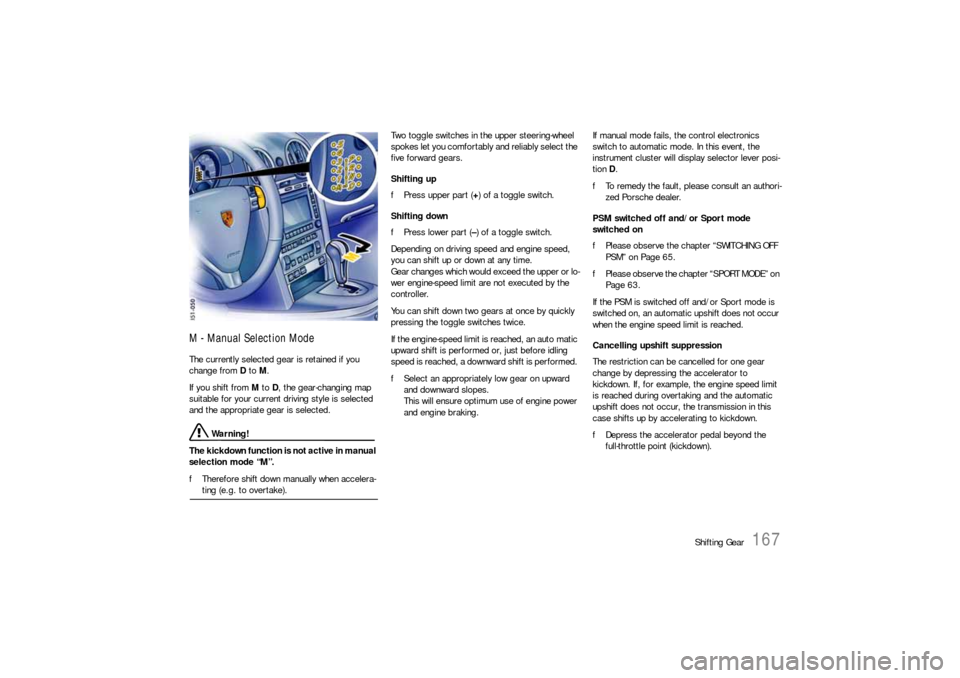
M - Manual Selection Mode The currently selected gear is retained if you
change from D to M.
If you shift from M to D, the gear-changing map
suitable for your current driving style is selected
and the appropriate gear is selected.
Warning!
The kickdown function is not active in manual
selection mode “M”.
fTherefore shift down manually when accelera-ting (e.g. to overtake). Two toggle switches in the upper steering-wheel
spokes let you comfortably and reliably select the
five forward gears.
Shifting up
fPress upper part (+) of a toggle switch.
Shifting down
fPress lower part (–) of a toggle switch.
Depending on driving speed and engine speed,
you can shift up or down at any time.
Gear changes which would exceed the upper or lo-
wer engine-speed limit are not executed by the
controller.
You can shift down two gears at once by quickly
pressing the toggle switches twice.
If the engine-speed limit is reached, an auto matic
upward shift is performed or, just before idling
speed is reached, a downward shift is performed.
fSelect an appropriately low gear on upward
and downward slopes.
This will ensure optimum use of engine power
and engine braking. If manual mode fails, the control electronics
switch to automatic mode. In this event, the
instrument cluster will display selector lever posi-
tion D.
fTo remedy the fault, please consult an authori-
zed Porsche dealer.
PSM switched off and/or Sport mode
switched on
fPlease observe the chapter “SWITCHING OFF
PSM” on Page 65.
fPlease observe the chapter “SPORT MODE” on
Page 63.
If the PSM is switched off and/or Sport mode is
switched on, an automatic upshift does not occur
when the engine speed limit is reached.
Cancelling upshift suppression
The restriction can be cancelled for one gear
change by depressing the accelerator to
kickdown. If, for example, the engine speed limit
is reached during overtaking and the automatic
upshift does not occur, the transmission in this
case shifts up by accelerating to kickdown.
fDepress the accelerator pedal beyond the
full-throttle point (kickdown).
Page 185 of 296
Maintenance, Car Care
185
Wiper BladesfWhen wiper performance deteriorates, replace
the wipers.
fPlease observe the chapter “CAR CARE IN-
STRUCTIONS” on Page 209.
Caution!
Risk of damage if the wiper arm accidentally
falls back on to the window.
fAlways hold the wiper arm securely when re-
placing the wiper blade.
Risk of damage if wiper blades that are fro-
zen in place are loosened improperly.
fThaw the wiper blades before loosening them.
Maintenance note
If the wiper blades rub or squeak, this can be as a
result of the following:
– If the vehicle is washed in an automatic car
wash, residues may adhere to the windshield.
These residues can only be removed using a
special cleaning solution.
Please contact your authorized Porsche dealer
for further information.
– The wiper blades may be damaged.
fReplace damaged wiper blades as soon as
possible.
Changing windshield wiper blades
Caution!
Risk of damage.
If a wiper blade is not changed properly, it
can come loose when the car is moving.
fCheck whether the wiper blade is seated
securely.
The wiper blade must engage the wiper arm properly.
1. Apply the handbrake.
2. Switch the wipers off (position 0) and remove
the ignition key.
3. Fold windshield wiper arm away from the
windshield.
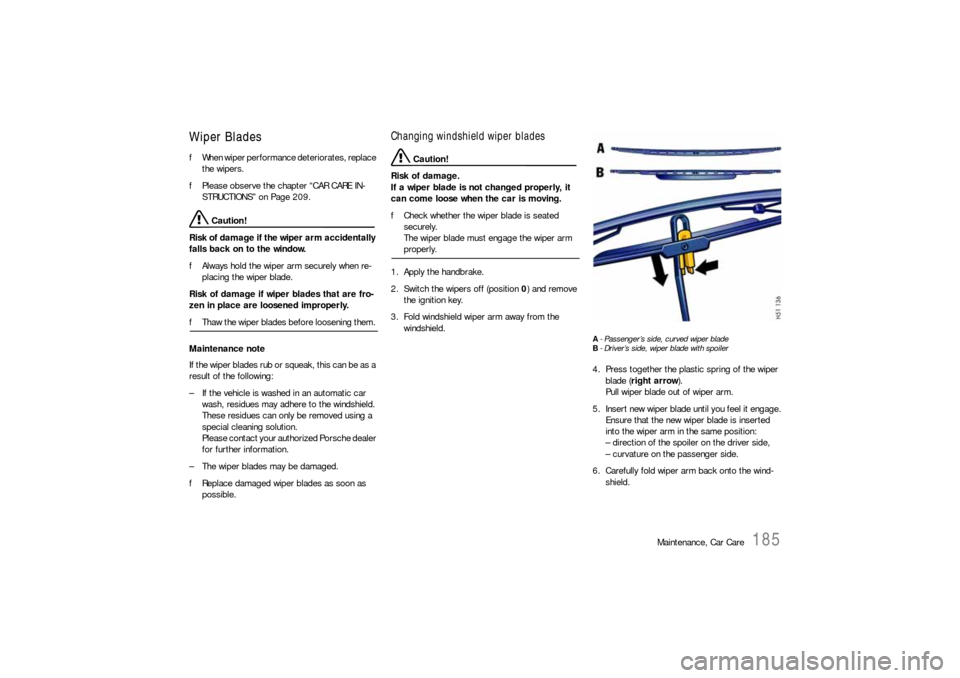
A- Passenger’s side, curved wiper blade
B- Driver’s side, wiper blade with spoiler4. Press together the plastic spring of the wiper
blade (right arrow).
Pull wiper blade out of wiper arm.
5. Insert new wiper blade until you feel it engage.
Ensure that the new wiper blade is inserted
into the wiper arm in the same position:
– direction of the spoiler on the driver side,
– curvature on the passenger side.
6. Carefully fold wiper arm back onto the wind-
shield.
Page 193 of 296

Maintenance, Car Care
193
Changing the brake fluid Brake fluid absorbs moisture from the air over ti-
me. This accumulation of water lowers the boiling
point and, under certain operating con ditions,
can affect the braking action.
Therefore have the brake fluid changed in accor-
dance with the change intervals stated in the bro-
chure “Maintenance”. The brake-fluid warning lights in the instrument pa-
nel and on-board computer indicate:
– brake-fluid level too low,
– in conjunction with large pedal travel, braking-
circuit failure.
If the warning lights should light up while
driving:
fStop immediately in a suitable place.
fDo not continue driving.
Please have the fault remedied at your nearest
authorized Porsche dealer.
Warning light USA
Warning light Canada
Page 211 of 296

Maintenance, Car Care
211
Convertible top
fNever remove snow and ice using a sharp
edged object.
Incorrect care and treatment can damage the con-
vertible top and cause leaks. Any repair work can
be done by your authorized Porsche dealer.
Important note
No folding top is 100% leak proof.
Due to the constant changing of loads and strains
to which a car is subject to when driving on roads,
minor wind noise and seepage at joints between
the top, body and doors on convertible tops can-
not be completely sealed in certain areas. There-
fore small leaks are considered normal for these
models. In addition, your convertible top should
not be washed in a car wash. The top may experi-
ence damage by the brushes or may experience
leaks due to the high pressure water streams di-
rected in areas which would not encounter water
in normal driving conditions. Cleaning
Caution!
Risk of damage due to the cleaning jet of the
high-pressure cleaning equipment or hot wax
treatment.
fDo not clean the convertible top with high-
pressure cleaning equipment.
fDo not use the hot wax treatment.
Do not wash the convertible top each time the car
is washed.
It is usually sufficient to spray or wash it with clean
water.
fBrush dust off the convertible top in the direc-
tion of the weave using a soft brush.
fOnly if there is heavy dirt, wet the convertible
top with lukewarm water and the Porsche
Wash-Shampoo & convertible-top cleaner,
using a sponge or soft brush, and rub gently.
Rinse Wash-Shampoo & convertible-top clea-
ner thoroughly off the convertible top with
clean water.
fAfter washing it, treat the convertible-top cover
at least once a year with the special Porsche
convertible-top care product.
Do not allow the convertible-top care product
to come into contact with paint or windows. If
it does, remove immediately. fIf there is leakage in the convertible-top cover
or at its seams or folds, the special Porsche
convertible-top care product can be used.
fPlease note the information on the container.
fRemove bird droppings immediately since the
acid in them will make the rubber swell and the
convertible top will become leaky.
fOpen convertible top only when it is completely
dry, otherwise damp stains and scrub marks
may occur which cannot be removed.
fTry to remove spots from the convertible-top
cover by rubbing carefully with a soft rubber
sponge.
Page 221 of 296

Practical Tips, Emergency Service
221
Tires/Wheels The original equipment tires and wheel rims on
your Porsche comply with all applicable Federal
Motor Vehicle Safety Standards.
For your safety remember the following:
– Wheel rims and wheel bolts are matched to fit
your Porsche.
– If you intend to use other than original equip-
ment wheels, be sure that they conform to
Porsche specifications for your model.
Only tires with the same make and with the
same specification code (e.g. “N0”, “N1”...)
can be mounted.
– The use of wheel rims and wheel bolts that do
not meet specifications of the original factory
installed equipment will affect the safe opera-
tion of your vehicle.
– Before you plan on exchanging wheels, or
snow tires already mounted on the wheel rims,
consult your authorized Porsche dealer. Your
dealer has the technical information necessary
to advise you which wheel rims and wheel bolts
are compatible with the original factory instal-
lations.
Danger!
Risk of loss of control and serious personal
injury or death.
fIf while driving, your vehicle experiences a sud-
den vibration or ride disturbance, and/or you
suspect that possible damage to your tires or
vehicle has occurred, you should immediately
reduce your speed without excessive use of
the brakes.
fStop the vehicle as soon as possible, and in-
spect the tires.
If you cannot determine the cause for the dis-
turbance, have your vehicle towed to the near-
est Porsche or tire dealer to have your vehicle
or tire(s) inspected.
fContinuing to operate the vehicle without cor-
rection could result in a loss of control and se-rious personal injury.
Page 230 of 296

230
Practical Tips, Emergency Service
Wheel alignment, wheel balancing As a precaution, have wheels with summer tires
balanced in the spring, and those with mud and
snow tires before winter.
Unbalanced wheels may affect car handling and
tire life.
Only the specified weights may be used for wheel
balancing.
Self-adhesive weights must not come into contact
with cleaning agents, since they could drop off.
Uneven tread wear indicates wheel imbalance. In
this event, the vehicle should be checked at an au-
thorized Porsche dealer.
Warning!
If, during a journey, uneven running or vibra-
tions occur that could be caused by damage
to tires or the car, the speed must be re-
duced immediately, but without braking
sharply.
If you continue your trip without having the
cause of the fault remedied, you might lose
control of your vehicle which could cause se-
vere personal injury.
fStop the vehicle and check the tires.
fIf no cause for the fault can be found, drive
carefully to the nearest authorized Porsche dealer.
Removing and storing tires fAfter changing, adjust tire pressure and torque
wheel bolts diagonally to 94 ftlb (130 Nm).
Tires must always remain on the same side of
the vehicle.
When wheels are removed, the direction of
rotation and position of each wheel should be
marked.
Example
FR (front right), FL, RR and RL.
Wheels must always be fitted in accordance with
their marking.
The preception that tire durability and perform-
ance are immune to the effects of storage and
age is unfounded.
Chemical additives, which make the rubber elas-
tic, lose their effectiveness in the course of time
and the rubber becomes brittle and cracks.
Therefore, the tires should be inspected from
time to time. Note
Under no circumstances should tires older than 6
years be used on your Porsche.
The age of the tire can be obtained from the “DOT”
code number. If, for example, the last four num-
bers read 1204, then the tire was produced in the
12th week of 2004.
fStore tires in a cool and dry place.
Page 242 of 296
242
Practical Tips, Emergency Service
Changing a wheel
Warning!
Risk of injury. The car may slip off the jack.
fMake sure that no one is in the vehicle when
jacking up and changing a wheel.
fAlways place the car on stable supports if work
has to be carried out under the car.
Risk of damage to the brake discs of the
Porsche Ceramic Composite Brake (PCCB).
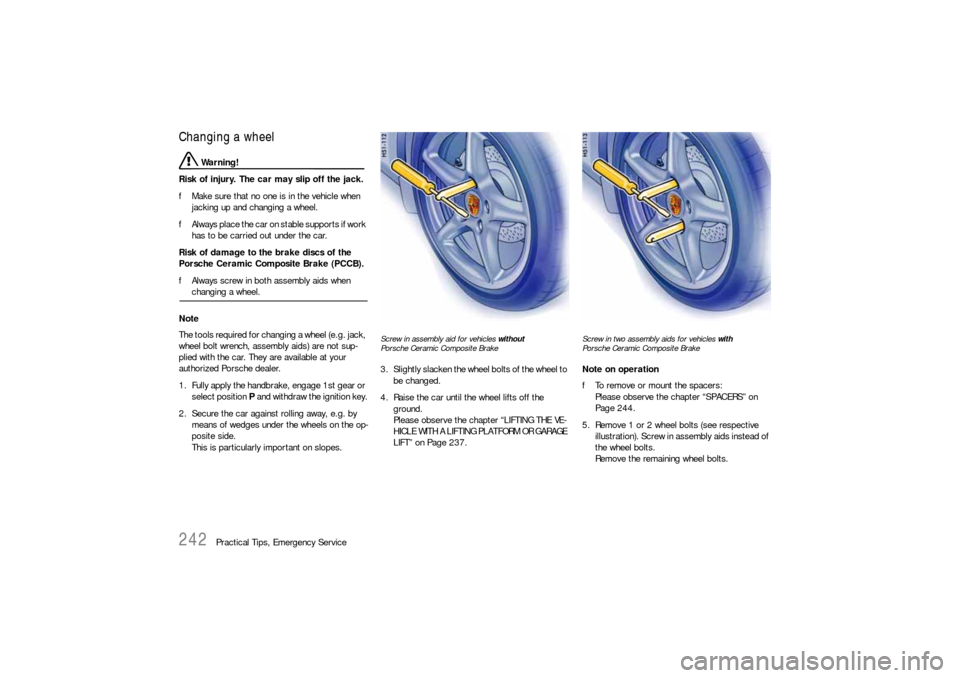
fAlways screw in both assembly aids when changing a wheel.
Note
The tools required for changing a wheel (e.g. jack,
wheel bolt wrench, assembly aids) are not sup-
plied with the car. They are available at your
authorized Porsche dealer.
1. Fully apply the handbrake, engage 1st gear or
select position P and withdraw the ignition key.
2. Secure the car against rolling away, e.g. by
means of wedges under the wheels on the op-
posite side.
This is particularly important on slopes.
Screw in assembly aid for vehicles without
Porsche Ceramic Composite Brake3. Slightly slacken the wheel bolts of the wheel to
be changed.
4. Raise the car until the wheel lifts off the
ground.
Please observe the chapter “LIFTING THE VE-
HICLE WITH A LIFTING PLATFORM OR GARAGE
LIFT” on Page 237.
Screw in two assembly aids for vehicles with
Porsche Ceramic Composite BrakeNote on operation
fTo remove or mount the spacers:
Please observe the chapter “SPACERS” on
Page 244.
5. Remove 1 or 2 wheel bolts (see respective
illustration). Screw in assembly aids instead of
the wheel bolts.
Remove the remaining wheel bolts.
Page 243 of 296

Practical Tips, Emergency Service
243
6. Take the wheel off and put a new wheel on.
7. Please observe the chapter “WHEEL BOLTS”
on Page 241.
Screw in wheel bolts; remove assembly aids
and screw in the remaining wheel bolts. Initially
tighten bolts in diagonally opposite sequence
so that the wheel is centered.
8. Lower the car completely.
9. Tighten wheel bolts in diagonally opposite
sequence.
Immediately after changing a wheel, use a
torque wrench to check the prescribed
tightening torque (130 Nm/96 ftlb.).