2006 MERCEDES-BENZ SPRINTER clutch
[x] Cancel search: clutchPage 1290 of 2305
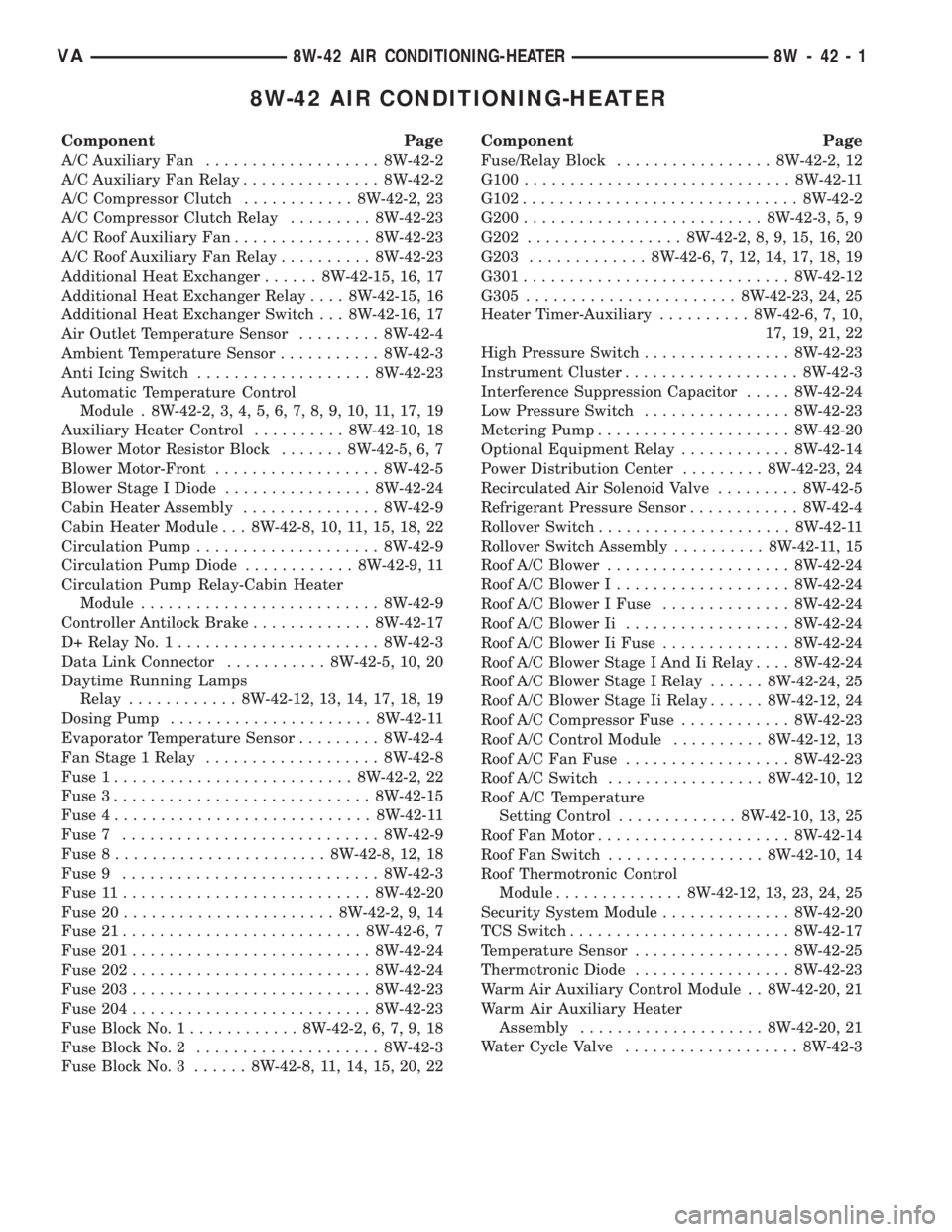
8W-42 AIR CONDITIONING-HEATER
Component Page
A/C Auxiliary Fan................... 8W-42-2
A/C Auxiliary Fan Relay............... 8W-42-2
A/C Compressor Clutch............ 8W-42-2, 23
A/C Compressor Clutch Relay......... 8W-42-23
A/C Roof Auxiliary Fan............... 8W-42-23
A/C Roof Auxiliary Fan Relay.......... 8W-42-23
Additional Heat Exchanger...... 8W-42-15, 16, 17
Additional Heat Exchanger Relay.... 8W-42-15, 16
Additional Heat Exchanger Switch . . . 8W-42-16, 17
Air Outlet Temperature Sensor......... 8W-42-4
Ambient Temperature Sensor........... 8W-42-3
Anti Icing Switch................... 8W-42-23
Automatic Temperature Control
Module . 8W-42-2, 3, 4, 5, 6, 7, 8, 9, 10, 11, 17, 19
Auxiliary Heater Control.......... 8W-42-10, 18
Blower Motor Resistor Block....... 8W-42-5, 6, 7
Blower Motor-Front.................. 8W-42-5
Blower Stage I Diode................ 8W-42-24
Cabin Heater Assembly............... 8W-42-9
Cabin Heater Module . . . 8W-42-8, 10, 11, 15, 18, 22
Circulation Pump.................... 8W-42-9
Circulation Pump Diode............ 8W-42-9, 11
Circulation Pump Relay-Cabin Heater
Module.......................... 8W-42-9
Controller Antilock Brake............. 8W-42-17
D+ Relay No. 1...................... 8W-42-3
Data Link Connector........... 8W-42-5, 10, 20
Daytime Running Lamps
Relay............ 8W-42-12, 13, 14, 17, 18, 19
Dosing Pump...................... 8W-42-11
Evaporator Temperature Sensor......... 8W-42-4
Fan Stage 1 Relay................... 8W-42-8
Fuse 1.......................... 8W-42-2, 22
Fuse 3............................ 8W-42-15
Fuse 4............................ 8W-42-11
Fuse 7............................ 8W-42-9
Fuse 8....................... 8W-42-8, 12, 18
Fuse 9............................ 8W-42-3
Fuse 11........................... 8W-42-20
Fuse 20....................... 8W-42-2, 9, 14
Fuse 21.......................... 8W-42-6, 7
Fuse 201.......................... 8W-42-24
Fuse 202.......................... 8W-42-24
Fuse 203.......................... 8W-42-23
Fuse 204.......................... 8W-42-23
Fuse Block No. 1............ 8W-42-2, 6, 7, 9, 18
Fuse Block No. 2.................... 8W-42-3
Fuse Block No. 3...... 8W-42-8, 11, 14, 15, 20, 22Component Page
Fuse/Relay Block................. 8W-42-2, 12
G100............................. 8W-42-11
G102.............................. 8W-42-2
G200.......................... 8W-42-3, 5, 9
G202................. 8W-42-2, 8, 9, 15, 16, 20
G203............. 8W-42-6, 7, 12, 14, 17, 18, 19
G301............................. 8W-42-12
G305....................... 8W-42-23, 24, 25
Heater Timer-Auxiliary.......... 8W-42-6, 7, 10,
17, 19, 21, 22
High Pressure Switch................ 8W-42-23
Instrument Cluster................... 8W-42-3
Interference Suppression Capacitor..... 8W-42-24
Low Pressure Switch................ 8W-42-23
Metering Pump..................... 8W-42-20
Optional Equipment Relay............ 8W-42-14
Power Distribution Center......... 8W-42-23, 24
Recirculated Air Solenoid Valve......... 8W-42-5
Refrigerant Pressure Sensor............ 8W-42-4
Rollover Switch..................... 8W-42-11
Rollover Switch Assembly.......... 8W-42-11, 15
Roof A/C Blower.................... 8W-42-24
Roof A/C Blower I................... 8W-42-24
Roof A/C Blower I Fuse.............. 8W-42-24
Roof A/C Blower Ii.................. 8W-42-24
Roof A/C Blower Ii Fuse.............. 8W-42-24
Roof A/C Blower Stage I And Ii Relay.... 8W-42-24
Roof A/C Blower Stage I Relay...... 8W-42-24, 25
Roof A/C Blower Stage Ii Relay...... 8W-42-12, 24
Roof A/C Compressor Fuse............ 8W-42-23
Roof A/C Control Module.......... 8W-42-12, 13
Roof A/C Fan Fuse.................. 8W-42-23
Roof A/C Switch................. 8W-42-10, 12
Roof A/C Temperature
Setting Control............. 8W-42-10, 13, 25
Roof Fan Motor..................... 8W-42-14
Roof Fan Switch................. 8W-42-10, 14
Roof Thermotronic Control
Module.............. 8W-42-12, 13, 23, 24, 25
Security System Module.............. 8W-42-20
TCS Switch........................ 8W-42-17
Temperature Sensor................. 8W-42-25
Thermotronic Diode................. 8W-42-23
Warm Air Auxiliary Control Module . . 8W-42-20, 21
Warm Air Auxiliary Heater
Assembly.................... 8W-42-20, 21
Water Cycle Valve................... 8W-42-3
VA8W-42 AIR CONDITIONING-HEATER 8W - 42 - 1
Page 1424 of 2305
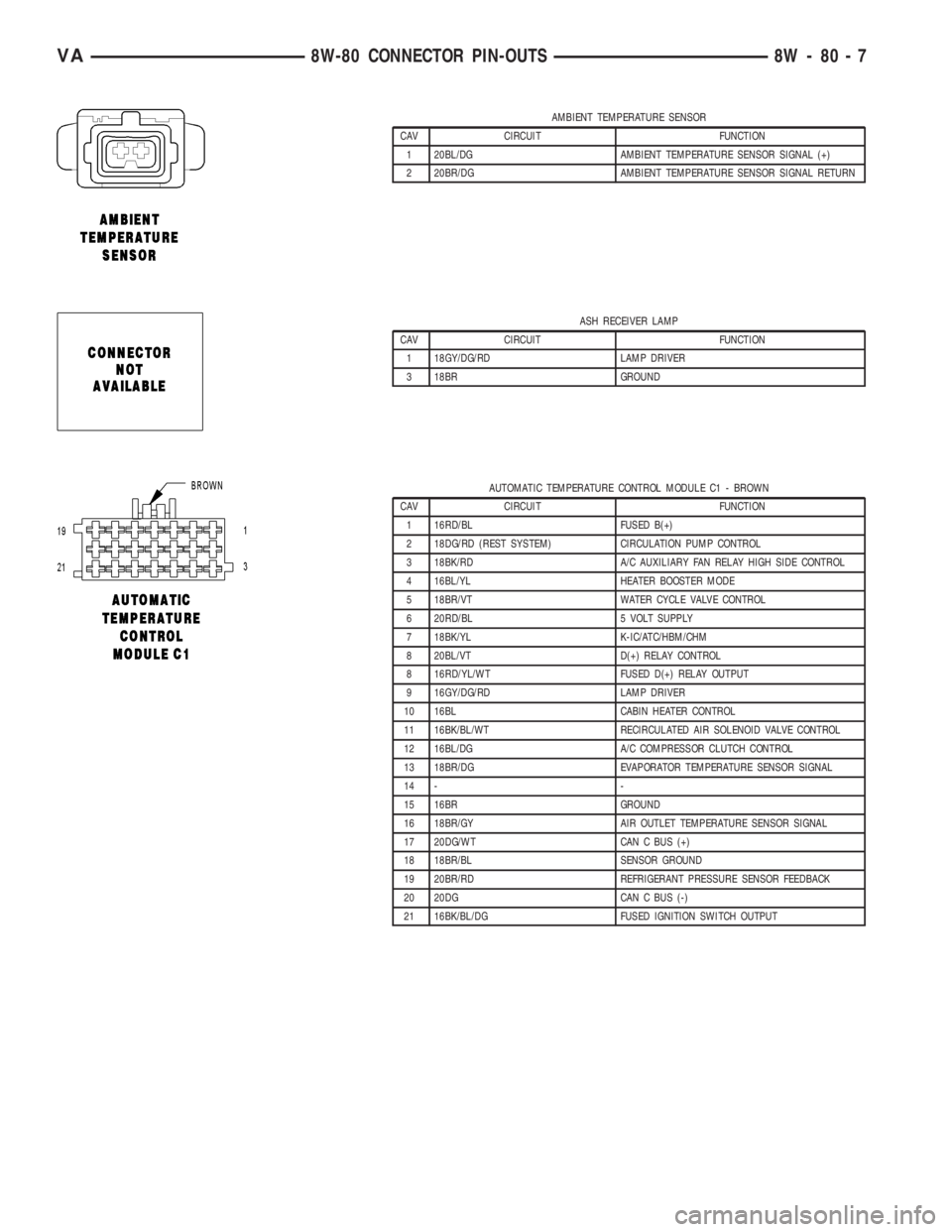
AMBIENT TEMPERATURE SENSOR
CAV CIRCUIT FUNCTION
1 20BL/DG AMBIENT TEMPERATURE SENSOR SIGNAL (+)
2 20BR/DG AMBIENT TEMPERATURE SENSOR SIGNAL RETURN
ASH RECEIVER LAMP
CAV CIRCUIT FUNCTION
1 18GY/DG/RD LAMP DRIVER
3 18BR GROUND
AUTOMATIC TEMPERATURE CONTROL MODULE C1 - BROWN
CAV CIRCUIT FUNCTION
1 16RD/BL FUSED B(+)
2 18DG/RD (REST SYSTEM) CIRCULATION PUMP CONTROL
3 18BK/RD A/C AUXILIARY FAN RELAY HIGH SIDE CONTROL
4 16BL/YL HEATER BOOSTER MODE
5 18BR/VT WATER CYCLE VALVE CONTROL
6 20RD/BL 5 VOLT SUPPLY
7 18BK/YL K-IC/ATC/HBM/CHM
8 20BL/VT D(+) RELAY CONTROL
8 16RD/YL/WT FUSED D(+) RELAY OUTPUT
9 16GY/DG/RD LAMP DRIVER
10 16BL CABIN HEATER CONTROL
11 16BK/BL/WT RECIRCULATED AIR SOLENOID VALVE CONTROL
12 16BL/DG A/C COMPRESSOR CLUTCH CONTROL
13 18BR/DG EVAPORATOR TEMPERATURE SENSOR SIGNAL
14 - -
15 16BR GROUND
16 18BR/GY AIR OUTLET TEMPERATURE SENSOR SIGNAL
17 20DG/WT CAN C BUS (+)
18 18BR/BL SENSOR GROUND
19 20BR/RD REFRIGERANT PRESSURE SENSOR FEEDBACK
20 20DG CAN C BUS (-)
21 16BK/BL/DG FUSED IGNITION SWITCH OUTPUT
VA8W-80 CONNECTOR PIN-OUTS 8W - 80 - 7
Page 1698 of 2305
REMOVAL - HIGH PRESSURE PUMP
(Refer to 14 - FUEL SYSTEM - WARNING)
(1) Disconnect negative battery cable.
(2) Remove viscous fan clutch (Refer to 7 - COOL-
ING/ENGINE/FAN DRIVE VISCOUS CLUTCH -
REMOVAL).
(3) Unplug electrical connectors at high pressure
pump.
CAUTION: DO NOT slacken the threaded connec-
tion. Use a wrench to counterhold at the threaded
connection when loosening and tightening the
union nut. DO NOT EXCEED tightening torque.
CAUTION: DO NOT crimp or bend fuel line. Capture
all fluids that flow out of connections.
(4) Disconnect the high pressure line at high pres-
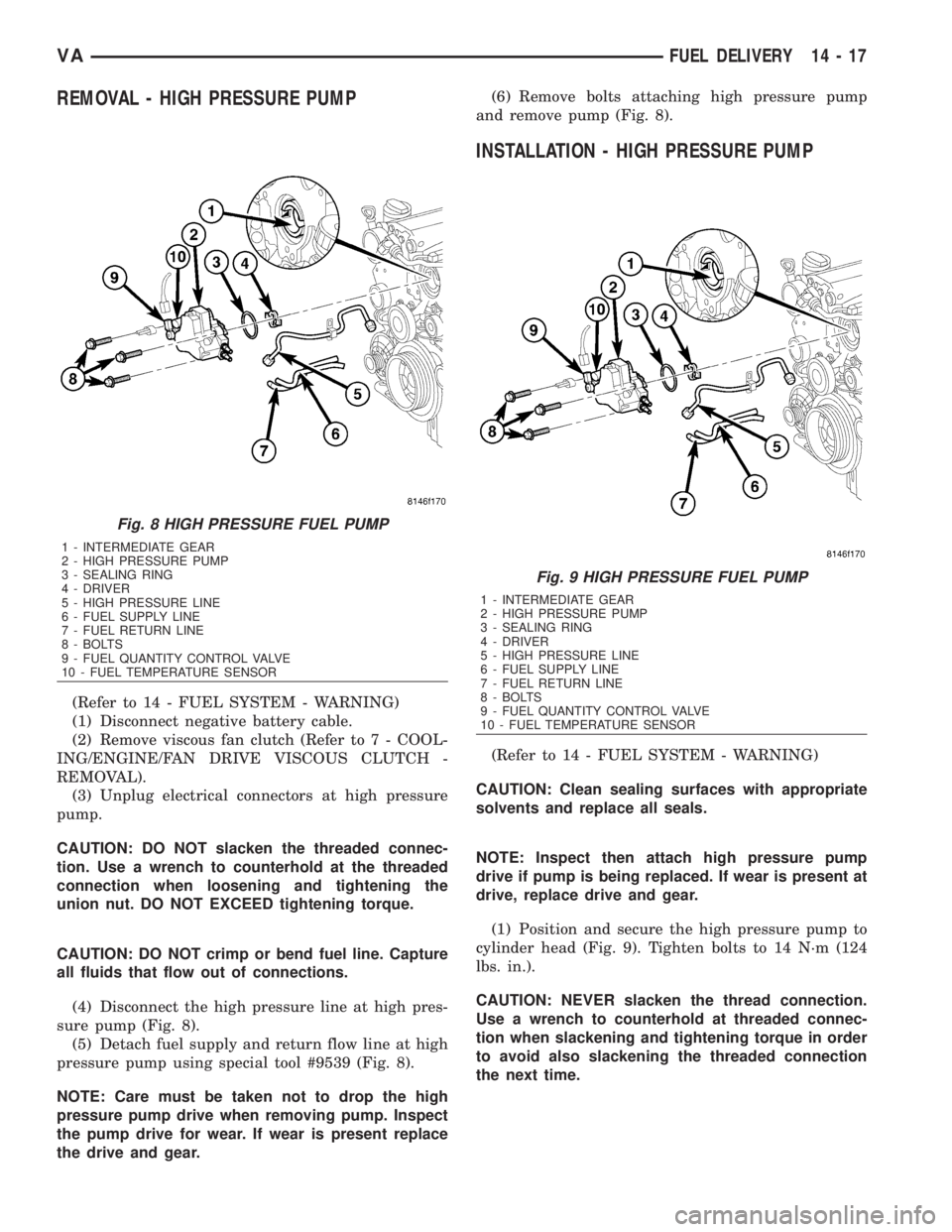
sure pump (Fig. 8).
(5) Detach fuel supply and return flow line at high
pressure pump using special tool #9539 (Fig. 8).
NOTE: Care must be taken not to drop the high
pressure pump drive when removing pump. Inspect
the pump drive for wear. If wear is present replace
the drive and gear.(6) Remove bolts attaching high pressure pump
and remove pump (Fig. 8).
INSTALLATION - HIGH PRESSURE PUMP
(Refer to 14 - FUEL SYSTEM - WARNING)
CAUTION: Clean sealing surfaces with appropriate
solvents and replace all seals.
NOTE: Inspect then attach high pressure pump
drive if pump is being replaced. If wear is present at
drive, replace drive and gear.
(1) Position and secure the high pressure pump to
cylinder head (Fig. 9). Tighten bolts to 14 N´m (124
lbs. in.).
CAUTION: NEVER slacken the thread connection.
Use a wrench to counterhold at threaded connec-
tion when slackening and tightening torque in order
to avoid also slackening the threaded connection
the next time.
Fig. 8 HIGH PRESSURE FUEL PUMP
1 - INTERMEDIATE GEAR
2 - HIGH PRESSURE PUMP
3 - SEALING RING
4 - DRIVER
5 - HIGH PRESSURE LINE
6 - FUEL SUPPLY LINE
7 - FUEL RETURN LINE
8 - BOLTS
9 - FUEL QUANTITY CONTROL VALVE
10 - FUEL TEMPERATURE SENSOR
Fig. 9 HIGH PRESSURE FUEL PUMP
1 - INTERMEDIATE GEAR
2 - HIGH PRESSURE PUMP
3 - SEALING RING
4 - DRIVER
5 - HIGH PRESSURE LINE
6 - FUEL SUPPLY LINE
7 - FUEL RETURN LINE
8 - BOLTS
9 - FUEL QUANTITY CONTROL VALVE
10 - FUEL TEMPERATURE SENSOR
VAFUEL DELIVERY 14 - 17
Page 1744 of 2305
TRANSMISSION
TABLE OF CONTENTS
page
AUTOMATIC TRANSMISSION NAG1 - SERVICE
INFORMATION............................1
AUTOMATIC TRANSMISSION NAG1 - SERVICE
INFORMATION
TABLE OF CONTENTS
page page
AUTOMATIC TRANSMISSION NAG1 - SERVICE
INFORMATION
DESCRIPTION..........................3
OPERATION............................4
DIAGNOSIS AND TESTING
AUTOMATIC TRANSMISSION............39
PRELIMINARY........................39
ROAD TESTING......................39
AUTOMATIC TRANSMISSION............40
STANDARD PROCEDURE - ALUMINUM
THREAD REPAIR......................42
REMOVAL.............................42
DISASSEMBLY.........................46
ASSEMBLY............................52
INSTALLATION.........................60
SCHEMATICS AND DIAGRAMS............65
SPECIFICATIONS - NAG1 AUTOMATIC
TRANSMISSION......................86
SPECIAL TOOLS - AUTOMATIC
TRANSMISSION - NAG1................87
INPUT CLUTCHES
DESCRIPTION.........................90
OPERATION...........................91
INPUT CLUTCH K1
DISASSEMBLY.........................92
ASSEMBLY............................94
INPUT CLUTCH K2
DISASSEMBLY.........................97
ASSEMBLY............................99
INPUT CLUTCH K3
DISASSEMBLY........................102
ASSEMBLY...........................103
ELECTROHYDRAULIC UNIT
DESCRIPTION........................105
OPERATION..........................112
REMOVAL............................120
DISASSEMBLY........................121
ASSEMBLY...........................125INSTALLATION........................129
FLUID AND FILTER
DESCRIPTION........................131
OPERATION..........................131
DIAGNOSIS AND TESTING
EFFECTS OF INCORRECT FLUID LEVEL . . 131
CAUSES OF BURNT FLUID.............132
FLUID CONTAMINATION...............132
STANDARD PROCEDURE
CHECK OIL LEVEL...................132
TRANSMISSION FILL.................133
FLUID/FILTER SERVICE...............134
FREEWHEELING CLUTCH
DESCRIPTION........................135
OPERATION..........................135
DISASSEMBLY........................136
ASSEMBLY...........................138
GEARSHIFT CABLE
DIAGNOSIS AND TESTING
GEARSHIFT CABLE..................138
REMOVAL............................139
INSTALLATION........................140
HOLDING CLUTCHES
DESCRIPTION........................141
OPERATION..........................142
HOLDING CLUTCH B1
DISASSEMBLY........................143
ASSEMBLY...........................145
HOLDING CLUTCH B2
DISASSEMBLY........................148
ASSEMBLY...........................150
INPUT SPEED SENSORS
DESCRIPTION........................153
OPERATION..........................154
OIL PUMP
DESCRIPTION........................154
OPERATION..........................154
DISASSEMBLY........................155
VATRANSMISSION 21 - 1
Page 1746 of 2305
AUTOMATIC TRANSMISSION NAG1 - SERVICE INFORMATION
DESCRIPTION
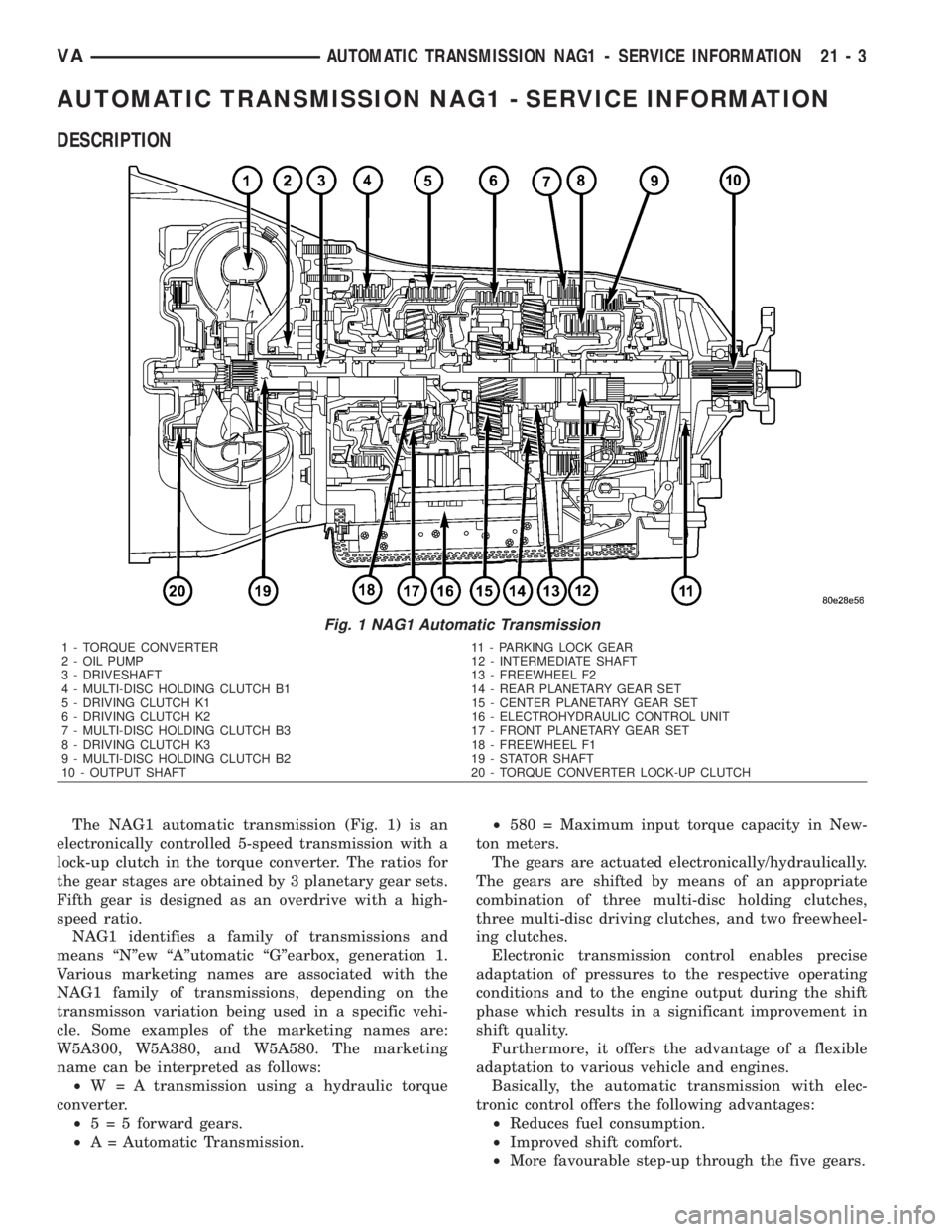
The NAG1 automatic transmission (Fig. 1) is an
electronically controlled 5-speed transmission with a
lock-up clutch in the torque converter. The ratios for
the gear stages are obtained by 3 planetary gear sets.
Fifth gear is designed as an overdrive with a high-
speed ratio.
NAG1 identifies a family of transmissions and
means ªNºew ªAºutomatic ªGºearbox, generation 1.
Various marketing names are associated with the
NAG1 family of transmissions, depending on the
transmisson variation being used in a specific vehi-
cle. Some examples of the marketing names are:
W5A300, W5A380, and W5A580. The marketing
name can be interpreted as follows:
²W = A transmission using a hydraulic torque
converter.
²5 = 5 forward gears.
²A = Automatic Transmission.²580 = Maximum input torque capacity in New-
ton meters.
The gears are actuated electronically/hydraulically.
The gears are shifted by means of an appropriate
combination of three multi-disc holding clutches,
three multi-disc driving clutches, and two freewheel-
ing clutches.
Electronic transmission control enables precise
adaptation of pressures to the respective operating
conditions and to the engine output during the shift
phase which results in a significant improvement in
shift quality.
Furthermore, it offers the advantage of a flexible
adaptation to various vehicle and engines.
Basically, the automatic transmission with elec-
tronic control offers the following advantages:
²Reduces fuel consumption.
²Improved shift comfort.
²More favourable step-up through the five gears.
Fig. 1 NAG1 Automatic Transmission
1 - TORQUE CONVERTER 11 - PARKING LOCK GEAR
2 - OIL PUMP 12 - INTERMEDIATE SHAFT
3 - DRIVESHAFT 13 - FREEWHEEL F2
4 - MULTI-DISC HOLDING CLUTCH B1 14 - REAR PLANETARY GEAR SET
5 - DRIVING CLUTCH K1 15 - CENTER PLANETARY GEAR SET
6 - DRIVING CLUTCH K2 16 - ELECTROHYDRAULIC CONTROL UNIT
7 - MULTI-DISC HOLDING CLUTCH B3 17 - FRONT PLANETARY GEAR SET
8 - DRIVING CLUTCH K3 18 - FREEWHEEL F1
9 - MULTI-DISC HOLDING CLUTCH B2 19 - STATOR SHAFT
10 - OUTPUT SHAFT 20 - TORQUE CONVERTER LOCK-UP CLUTCH
VAAUTOMATIC TRANSMISSION NAG1 - SERVICE INFORMATION 21 - 3
Page 1747 of 2305
²Increased service life and reliability.
²Lower maintenance costs.
TRANSMISSION IDENTIFICATION
The transmission can be generically identified
visually by the presence of a round 13-way connector
located near the front corner of the transmission oil
pan, on the right side. Specific transmission informa-
tion can be found stamped into a pad on the left side
of the transmission, above the oil pan rail.
TRANSMISSION GEAR RATIOS
The gear ratios for the NAG1 automatic transmis-
sion are as follows:
1st Gear............................3.59:1
2nd Gear............................2.19:1
3rd Gear............................1.41:1
4th Gear............................1.00:1
5th Gear............................0.83:1
Reverse.............................3.16:1
TRANSMISSION HOUSING
The converter housing and transmission are made
from a light alloy. These are bolted together and cen-
tered via the outer multi-disc carrier of multi-disc
holding clutch, B1. A coated intermediate plate pro-
vides the sealing. The oil pump and the outer multi-
disc carrier of the multi-disc holding clutch, B1, are
bolted to the converter housing. The stator shaft is
pressed into it and prevented from rotating by
splines. The electrohydraulic unit is bolted to the
transmission housing from underneath. A sheet
metal steel oil pan forms the closure.
MECHANICAL SECTION
The mechanical section consists of a input shaft,
output shaft, a sun gear shaft, and three planetary
gear sets which are coupled to each other. The plan-
etary gear sets each have four planetary pinion
gears. The oil pressure for the torque converter
lock-up clutch and clutch K2 is supplied through
bores in the input shaft. The oil pressure to clutch
K3 is transmitted through the output shaft. The
lubricating oil is distributed through additional bores
in both shafts. All the bearing points of the gear sets,
as well as the freewheeling clutches and actuators,
are supplied with lubricating oil. The parking lock
gear is connected to the output shaft via splines.
Freewheeling clutches F1 and F2 are used to opti-
mize the shifts. The front freewheel, F1, is supported
on the extension of the stator shaft on the transmis-
sion side and, in the locking direction, connects the
sun gear of the front planetary gear set to the trans-
mission housing. In the locking direction, the rear
freewheeling clutch, F2, connects the sun gear of the
center planetary gear set to the sun gear of the rear
planetary gear set.
ELECTROHYDRAULIC CONTROL UNIT
The electrohydraulic control unit comprises the
shift plate made from light alloy for the hydraulic
control and an electrical control unit. The electrical
control unit comprises of a supporting body made of
plastic, into which the electrical components are
assembled. The supporting body is mounted on the
shift plate and screwed to it.
Strip conductors inserted into the supporting body
make the connection between the electrical compo-
nents and a plug connector. The connection to the
wiring harness on the vehicle and the transmission
control module (TCM) is produced via this 13-pin
plug connector with a bayonet lock.
SHIFT GROUPS
The hydraulic control components (including actua-
tors) which are responsible for the pressure distribu-
tion before, during, and after a gear change are
described as a shift group. Each shift group contains
a command valve, a holding pressure shift valve, a
shift pressure shift valve, overlap regulating valve,
and a solenoid.
The hydraulic system contains three shift groups:
1-2/4-5, 2-3, and 3-4. Each shift group can also be
described as being in one of two possible states. The
active shift group is described as being in the shift
phase when it is actively engaging/disengaging a
clutch combination. The 1-2/4-5 shift group control
the B1 and K1 clutches. The 2-3 shift group controls
the K2 and K3 clutches. The 3-4 shift group controls
the K3 and B2 clutches.
OPERATION
The transmission control is divided into the elec-
tronic and hydraulic transmission control functions.
While the electronic transmission control is responsi-
ble for gear selection and for matching the pressures
to the torque to be transmitted, the transmission's
power supply control occurs via hydraulic elements
in the electrohydraulic control module. The oil supply
to the hydraulic elements, such as the hydrodynamic
torque converter, the shift elements and the hydrau-
lic transmission control, is provided by way of an oil
pump connected with the torque converter.
The Transmission Control Module (TCM) allows for
the precise adaptation of pressures to the correspond-
ing operating conditions and to the engine output
during the gearshift phase, resulting in a noticeable
improvement in shift quality. The engine speed limit
can be reached in the individual gears at full throttle
and kickdown. The shift range can be changed in the
forward gears while driving, but the TCM employs a
downshift safeguard to prevent over-revving the
engine. The system offers the additional advantage of
21 - 4 AUTOMATIC TRANSMISSION NAG1 - SERVICE INFORMATIONVA
Page 1748 of 2305
flexible adaptation to different vehicle and engine
variants.
EMERGENCY RUNNING FUNCTION
In order to ensure a safe driving state and to pre-
vent damage to the automatic transmission, the TCM
control module switches to limp-home mode in the
event of critical faults. A diagnostic trouble code
(DTC) assigned to the fault is stored in memory. All
solenoid and regulating valves are thus de-energized.
The net effect is:
²The last engaged gear remains engaged.
²The modulating pressure and shift pressures
rise to the maximum levels.
²The torque converter lockup clutch is deacti-
vated.
In order to preserve the operability of the vehicle
to some extent, the hydraulic control can be used to
engage 2nd gear or reverse using the following pro-
cedure:²Stop the vehicle.
²Move selector lever to ªPº.
²Switch off engine.
²Wait at least 10 seconds.
²Start engine.
²Move selector lever to D: 2nd gear.
²Move selector lever to R: Reverse gear.
The limp-home function remains active until the
DTC is rectified or the stored DTC is erased with the
appropriate scan tool. Sporadic faults can be reset
via ignition OFF/ON.
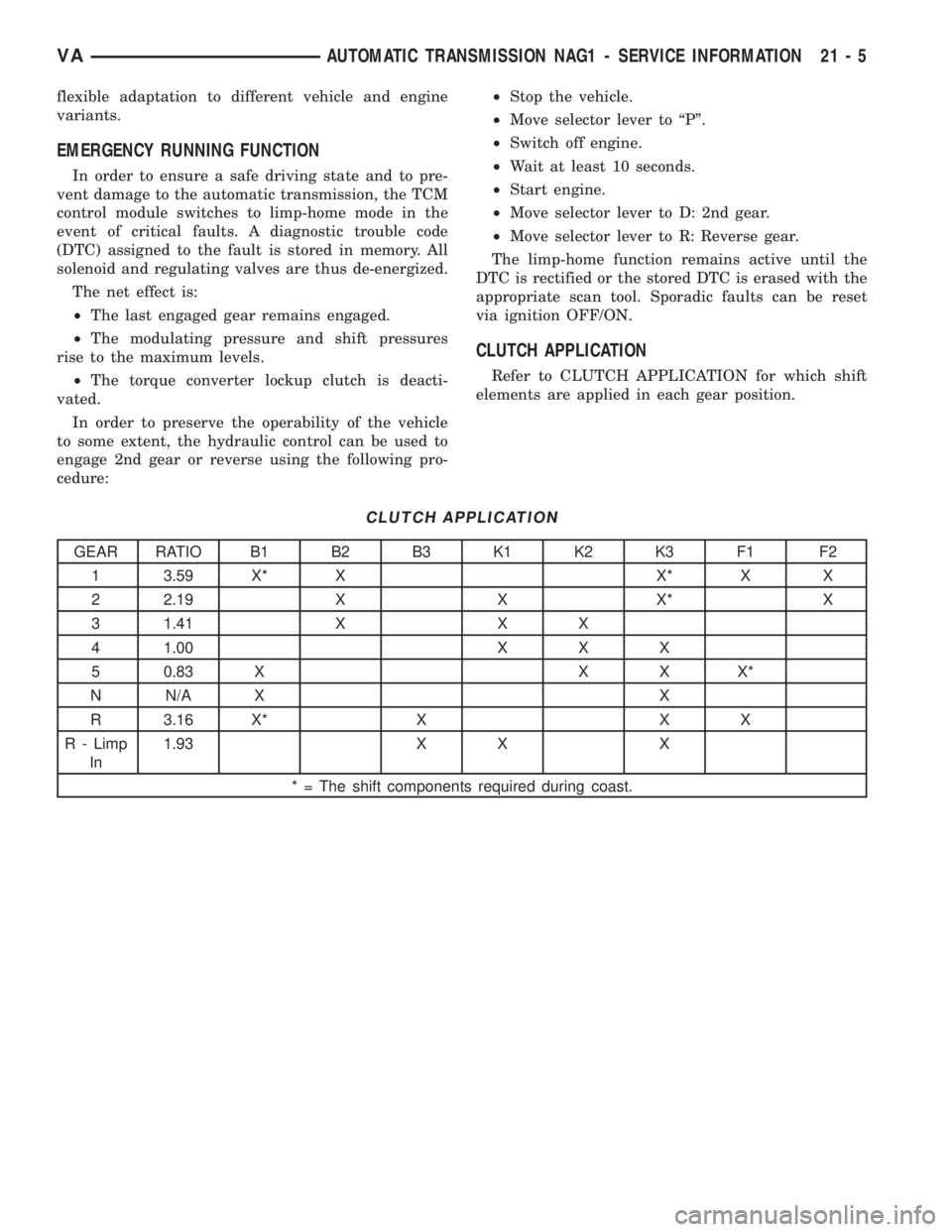
CLUTCH APPLICATION
Refer to CLUTCH APPLICATION for which shift
elements are applied in each gear position.
CLUTCH APPLICATION
GEAR RATIO B1 B2 B3 K1 K2 K3 F1 F2
1 3.59 X* X X* X X
2 2.19 X X X* X
3 1.41 X X X
4 1.00 X X X
5 0.83 X X X X*
N N/A X X
R 3.16 X* X X X
R - Limp
In1.93 X X X
* = The shift components required during coast.
VAAUTOMATIC TRANSMISSION NAG1 - SERVICE INFORMATION 21 - 5
Page 1749 of 2305
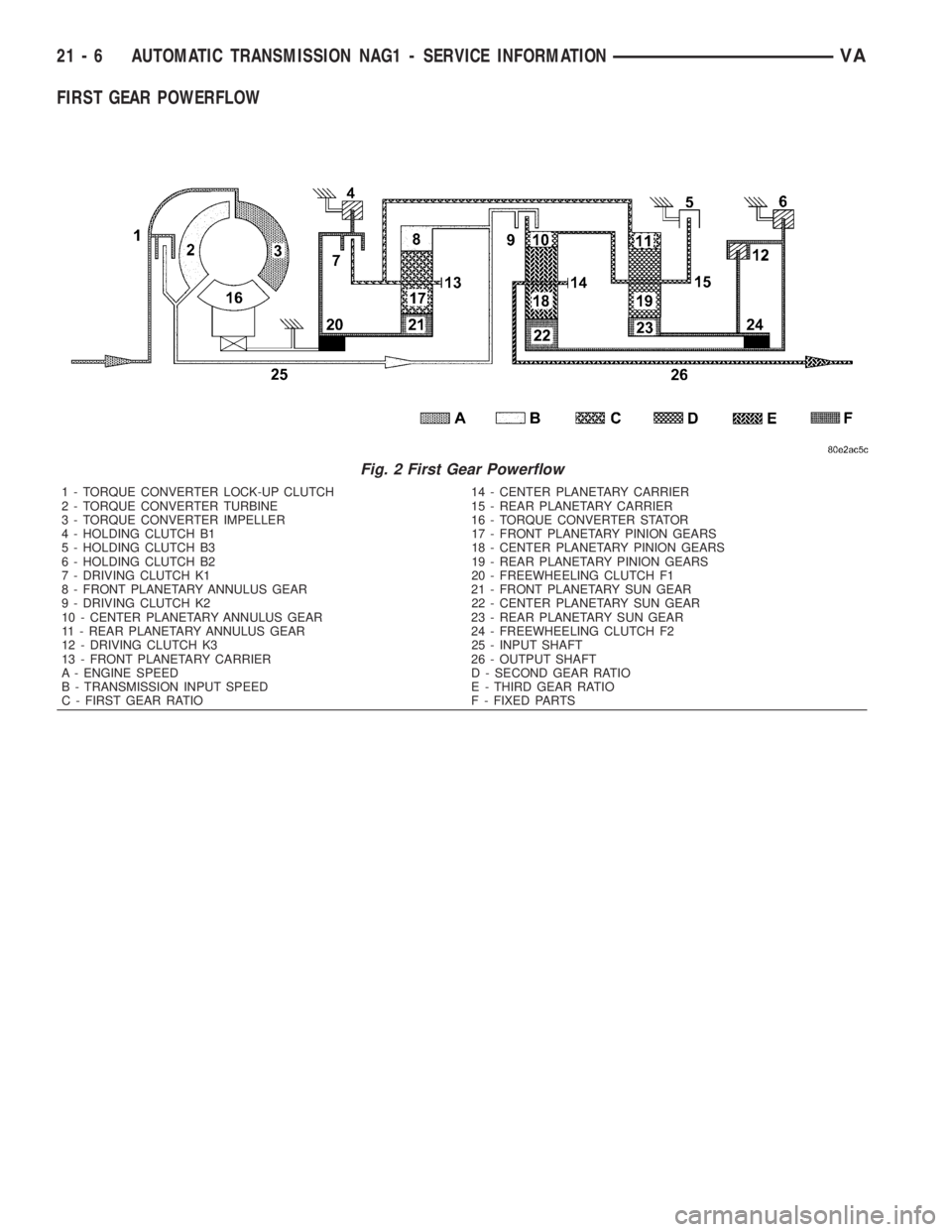
FIRST GEAR POWERFLOW
Fig. 2 First Gear Powerflow
1 - TORQUE CONVERTER LOCK-UP CLUTCH 14 - CENTER PLANETARY CARRIER
2 - TORQUE CONVERTER TURBINE 15 - REAR PLANETARY CARRIER
3 - TORQUE CONVERTER IMPELLER 16 - TORQUE CONVERTER STATOR
4 - HOLDING CLUTCH B1 17 - FRONT PLANETARY PINION GEARS
5 - HOLDING CLUTCH B3 18 - CENTER PLANETARY PINION GEARS
6 - HOLDING CLUTCH B2 19 - REAR PLANETARY PINION GEARS
7 - DRIVING CLUTCH K1 20 - FREEWHEELING CLUTCH F1
8 - FRONT PLANETARY ANNULUS GEAR 21 - FRONT PLANETARY SUN GEAR
9 - DRIVING CLUTCH K2 22 - CENTER PLANETARY SUN GEAR
10 - CENTER PLANETARY ANNULUS GEAR 23 - REAR PLANETARY SUN GEAR
11 - REAR PLANETARY ANNULUS GEAR 24 - FREEWHEELING CLUTCH F2
12 - DRIVING CLUTCH K3 25 - INPUT SHAFT
13 - FRONT PLANETARY CARRIER 26 - OUTPUT SHAFT
A - ENGINE SPEED D - SECOND GEAR RATIO
B - TRANSMISSION INPUT SPEED E - THIRD GEAR RATIO
C - FIRST GEAR RATIO F - FIXED PARTS
21 - 6 AUTOMATIC TRANSMISSION NAG1 - SERVICE INFORMATIONVA