2006 MERCEDES-BENZ SPRINTER remote control
[x] Cancel search: remote controlPage 175 of 2305
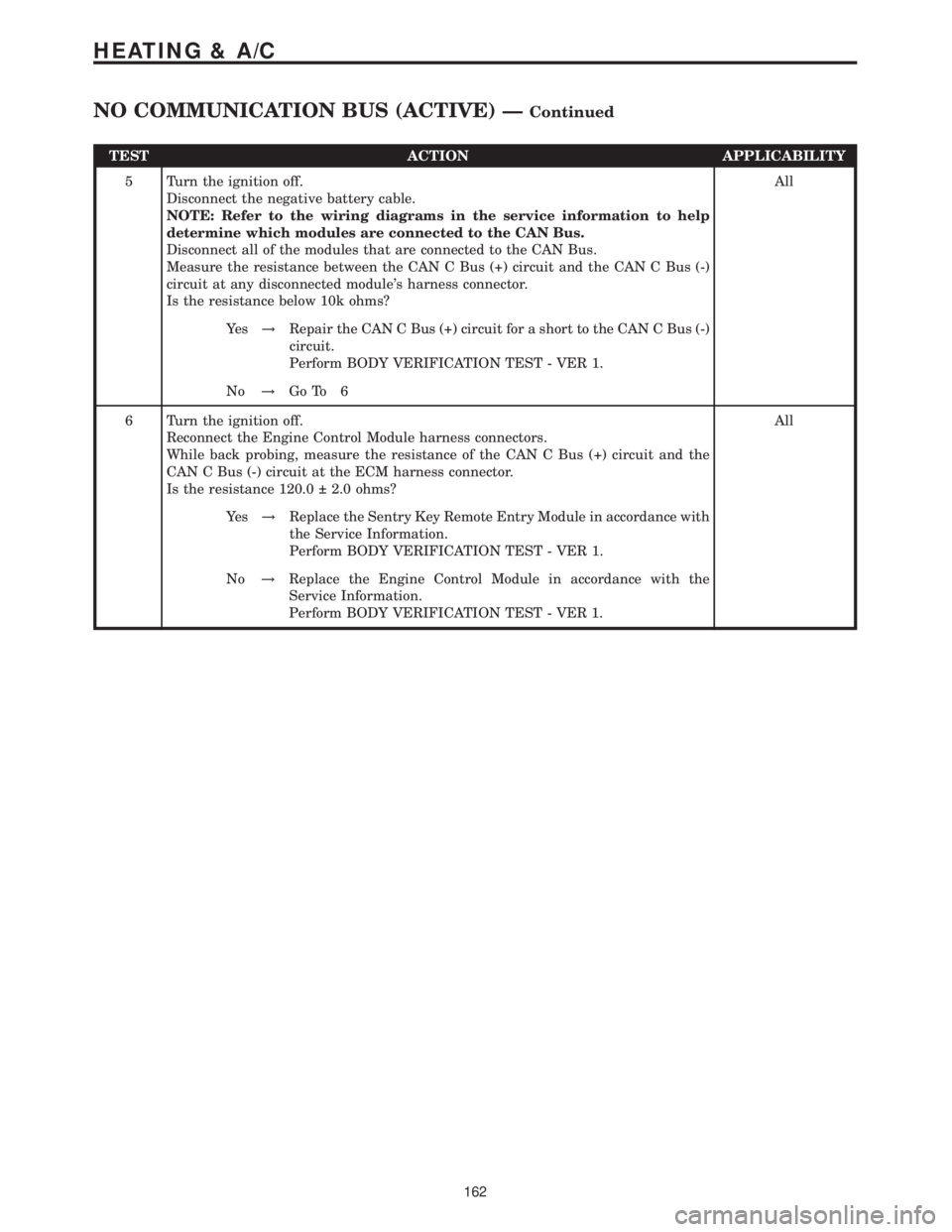
TEST ACTION APPLICABILITY
5 Turn the ignition off.
Disconnect the negative battery cable.
NOTE: Refer to the wiring diagrams in the service information to help
determine which modules are connected to the CAN Bus.
Disconnect all of the modules that are connected to the CAN Bus.
Measure the resistance between the CAN C Bus (+) circuit and the CAN C Bus (-)
circuit at any disconnected module's harness connector.
Is the resistance below 10k ohms?All
Ye s!Repair the CAN C Bus (+) circuit for a short to the CAN C Bus (-)
circuit.
Perform BODY VERIFICATION TEST - VER 1.
No!Go To 6
6 Turn the ignition off.
Reconnect the Engine Control Module harness connectors.
While back probing, measure the resistance of the CAN C Bus (+) circuit and the
CAN C Bus (-) circuit at the ECM harness connector.
Is the resistance 120.0 2.0 ohms?All
Ye s!Replace the Sentry Key Remote Entry Module in accordance with
the Service Information.
Perform BODY VERIFICATION TEST - VER 1.
No!Replace the Engine Control Module in accordance with the
Service Information.
Perform BODY VERIFICATION TEST - VER 1.
162
HEATING & A/C
NO COMMUNICATION BUS (ACTIVE) ÐContinued
Page 213 of 2305
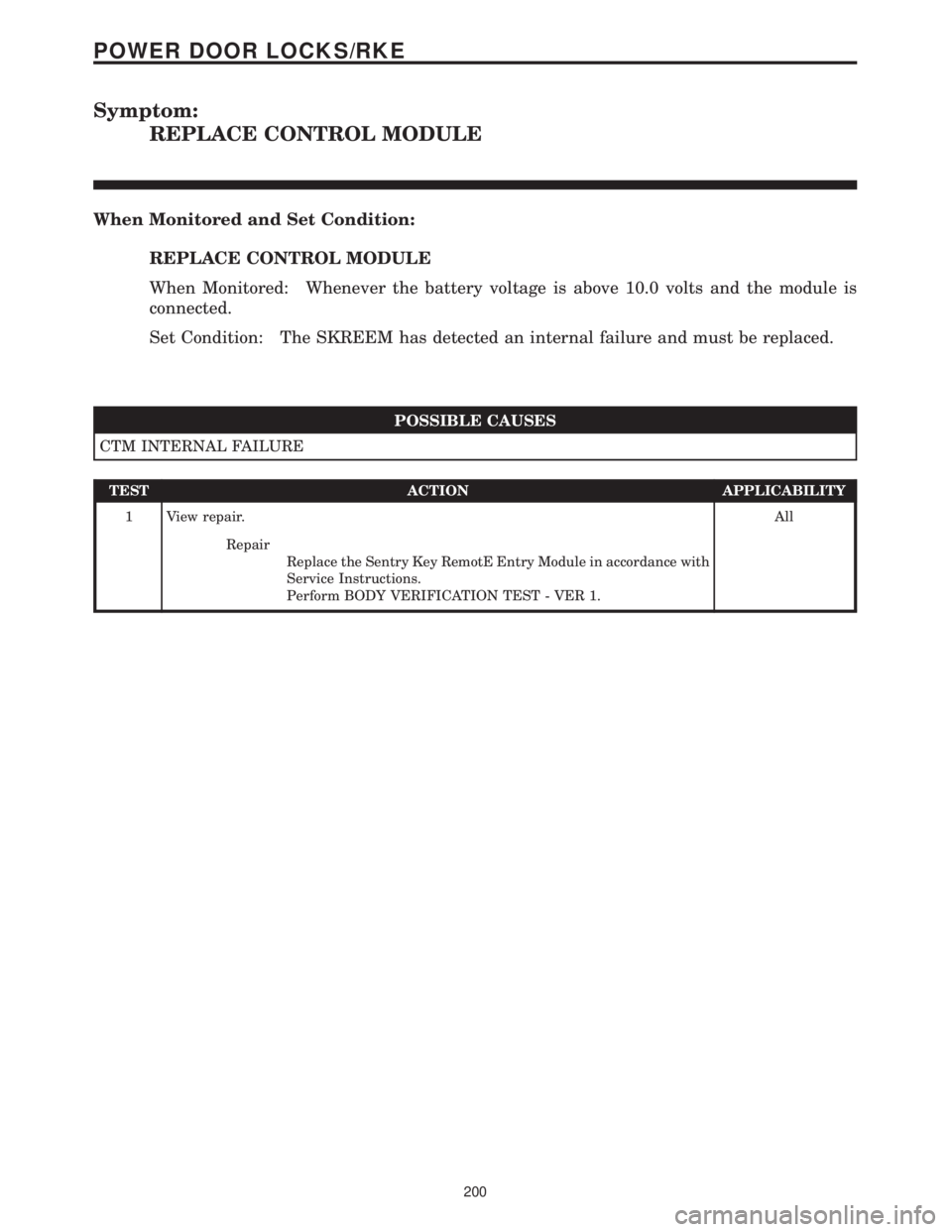
Symptom:
REPLACE CONTROL MODULE
When Monitored and Set Condition:
REPLACE CONTROL MODULE
When Monitored: Whenever the battery voltage is above 10.0 volts and the module is
connected.
Set Condition: The SKREEM has detected an internal failure and must be replaced.
POSSIBLE CAUSES
CTM INTERNAL FAILURE
TEST ACTION APPLICABILITY
1 View repair.All
Repair
Replace the Sentry Key RemotE Entry Module in accordance with
Service Instructions.
Perform BODY VERIFICATION TEST - VER 1.
200
POWER DOOR LOCKS/RKE
Page 297 of 2305
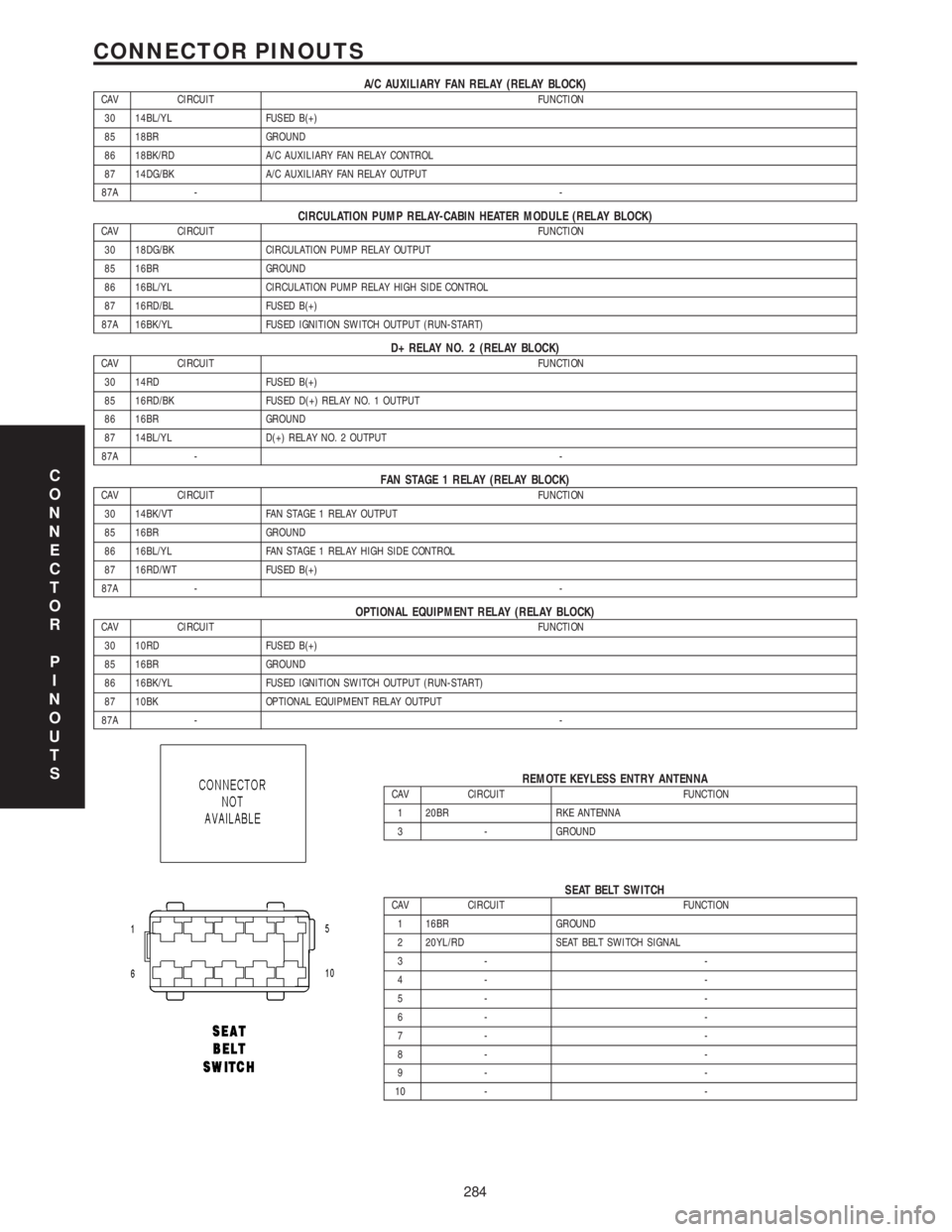
A/C AUXILIARY FAN RELAY (RELAY BLOCK)CAV CIRCUIT FUNCTION
30 14BL/YL FUSED B(+)
85 18BR GROUND
86 18BK/RD A/C AUXILIARY FAN RELAY CONTROL
87 14DG/BK A/C AUXILIARY FAN RELAY OUTPUT
87A --
CIRCULATION PUMP RELAY-CABIN HEATER MODULE (RELAY BLOCK)CAV CIRCUIT FUNCTION
30 18DG/BK CIRCULATION PUMP RELAY OUTPUT
85 16BR GROUND
86 16BL/YL CIRCULATION PUMP RELAY HIGH SIDE CONTROL
87 16RD/BL FUSED B(+)
87A 16BK/YL FUSED IGNITION SWITCH OUTPUT (RUN-START)
D+ RELAY NO. 2 (RELAY BLOCK)CAV CIRCUIT FUNCTION
30 14RD FUSED B(+)
85 16RD/BK FUSED D(+) RELAY NO. 1 OUTPUT
86 16BR GROUND
87 14BL/YL D(+) RELAY NO. 2 OUTPUT
87A --
FAN STAGE 1 RELAY (RELAY BLOCK)CAV CIRCUIT FUNCTION
30 14BK/VT FAN STAGE 1 RELAY OUTPUT
85 16BR GROUND
86 16BL/YL FAN STAGE 1 RELAY HIGH SIDE CONTROL
87 16RD/WT FUSED B(+)
87A --
OPTIONAL EQUIPMENT RELAY (RELAY BLOCK)CAV CIRCUIT FUNCTION
30 10RD FUSED B(+)
85 16BR GROUND
86 16BK/YL FUSED IGNITION SWITCH OUTPUT (RUN-START)
87 10BK OPTIONAL EQUIPMENT RELAY OUTPUT
87A --
REMOTE KEYLESS ENTRY ANTENNACAV CIRCUIT FUNCTION
1 20BR RKE ANTENNA
3 - GROUND
SEAT BELT SWITCHCAV CIRCUIT FUNCTION
1 16BR GROUND
2 20YL/RD SEAT BELT SWITCH SIGNAL
3- -
4- -
5- -
6- -
7- -
8- -
9- -
10 - -
C
O
N
N
E
C
T
O
R
P
I
N
O
U
T
S
284
CONNECTOR PINOUTS
Page 299 of 2305

SECURITY SYSTEM MODULE C2 - LT. GREENCAV CIRCUIT FUNCTION
1 16DG/YL INTRUSION SENSOR INTERFACE
2 16GY/BL WINDOW DEFOGGER-LEFT REAR OUTPUT
3 16GY WINDOW DEFOGGER RELAY-RIGHT REAR OUTPUT
4 20DG/BK INTRUSION SENSOR 1 SIGNAL
5- -
6- -
7 20GY/BK INTRUSION SENSOR 2 SIGNAL
8 16GY/DG K-CTM/SSM
9 18BK/BL SIREN SIGNAL CONTROL
10 20DG/WT/BL INTRUSION SENSOR 3 SIGNAL
11 16WT/BL RKE INTERFACE
12 16WT/BL/RD SECURITY SYSTEM INTERFACE
SENTRY KEY REMOTE ENTRY MODULE (SKREEM)CAV CIRCUIT FUNCTION
1 18YL RKE ANTENNA
2 16BR GROUND
3 16RD/YL FUSED B(+)
4 16BK/WT LEFT TURN SIGNAL
5 20DG/WT CAN C BUS (+)
6 20DG CAN C BUS (-)
7 16BK/YL FUSED IGNITION SWITCH OUTPUT (RUN-START)
8 20WT/DG K-SKREEM
9 16WT/BL/RD (EXCEPT
VTSS)RKE INTERFACE
9 16WT/BL/RD (VTSS) SECURITY SYSTEM INTERFACE
10 18DG/YL TURN SIGNAL/ANTI-THEFT ALARM RELAY-LEFT/RIGHT CONTROL
11 20BR TRANSPONDER COIL (+)
12 - TRANSPONDER COIL (-)
SHIFTER ASSEMBLY - BLACKCAV CIRCUIT FUNCTION
1- -
2 20GY/DG/RD LAMP DRIVER
3 20BL/DG K-ABS/SHIFTER ASSEMBLY
4 18BR GROUND
5 20BK/BL/RD BRAKE LAMP SWITCH
6 20DG/WT CAN C BUS (+)
7 20DG CAN C BUS (-)
8 18BK/DG TRANSMISSION RELAY OUTPUT
9 16WT/BL/RD FUSED IGNITION SWITCH OUTPUT (RUN-START)
10 16WT/RD BACK-UP LAMP
SIREN - BLACKCAV CIRCUIT FUNCTION
1 18RD/DG FUSED B(+)
2 18BR GROUND
3 18BK/BL SIREN SIGNAL CONTROL
C
O
N
N
E
C
T
O
R
P
I
N
O
U
T
S
286
CONNECTOR PINOUTS
Page 370 of 2305
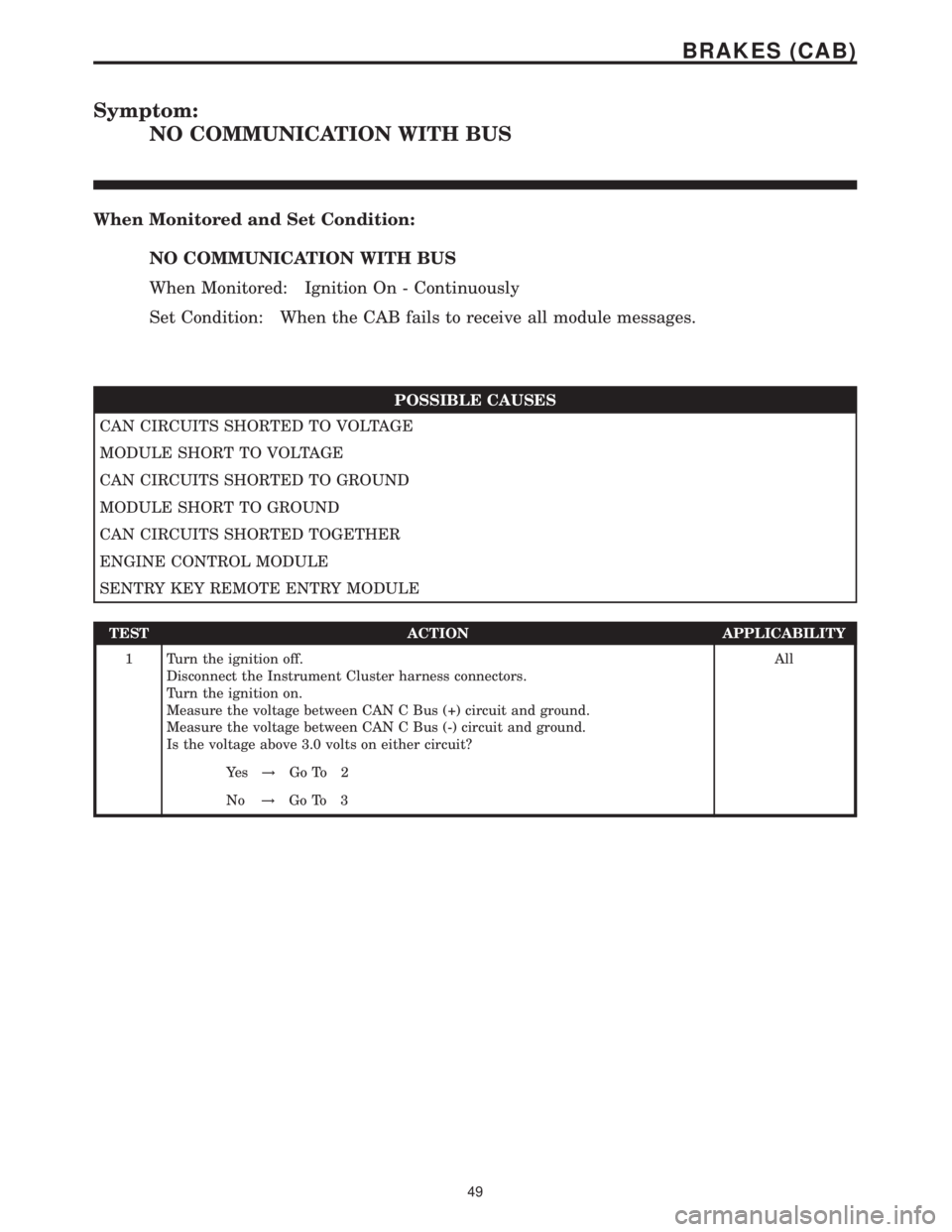
Symptom:
NO COMMUNICATION WITH BUS
When Monitored and Set Condition:
NO COMMUNICATION WITH BUS
When Monitored: Ignition On - Continuously
Set Condition: When the CAB fails to receive all module messages.
POSSIBLE CAUSES
CAN CIRCUITS SHORTED TO VOLTAGE
MODULE SHORT TO VOLTAGE
CAN CIRCUITS SHORTED TO GROUND
MODULE SHORT TO GROUND
CAN CIRCUITS SHORTED TOGETHER
ENGINE CONTROL MODULE
SENTRY KEY REMOTE ENTRY MODULE
TEST ACTION APPLICABILITY
1 Turn the ignition off.
Disconnect the Instrument Cluster harness connectors.
Turn the ignition on.
Measure the voltage between CAN C Bus (+) circuit and ground.
Measure the voltage between CAN C Bus (-) circuit and ground.
Is the voltage above 3.0 volts on either circuit?All
Ye s!Go To 2
No!Go To 3
49
BRAKES (CAB)
Page 372 of 2305
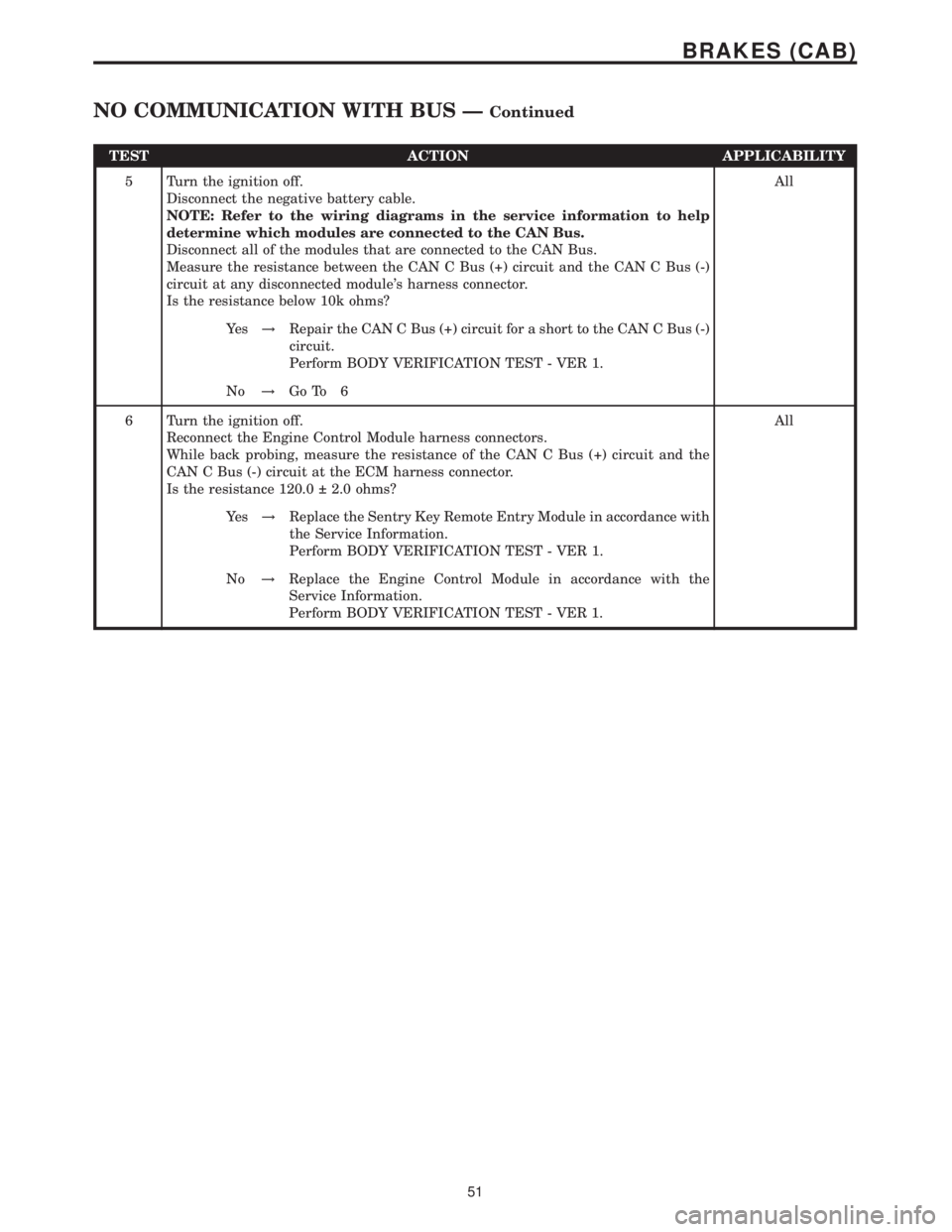
TEST ACTION APPLICABILITY
5 Turn the ignition off.
Disconnect the negative battery cable.
NOTE: Refer to the wiring diagrams in the service information to help
determine which modules are connected to the CAN Bus.
Disconnect all of the modules that are connected to the CAN Bus.
Measure the resistance between the CAN C Bus (+) circuit and the CAN C Bus (-)
circuit at any disconnected module's harness connector.
Is the resistance below 10k ohms?All
Ye s!Repair the CAN C Bus (+) circuit for a short to the CAN C Bus (-)
circuit.
Perform BODY VERIFICATION TEST - VER 1.
No!Go To 6
6 Turn the ignition off.
Reconnect the Engine Control Module harness connectors.
While back probing, measure the resistance of the CAN C Bus (+) circuit and the
CAN C Bus (-) circuit at the ECM harness connector.
Is the resistance 120.0 2.0 ohms?All
Ye s!Replace the Sentry Key Remote Entry Module in accordance with
the Service Information.
Perform BODY VERIFICATION TEST - VER 1.
No!Replace the Engine Control Module in accordance with the
Service Information.
Perform BODY VERIFICATION TEST - VER 1.
51
BRAKES (CAB)
NO COMMUNICATION WITH BUS ÐContinued
Page 412 of 2305

TABLE OF CONTENTS
1.0 INTRODUCTION.........................................................1
1.1SYSTEM COVERAGE...............................................1
1.2SIX-STEP TROUBLESHOOTING PROCEDURE..........................1
2.0 IDENTIFICATION OF SYSTEM.............................................1
3.0 SYSTEM DESCRIPTION AND FUNCTIONAL OPERATION......................1
3.1GENERAL DESCRIPTION............................................1
3.2FUNCTIONAL OPERATION...........................................1
3.2.1ECM ON-BOARD DIAGNOSTICS..............................1
3.2.2ECM OPERATING MODES...................................2
3.2.3MONITORED CIRCUITS......................................2
3.2.4SKREEM OVERVIEW........................................2
3.2.5SKREEM ON-BOARD DIAGNOSTICS...........................2
3.2.6SKREEM OPERATION.......................................3
3.3DIAGNOSTIC TROUBLE CODES......................................3
3.3.1HARD CODE...............................................3
3.3.2INTERMITTENT CODE.......................................3
3.3.3ECM DIAGNOSTIC TROUBLE CODES..........................3
3.3.4HANDLING NO TROUBLE CODE PROBLEMS...................8
3.4USING THE DRBIIIT.................................................8
3.4.1DRBIIITDOES NOT POWER UP...............................8
3.4.2DISPLAY IS NOT VISIBLE....................................8
4.0 DISCLAIMERS, SAFETY, WARNINGS.......................................8
4.1DISCLAIMERS......................................................8
4.2SAFETY...........................................................8
4.2.1TECHNICIAN SAFETY INFORMATION..........................8
4.2.2VEHICLE PREPARATION FOR TESTING........................9
4.2.3SERVICING SUB-ASSEMBLIES...............................9
4.2.4DRBIIITSAFETY INFORMATION...............................9
4.3WARNINGS AND CAUTIONS.........................................9
4.3.1ROAD TEST WARNINGS.....................................9
4.3.2VEHICLE DAMAGE CAUTIONS...............................9
5.0 REQUIRED TOOLS AND EQUIPMENT......................................9
6.0 GLOSSARY OF TERMS..................................................10
7.0 DIAGNOSTIC INFORMATION AND PROCEDURES...........................11
COMMUNICATION
*NO RESPONSE FROM ENGINE CONTROL MODULE........................12
*NO RESPONSE FROM SENTRY KEY REMOTE ENTRY MODULE..............14
DRIVEABILITY - DIESEL
P-1105 ATMOSPHERIC PRESSURE SENSOR PLAUSIBILITY WITH BOOST
PRESSURE SENSOR....................................................16
P1105-ATMOSPHERIC PRESSURE SENSOR SIGNAL VOLTAGE TOO HIGH......16
P1105-ATMOSPHERIC PRESSURE SENSOR SIGNAL VOLTAGE TOO LOW......16
P1617- ECM READ/WRITE ERROR........................................16
i
Page 424 of 2305

1.0 INTRODUCTION
The procedures contained in this manual include
all specifications, instructions and graphics needed
to diagnose engine control module (ECM) and sen-
try key remote entry module (SKREEM) problems;
they are no start, diagnostic trouble code (DTC) and
no trouble code problems for the ECM. The diagnos-
tics in this manual are based on the trouble condi-
tion or symptom being present at the time of diag-
nosis.
When repairs are required, refer to the appropri-
ate service information for the proper removal and
repair procedure.
Diagnostic procedures change every year. New
diagnostic systems may be added; carryover sys-
tems may be enhanced. IT IS RECOMMENDED
THAT YOU REVIEW THE ENTIRE MANUAL TO
BECOME FAMILIAR WITH ALL NEW AND
CHANGED DIAGNOSTIC PROCEDURES.
This manual will cover all the necessary require-
ments to begin a logical diagnostic path for each
problem. If there is a diagnostic trouble code (DTC)
detected, go to the trouble code test. If there are no
DTCs present, go to a no trouble code (*), symptom
based test.
This book reflects many suggested changes from
readers of past issues. After using this book, if you
have any comments or recommendations, please fill
out the form at the back of the book and mail it back
to us.
1.1 SYSTEM COVERAGE
This diagnostic procedures manual covers 2005
Sprinter vehicles equipped with the 2.7L common
rail diesel engine.
1.2 SIX-STEP TROUBLESHOOTING
PROCEDURE
Diagnosis of the engine control module (ECM)
and sentry key immobilizer system (SKREEM) is
done in six basic steps:
²verification of complaint
²verification of any related symptom
²symptom analysis
²problem isolation
²repair of isolated problem
²verification of proper operation
NOTE: All tests in this manual should be per-
formed with the engine at operating temperature,
unless otherwise specified within a particular test.
2.0 IDENTIFICATION OF
SYSTEM
The ECM is located to the left of the steering
column behind the steering column opening cover.
The sentry remote entry module (SKREEM) is
attached to the rear of the instrument cluster.
3.0 SYSTEM DESCRIPTION AND
FUNCTIONAL OPERATION
3.1 GENERAL DESCRIPTION
The 2.7L direct injection diesel engine system is
equipped with the latest technical advances. The
on-board diagnostics incorporated in the engine
control module and SKREEM are intended to assist
the field technician in repairing vehicle problems by
the quickest means.
The engine system incorporates a common rail
fuel delivery design with exhaust emission feed-
back. This design utilizes electronically controlled
solenoid valve type fuel injectors. Each injector is
controlled individually by the ECM. Injector timing
and fuel quantity are controlled by the ECM based
on inputs from various sensors. The precision con-
trol of the injectors by the ECM helps to reduce the
engine noise, odor and smoke.
3.2 FUNCTIONAL OPERATION
3.2.1 ECM ON-BOARD DIAGNOSTICS
The ECM is programmed to monitor different
circuits of the diesel fuel injection system. This
monitoring is called on-board diagnostics.
Certain criteria must be met for a diagnostic
trouble code to be entered into the ECM memory.
The criteria may be a range of: engine rpm, engine
temperature, time or other input signals to the
ECM. If all of the criteria for monitoring a system or
circuit are met, and a problem is sensed, then a
DTC will be stored in the ECM memory.
It is possible that a DTC for a monitored circuit
may not be entered into the ECM memory, even
though a malfunction has occurred. This may hap-
pen when the monitoring criteria have not been
met.
The ECM compares input signal voltages from
each input device with specifications (the estab-
lished high and low limits of the input range) that
are programmed into it for that device. If the input
voltage is not within the specifications and other
trouble code criteria are met, a DTC will be stored
in the ECM memory.
1
GENERAL INFORMATION