Page 545 of 651
IN CASE OF AN EMERGENCY
524
3. Tighten the front towing eyelet securely by a wheel nut
wrench.
CAUTION
When installing the eyelet on the vehicle, be sure to
tighten the front eyelet securely. If the eyelet is loose,
it may come off when being towed and result in death or
serious injury.
IF YOU CANNOT SHIFT AUTOMATICTRANSMISSION SELECTOR LEVER
If you cannot shift the selector lever out of “P” position to
other positions even though the brake pedal is depressed,
use the shift lock override button as follows:
1Turn the ignition key to “LOCK”. Make sure the parking
brake is applied.
2Pry up the cover with a flathead screwdriver or equivalent.
Page 552 of 651

MAINTENANCE
531
Accelerator pedal
Check
the pedal for smooth operation and uneven pedal ef fort
or catching.
Brake pedal
Check the pedal for smooth operation and the proper
clearance and free play. Check the brake booster function.
Brakes
In a safe place, check that the brakes do not pull to one side
when applied.
Parking brake
Check that the pedal has the proper travel and that, on a safe
incline, your vehicle is held securely with only the parking brake
applied.
Automatic transmission “Park” mechanism
Check the lock release button of the selector lever for proper
and smooth operation. On a safe incline, check that your
vehicle is held securely with the selector lever in “P” position
and all brakes released.
Vehicle exterior
Items listed below should be performed from time to time,
unless otherwise specified.
Wheel nuts
When checking the tires, make sure to check the nuts for
looseness. Tighten them if necessary.
Fluid leaks
Check underneath for leaking fuel, oil, water or other fluid after
the vehicle has been parked for a while. If you smell fuel fumes
or notice any leak, have the cause found and corrected
immediately.
Doors and engine hood
Check that all side doors and back door operate smoothly and
all latches lock securely. Make sure the engine hood
secondary latch secures the hood when the primary latch is
released.
Page 563 of 651

INTRODUCTION
542
�Use eye protection whenever you work on or under
your vehicle where you may be exposed to flying or
falling material, fluid spray, etc.
� Take care when filling the brake fluid reservoir
because brake fluid can harm your eyes and damage
painted surfaces. If fluid gets in your eyes, flush your
eyes with clean water immediately. If you still feel
uncomfortable with your eyes, go to the doctor.
� Be extremely cautious when working on the battery.
It contains poisonous and corrosive sulfuric acid.NOTICE
�Remember that battery and ignition cables carry high
currents or voltages. Be careful of accidentally
causing a short circuit.
� Before closing the engine hood, check to see that you
have not forgotten any tools, rags, etc.
� Do not drive with the air cleaner removed, or
excessive engine wear could result. Also backfiring
could cause a fire in the engine compartment.
� If you spill the fluid, be sure to wash it off with water
to prevent it from damaging the parts or paint.
� Do not overfill automatic transmission fluid and
power steering fluid, or the transmission and power
steering could be damaged.
� Be careful not to scratch the glass surface with the
wiper frame.
Page 564 of 651

INTRODUCTION
543
PARTS AND TOOLS
Here is a list of parts and tools you will need to perform
do−it−yourself maintenance. Remember all Lexus parts are
designed in metric sizes, so your tools must be metric.
Checking the engine oil level
Parts (if level is low):
�“Toyota Genuine Motor Oil” or equivalent
See page 558 for details about engine oil selection.
Tools:
� Rag or paper towel
� Funnel (only for adding oil)
Checking the engine coolant level
Parts (if level is low):
�“Toyota Super Long Life Coolant” or similar high quality
ethylene glycol based non −silicate, non− amine, non−nitrite,
and non −borate coolant with long −life hybrid organic acid
technology.
“Toyota Super Long Life Coolant” is a mixture of 50%
coolant and 50% deionized water (for the U.S.A.) or 55%
coolant and 45% deionized water (for Canada). Tools:
�
Funnel (only for adding coolant)
Checking brake fluid
Parts (if level is low):
�FMVSS No.116 DOT 3 or SAE J1703 brake fluid
Tools:
� Rag or paper towel
� Funnel (only for adding fluid)
Checking power steering fluid
Parts (if level is low):
�Automatic transmission fluid DEXRON
�II or III
Tools:
� Rag or paper towel
� Funnel (only for adding fluid)
Page 585 of 651

CHASSIS
564
SPECIFICATIONS
— REAR DIFFERENTIALOil capacity
0.9 L (1.0 qt., 0.8 Imp. qt.)
Oil typeHypoid gear oil API GL −5
Recommended oil viscosityAbove − 18�C (0�F) SAE 90
Below − 18�C (0�F) SAE 80W or 80W −90
NOTE:
“Toyota Genuine Differential Gear Oil” is used in your Lexus vehicle. Use Lexus approve\
d “Toyota Genuine Differential Gear Oil ”
or equivalent to satisfy the following grade and viscosity. Please contact your Lexus dealer for further details.
— AUTOMATIC TRANSAXLE
Fluid capacity Drain and refill
3.5 L (3.7 qt., 3.1 Imp. qt.)
Fluid typeToyota Genuine ATF Type TIV*
* Change automatic transmission fluid only as necessary.
Generally, it is necessary to change automatic transmission
fluid only if your vehicle is driven under one of the Special
Operating Conditions listed in your “Owner’s Manual
Supplement / Scheduled Maintenance”. When changing the
automatic transmission fluid, use only “Toyota Genuine ATF
Type T−IV” (ATF JWS3309 or NWS6500) to aid in assuring
optimum transaxle performance.NOTICE
Using automatic transmission fluid other than “Toyota
Genuine ATF Type TIV” may cause deterioration in
shift quality, locking up of your transmission
accompanied by vibration, and ultimately damage the
automatic transmission of your vehicle.
Please contact your Lexus dealer for further details.
Page 586 of 651
CHASSIS
565
— TRANSFER
Oil capacity
0.9 L (1.0 qt., 0.8 Imp. qt.)
Oil typeHypoid gear oil API GL −5
Recommended oil viscosityAbove − 18�C (0�F) SAE 90
Below − 18�C (0�F) SAE 80W or 80W −90
— BRAKES
Pedal clearance
80 mm (3.1 in.) Min. *1
Pedal free play2 — 3 mm (0.079 — 0.118 in.)
Brake pad wear limit1.0 mm (0.04 in.)
Parking brake lining wear limit1.0 mm (0.04 in.)
Parking brake adjustment5 — 7 clicks *2
Fluid typeSAE J1703 or FMVSS No.116 DOT 3
*1: Minimum pedal clearance when depressed with the pressure of 490 N (50\
kgf, 110 lbf) with the engine running
*2: Parking brake adjustment when depressed with the pressure of 300 N (3\
1 kgf, 67 lbf)
— STEERING
Wheel free play
Less than 30 mm (1.2 in.)
Power steering fluid typeAutomatic transmission fluid DEXRON�II or III
Page 590 of 651
CHASSIS
569
CHECKING POWER STEERINGFLUID
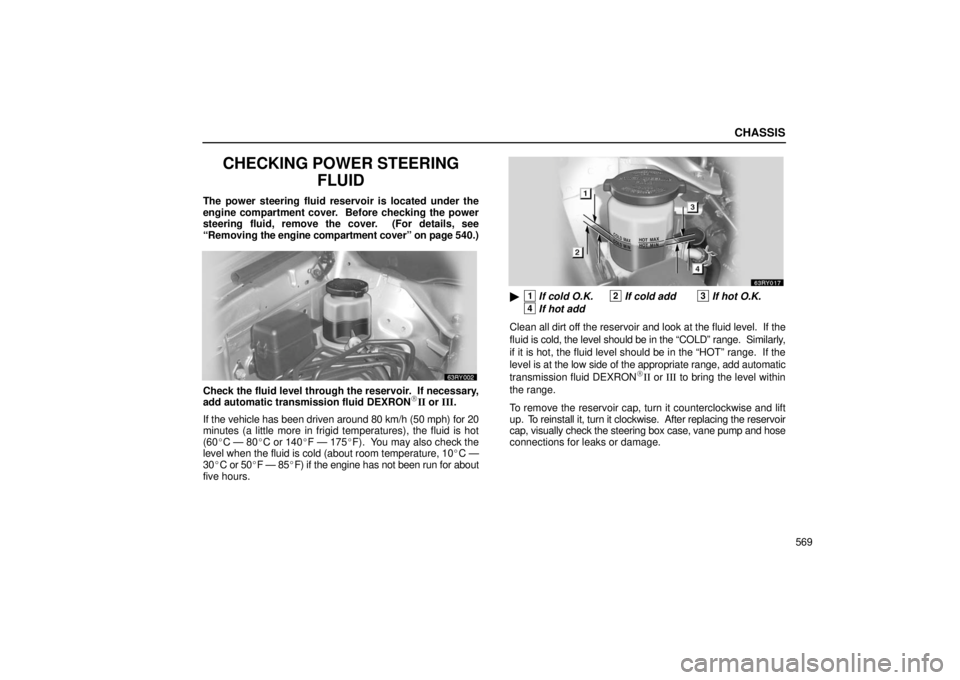
The power steering fluid reservoir is located under the
engine compartment cover. Before checking the power
steering fluid, remove the cover. (For details, see
“Removing the e ngine compartment cover” on page 540.)
Check the fluid level through the reservoir. If necessary,
add automatic transmission fluid DEXRON�II or III .
If the vehicle has been driven around 80 km/h (50 mph) for 20
minutes (a little more in frigid temperatures), the fluid is hot
(60 �C — 80�C or 140�F — 175�F). You may also check the
level when the fluid is cold (about room temperature, 10 �C —
30 �C or 50�F — 85�F) if the engine has not been run for about
five hours.
�1If cold O.K.2If cold add3If hot O.K.
4If hot add
Clean all dirt off the reservoir and look at the fluid level. If the
fluid is cold, the level should be in the “COLD” range. Similarly,
if it is hot, the fluid level should be in the “HOT” range. If th\
e
level is at the low side of the appropriate range, add automatic
transmission fluid DEXRON
�II or III to bring the level within
the range.
To remove the reservoir cap, turn it counterclockwise and lift
up. To reinstall it, turn it clockwise. After replacing the reservoir
cap, visually check the steering box case, vane pump and hose
connections for leaks or damage.
Page 600 of 651

of automatic transmission, power steer")
CHASSIS
579
Glossary of tire terminology
Tire related termMeaning
Accessory weightthe combined weight (in excess of those standard items which may be rep\
laced)
of automatic transmission, power steering, power brakes, power windows, \
power
seats, radio, and heater, to the extent that these items are available as
factory−installed equipment (whether installed or not)
Cold tire inflation
pressuretire inflation pressure when the vehicle has been parked for at least 3 \
hours or
more, or it has not been driven more than 1.5 km or 1 mile under that co\
ndition
Curb weightthe weight of a motor vehicle with standard equipment including the maxi\
mum
capacity of fuel, oil, and coolant, and, if so equipped, air conditionin\
g and
additional weight optional engine
Intended outboard
sidewall(a) the sidewall that contains a whitewall, bears white lettering or bearsmanufacturer, brand, and/or model name molding that is higher or deeper
than the same molding on the other sidewall of the tire, or
(b) the outward facing sidewall of an asymmetrical tire that has a particula\
r side that must always face outward when mounted on a vehicle
Maximum inflation
pressurethe maximum cold inflation pressure to which a tire may be inflated and \
it is
shown on the sidewall of the tire
Maximum loaded
vehicle weightthe sum of —
(a) curb weight;
(b) accessory weight;
(c) vehicle capacity weight; and
(d) production options weight

