Page 168 of 651
OCCUPANT RESTRAINT SYSTEMS
147
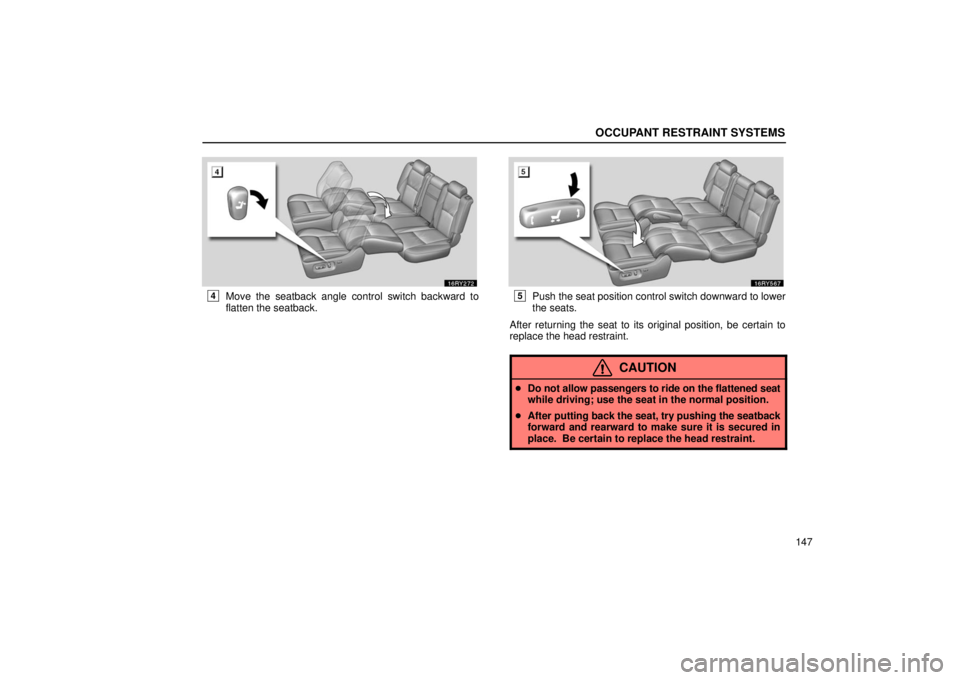
4Move the seatback angle control switch backward to
flatten the seatback.5Push the seat position control switch downward to lower
the seats.
After returning the seat to its original position, be certain to
replace the head restraint.
CAUTION
� Do not allow passengers to ride on the flattened seat
while driving; use the seat in the normal position.
� After putting back the seat, try pushing the seatback
forward and rearward to make sure it is secured in
place. Be certain to replace the head restraint.
Page 169 of 651
OCCUPANT RESTRAINT SYSTEMS
148
REAR SEATS
Sliding and reclining rear seats
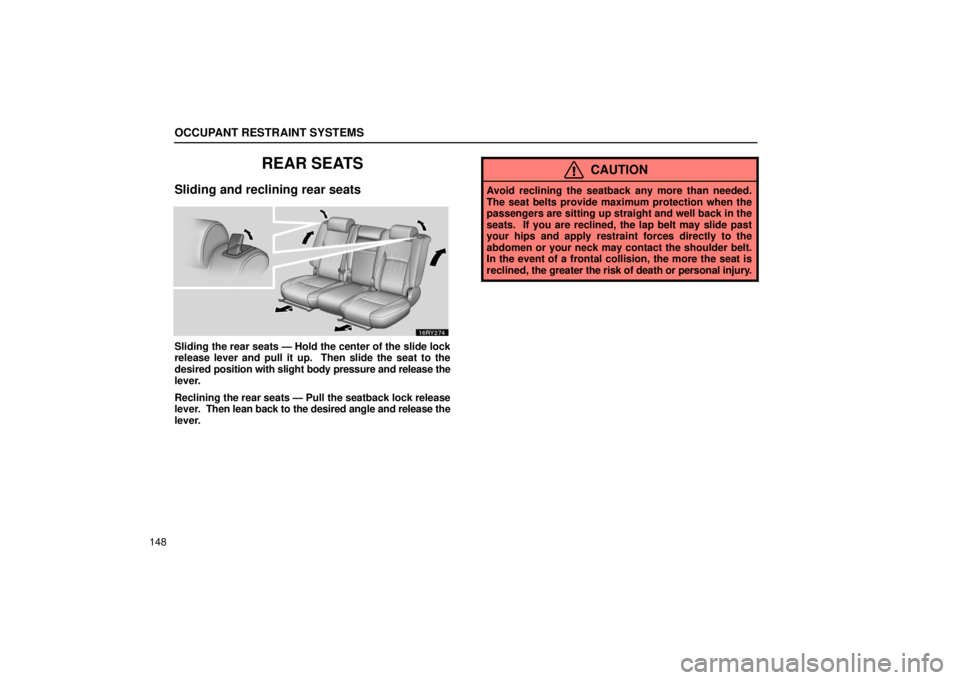
Sliding the rear seats — Hold the center of the slide lock
release lever and pull it up. Then slide the seat to the
desired position with slight body pressure and release the
lever.
Reclining the rear seats — Pull the seatback lock release
lever. Then lean back to the desired angle and release the
lever.
CAUTION
Avoid reclining the seatback any more than needed.
The seat belts provide maximum protection when the
passengers are sitting up straight and well back in the
seats. If you are reclined, the lap belt may slide past
your hips and apply restraint forces directly to the
abdomen or your neck may contact the shoulder belt.
In the event of a frontal collision, the more the seat is
reclined, the greater the risk of death or personal injury.
Page 173 of 651
OCCUPANT RESTRAINT SYSTEMS
152
HEAD RESTRAINTS
For your safety and comfort, adjust the head restraint
before driving.
Front seats
To raise the head restraint, pull it up. To lower it, press the
lock release button and push the head restraint down. To
move the head restraint forward or rearward, pull or push
the base of the head restraint.
The head restraint is most effective when it is close to your
head. Therefore, using a cushion on the seatback is not
recommended.
CAUTION
�Adjust the center of the head restraint so that it is
closest to the top of your ears.
� After adjusting the head restraint, make sure it is
locked in position.
� Do not drive with the head restraints removed.
Page 174 of 651
OCCUPANT RESTRAINT SYSTEMS
153
Rear seats
To raise the head restraint, pull it up. To lower it, press the
lock release button and push the head restraint down.
Rear center head restraint — When an occupant sits on the
rear center seat, always pull up the rear center head restraint
to the lock position.
The head restraint is most effective when it is close to your
head. Therefore, using a cushion on the seatback is not
recommended.
CAUTION
�Adjust the center of the head restraint so that it is
closest to the top of your ears.
� After adjusting the head restraint, make sure it is
locked in position.
� Do not drive with the head restraints removed.
Page 175 of 651

OCCUPANT RESTRAINT SYSTEMS
154
SEAT BELTS
Seat belt precautions
Lexus strongly urges that the driver and passengers in the
vehicle be properly restrained at all times with the seat belts
provided. Failure to do so could increase the chance of injury
and/or the severity of injury in accidents.
The seat belts provided for your vehicle are designed for
people of adult size, large enough to properly wear them.
Child. Use a child restraint system appropriate for the child
until the child becomes large enough to properly wear the
vehicle’s seat belts. See “Child restraint” on page 198 for
details.
If a child is too large for a child restraint system, the child should
sit in the rear seat and must be restrained using the vehicle’s
seat belt. According to accident statistics, the child is safer
when properly restrained in the rear seat than in the front seat.If a child must sit in the front seat, the seat belts should be worn
properly. If an accident occurs and the seat belts are not worn
properly,
the force of the rapid inflation of the airbag may cause
death or serious injury to the child.
Do not allow any children to stand up or kneel on either rear or
front seats. An unrestrained child could suffer serious injury or
death during emergency braking or a collision. Also, do not let
the child sit on your lap. Holding a child in your arms does not
provide sufficient restraint.
Pregnant woman. Lexus recommends the use of a seat belt.
Ask your doctor for specific recommendations. The lap belt
should be worn securely and as low as possible over the hips
and not on the waist.
Injured person. Lexus recommends the use of a seat belt.
Depending on the injury, first check with your doctor for specific
recommendations.
Page 176 of 651
OCCUPANT RESTRAINT SYSTEMS
155
CAUTION
Persons should ride in their seats properly wearing
their seat belts whenever the vehicle is moving.
Otherwise, they are much more likely to suffer serious
bodily injury or death in the event of sudden braking or
a collision.
When using the seat belts, observe the following:
�Use the belt for only one person at a time. Do not use
a single belt for two or more people — even children.
� Avoid reclining the seatback any more than needed.
The seat belts provide maximum protection in a
frontal or rear collision when the driver and the front
passenger are sitting up straight and well back in the
seats. If you are reclined, the lap belt may slide past
your hips and apply restraint forces directly to the
abdomen or your neck may contact the shoulder belt.
In the event of a frontal collision, the more the seat is
reclined, the greater the risk of death or personal
injury.
� Be careful not to damage the belt webbing or
hardware. Take care that they do not get caught or
pinched in the seat or doors.
� Inspect the belt system periodically. Check for cuts,
fraying, and loose parts. Damaged parts should be
replaced. Do not disassemble or modify the system.
� Keep the belts clean and dry. If they need cleaning,
use a mild soap solution or lukewarm water. Never
use bleach, dye, or abrasive cleaners, or allow them
to come into contact with the belts — they may
severely weaken the belts. (See “Cleaning the
interior” on page 621 for instructions.)
� Replace the belt assembly (including bolts) if it has
been used in a severe impact. The entire assembly
should be replaced even if damage is not obvious.
Page 203 of 651
OCCUPANT RESTRAINT SYSTEMS
182
CAUTION
�The SRS side airbag and curtain shield airbag
systems are designed only as a supplement to the
primary protection of the driver, front passenger and
rear outboard passenger seat belt systems. To
ensure maximum protection in an accident, the driver
and all passengers in the vehicle must wear their seat
belts properly. Wearing a seat belt properly during an
accident reduces the chances of death or serious
injury or being thrown out of the vehicle. For
instructions and precautions concerning the seat
belt system, see “Seat belts” on page 154.
� Do not allow anyone to lean his/her head or any part
of his/her body against the door or the area of the
seat, front pillar, rear pillar or roof side rail from which
the SRS side airbag and curtain shield airbag deploy
eve if he/she is a child seated in the child restraint
system. It is dangerous if the SRS side airbag and
curtain shield airbag inflate, and the impact of the
deploying airbag could cause death or serious injury
to the occupant.
� Improperly seated and/or restrained infants and
children can be killed or seriously injured by the
deploying airbags. An infant or child who is too small
to use a seat belt should be properly secured using
a child restraint system. Lexus strongly
recommends that all infants and children be placed
in the rear seats of the vehicle and properly
restrained. The rear seats are the safest for infants
and children. For instructions concerning the
installation of a child restraint system, see “Child
restraint” on page 198.
Page 207 of 651

OCCUPANT RESTRAINT SYSTEMS
186�
1Curtain shield airbag modules (airbag and inflater)
2Side airbag modules (airbag and inflator)
3Front passenger occupant classification system
(ECU and sensors)
4“AIRBAG ON” and “AIRBAG OFF” indicator lights
5SRS warning light
6Curtain shield airbag sensor assemblies
7Side and curtain shield airbag sensor assemblies
8Airbag sensor assembly
9Front passenger’s seat belt buckle switch
The SRS side airbag and curtain shield airbag system consists
mainly of the above components, and their locations are shown
in the illustration.
The SRS side airbag and curtain shield airbag system is
controlled by the airbag sensor assembly. The airbag sensor
assembly consists of a safing sensor and airbag sensor.
In a severe side impact, the side and curtain shield airbag
sensor and/or the curtain shield airbag sensor trigger(s) the
side airbag inflators and/or the curtain shield airbag inflators.
At this time a chemical reaction in the inflators quickly fills the
airbags with non −toxic gas to help restrain the lateral motion
of the occupants.
In a vehicle rollover, the airbag sensor assembly triggers the
curtain shield airbag inflator. At this time, a chemical reaction
in the inflators quickly fills the airbags with non −toxic gas to
help restrain the lateral motion of the occupants. When the airbags inflate, they produce a fairly loud noise and
release some smoke and residue along with non
−toxic gas.
This does not indicate a fire. This smoke may remain inside the
vehicle for some time, and may cause some minor irritation to
the eyes, skin or breathing. Be sure to wash off any residue as
soon as possible to prevent any potential skin irritation with
soap and water. If you can safely exit from the vehicle, you
should do so immediately.
Deployment of the airbags happens in a fraction of a second,
so the airbags must inflate with considerable force. While the
system is designed to reduce se rious injuries, it may also
cause minor burns or abrasions and swelling.
Front seats as well as parts of the front and rear pillars, and roof
side rail may be hot for several minutes, but the airbags
themselves will not be hot. The airbags are designed to inflate
only once.
CAUTION
SRS side airbags and curtain shield airbags inflate with
considerable force. To reduce the possibility of death
or serious injury when they inflate, the driver, front
passenger and rear outboard passengers must:
� Wear their seat belts properly.
� Remain properly seated with their backs upright and
against the seats at all times.