Page 496 of 651
DRIVING TIPS
475
Do not use your parking brake when there is a possibility
it could freeze.
When
parking, put the transmission into “P” and block the rear
wheels. Do not use the parking brake, or snow or water
accumulated in and around the parking brake mechanism may
freeze the parking brake, making it hard to release.
Keep ice and snow from accumulating under the fenders.
Ice and snow built up under your fenders can make steering
difficult. During bad winter driving, stop and check under the
fenders occasionally.
Depending on where you are driving, we recommend you
carry some emergency equipment.
Some of the things you might put in the vehicle are tire chains,
window scraper, bag of sand or salt, flares, small shovel,
jumper cables, etc.
DINGHY TOWING
Your vehicle is not designed to be dinghy towed (with four
wheels on the ground) behind a motorhome.
NOTICE
Do not tow your vehicle with four wheels on the ground.
This may cause serious damage to your vehicle.
Page 523 of 651
IN CASE OF AN EMERGENCY
502
NOTICE
Do not continue driving with a deflated tire.
Driving even a short distance can damage a tire
and wheel beyond repair.
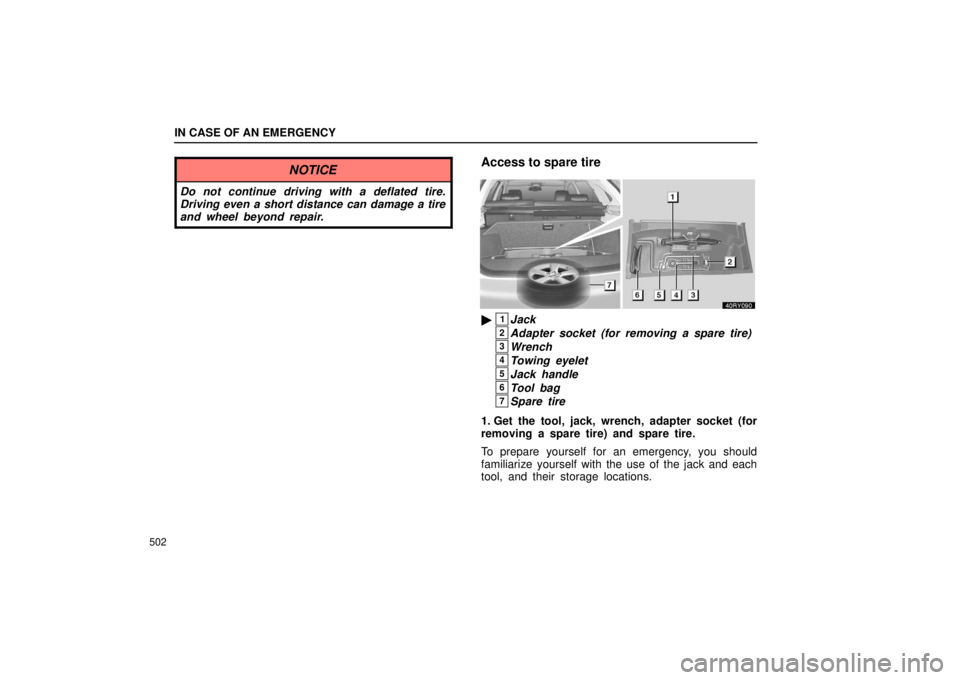
Access to spare tire
�1Jack
2Adapter socket (for removing a spare tire)
3Wrench
4Towing eyelet
5Jack handle
6Tool bag
7Spare tire
1. Get the tool, jack, wrench, adapter socket (for
removing a spare tire) and spare tire.
To prepare yourself for an emergency, you should
familiarize yourself with the use of the jack and each
tool, and their storage locations.
Page 536 of 651

IN CASE OF AN EMERGENCY
515
NOTICE
If you rock your vehicle, observe the following
precautions to prevent damage to the transmission and
other parts.
� Do not depress the accelerator pedal while shifting
the selector lever or before the transmission is
completely shifted to forward or reverse gear.
� Do not race the engine and avoid spinning the
wheels.
� If your vehicle remains stuck after rocking the vehicle
several times, consider other ways such as towing.
IF YOUR VEHICLE NEEDS TO BE
TOWED
If towing is necessary, we recommend you to have it done
by your Lexus dealer or a commercial tow truck service.
In consultation with them, have your vehicle towed using
either (a) or (b).
(a) Towing with a wheel lift type truck
(b) Using a flat bed truck
(c) Never tow with a sling type truck
Only when you cannot receive a towing service from a
Lexus dealer or commercial tow truck service, tow your
vehicle carefully in accordance with the instructions
given in “(d) Emergency towing” on page 520.
Proper equipment will help ensure that your vehicle is not
damaged while being towed. Commercial operators are
generally aware of the state/provincial and local laws
pertaining to towing.
Your vehicle can be damaged if it is towed incorrectly. Although
most operators know the correct procedure, it is possible to
make a mistake. To avoid damage to your vehicle, make sure
the following precautions are observed. If necessary, show
this page to the tow truck driver.
Page 537 of 651
IN CASE OF AN EMERGENCY
516TOWING PRECAUTIONS:
Use a safety chain system for all towing, and abide by the
state/provincial and local laws. The wheels and axle on the
ground must be in good condition. If they are damaged, use
a towing dolly.
CAUTION
Vehicles with electronically modulated air suspension:
When
your vehicle is towed, put the vehicle height in the
“N” (normal) mode and push the height control switch
to turn off the electronically modulated air suspension.
Otherwise, the vehicle height may be changed in the
automatic leveling function, resulting in an unexpected
accident. For details, see “Electronically modulated air
suspension” on page 437.
(a) Towing with a wheel lift type truck
� From front
� Twowheel drive models
Release the parking brake.
NOTICE
When lifting wheels, take care to ensure adequate
ground clearance for towing at the opposite end of the
raised vehicle. Otherwise, the bumper and/or
underbody of the towed vehicle will be damaged during
towing.
Page 538 of 651
IN CASE OF AN EMERGENCY
517
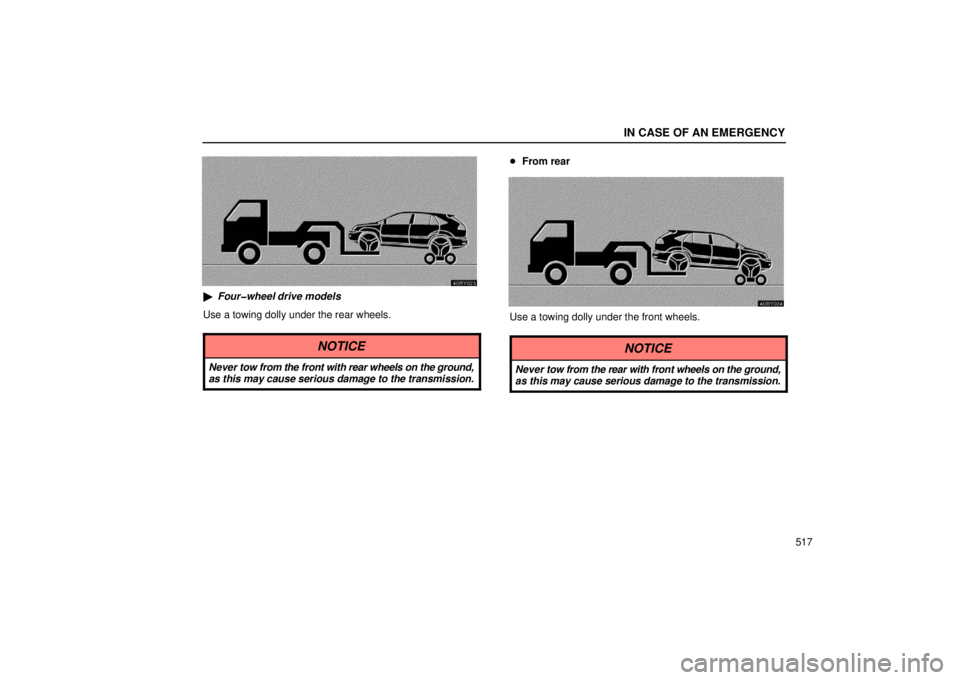
�Fourwheel drive models
Use a towing dolly under the rear wheels.
NOTICE
Never tow from the front with rear wheels on the ground,
as this may cause serious damage to the transmission.
� From rear
Use a towing dolly under the front wheels.
NOTICE
Never tow from the rear with front wheels on the ground,
as this may cause serious damage to the transmission.
Page 540 of 651
IN CASE OF AN EMERGENCY
519
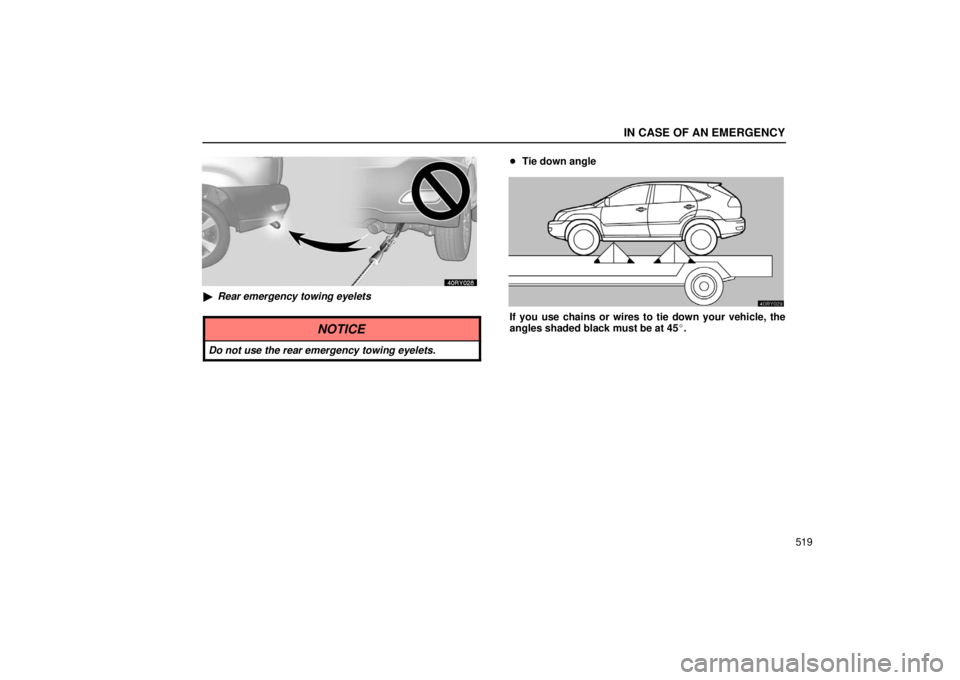
�Rear emergency towing eyelets
NOTICE
Do not use the rear emergency towing eyelets.
�Tie down angle
If you use chains or wires to tie down your vehicle, the
angles shaded black must be at 45�.
Page 541 of 651
IN CASE OF AN EMERGENCY
520
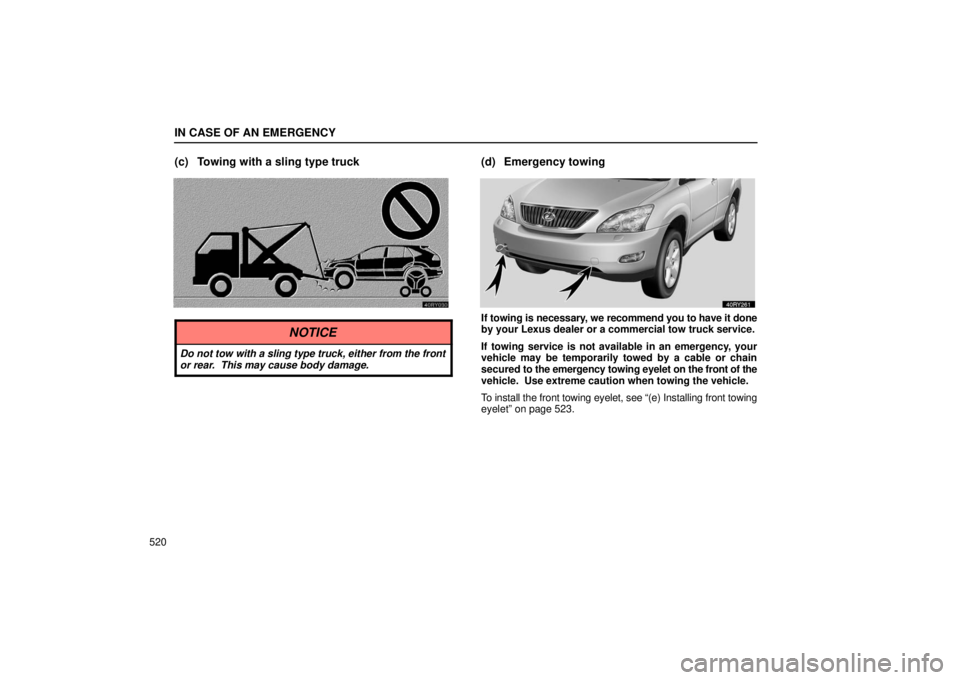
(c) Towing with a sling type truck
NOTICE
Do not tow with a sling type truck, either from the front
or rear. This may cause body damage.
(d) Emergency towing
If towing is necessary, we recommend you to have it done
by your Lexus dealer or a commercial tow truck service.
If towing service is not available in an emergency, your
vehicle may be temporarily towed by a cable or chain
secured to the emergency towing eyelet on the front of the
vehicle. Use extreme caution when towing the vehicle.
To install the front towing eyelet, see “(e) Installing front towing
eyelet” on page 523.
Page 542 of 651

IN CASE OF AN EMERGENCY
521
NOTICE
�Only use specified towing eyelet; otherwise your
vehicle may be damaged.
� Never tow a vehicle from the rear with four wheels on
the ground. This may cause serious damage to the
transmission.
A driver must be in the vehicle to steer it and operate the
brakes.
Towing in this manner may be done only on hard −surfaced
roads for a short distance and at low speeds. Also, the wheels,
axles, drive train, steering and brakes must all be in good
condition.
CAUTION
Use extreme caution when towing the vehicle. Avoid
sudden starts or erratic driving maneuvers which would
place excessive stress on the emergency towing eyelet
and towing cable or chain. The eyelet and towing cable
or chain may break and cause serious injury or damage.
NOTICE
Use only a cable or chain specifically intended for use
in towing vehicles. Securely fasten the cable or chain
to the towing eyelet provided.
Before towing, release the parking brake and put the
transmission in “N”. The ignition key must be in “ACC” (engine
off) or “ON” (engine running).
CAUTION
If the engine is not running, the power assist for the
brakes and steering will not work so steering and
braking will be much harder than usual.