Page 290 of 651
AUDIO
269
(e) Your CD player
When you insert a
CD, gently push it in with the label face up.
(The player will automatically eject a CD if the label face is
down.) The CD player will play from track 1 through the end
of the CD. Then it will play from track 1 again. On models with
the CD auto changer, next CD will be played from track 1.
NOTICE
Never try to disassemble or oil any part of the CD player.
Do not insert anything other than CD into the slot.
The player is intended for use with 12 cm (4.7 in.) CDs only.
Radio operation
(a) Listening to the radio
Push these buttons to choose either an AM or FM station.
“AM”, “FM1”, “FM2” or “FM TYPE” appears on the d\
isplay.
Page 309 of 651
AUDIO
288(e) Your CD player with changer
Your CD player with changer can store up to 6 CDs and play
selected
CDs or continuously play all the CDs set in the player.
When you set CDs into the player, make sure their labels face
up. If not, the player will display “ERROR 1” and the CD
number.
NOTICE
� Do not stack up two CDs for insertion, or it will cause
damage to the CD changer. Insert only one CD into
slot at a time.
� Never try to disassemble or oil any part of the CD
player. Do not insert anything other than CDs into the
slot.
The player is intended for use with 12 cm (4.7 in.) CDs only.
Page 551 of 651

MAINTENANCE
530Battery
Check the battery condition by the indicator color. See page
601 for additional information.
Brake fluid level
Make sure the brake fluid level is correct. See page 568 for
additional information.
Engine oil level
Check the level on the dipstick with the engine turned off and
the vehicle parked on a level spot. See page 556 for
additional
information.
Power steering fluid level
Check the level through the reservoir. The level should be in
the “HOT” or “COLD” range depending on the fluid
temperature. See page 569 for additional information.
Exhaust system
If you notice any change in the sound of the exhaust or smell
exhaust fumes, have the cause located and corrected
immediately. (See “Engine exhaust caution” on page 384.)
Vehicle interior
Items listed below should be checked regularly, e.g. while
performing periodic services, cleaning the vehicle, etc.
Lights
Make sure the headlight, stop lights, tail lights, turn signal
lights, and other lights are working. Check headlight aim.
Service reminder indicators and warning buzzers
Check that all service reminder indicators and warning buzzers
function properly.
Steering wheel
Check that it has the specified free play. Be alert for changes
in steering condition, such as hard steering, excessive free
play or strange noise.
Seats
Check that all front seat controls such as seat adjusters,
seatback recliner, etc., operate smoothly. Check that the head
restraints move up and down smoothly and that the locks hold
securely in any latched position. For folding −down rear
seatbacks, check that the latches lock securely.
Seat belts
Check that the seat belt system such as buckles, retractors
and anchors operate properly and smoothly. Make sure the
belt webbing is not cut, frayed, worn or damaged.
Page 575 of 651

ENGINE
554
FACTS ABOUT ENGINE OILCONSUMPTION
Functions of engine oil
Engine oil has the primary function of lubricating and cooling
the inside of the engine, and plays a major role in maintaining
the engine in proper working order.
Engine oil consumption
It is normal that an engine should consume some engine
oil during normal engine operation. The causes of oil
consumption in a normal engine are as follows.
�Oil is used to lubricate pistons, piston rings and cylinders.
A thin film of oil is left on the cylinder wall when a piston
moves downwards in the cylinder. High negative pressure
generated when the vehicle is decelerating sucks some of
this oil into the combustion chamber. This oil as well as
some part of the oil film left on the cylinder wall is burned by
the high temperature combustion gases during the
combustion process.
� Oil is also used to lubricate the stems of the intake valves.
Some of this oil is sucked into the combustion chamber
together with the intake air and is burned along with the fuel.
High temperature exhaust gases also burn the oil used to
lubricate the exhaust valve stems. The amount of engine oil consumed depends on the
viscosity of the oil, the quality of the oil and the way the
vehicle is driven.
More oil is consumed under driving conditions such as high
speeds and frequent acceleration and deceleration.
A new engine consumes more oil, since its pistons, piston rings
and cylinder walls have not become conditioned.
Oil consumption:
Max. 1.0 L per 1000 km (1.1 qt./600 miles,
0.9 Imp. qt./600 miles)
When judging the amount of oil consumption, keep in
mind that the oil may have become diluted, making it
difficult to judge the true level accurately.
For example, if a vehicle is used for repeated short trips and
consumes a normal amount of oil, the dipstick may not show
any drop in the oil level at all, even after 1000 km (600 miles)
or more. This is because the oil is gradually becoming diluted
with fuel or moisture, making it appear that the oil level has not
changed.
The diluting ingredients evaporate out when the vehicle is then
driven at high speeds, as on an expressway, making it appear
that oil is excessively consumed after driving at high speeds.
Page 579 of 651
ENGINE
558
Engine oil selection
“Toyota Genuine Motor Oil” is used in your Lexus vehicle. Use
Lexus approved “Toyota Genuine Motor Oil” or equivalent to
satisfy the following grade and viscosity.
Oil grade: ILSAC multigrade engine oil
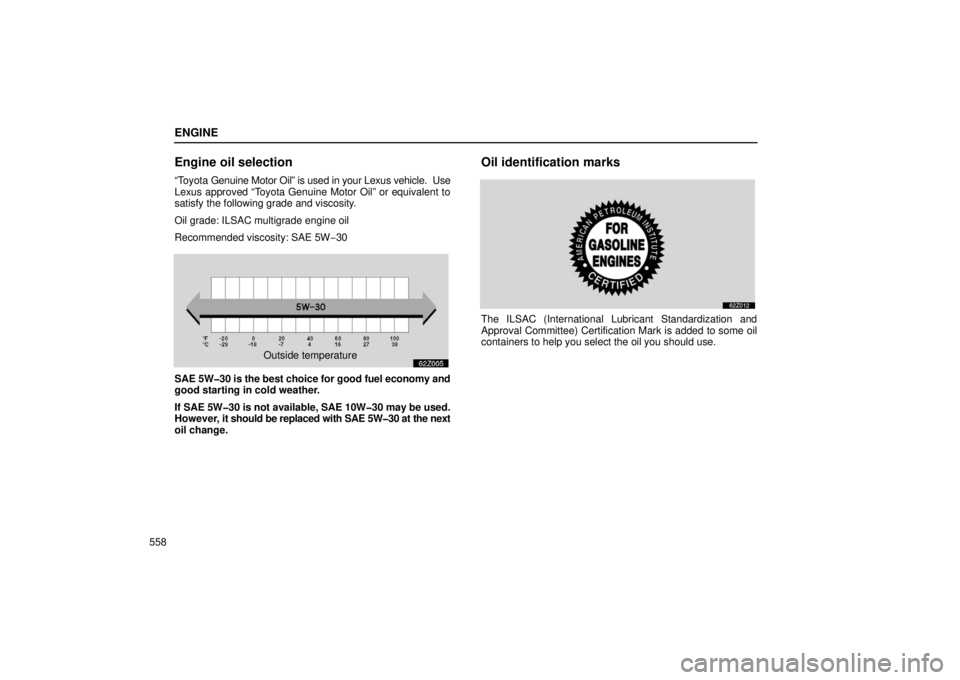
Recommended viscosity: SAE 5W −30
Outside temperature
SAE 5W30 is the best choice for good fuel economy and
good starting in cold weather.
If SAE 5W30 is not available, SAE 10W30 may be used.
However, it should be replaced with SAE 5W30 at the next
oil change.
Oil identification marks
The ILSAC (International Lubricant Standardization and
Approval Committee) Certification Mark is added to some oil
containers to help you select the oil you should use.
Page 585 of 651

CHASSIS
564
SPECIFICATIONS
— REAR DIFFERENTIALOil capacity
0.9 L (1.0 qt., 0.8 Imp. qt.)
Oil typeHypoid gear oil API GL −5
Recommended oil viscosityAbove − 18�C (0�F) SAE 90
Below − 18�C (0�F) SAE 80W or 80W −90
NOTE:
“Toyota Genuine Differential Gear Oil” is used in your Lexus vehicle. Use Lexus approve\
d “Toyota Genuine Differential Gear Oil ”
or equivalent to satisfy the following grade and viscosity. Please contact your Lexus dealer for further details.
— AUTOMATIC TRANSAXLE
Fluid capacity Drain and refill
3.5 L (3.7 qt., 3.1 Imp. qt.)
Fluid typeToyota Genuine ATF Type TIV*
* Change automatic transmission fluid only as necessary.
Generally, it is necessary to change automatic transmission
fluid only if your vehicle is driven under one of the Special
Operating Conditions listed in your “Owner’s Manual
Supplement / Scheduled Maintenance”. When changing the
automatic transmission fluid, use only “Toyota Genuine ATF
Type T−IV” (ATF JWS3309 or NWS6500) to aid in assuring
optimum transaxle performance.NOTICE
Using automatic transmission fluid other than “Toyota
Genuine ATF Type TIV” may cause deterioration in
shift quality, locking up of your transmission
accompanied by vibration, and ultimately damage the
automatic transmission of your vehicle.
Please contact your Lexus dealer for further details.