Page 114 of 419
98
2-1. Driving procedures
Automatic transmission
Select a gear position appropriate for the driving conditions.
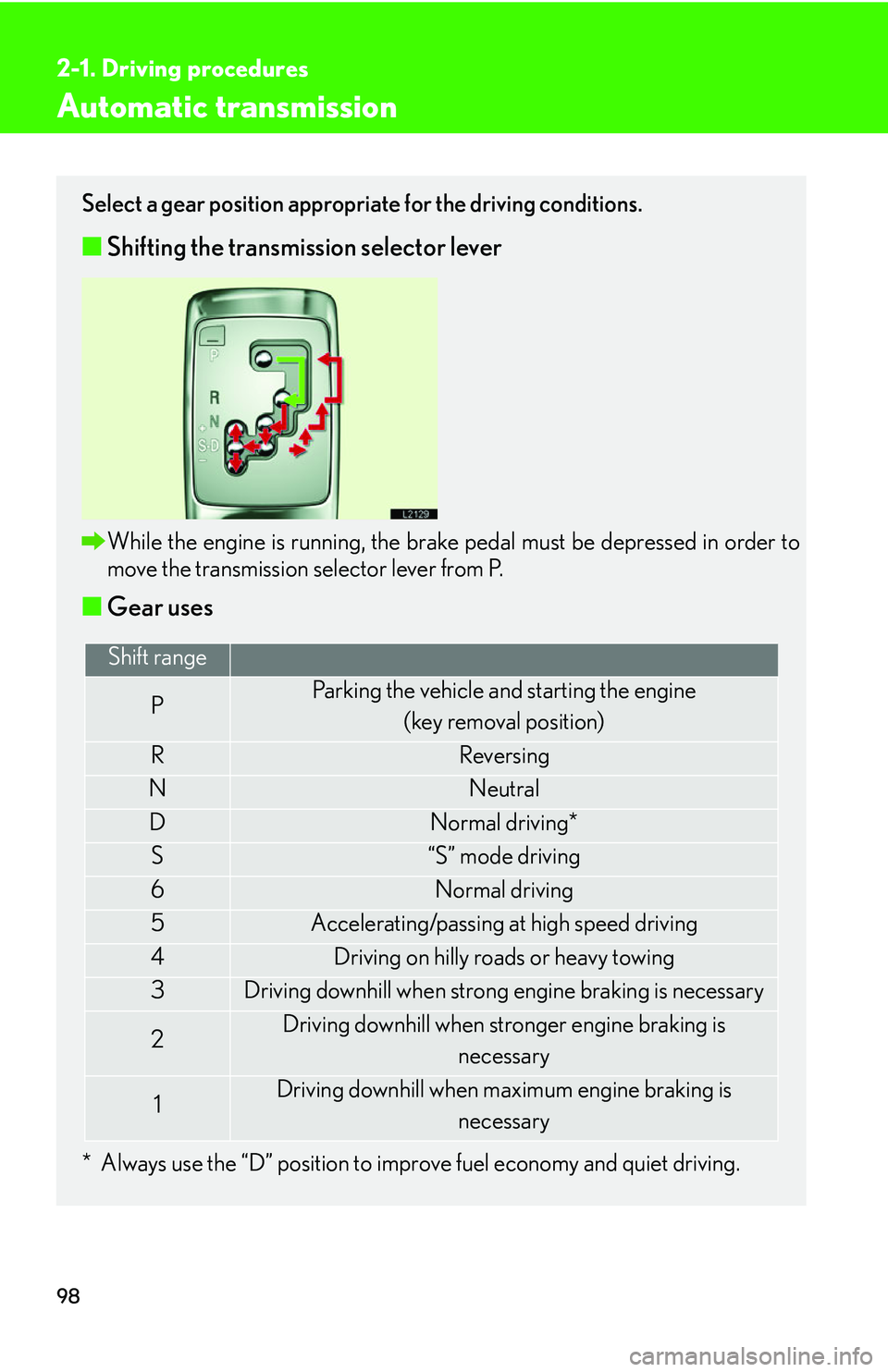
■Shifting the transmission selector lever
While the engine is running, the brake pedal must be depressed in order to
move the transmission selector lever from P.
■Gear uses
* Always use the “D” position to improve fuel economy and quiet driving.
Shift range
PParking the vehicle and starting the engine
(key removal position)
RReversing
NNeutral
DNormal driving*
S“S” mode driving
6Normal driving
5Accelerating/passing at high speed driving
4Driving on hilly roads or heavy towing
3Driving downhill when strong engine braking is necessary
2Driving downhill when stronger engine braking is necessary
1Driving downhill when maximum engine braking is
necessary
Page 116 of 419
100
2-1. Driving procedures
■Downshifting restrictions in “S” mode
The selector lever cannot be down-shifted if the following speeds are exceeded. (A
buzz
er will sound twice in this situation.)
■Accelerating rapidly
Fully depress the accelerator pedal. Engine sp
eed will increase and the vehicle will
accelerate rapidly.
■When driving at a set speed using the cruise control system
Engine braking will not operate when driving in the “S” shifting mode, even if the
select
or lever is downshifted to “5” or “4”. ( P.129 )
■SNOW mode automatic deactivation
SNOW mode is automatically deactivated if the ignition switch is turned to ACC or
L
OCK after driving in SNOW mode.
■If the transmission selector le ver cannot be shifted from P.
P.
3 5 4
■If the “S” mode indicator does not come on when the “S” mode is engaged
There may be a malfunction in the automatic transmission system.
Have the vehicle inspected by your Lexus dealer immediately.
(In this situation, the vehicle operates as if
the selector lever is in D.)
DownshiftingMaximum speed
mph (km/h)
D 390 (146)
3 262 (100)
2 136 (59)
Page 119 of 419
103
2
When driving
2-2. Instrument cluster
Gauges and meters
When the ignition switch is turned to ON;
Engine coolant temperature gaugeDisplays the engine coolant temperature.
Tachometer
Displays the number of engine speed in revolutions per minute.
Speedometer Displays the vehicle speed.
Fuel gauge Displays the quantity of fuel remaining in the tank.
Trip meter reset button
Resets the distance traveled to 0 mile (0 km).
Trip meter button Changes between trip meter A and B indication.
Trip meter A and trip meter B Trip meters display the distance the v
ehicle has been driven since the
meter was reset.
1
2
3
4
5
6
7
Page 120 of 419
104
2-2. Instrument cluster
Instrument panel light control
The brightness of the instrument panel lights can be adjusted by turning
the instrument panel light control knob.
Darker
Brighter
Odometer
Displays the total distance the vehicle has been driven.
Multi-information display ( P.107 )
8
9
1
2
NOTICE
■To prevent damage to the engine and its components
●Do not let the indicator needle of the tachometer enter the red zone, which indi -
cates the maximum range of engine revolutions.
●The engine may be overheating if the temperature gauge is in the red zone (H).
Immediately stop the vehicle in a safe place and check the engine. ( P.359 )
Page 122 of 419
106
2-2. Instrument cluster
CAUTION
■If a safety system warning light does not come on
Should a safety system light such as ABS, TR
AC OFF or the airbag warning light
not come on when you start the engine, th is could mean that these systems are not
available to help protect you in an accident, which could result in death or serious
injury. Have the vehicle inspected by your Lexus dealer immediately if this occurs.
■ Warning lights
Warning lights inform the driver of a malfunction in the indicated vehi -
cle’s systems. (
P. 328 )
* These lights turn on when the ignition sw itch is turned to ON to indicate that
a system check is being performed. Th ey will turn off after the engine is
started on, or after a few seconds.
There may be a malfunction in a system if a
light does not come on, or if the
lights do not turn off. Have the vehicle inspected by your Lexus dealer.
*
(U.S.A)
(U.S.A) (Canada) (U.S.A) (Canada)
(Canada)
Page 124 of 419
108
2-2. Instrument cluster
■Cruise information messages
The displayed figure is for general information purposes and is not pre -
cise
*:Push RESET button 1 to 2 se
conds to recalculate
On the displayDetails
Available driving distance
When the fuel gauge is close to “F”
When the fuel gauge is close to middle
When the fuel gauge is close to “E”
Average fuel consumption
Updated every 10 seconds (*)
Current fuel consumption
Updated every 2 seconds
Average fuel consumption
after refueling
Recalculates after the vehicle is refueled (*)
Driving distance after refuel-
ing
Recalculates after the vehicle is refueled (*)
Elapsed time
Total running time since refueling. (*) If you
turn the engine on and off again, the elapsed
time continues. When the total time exceeds
99 hours 59 minutes, the display returns to 0
and starts over.
Average vehicle speed
Updates every 10 seconds (*)
Page 127 of 419

111
2-3. Operating the headlight and windshield wipers
2
When driving
Daytime running light system
The headlights turn on automatically (at a reduced intensity) whenever the
engine is started and the parking brake is released to make your vehicle
more visible to other drivers. Dayt ime running lights are not designed for
use at night.
■Headlight control sensor
■Automatic light off system
The headlights turn off automatically if the engine is stopped and the driver’s door is
opened wh
ile the headlights are turned on.
To turn the headlights on again, turn the key to ON, or turn the light switch off once
and then
back to or position.
■Automatic headlight leveling system
The level of the headlights is
automatically adjusted according to the number of
passengers and the loading condition of the vehicle to ensure that the headlights do
not interfere other road users.
■Customization
The time it takes for the headlights to automatically turn on or off can be changed.
( P.384 )
The sensor may not function properly if an
object is placed on the sensor, or anything
that blocks the sensor is affixed to the wind-
shield.
Doing so interferes with the sensor detect-
ing the level of ambient light and may cause
the automatic headlight system malfunc-
tion.
Page 128 of 419
112
2-3. Operating the headlight and windshield wipers
Adaptive front lighting system (AFS)
To improve road illumination when turning, the right side headlight moves right
on right turns, and the left side headlight moves left on left turns.
Adaptive front lighting system
cancel switch
On
Off
When the system is canceled,
the “
AFS OFF” indicator lights
up in the instrument cluster.
1
2
3
■Operating conditions
The system starts to operate when the v
ehicle’s speed increases above 6 mph (10
km/h), and stops when the vehicles speed drops below 6 mph (10 km/h).
■When the “AFS OFF” indicator light flashes,
This indicates a system failure. Have your vehicle checked at your Lexus dealer.
NOTICE
■To prevent battery discharge
Do not leave the lights on longer than necessary when the engine is not running.