Page 76 of 419
60
1-7. Safety information
SRS airbags
The SRS airbags inflate when the vehicle is subjected to certain types of
severe impacts that may cause significant injury to the occupants. They
work together with the seat belts, to help reduce the risk of death or serious
injury.
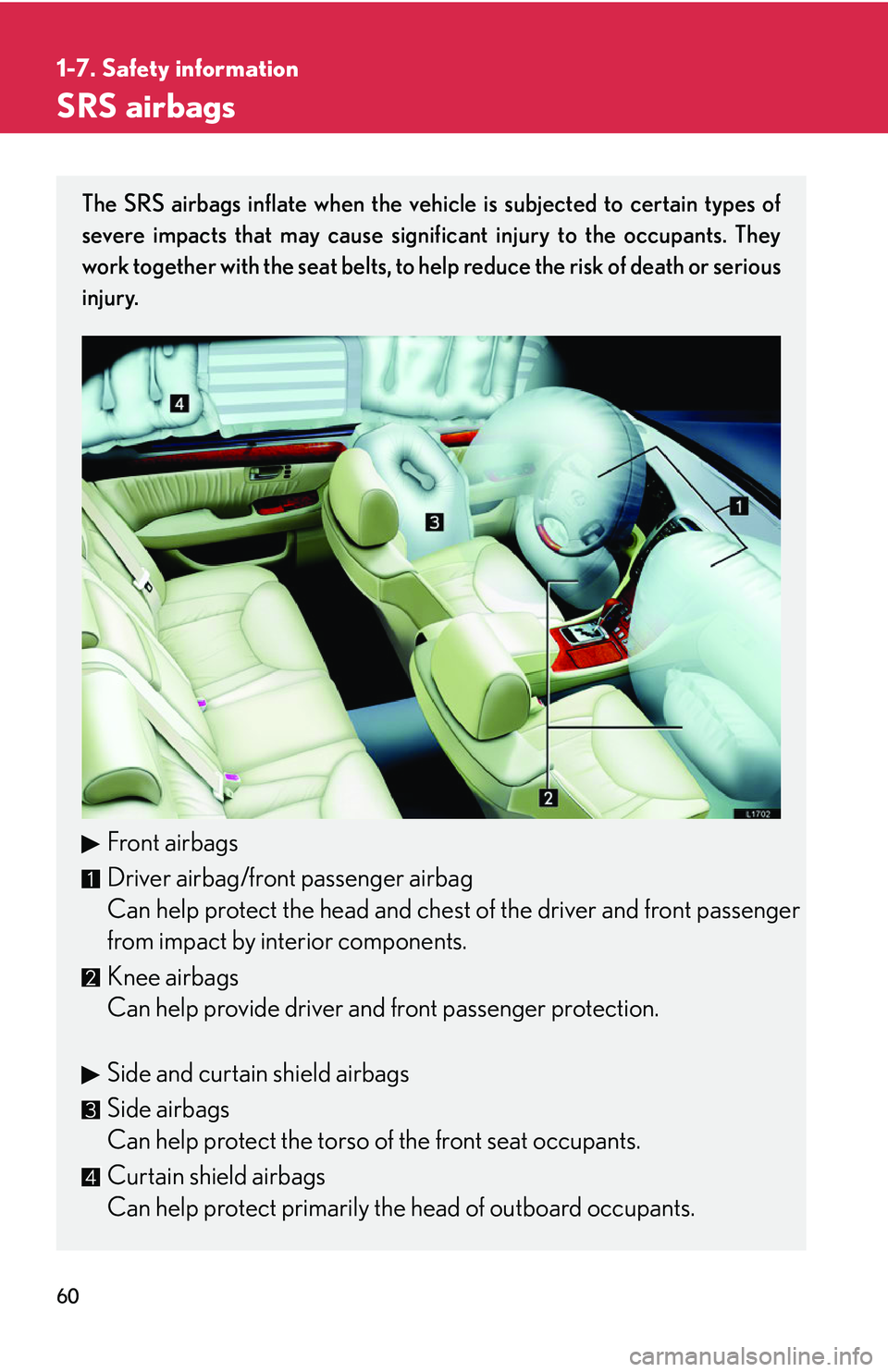
Front airbags
Driver airbag/front passenger airbag
Can help protect the head and chest of the driver and front passenger
fr
om impact by interior components.
Knee airbags
Can help provide driver and front passenger protection.
Side and curtain shield airbags
Side airbags
Can help protect the torso of the fr
ont seat occupants.
Curtain shield airbags
Can help protect primarily the head of ou
tboard occupants.
Page 77 of 419
61
1-7. Safety information
1
Before driving
Airbag system components
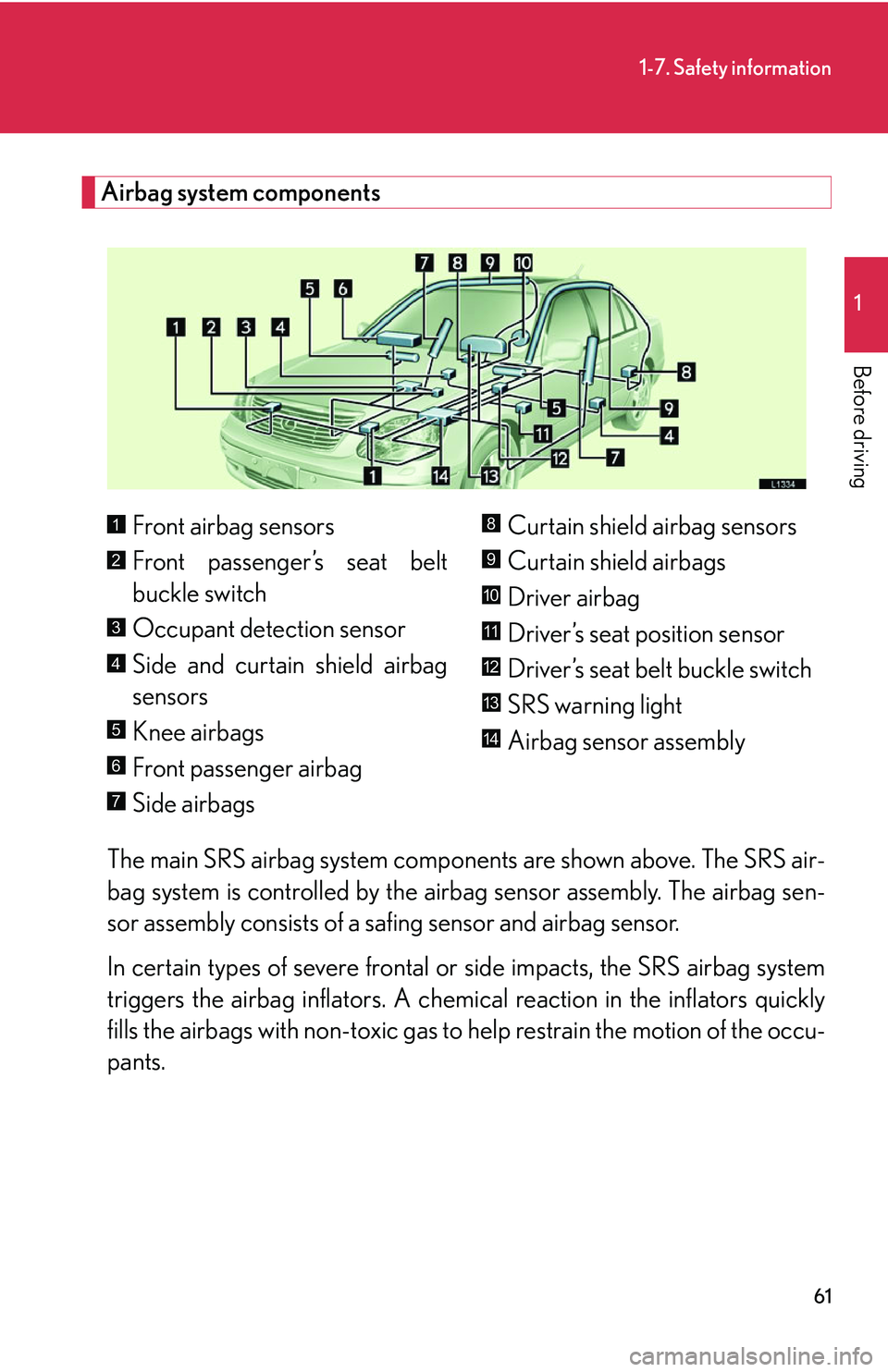
The main SRS airbag system components are shown above. The SRS air-
bag system is controlled by the airb ag sensor as
sembly. The airbag sen-
sor assembly consists of a safing sensor and airbag sensor.
In certain types of severe frontal or side impacts, the SRS airbag s
ystem
triggers the airbag inflators. A chemica l reaction in the inflators quickly
fills the airbags with non-toxic gas to help restrain the motion of the occu -
pants. Front airbag sensors
Front passenger’s seat belt
buckle switch
Occupant detection sensor
Side and curtain shield airbag
sensors
Knee airbags
Front passenger airbag
Side airbags
Curtain shield airbag sensors
Curtain shield airbags
Driver airbag
Driver’s seat position sensor
Driver’s seat belt buckle switch
SRS warning light
Airbag sensor assembly
1
2
3
4
5
6
7
8
9
10
11
12
13
14
Page 78 of 419
62
1-7. Safety information
■If the SRS airbags deploy (inflate)
●Bruising and slight abrasions may result from contact with a deploying (inflating)
SRS airbag.
●A loud noise and white powder will be emitted.
●Parts of the airbag module (steering whee l hub, airbag cover and inflator), as
well as the front seats, apart from the front pillar and roof side rail may be hot for
several minutes, and the airbags themselves will be hot.
●The front windshield may crack.
■Operating conditions (front airbags)
●The SRS front airbags will deploy if the severity of the frontal impact is above the
designed threshold level, comparable to an approximate 15 mph (25 km/h) col -
lision, when the vehicle imp acts
straight into a fixed barrier that does not move
or deform.
However, this threshold velocity will be considerably higher, if the vehicle strikes
a
n object, such as a parked vehicle or sign pole, which can move or deform on
impact, or if the vehicle is involved in an underride collision (e.g., a collision in
which the front of the vehicle “underrides”, or goes under, the bed of a truck, etc.).
●It is possible that in some collisions where the forward deceleration of the vehi -
cle is very close to the designed thresh ol
d level, the SRS front airbags and the
seat belt pretensioners ma y not activate together.
●The SRS front passenger airbag will not activate, if there is no passenger sitting
in the front passenger seat. However, th e front passenger airbag may deploy, if
luggage is put in the seat or the seat belt is buckled up, regardless of the pres -
ence of an occupant in the seat.
■Operating conditions (side and curtain shield airbags)
●The SRS side airbags and curtain shield airbags are designed to inflate, when
the passenger compartment is subjected to a severe impact from the side.
●The SRS side airbag on the passenger seat will not activate, if there is no passen -
ger sitting in the front passenger seat. Ho
wever, the side airbag on the passen-
ger seat may deploy, if luggage is put in the seat or the seat belt is buckled up,
r
egardless of the presence of the occupant in the seat.
Page 82 of 419
66
1-7. Safety information
CAUTION
■SRS airbag precautions
Observe the following precautions regarding the airbags. Failure to do so may
ca
use death or serious injury:
●The driver and all passengers in the vehicle must wear their seat belts properly.
The SRS airbags are supplemental devices to be used with seat belts.
●The SRS driver airbag deploys by a cons iderable force and can cause death or
serious injury especially, if the driver is very close to the airbag. The National
Highway Traffic Safety Administration (“NHTSA”) advises:
Since the risk zone for driver airbag is th e fi
rst 2 - 3 in. (50 - 75 mm) of inflation,
placing yourself 10 in. (250 mm) from your driver airbag provides you with a
clear margin of safety. This distance is measured from the center of the steering
wheel to your breastbone. If you sit less than 10 in. (250 mm) away now, you can
change your driving position in several ways:
• Move your seat to the rear as far as you can while still reaching the pedals
co
mfortably.
• Slightly recline the back of the seat. Alt
hough vehicle designs vary, many driv-
ers can achieve the 10 in. (250 mm) distance, even with the driver seat all the
w
ay forward, simply by reclining the back of the seat somewhat. If reclining
the back of your seat makes it hard to see the road, raise yourself by using a
firm, non-slippery cushion or raise the seat if your vehicle has that feature.
• If your steering wheel is adjustable, ti lt it do
wnward. This points the airbag
toward your chest instead of your head and neck.
Page 83 of 419
67
1-7. Safety information
1
Before driving
CAUTION
The seat should be adjusted as recommended by NHTSA above, while still main-
taining control of the foot pedals, steerin g
wheel and your view of the instrument
panel controls.
●The SRS front passenger airbag also de ploys by a considerable force and can
cause death or serious injury especially, if the front passenger is very close to the
airbag. The front passenger seat should be as far from the airbag as possible with
the seatback adjusted, so the front passenger sits upright.
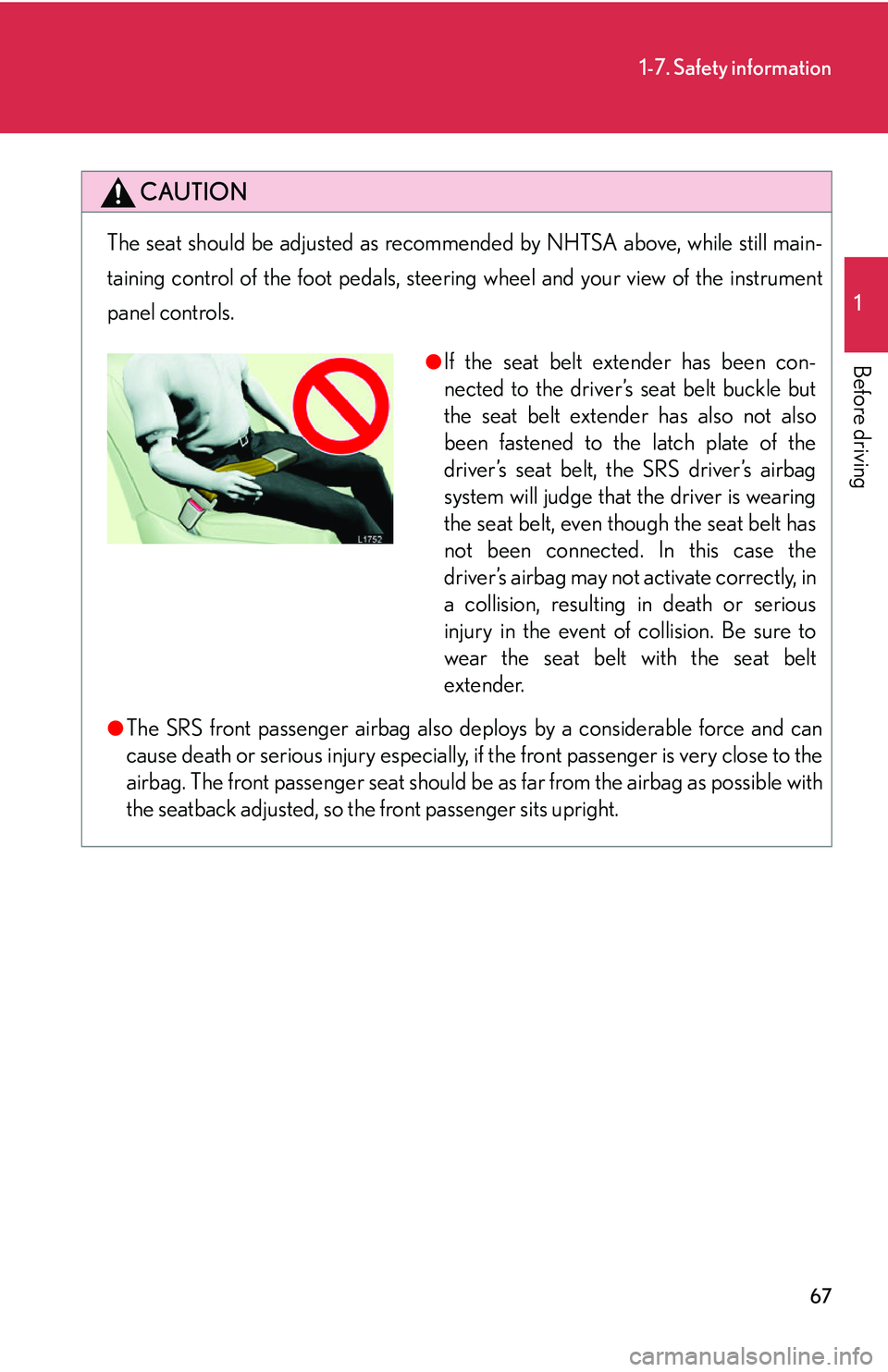
●If the seat belt extender has been con-
nected to the driver’s seat belt buckle but
the seat belt extender has also not also
been fastened to the latch plate of the
driver’s seat belt, the SRS driver’s airbag
system will judge that the driver is wearing
the seat belt, even though the seat belt has
not been connected. In this case the
driver’s airbag may not activate correctly, in
a collision, resulting in death or serious
injury in the event of collision. Be sure to
wear the seat belt with the seat belt
extender.
Page 85 of 419
69
1-7. Safety information
1
Before driving
CAUTION
■SRS airbag precautions
●Improperly seated and/or restrained infants and children can be killed or seri-
ously injured by the deploying airbags. An infant or child who is too small to use a
sea
t belt should be properly secured using a child restraint system. Lexus strongly
recommends that all infants and children be placed in the rear seats of the vehicle
and properly restrained. The rear seats are the safest for infants and children.
( P.73 )
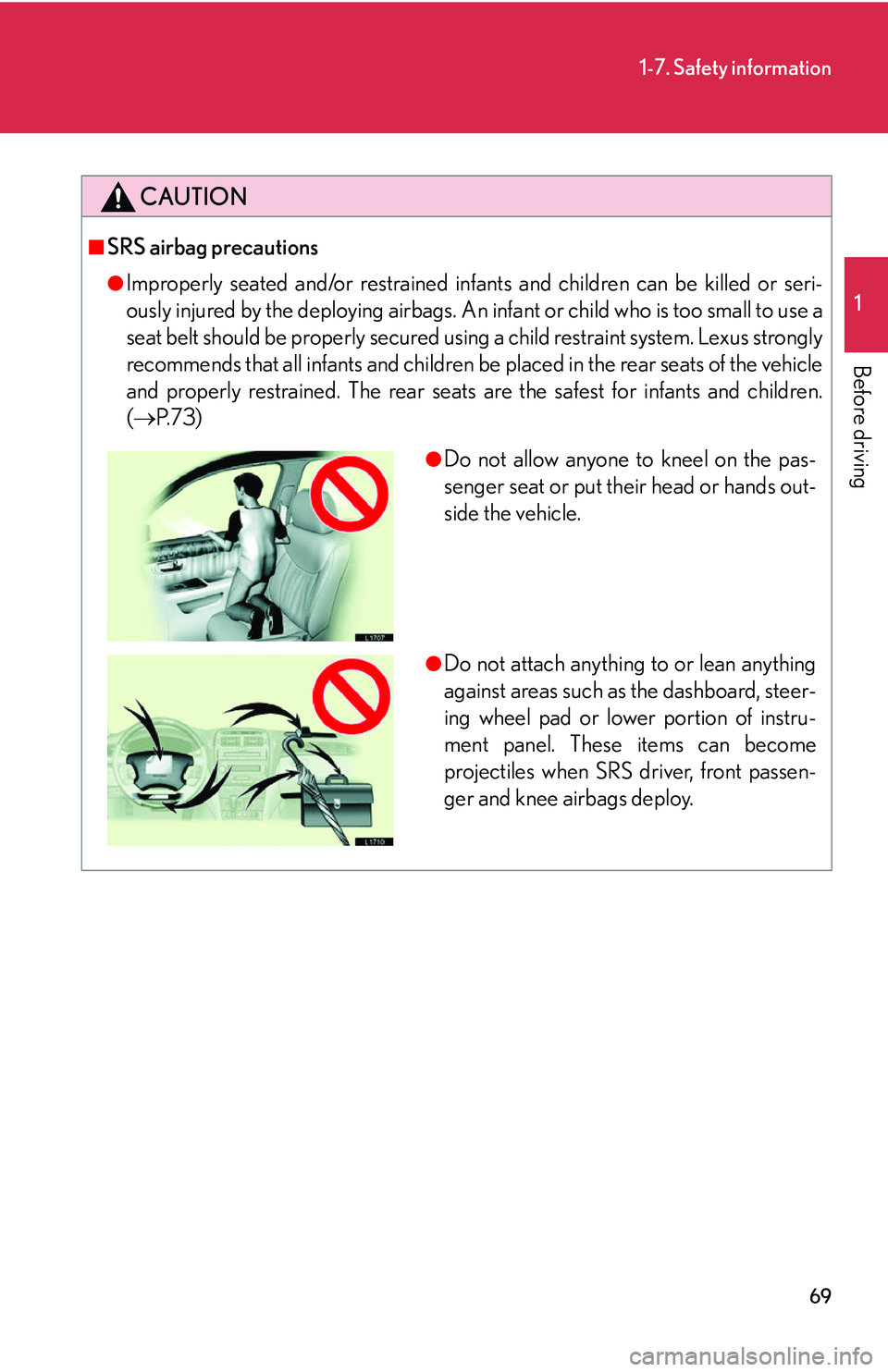
●Do not allow anyone to kneel on the pas-
senger seat or put their head or hands out-
side the vehicle.
●Do not attach anything to or lean anything
against areas such as the dashboard, steer-
ing wheel pad or lower portion of instru-
ment panel. These items can become
projectiles when SRS driver, front passen-
ger and knee airbags deploy.
Page 90 of 419
74
1-7. Safety information
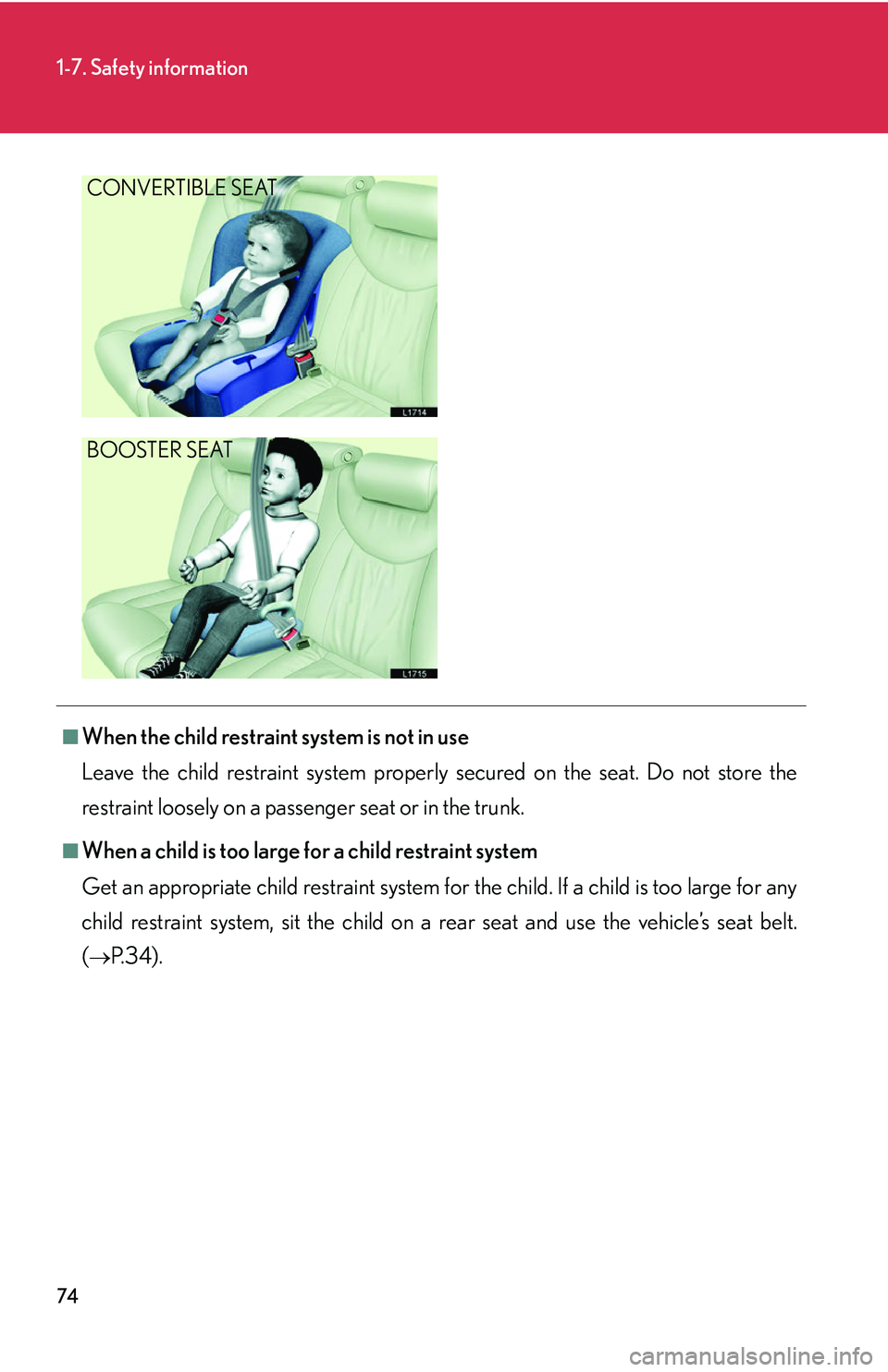
CONVERTIBLE SEAT
BOOSTER SEAT
■When the child restraint system is not in use
Leave the child restraint system properly secur
ed on the seat. Do not store the
restraint loosely on a passenger seat or in the trunk.
■When a child is too large for a child restraint system
Get an appropriate child restraint system for the
child. If a child is too large for any
child restraint system, sit the child on a re ar seat and use the vehicle’s seat belt.
(
P. 34 ).
Page 91 of 419
75
1-7. Safety information
1
Before driving
CAUTION
■Child restraint precautions
●For effective protection in automobile accidents and sudden stops, a child must
be properly restrained, using a seat belt or child restraint system depending on
the age and size of the child.
Holding a child in your arms is not a substitute for a child restraint system. In an
acc
ident, the child can be crushed against the windshield, or between you and
the vehicle’s interior.
●Lexus strongly urges use of a proper chil d restraint system which conforms to the
size of the child, installed on the rear seat. According to accident statistics, the
child is safer when properly restrained in the rear seat than in the front seat.
●Never install a rear-facing child restraint system on the front passenger seat. In
the event of an accident, the force of the rapid inflation of the front passenger air -
bag can cause death or serious injury to th e chi
ld, if the rear-facing child restraint
system is installed on the front passenger seat.
●A forward-facing child restraint system sh ould not be placed on the front passen-
ger seat except when it is unavoidable. Always move the front seat as far back as
possible
, because the front passenger airb ag could inflate by considerable speed
and force. Otherwise, the child may be killed or seriously injured.
●Do not use the seat belt extender when installing a child restraint system on the
front or rear passenger seat. If installing a child restraint system with the seat belt
extender connected to the seat belt, the seat belt will not securely hold the child
restraint system, which could cause death or serious injury to the child or other
passengers in the event of collision.
●Do not allow the child to lean his/her head or any part of his/her body against the
door or the area of the seat, front pillar or roof side rail from which the side air -
bags or curtain shield airbags deploy, even if the child is seated in the child
r
estraint system. It is dangerous if th e side airbags and curtain shield airbags
inflate, and the impact could cause death or serious injury to the child.
●Make sure you have complied with all inst allation instructions provided by the
child restraint manufacturer and that the sy stem is properly secured. If it is not
secured properly, it may cause death or serious injury to the child in the event of a
sudden stop or accident.