Page 121 of 312
Transfer shift knob operation
AUTO ↔ ↔
LOW
1. Stop the vehicle.
2. Depress the clutch pedal (Manual
transmission) or put the shift lever
into N (Neutral) position (Automatic
transmission).
3.
AUTO ➝ ➝
LOW: Turn the transfer shift knob to
LOW mode.LOW ➝ ➝
AUTO: Turn the transfer shift knob to
AUTO mode.
4. Before releasing the clutch pedal
(Manual Transmission) or shifting
to other ranges from N (Automatic
Transmission), wait for the corre-
sponding indicator light in the
instrument cluster to go ON or
OFF.Part-Time 4WD Operation
(If equipped)
You can send your engine's driving
power to all front and rear wheels for
maximum power.
Four-wheel drive is useful when you
drive in snow, mud, ice or sand where
good traction is required, or when
your wheels lose traction using two-
wheel drive.
DRIVING YOUR VEHICLE
4-23
L
O
WAUTO
S2BLA412
CAUTION
If the vehicle moves while the
transfer shift is in process, the
gearbox may be damaged.
BL-ENG (CAN)-4.qxd 7/28/05 5:55 PM Page 23
Page 126 of 312

Do not drive in water if the level is
higher than the bottom of the wheel
hubs.
Check your brake condition once
you are out of mud or water. Press
the brake pedal several times as
you move slowly until you feel nor-
mal braking forces return.
Shorten your scheduled mainte-
nance interval if you drive off-road in
conditions such as sand, mud or
water (see “Scheduled Maintenance’’
in the Index). Always wash your car
thoroughly.
The full time four wheel drive vehi-
cle cannot be towed by an ordinari-
ly tow truck. Make sure that the
vehicle is towed with its four wheels
raised off the ground.Since the driving torque is always
applied to the 4 wheels the perform-
ance of the 4WD vehicle is greatly
affected by the condition of the tires.
Be sure to equip them with all four
tires with same size and type.DRIVING YOUR VEHICLE4-28
CAUTION
While the full-time 4WD vehicle
is being raised on a jack, never
start the engine or cause the
tires to rotate.
There is the danger that rotating
tires touching the ground could
cause the vehicle to go off the
jack and to jump forward.
If one of the front or rear wheels
begins to spin in mud, snow,
etc. the vehicle can sometimes
be driven out by depressing the
accelerator pedal further; how-
ever avoid running the engine
continuously at high rpm
because doing so could dam-
age the 4WD system.
WARNING
-Driving Through Water
If you are driving too fast in
water, the water spray can get
into the engine compartment
and wet the ignition system,
causing your vehicle to sudden-
ly stop. If this happens and your
vehicle is in a tilted position,
your vehicle may roll over.
WARNING
Your vehicle is equipped with
tires designed to provide for safe
ride and handling capability. Do
not use a size and type of tire
and wheel that is different from
the one that is originally
installed on your vehicle. It can
affect the safety and perform-
ance of your vehicle, which
could lead to handling failure or
rollover and serious injury.
When replacing the tires, be
sure to equip all four tires with
the tire and wheel of the same
size, type, tread, brand and
load-carrying capacity. If you
nevertheless decide to equip
your vehicle with any tire/wheel
combination not recommended
by Kia for off road driving, you
should not use these tires for
highway driving.
BL-ENG (CAN)-4.qxd 7/28/05 5:55 PM Page 28
Page 128 of 312

LIMITED SLIP DIFFERENTIAL
(IF EQUIPPED) A limited slip differential if equipped,
is for the rear wheel differential only.
The features of this limited slip differ-
ential are described below;
Just as with conventional differential,
the wheel on one side is allowed to
turn at a different speed from the
wheel on the other side when the
vehicle is cornering.
The difference between the limited
slip differential and a conventional
differential is that if the wheel on one
side of the vehicle loses traction, a
greater amount of torque is applied to
the rear wheel on the other side to
improve traction.
BRAKE SYSTEMPower Brakes
Your vehicle has power-assisted
brakes that adjust automatically
through normal usage.
In the event that the power-assisted
brakes lose power because of a
stalled engine or some other reason,
you can still stop your vehicle by
applying greater force to the brake
pedal than you normally would. The
stopping distance, however, will be
longer. Refer to the scheduled main-
tenance guide for scheduled mainte-
nance intervals.
When the engine is not running, the
reserve brake power is partially
depleted each time the brake pedal is
applied. Do not pump the brake pedal
when the power assist has been
interrupted. Pump the brake pedal
only when necessary to maintain
steering control on slippery surfaces.
DRIVING YOUR VEHICLE4-30
WARNING
To avoid injury, never run the
engine with one wheel off the
ground, such as when changing
a tire.
BL-ENG (CAN)-4.qxd 7/28/05 5:55 PM Page 30
Page 131 of 312
To release the parking brake, pull the
handle up slightly and push the
release button. Then lower the handle
to the released position while holding
the button in.Check the brake warning light each
time you start the engine. This warn-
ing will be illuminated when the
engine is running and the parking
brake is set.
Before driving, be sure the parking
brake is fully released and the brake
warning light is off.
DRIVING YOUR VEHICLE
4-33
S2BLC302C
WARNING
To prevent unintentional move-
ment when stopped and leaving
the vehicle, do not use the
gearshift lever in place of the
parking brake. Set the parking
brake AND make sure the
gearshift lever is securely posi-
tioned in 1st (First) gear or R
(Reverse) for manual transmis-
sion equipped vehicles and in P
(Park) for automatic transmis-
sion equipped vehicles.
BL-ENG (CAN)-4.qxd 7/28/05 5:55 PM Page 33
Page 134 of 312

DRIVING YOUR VEHICLE4-36
✽ ✽
NOTICEWhen you jump start your vehicle
because of a discharged battery, the
engine may not run as smoothly
and the ABS warning light may
blink at the same time. This hap-
pens because of the low battery
voltage. It does not mean your ABS
is malfunctioning.
Do not pump your brakes!
Have the battery recharged
before driving the vehicle.
✽ ✽
NOTICE If the ABS warning light is on and
stays on, you may have a problem
with the ABS system. In this case,
however, your regular brakes will
work normally.
The ABS warning light will stay
on for 2-3 seconds after the
engine starts. During that time,
the ABS will go through self-diag-
nosis and the light will go off if
everything is normal. If the light
stays on, you may have a problem
with your ABS system. Contact
an authorized Kia dealer as soon
as possible.
✽ ✽
NOTICE When you drive on a road having
poor traction, such as an icy road,
and operate your brakes continu-
ously, the ABS will be active con-
tinuously and the ABS warning
light may illuminate. Pull your
car over to a safe place and stop
the engine.
Restart the engine. If the ABS
warning light is off, then your
ABS system is normal.
Otherwise, you may have a prob-
lem with the ABS. Contact an
authorized Kia dealer as soon as
possible.
BL-ENG (CAN)-4.qxd 7/28/05 5:55 PM Page 36
Page 135 of 312

POWER STEERINGPower steering uses energy from the
engine to assist you in steering the
vehicle. If the engine is off or if the
power steering system becomes
inoperative, the vehicle may still be
steered, but it will require increased
steering effort.
Should you notice any change in the
effort required to steer during normal
vehicle operation, have the power
steering system checked by an
authorized Kia dealer.
DRIVING YOUR VEHICLE
4-37
✽ ✽
NOTICEIf the vehicle is parked for extended
periods outside in cold weather
(below-10°C (14°F)), the power
steering may require increased
effort when the engine is first start-
ed. This is caused by increased fluid
viscosity due to the cold weather
and does not indicate a malfunc-
tion.
When this happens, increase the
engine RPM to 1500rpm then
release or let the engine idle for two
or three minutes to warm up the
fluid.
✽ ✽
NOTICE Never hold the steering wheel
against a stop (extreme right or
left turn) for more than five sec-
onds with the engine running.
Holding the steering wheel for
more than five seconds in either
position may cause damage to the
power steering pump.
If the power steering drive belt
breaks or if the power steering
pump malfunctions, the steering
effort will greatly increase.
BL-ENG (CAN)-4.qxd 7/28/05 5:55 PM Page 37
Page 139 of 312
DRIVING YOUR VEHICLE
4-41
ABS
CHECK
4WD
LOW
H
C
F
E
BRAKE
0 1 234567
8
0
0 10 203040506070
80
90
100
110
120
130
20406080100120
140
160
180
200
220
1000rpm
CRUISE
km/hMPH
IMMO
1. Tachometer
2. Turn signal indicators
3. Speedometer
4. Engine temperature gauge
5. Warning and indicator lights
6. Tripmeter / Odometer
7. Trip meter reset button
8. Fuel gauge
1
2
3
2
4
5
6
7
8
5
5BLD401
INSTRUMENT CLUSTER (MANUAL TRANSMISSION)
BL-ENG (CAN)-4.qxd 7/28/05 5:55 PM Page 41
Page 140 of 312
DRIVING YOUR VEHICLE4-42
ABS
CHECK
O/D
OFF4WD
LOW
PN R
D
2
L
H
C
F
E
BRAKE
0 1 234567
8
0
0 10 203040506070
80
90
100
110
120
130
20406080100120
140
160
180
200
220
1000rpm
CRUISE
km/hMPH
IMMO
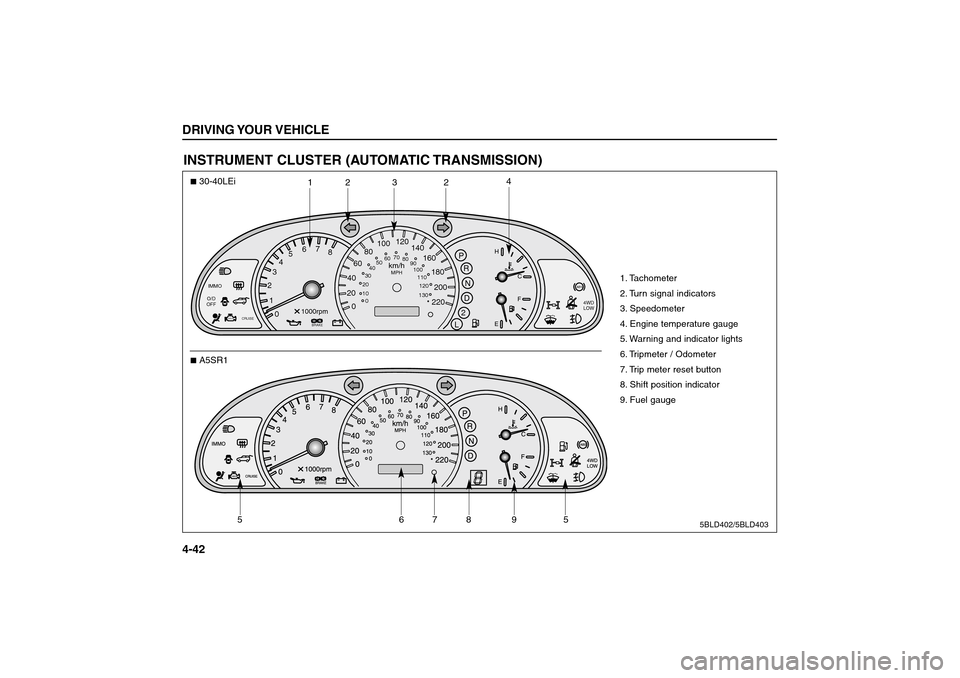
1. Tachometer
2. Turn signal indicators
3. Speedometer
4. Engine temperature gauge
5. Warning and indicator lights
6. Tripmeter / Odometer
7. Trip meter reset button
8. Shift position indicator
9. Fuel gauge
1
2
3
2
4
5BLD402/5BLD403
INSTRUMENT CLUSTER (AUTOMATIC TRANSMISSION)
5
6
7
9
8
5
�30-40LEi�A5SR1
BL-ENG (CAN)-4.qxd 7/28/05 5:55 PM Page 42