2006 KIA Sorento engine
[x] Cancel search: enginePage 189 of 312

FUEL REQUIREMENTSYour new Kia vehicle must use
only unleaded fuel having an
octane rating of at least 87.
Your new Kia is designed to obtain
maximum performance with
UNLEADED FUEL, as well as mini-
mize exhaust emissions and spark
plug fouling.Gasoline Containing Alcohol and
Methanol
Gasohol, a mixture of gasoline and
ethanol (also known as grain alco-
hol), and gasoline or gasohol con-
taining methanol (also known as
wood alcohol) are being marketed
along with or instead of leaded or
unleaded gasoline.
Do not use gasohol containing more
than 10% ethanol, and do not use
gasoline or gasohol containing any
methanol. Either of these fuels may
cause driveability problems and dam-
age to the fuel system.
Discontinue using gasohol of any
kind if driveability problems occur.Vehicle damage or driveability prob-
lems may not be covered by the man-
ufacturer’s warranty if they result from
the use of:
1. Gasohol containing more than
10% ethanol.
2. Gasoline or gasohol containing
methanol.
3. Leaded fuel or leaded gasohol.DRIVING TIPS5-2✽ ✽
NOTICENEVER USE LEADED FUEL. The
use of leaded fuel is detrimental to
the catalytic converter and will
damage the engine control system’s
oxygen sensor and affect emission
control.
Never add any fuel system cleaning
agents to the fuel tank other than
what Kia has specified.
(Consult an authorized Kia dealer
for details.)
✽ ✽
NOTICENever use gasohol which contains
methanol. Discontinue use of any
gasohol product which impairs dri-
veability.
BL-ENG (CAN)-5.qxd 7/28/05 5:56 PM Page 2
Page 190 of 312

EMISSION CONTROL
SYSTEMThe emissions control system of your
vehicle is covered by a written limited
warranty. Please see the warranty
information contained in the Warranty
and Consumer Information Manual in
your vehicle.
Vehicle Modifications
This vehicle should not be modified.
Modification of your Kia could affect
its performance, safety or durability
and may even violate governmental
safety and emissions regulations.
In addition, damage or performance
problems resulting from any modifi-
cation may not be covered under
warranty.Engine Exhaust Gas Precautions
(Carbon Monoxide)
Carbon monoxide can be present
with other exhaust fumes.
Therefore, if you smell exhaust
fumes of any kind inside your vehi-
cle, have it inspected and repaired
immediately by an authorized Kia
dealer. If you ever suspect exhaust
fumes are coming into your vehicle,
drive it only with all the windows
fully open. Have your vehicle
checked and repaired immediately. Do not operate the engine in con-
fined or closed areas (such as
garages) any more than what is
necessary to move the vehicle in or
out of the area.
When the vehicle is stopped in an
open area for more than a short
time with the engine running, adjust
the heating or cooling system (as
needed) to draw outside air into the
vehicle.
Never sit in a parked or stopped
vehicle for any extended time with
the engine running.
When the engine stalls or fails to
start, excessive attempts to re-start
the engine may cause damage to
the emission control system.
DRIVING TIPS
5-3
WARNING
Engine exhaust gases contain
carbon monoxide (CO). Though
colorless and odorless, it is dan-
gerous and could be lethal if
inhaled. Follow the instructions
following to avoid CO poisoning.
BL-ENG (CAN)-5.qxd 7/28/05 5:56 PM Page 3
Page 191 of 312
Operating Precautions for
Catalytic Converters
Your vehicle is equipped with a cat-
alytic converter emission control
device.
Therefore, the following precautions
must be observed:
Use only UNLEADED FUEL.
Do not operate the vehicle when
there are signs of engine malfunc-
tion, such as misfire or a noticeable
loss of performance.
Do not misuse or abuse the engine.
Examples of misuse are coasting
with the ignition off and descending
steep grades in gear with the igni-
tion off. Do not operate the engine at high
idle speed for extended periods (5
minutes or more).
Do not modify or tamper with any
part of the engine or emission con-
trol system. All inspections and
adjustments must be made by a
qualified technician.
Failure to observe these precautions
could result in damage to the catalyt-
ic converter and to your vehicle.
Additionally, such actions could void
your warranties.DRIVING TIPS5-4
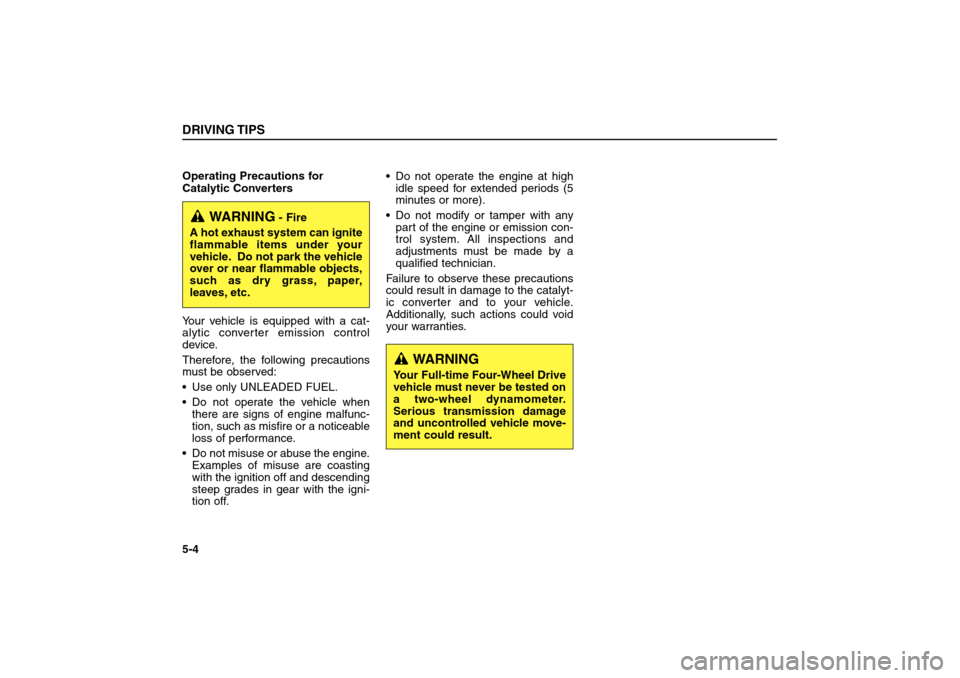
WARNING
Your Full-time Four-Wheel Drive
vehicle must never be tested on
a two-wheel dynamometer.
Serious transmission damage
and uncontrolled vehicle move-
ment could result.
WARNING
- Fire
A hot exhaust system can ignite
flammable items under your
vehicle. Do not park the vehicle
over or near flammable objects,
such as dry grass, paper,
leaves, etc.
BL-ENG (CAN)-5.qxd 7/28/05 5:56 PM Page 4
Page 192 of 312

TIPS ON DRIVING YOUR
VEHICLEBefore Entering Vehicle:
Be sure that all windows, outside
mirror(s), and outside lights are
clean.
Check the condition of the tires.
Check under the vehicle for any
sign of leaks.
Be sure there are no obstacles
behind you if you intend to back up.
Necessary Inspections
Fluid levels, such as engine oil,
engine coolant, brake/clutch fluid,
and washer fluid should be checked
on a regular basis, with the exact
interval depending on the fluid.
Further details are provided in the
“Maintenance” section.Before Starting
Close and lock all doors.
Position the seat so that all controls
are easily reached.
Adjust the inside and outside
rearview mirrors.
Be sure that all lights work.
Check all gauges.
Check the operation of warning
lights when the ignition switch is
turned to the ON position.
Release the parking brake and
make sure the brake warning light
goes out.
For safe operation, be sure you are
familiar with your vehicle and its
equipment.
DRIVING TIPS
5-5
WARNING- Driving Under the
Influence of Alcohol or
Drugs
Drinking and driving is danger-
ous. Drunk driving is the num-
ber one contributor to the high-
way death toll each year. Even
a small amount of alcohol will
affect your reflexes, percep-
tions and judgement.
You are much more likely to
have a serious accident if you
drink and drive.
If you are drinking or taking
drugs, don’t drive. Do not ride
with a driver who has been
drinking or taking drugs.
Choose a designated driver or
call a cab.
Driving while under the influ-
ence of drugs is as dangerous
or more dangerous than driving
drunk.
BL-ENG (CAN)-5.qxd 7/28/05 5:56 PM Page 5
Page 193 of 312

SUGGESTIONS FOR
ECONOMICAL OPERATIONYour vehicle’s fuel economy depends
mainly on your style of driving, where
you drive and when you drive.
Each of these factors affects how
many miles (kilometers) you can get
from a gallon (liter) of fuel. To operate
your vehicle as economically as pos-
sible, use the following driving sug-
gestions to help save money in both
fuel and repairs:
Avoid lengthy warm-up idling. Once
the engine is running smoothly,
begin driving. Remember, engine
warm-up may take a little longer on
cold days.
Save fuel by accelerating slowly
after stopping.
Keep the engine in tune and follow
the recommended periodic mainte-
nance schedule. This will increase
the life of all parts and lower your
operating costs. Do not use the air conditioner
unnecessarily.
Slow down when driving on rough
roads.
For longer tire life and better fuel
economy, always keep the tires
inflated to the recommended pres-
sures.
Maintain a safe distance from other
vehicles to avoid sudden stops.
This will reduce wear on brake lin-
ings and pads. Driving in such a
way will also save fuel because
extra fuel is required to accelerate
back to driving speed.
Do not carry unnecessary weight in
the vehicle.
Do not rest your foot on the brake
pedal while driving. This can cause
needless wear, possible damage to
the brakes, and poor fuel economy. Improper wheel alignment results
in faster tire wear and lower fuel
economy.
Open windows at high speeds can
reduce fuel economy.
Fuel economy is less in crosswinds
and headwinds. To help offset
some of this loss, slow down when
driving in these conditions.
Keeping a vehicle in good operating
condition is important both for econo-
my and safety. Therefore, have an
authorized Kia dealer perform sched-
uled inspections and maintenance.DRIVING TIPS5-6
BL-ENG (CAN)-5.qxd 7/28/05 5:56 PM Page 6
Page 194 of 312
DRIVING TIPS
5-7
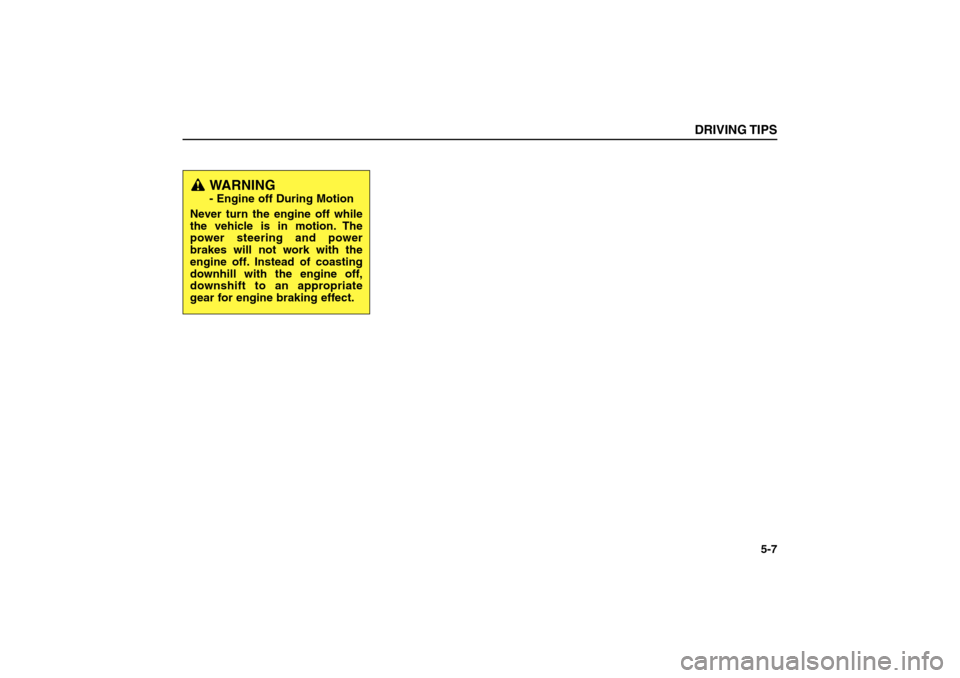
WARNING - Engine off During Motion
Never turn the engine off while
the vehicle is in motion. The
power steering and power
brakes will not work with the
engine off. Instead of coasting
downhill with the engine off,
downshift to an appropriate
gear for engine braking effect.
BL-ENG (CAN)-5.qxd 7/28/05 5:56 PM Page 7
Page 196 of 312

Rocking the Vehicle
If it is necessary to rock the vehicle to
free it from snow, sand, or mud, first
turn the steering wheel right and left
to clear the area around your front
wheels. Then, shift back and forth
between 1 (First) and R (Reverse) in
vehicles equipped with a manual
transmission or R (Reverse) and any
forward gear in vehicles equipped
with an automatic transmission. Do
not race the engine, and spin the
wheels as little as possible. If you are
still stuck after a few tries, have the
vehicle pulled out by a tow vehicle to
avoid engine overheating and possi-
ble damage to the transmission,
transfer case (if equipped), or differ-
ential.Driving at Night
Because night driving presents many
more hazards than driving in the day-
light, here are some important tips to
remember:
Slow down and keep more distance
between you and other vehicles, as
it may be more difficult to see at
night, especially in areas where
there may not be any street lights.
Adjust your mirrors to reduce the
glare from other driver’s headlights.
Keep your headlights clean and
properly aimed. Dirty or improperly
aimed headlights will make it much
more difficult to see at night.
Avoid staring directly at the head-
lights of oncoming vehicles. You
could be temporarily blinded, and it
will take several seconds for your
eyes to readjust to the darkness.
DRIVING TIPS
5-9
✽ ✽
NOTICEProlonged rocking may cause
engine over-heating, transmission
or transfer case (if equipped) dam-
age or failure, and tire damage.
WARNING- Spinning Tires
Do not spin the wheels, espe-
cially at speeds more than 35
mph (56 km/h). Spinning the
wheels at high speeds when the
vehicle is stationary could
cause a tire to overheat,
explode and injure bystanders.
BL-ENG (CAN)-5.qxd 7/28/05 5:56 PM Page 9
Page 197 of 312

Driving in the Rain
Rain and wet roads can make driving
dangerous, especially if you’re not
prepared for the slick pavement. Here
are a few things to consider when
driving in the rain:
A heavy rainfall will make it harder
to see and will increase the dis-
tance needed to stop your vehicle,
so slow down.
Keep your windshield wiping equip-
ment in good shape. Replace your
windshield wiper blades when they
show signs of streaking or missing
areas on the windshield.
If your tires are not in good condi-
tion, making a quick stop on wet
pavement can cause a skid and
possibly lead to an accident. Be
sure your tires are in good shape. Turn on your headlights to make it
easier for others to see you.
Driving too fast through large pud-
dles can affect your brakes. If you
must go through puddles, try to
drive through them slowly.
If you believe your brakes may have
become wet, apply them lightly
while driving until normal braking
operation returns.Winter Driving
We recommend that you carry
emergency equipment, including
tire chains, a window scraper, wind-
shield de-icer, a bag of sand or salt,
flares, a small shovel and jumper
cables.
Make sure you have sufficient eth-
ylene-glycol coolant in the radiator.
Check the battery condition and
cables. Cold temperatures reduce
the capacity of any battery, so it
must be in excellent condition to
provide enough winter starting
power.
Make sure the engine oil viscosity
is suitable for cold weather.
Check the ignition system for loose
connections and damage.DRIVING TIPS5-10
BL-ENG (CAN)-5.qxd 7/28/05 5:56 PM Page 10