2006 KIA AMANTI ECU
[x] Cancel search: ECUPage 232 of 322
In case of an emergency12
6
1
2
3
4
5
6
7
8
910
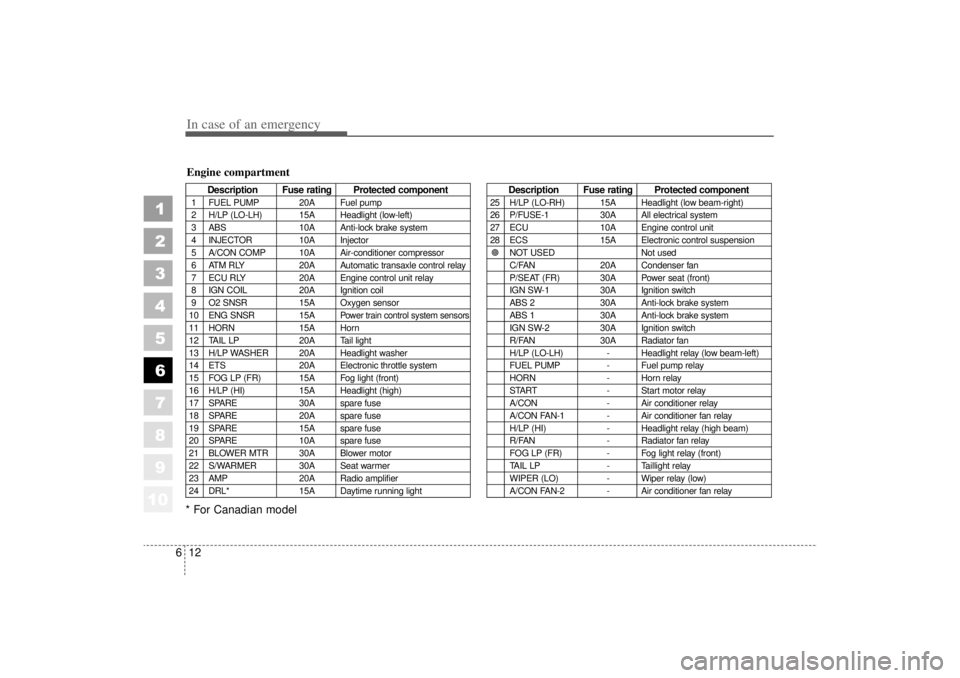
* For Canadian model
Description Fuse rating Protected component
1 FUEL PUMP 20A Fuel pump
2 H/LP (LO-LH) 15A Headlight (low-left)
3 ABS 10A Anti-lock brake system
4 INJECTOR 10A Injector
5 A/CON COMP 10A Air-conditioner compressor
6 ATM RLY 20A Automatic transaxle control relay
7 ECU RLY 20A Engine control unit relay
8 IGN COIL 20A Ignition coil
9 O2 SNSR 15A Oxygen sensor
10 ENG SNSR 15A
Power train control system sensors
11 HORN 15A Horn
12 TAIL LP 20A Tail light
13 H/LP WASHER 20A Headlight washer
14 ETS 20A Electronic throttle system
15 FOG LP (FR) 15A Fog light (front)
16 H/LP (HI) 15A Headlight (high)
17 SPARE 30A spare fuse
18 SPARE 20A spare fuse
19 SPARE 15A spare fuse
20 SPARE 10A spare fuse
21 BLOWER MTR 30A Blower motor
22 S/WARMER 30A Seat warmer
23 AMP 20A Radio amplifier
24 DRL* 15A Daytime running light
Description Fuse rating Protected component
25 H/LP (LO-RH) 15A Headlight (low beam-right)
26 P/FUSE-1 30A All electrical system
27 ECU 10A Engine control unit
28 ECS 15A Electronic control suspension
NOT USED Not used
C/FAN 20A Condenser fan
P/SEAT (FR) 30A Power seat (front)
IGN SW-1 30A Ignition switch
ABS 2 30A Anti-lock brake system
ABS 1 30A Anti-lock brake system
IGN SW-2 30A Ignition switch
R/FAN 30A Radiator fan
H/LP (LO-LH) - Headlight relay (low beam-left)
FUEL PUMP - Fuel pump relay
HORN - Horn relay
START - Start motor relay
A/CON - Air conditioner relay
A/CON FAN-1 - Air conditioner fan relay
H/LP (HI) - Headlight relay (high beam)
R/FAN - Radiator fan relay
FOG LP (FR) - Fog light relay (front)
TAIL LP - Taillight relay
WIPER (LO) - Wiper relay (low)
A/CON FAN-2 - Air conditioner fan relay
Engine compartment
Page 237 of 322
617
In case of an emergency
1
2
3
4
5
6
7
8
910
Towing with a vehicle other
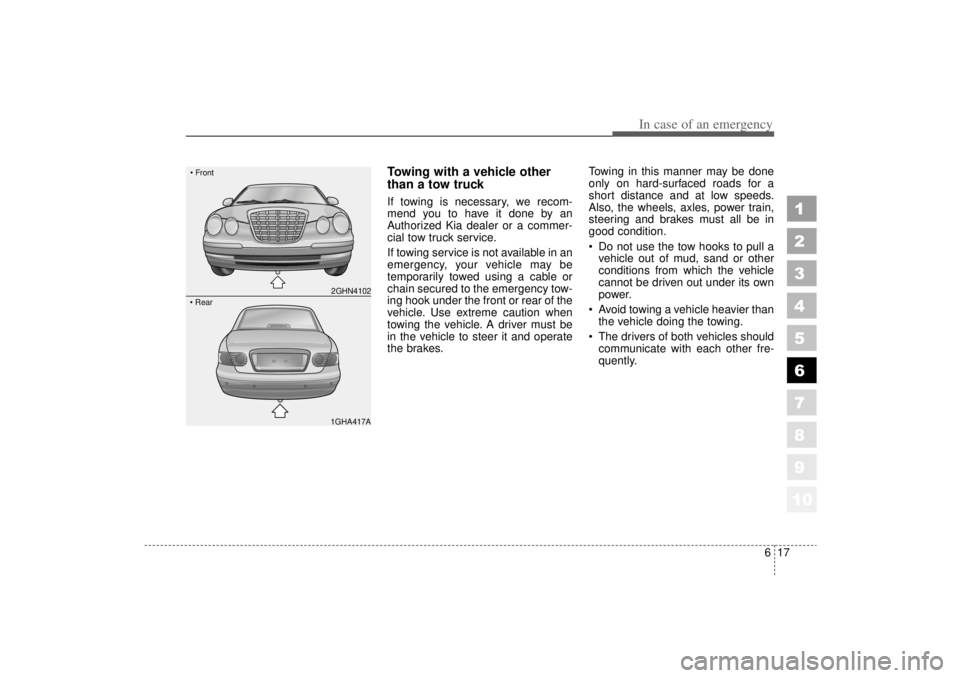
than a tow truck If towing is necessary, we recom-
mend you to have it done by an
Authorized Kia dealer or a commer-
cial tow truck service.
If towing service is not available in an
emergency, your vehicle may be
temporarily towed using a cable or
chain secured to the emergency tow-
ing hook under the front or rear of the
vehicle. Use extreme caution when
towing the vehicle. A driver must be
in the vehicle to steer it and operate
the brakes.Towing in this manner may be done
only on hard-surfaced roads for a
short distance and at low speeds.
Also, the wheels, axles, power train,
steering and brakes must all be in
good condition.
Do not use the tow hooks to pull a
vehicle out of mud, sand or other
conditions from which the vehicle
cannot be driven out under its own
power.
Avoid towing a vehicle heavier than
the vehicle doing the towing.
The drivers of both vehicles should
communicate with each other fre-
quently.
2GHN4102
Front1GHA417A
Rear
Page 238 of 322
In case of an emergency18
6
1
2
3
4
5
6
7
8
910
✽ ✽
NOTICE• Attach a towing strap to the tow
hook.
• Using a portion of the vehicle other than the tow hooks for tow-
ing may damage the body of your
vehicle.
• Use only a cable or chain specifi- cally intended for use in towing
vehicles. Securely fasten the cable
or chain to the towing hook pro-
vided. Before emergency towing, check
that the hook is not broken or dam-
aged.
Fasten the towing cable or chain
securely to the hook.
Do not jerk the hook. Apply steady
and even force.
To avoid damaging the hook, do
not pull from the side or at a verti-
cal angle. Always pull straight
ahead.
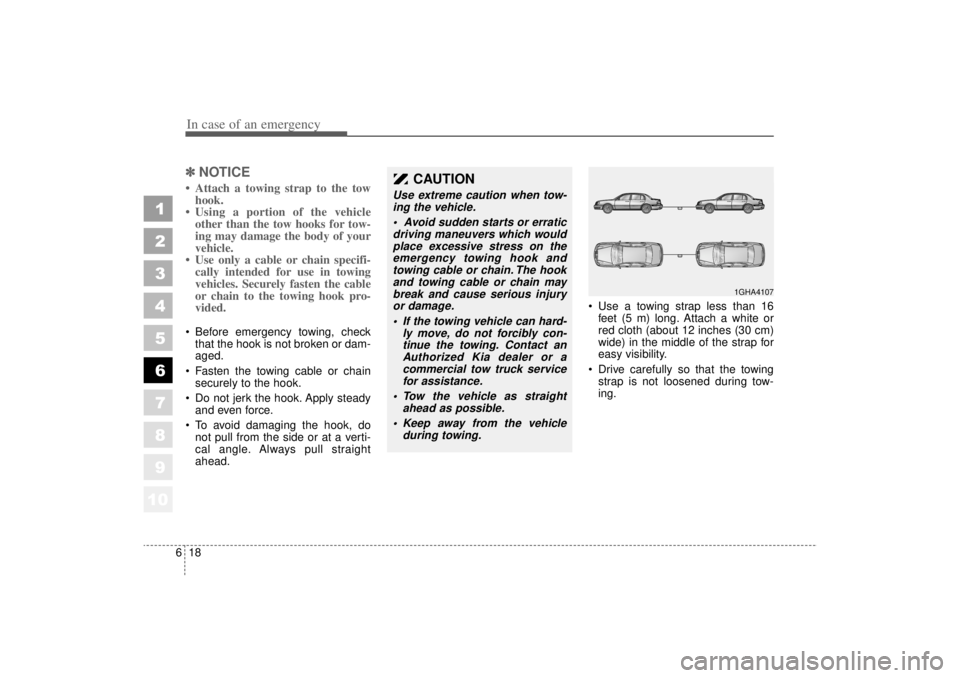
Use a towing strap less than 16
feet (5 m) long. Attach a white or
red cloth (about 12 inches (30 cm)
wide) in the middle of the strap for
easy visibility.
Drive carefully so that the towing
strap is not loosened during tow-
ing.
CAUTION
Use extreme caution when tow-
ing the vehicle.
Avoid sudden starts or erraticdriving maneuvers which wouldplace excessive stress on theemergency towing hook andtowing cable or chain. The hookand towing cable or chain maybreak and cause serious injuryor damage.
If the towing vehicle can hard- ly move, do not forcibly con-tinue the towing. Contact anAuthorized Kia dealer or acommercial tow truck servicefor assistance.
Tow the vehicle as straight ahead as possible.
Keep away from the vehicle during towing.
1GHA4107
Page 241 of 322
621
In case of an emergency
1
2
3
4
5
6
7
8
910
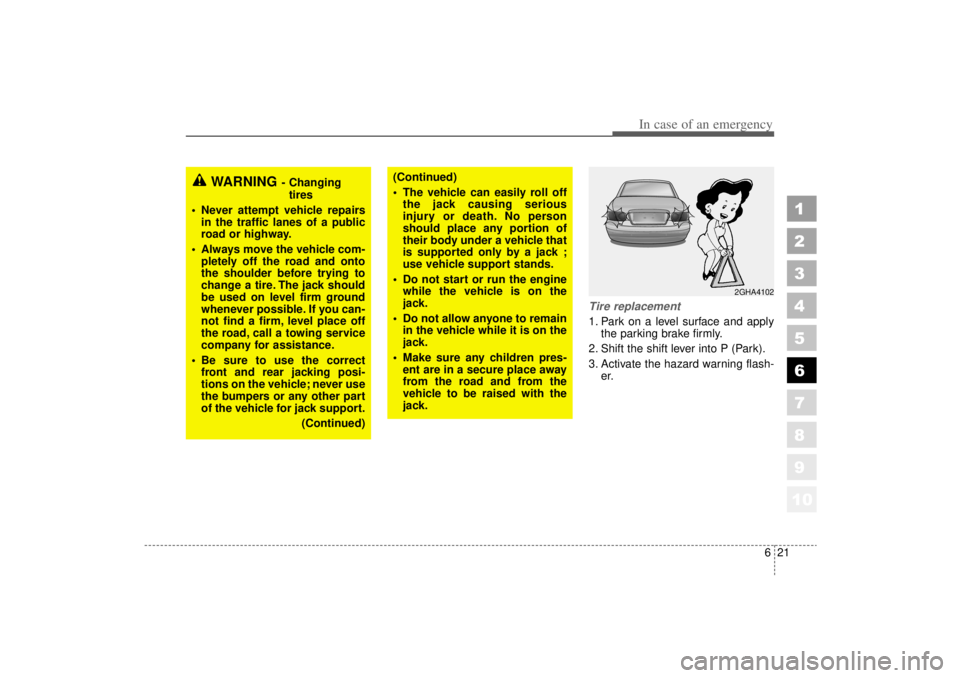
Tire replacement 1. Park on a level surface and applythe parking brake firmly.
2. Shift the shift lever into P (Park).
3. Activate the hazard warning flash- er.
WARNING
- Changing
tires
Never attempt vehicle repairs in the traffic lanes of a public
road or highway.
Always move the vehicle com- pletely off the road and onto
the shoulder before trying to
change a tire. The jack should
be used on level firm ground
whenever possible. If you can-
not find a firm, level place off
the road, call a towing service
company for assistance.
Be sure to use the correct front and rear jacking posi-
tions on the vehicle; never use
the bumpers or any other part
of the vehicle for jack support.
(Continued)
(Continued)
The vehicle can easily roll offthe jack causing serious
injury or death. No person
should place any portion of
their body under a vehicle that
is supported only by a jack ;
use vehicle support stands.
Do not start or run the engine while the vehicle is on the
jack.
Do not allow anyone to remain in the vehicle while it is on the
jack.
Make sure any children pres- ent are in a secure place away
from the road and from the
vehicle to be raised with the
jack.
2GHA4102
Page 244 of 322
In case of an emergency24
6
1
2
3
4
5
6
7
8
910
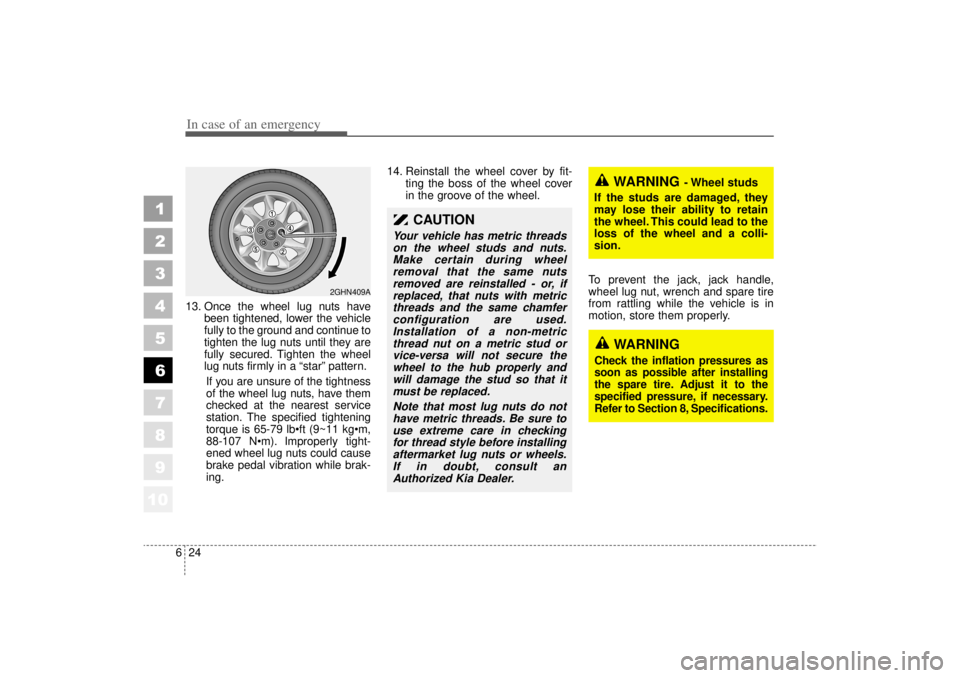
13. Once the wheel lug nuts have
been tightened, lower the vehicle
fully to the ground and continue to
tighten the lug nuts until they are
fully secured. Tighten the wheel
lug nuts firmly in a “star” pattern.
If you are unsure of the tightness
of the wheel lug nuts, have them
checked at the nearest service
station. The specified tightening
torque is 65-79 lb ft (9~11 kgm,
88-107 N m). Improperly tight-
ened wheel lug nuts could cause
brake pedal vibration while brak-
ing. 14. Reinstall the wheel cover by fit-
ting the boss of the wheel cover
in the groove of the wheel.
To prevent the jack, jack handle,
wheel lug nut, wrench and spare tire
from rattling while the vehicle is in
motion, store them properly.
2GHN409A
CAUTION
Your vehicle has metric threadson the wheel studs and nuts.Make certain during wheelremoval that the same nutsremoved are reinstalled - or, ifreplaced, that nuts with metricthreads and the same chamferconfiguration are used.Installation of a non-metricthread nut on a metric stud orvice-versa will not secure thewheel to the hub properly andwill damage the stud so that itmust be replaced.
Note that most lug nuts do nothave metric threads. Be sure touse extreme care in checkingfor thread style before installingaftermarket lug nuts or wheels.If in doubt, consult anAuthorized Kia Dealer.
WARNING
- Wheel studs
If the studs are damaged, they
may lose their ability to retain
the wheel. This could lead to the
loss of the wheel and a colli-
sion.
WARNING
Check the inflation pressures as
soon as possible after installing
the spare tire. Adjust it to the
specified pressure, if necessary.
Refer to Section 8, Specifications.
Page 260 of 322
Maintenance16
7
1
2
3
4
5
6
7
8
910
1. Warm the engine up for a few min-
utes and then turn it off. Remove
the oil filler cap.
2. Drain the oil into a suitable con- tainer by removing the oil drain
plug. 3. Remove the engine oil filter with
an oil filter wrench.
✽ ✽NOTICEDo not allow the oil filter gasket to
remain on the oil filter mounting
surface. This will cause oil leakage
and engine damage. Remove the old
gasket completely so that a new gas-
ket may be properly seated. 4. Use a clean rag to clean the oil fil-
ter mounting surface on the
engine.
5. Apply a small amount of engine oil to the new oil filter O-ring seal. 6. Install the oil filter and tighten it.
(Refer to the oil filter caution label
for tightening instructions.)
7. Install a new washer on the drain plug. Don’t use an old washer
repeatedly.
8. Replace the drain plug after the oil has thoroughly drained. Torque the
plug to 26~32 lbft (3.5~4.5 kgm,
35~44 Nm).
9. Refill the engine with new oil to the F mark on the dipstick. Do not
overfill.
10. Reinstall the oil filler cap secure- ly.
11. Start the engine and inspect around the oil filter seal for leaks.
Stop the engine.
12. Check the oil level and fill to the F mark as necessary.
PROPOSITION 65
WARNING
Used engine oil may cause irri-
tation or cancer of the skin if left
in contact with the skin for pro-
longed periods of time. Used
engine oil contains chemicals
that have caused cancer in lab-
oratory animals. Always protect
your skin by washing your
hands thoroughly with soap and
warm water as soon as possible
after handling used oil.
CAUTION
Both the oil and engine arehot. Do not burn yourself.
Keep all engine oil out of the reach of children.
Page 266 of 322
Maintenance22
7
1
2
3
4
5
6
7
8
910
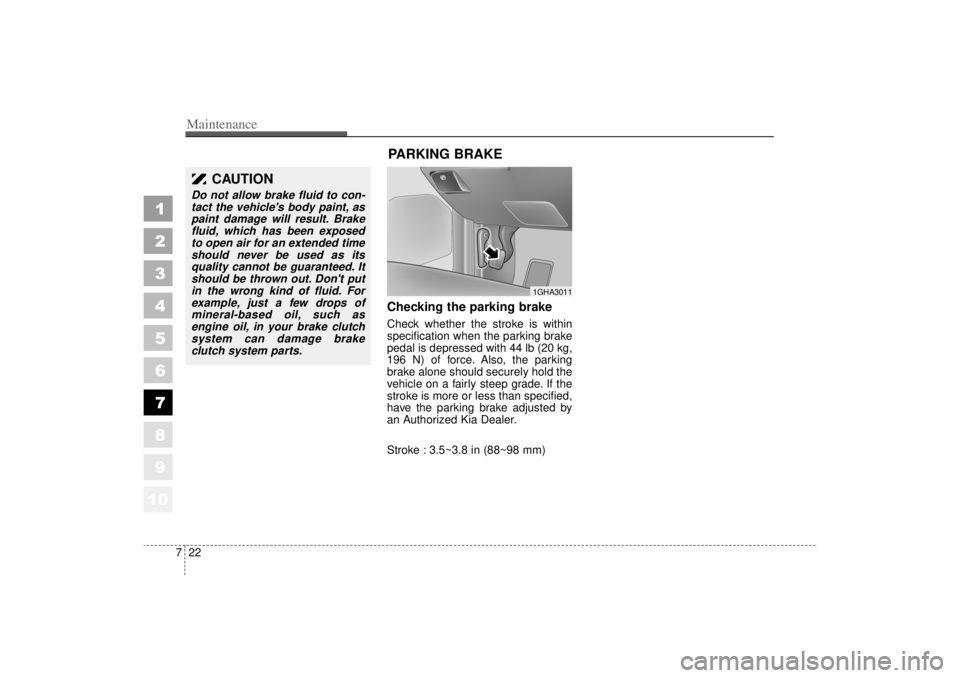
Checking the parking brake Check whether the stroke is within
specification when the parking brake
pedal is depressed with 44 lb (20 kg,
196 N) of force. Also, the parking
brake alone should securely hold the
vehicle on a fairly steep grade. If the
stroke is more or less than specified,
have the parking brake adjusted by
an Authorized Kia Dealer.
Stroke : 3.5~3.8 in (88~98 mm)
1GHA3011
PARKING BRAKE
CAUTION
Do not allow brake fluid to con-
tact the vehicle's body paint, aspaint damage will result. Brakefluid, which has been exposedto open air for an extended timeshould never be used as itsquality cannot be guaranteed. Itshould be thrown out. Don't putin the wrong kind of fluid. Forexample, just a few drops ofmineral-based oil, such asengine oil, in your brake clutchsystem can damage brakeclutch system parts.
Page 279 of 322
735
Maintenance
1
2
3
4
5
6
7
8
910
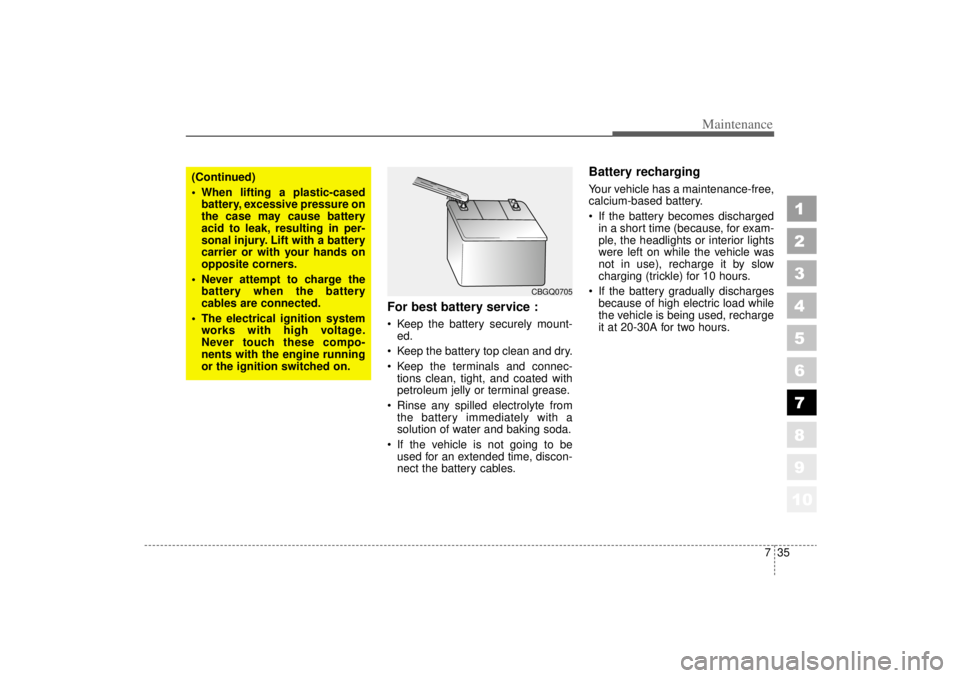
For best battery service :Keep the battery securely mount-
ed.
Keep the battery top clean and dry.
Keep the terminals and connec-
tions clean, tight, and coated with
petroleum jelly or terminal grease.
Rinse any spilled electrolyte from
the battery immediately with a
solution of water and baking soda.
If the vehicle is not going to be
used for an extended time, discon-
nect the battery cables.
Battery recharging Your vehicle has a maintenance-free,
calcium-based battery.
If the battery becomes discharged
in a short time (because, for exam-
ple, the headlights or interior lights
were left on while the vehicle was
not in use), recharge it by slow
charging (trickle) for 10 hours.
If the battery gradually discharges
because of high electric load while
the vehicle is being used, recharge
it at 20-30A for two hours.
CBGQ0705
(Continued)
When lifting a plastic-cased
battery, excessive pressure on
the case may cause battery
acid to leak, resulting in per-
sonal injury. Lift with a battery
carrier or with your hands on
opposite corners.
Never attempt to charge the
battery when the battery
cables are connected.
The electrical ignition system
works with high voltage.
Never touch these compo-
nents with the engine running
or the ignition switched on.