2006 KIA AMANTI warning light
[x] Cancel search: warning lightPage 47 of 322
Knowing your vehicle36
3
1
2
3
4
5
6
7
8
910
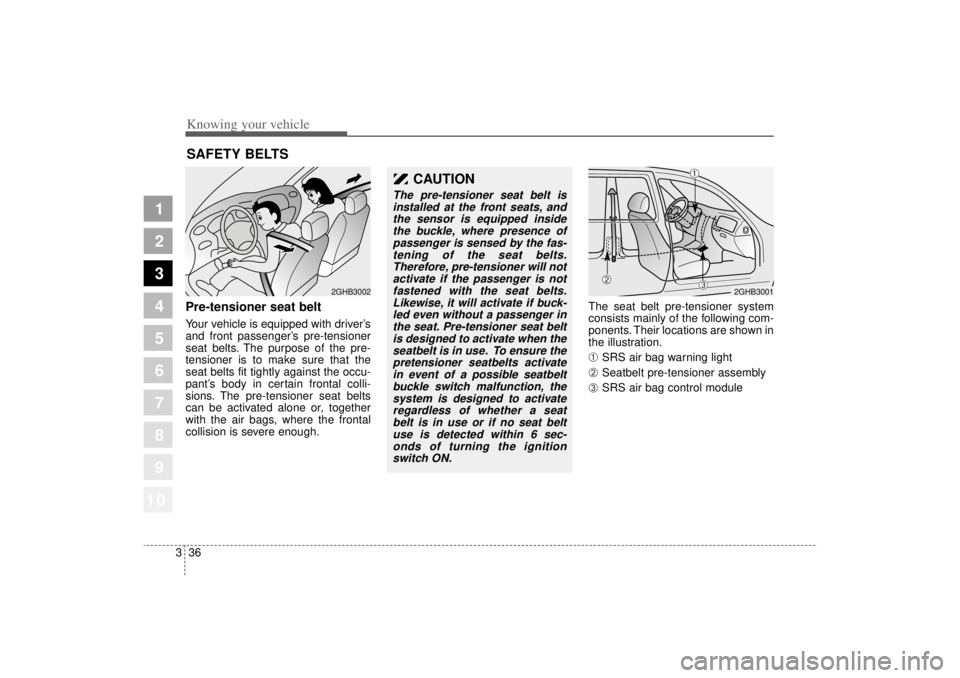
Pre-tensioner seat beltYour vehicle is equipped with driver’s
and front passenger’s pre-tensioner
seat belts. The purpose of the pre-
tensioner is to make sure that the
seat belts fit tightly against the occu-
pant’s body in certain frontal colli-
sions. The pre-tensioner seat belts
can be activated alone or, together
with the air bags, where the frontal
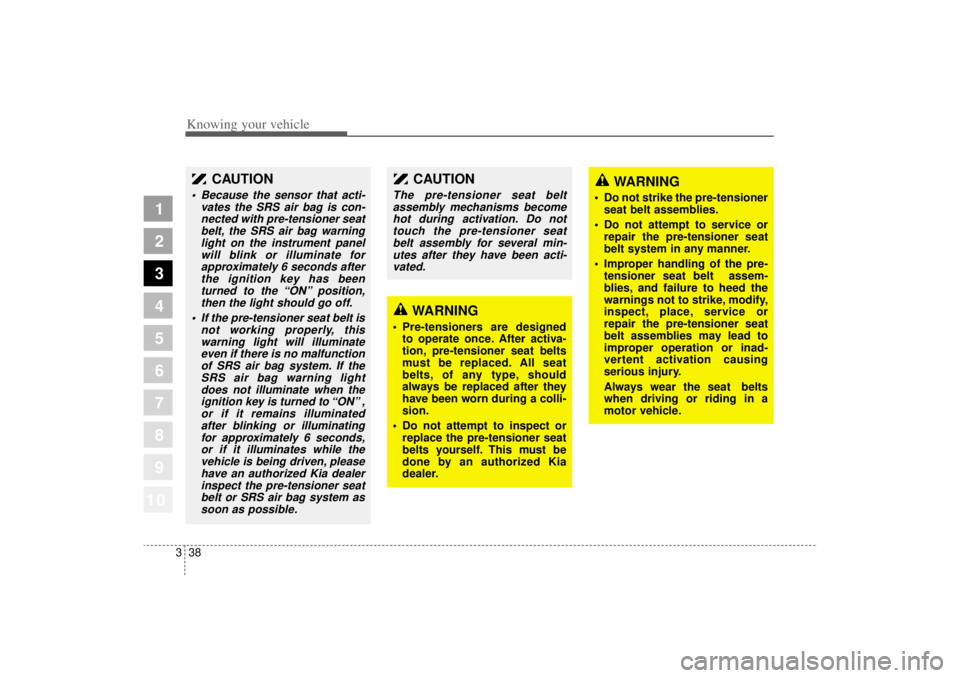
collision is severe enough. The seat belt pre-tensioner system
consists mainly of the following com-
ponents. Their locations are shown in
the illustration.
➀
SRS air bag warning light
➁
Seatbelt pre-tensioner assembly
➂
SRS air bag control module
SAFETY BELTS
2GHB3002
CAUTION
The pre-tensioner seat belt is
installed at the front seats, andthe sensor is equipped insidethe buckle, where presence ofpassenger is sensed by the fas-tening of the seat belts.Therefore, pre-tensioner will notactivate if the passenger is notfastened with the seat belts.Likewise, it will activate if buck-led even without a passenger inthe seat. Pre-tensioner seat beltis designed to activate when theseatbelt is in use. To ensure thepretensioner seatbelts activatein event of a possible seatbeltbuckle switch malfunction, thesystem is designed to activateregardless of whether a seatbelt is in use or if no seat beltuse is detected within 6 sec-onds of turning the ignitionswitch ON.
2GHB3001
➀
➁
➂
Page 49 of 322
Knowing your vehicle38
3
1
2
3
4
5
6
7
8
910
WARNING
Do not strike the pre-tensioner
seat belt assemblies.
Do not attempt to service or
repair the pre-tensioner seat
belt system in any manner.
Improper handling of the pre-
tensioner seat belt assem-
blies, and failure to heed the
warnings not to strike, modify,
inspect, place, service or
repair the pre-tensioner seat
belt assemblies may lead to
improper operation or inad-
vertent activation causing
serious injury.
Always wear the seat belts
when driving or riding in a
motor vehicle.
CAUTION
Because the sensor that acti-
vates the SRS air bag is con-nected with pre-tensioner seatbelt, the SRS air bag warninglight on the instrument panelwill blink or illuminate forapproximately 6 seconds afterthe ignition key has beenturned to the “ON”position,
then the light should go off.
If the pre-tensioner seat belt is
not working properly, thiswarning light will illuminateeven if there is no malfunctionof SRS air bag system. If theSRS air bag warning lightdoes not illuminate when theignition key is turned to “ON”,
or if it remains illuminated after blinking or illuminatingfor approximately 6 seconds,or if it illuminates while thevehicle is being driven, pleasehave an authorized Kia dealerinspect the pre-tensioner seatbelt or SRS air bag system assoon as possible.
WARNING
Pre-tensioners are designed
to operate once. After activa-
tion, pre-tensioner seat belts
must be replaced. All seat
belts, of any type, should
always be replaced after they
have been worn during a colli-
sion.
Do not attempt to inspect or
replace the pre-tensioner seat
belts yourself. This must be
done by an authorized Kia
dealer.
CAUTION
The pre-tensioner seat belt
assembly mechanisms becomehot during activation. Do nottouch the pre-tensioner seatbelt assembly for several min-utes after they have been acti-vated.
Page 51 of 322
Knowing your vehicle40
3
1
2
3
4
5
6
7
8
910
The rear safety belts use a special
auto-lock feature designed to allow a
child restraint to be used in these
positions without an added locking
clip. They normally lock only under
extreme or emergency conditions
(emergency lock mode). However
they can be adjusted so that they
remain in fixed and locked when a
child restraint system is placed in
these positions. (Use this auto-lock
mode only to secure a child restraint,
never for passengers restrained by
the safety belts.) Page 3-53 gives
instructions on placing the safety belt
in the auto lock mode.
The drivers safety belt can only oper-
ate in the emergency lock mode. Safety belts provide the best restraint
when:
The seatback is upright.
The occupant is sitting upright (not
slouched).
The lap belt is snug across the hips.
The shoulder belt is snug across the chest.
The knees are straight forward.
To help you remember to fasten your
safety belt, a warning light will come
on and a chime will sound. See
Safety Belt Warning Light and Chime
on page 3-42.
WARNING
- After a colli- sion
Lap/shoulder belt assemblies
may be stretched or damaged
when subjected to the stress
and forces of a collision.
The entire restraint system
should be inspected following
any collision. All belts, retrac-
tors, anchors and hardware
damaged by a collision should
be replaced before the vehicle
is operated again.
Page 53 of 322
Knowing your vehicle42
3
1
2
3
4
5
6
7
8
910
WARNING
- Safety belt
care
A damaged belt may not give
you the protection you need in
an accident.
Inspect your safety belts peri-
odically for excessive wear or
damage. Pull out each belt
fully and look for fraying, cuts,
burns or other damage. Pull
the safety belt out and let it
retract a number of times.
Make sure that the lap/shoul-
der belts return smoothly and
easily into the retractor.
Check the latches to make
sure they latch and release
without interference or delay.
Never close the doors on any
part of the lap or shoulder
belt.
Any belt not in good condition
or in good working order
should be promptly replaced.
CAUTION
Never close the doors on any
part of the lap or shoulder belt.It can damage the safety belt orbuckle which could increase therisk of injury in case of an acci-dent.
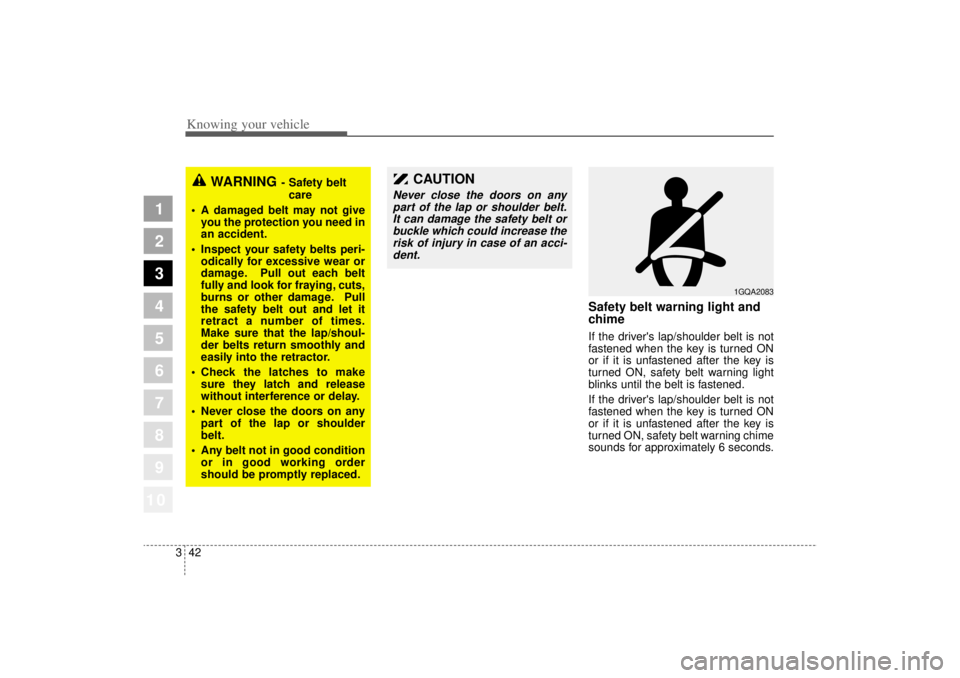
Safety belt warning light and
chimeIf the driver's lap/shoulder belt is not
fastened when the key is turned ON
or if it is unfastened after the key is
turned ON, safety belt warning light
blinks until the belt is fastened.
If the driver's lap/shoulder belt is not
fastened when the key is turned ON
or if it is unfastened after the key is
turned ON, safety belt warning chime
sounds for approximately 6 seconds.
1GQA2083
Page 60 of 322
349
1
2
3
4
5
6
7
8
910
Knowing your vehicle
Restraint of larger children As children grow, they may need to
use new child-restraint systems,
including larger child seats or boost-
er seats, which are appropriate for
their increased size.
A child who has outgrown available
child-restraint systems should use
the belts provided in the vehicle.
When seated in the rear outboard
seats, the child should be restrained
by the lap/shoulder belt.
If the shoulder belt portion slightly
touches the child’s neck or face, try
placing the child closer to the center
of the vehicle. If the shoulder belt still
touches their face or neck they may
need to be returned to a child
restraint system. In addition, after-
market devices are available from
independent manufacturers which
help pull the shoulder belt down and
away from the child’s face or neck.
Larger children should use one of
the seat belts provided.
WARNING
- Shoulder
belts on small children
Never allow a shoulder belt to
be in contact with a child’ s
neck or face while the vehicle
is in motion.
If safety belts are not properly
worn and adjusted, there is a
risk of death or serious injury
to such a child.
CAUTION
- Hot metal
parts
Safety belts and seats canbecome hot in a vehicle that hasbeen closed during warm/hotweather; they could burn achild. Check seat covers andbuckles before you place a childanywhere near them.
Page 72 of 322
361
1
2
3
4
5
6
7
8
910
Knowing your vehicle
➀
Driver’s air bag
(see page 3- 65)
➁
Front passenger’ s air bag
(see page 3- 66)
➂
Side air bag (see page 3- 72)
➃
Curtain Air bag(see page 3- 73)
➄ Front impact sensor
(see page 3- 74)
\b
Side impact sensor(see page 3- 74)
➆
SRS Control Module(see page 3- 74)
➇
Front seat position sensor
\f
Occupant classification system(see page 3- 66)
Air bag inflation condition(see page 3- 75)
Air bag non-inflation condition(see page 3- 76)
Air bag warning light(see page 3- 81)
Air bag service(see page 3- 82)
Air bag warning label(see page 3- 83)
What your air bag system
doesDriver’s air bag and front passen-
ger’ s air bag are designed to supple-
ment the protection offered by the
safety belt in certain frontal colli-
sions. Likewise, side air bag and cur-
tain air bags are designed to supple-
ment the protection offered by the
safety belt in side collisions. Safety
belts are designed to reduce the
injury of the driver or passengers in
case of impact or collision. No safety
belt or air bag system can complete-
ly eliminate injuries that may cause
in collisions or impacts. To help
reduce impact on driver or passen-
gers in any collision, safety belts
must be correctly worn.
What your air bag system
does not doThe air bag system is designed to
supplement the protection offered by
the safety belt system. IT IS NOT A
SUBSTITUTE FOR THE SAFETY
BELT.
Page 75 of 322
Knowing your vehicle64
3
1
2
3
4
5
6
7
8
910
The advanced SRS offers the ability
to control the air bag inflation with
two levels. A first stage level is pro-
vided for moderate-severity impacts.
A second stage level is provided for
more severe impacts.
According to the impact severity,
seating position and safety belt
usage, the SRSCM (SRS Control
Module) controls the air bag inflation.
Failure to properly wear safety
belts can increase the risk or
severity of injury in an accident.
Additionally, your SRS is equipped
with an occupant classification sys-
tem in the front passenger’ s seat.
The occupant classification system
detects the presence of a passenger
in the front passenger’ s seat and will
turn off the front passenger ’s air bag
under certain conditions. For more
detail, see “Occupant Classification
System” later in this section.
CAUTION
If the seat position sensor is not
working properly, the SRS airbag warning light ( ) on theinstrument panel will illuminateeven if there is no malfunctionof the SRS air bag system,because the SRS air bag warn-ing light is connected with theseat position sensor. If the SRSair bag warning light does notilluminate when the ignition keyis turned to the "ON" position, ifit remains illuminated afterblinking for approximately 6seconds, or if it illuminateswhile the vehicle is being driv-en, have an authorized Kia deal-er inspect the seat position sen-sor and the advanced SRS airbag system as soon as possi-ble.
AIR
BAG
WARNING
Modification to the seat struc-
ture can adversely affect the
seat position sensor and
cause the air bag to deploy at
a different level than should
be provided.
Failure to properly wear safety
belts can increase the risk or
severity of injury by causing
the air bags to deploy at a dif-
ferent level than should be
provided.
Do not place any objects
underneath the front seats
which could damage the seat
position sensor or interfere
with the occupant classifica-
tion system.
Do not place any objects that
may cause magnetic fields
near the front seat. These may
cause a malfunction of the
seat position sensor.
(Continued)
Page 76 of 322
365
1
2
3
4
5
6
7
8
910
Knowing your vehicle
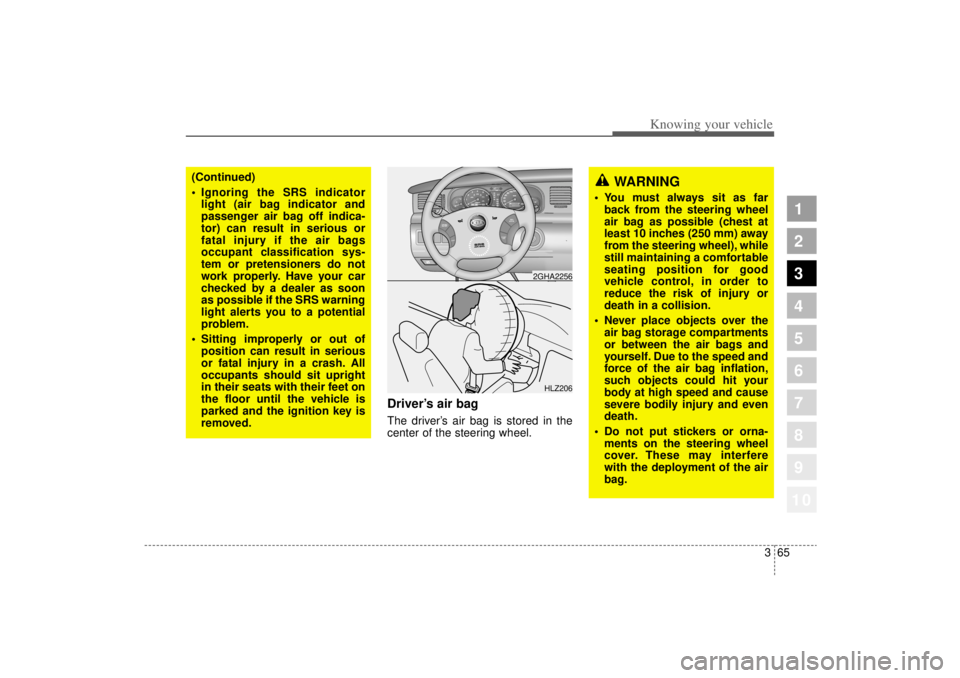
Driver’s air bagThe driver’ s air bag is stored in the
center of the steering wheel.
CRUISE
ON/OFFCAN CE
L
COAST
SETRES
ACCEL
HLZ2062GHA2256
(Continued)
Ignoring the SRS indicator
light (air bag indicator and
passenger air bag off indica-
tor) can result in serious or
fatal injury if the air bags
occupant classification sys-
tem or pretensioners do not
work properly. Have your car
checked by a dealer as soon
as possible if the SRS warning
light alerts you to a potential
problem.
Sitting improperly or out of
position can result in serious
or fatal injury in a crash. All
occupants should sit upright
in their seats with their feet on
the floor until the vehicle is
parked and the ignition key is
removed.
WARNING
You must always sit as far
back from the steering wheel
air bag as possible (chest at
least 10 inches (250 mm) away
from the steering wheel), while
still maintaining a comfortable
seating position for good
vehicle control, in order to
reduce the risk of injury or
death in a collision.
Never place objects over the
air bag storage compartments
or between the air bags and
yourself. Due to the speed and
force of the air bag inflation,
such objects could hit your
body at high speed and cause
severe bodily injury and even
death.
Do not put stickers or orna-
ments on the steering wheel
cover. These may interfere
with the deployment of the air
bag.