2006 KIA AMANTI coolant level
[x] Cancel search: coolant levelPage 262 of 322
Maintenance18
7
1
2
3
4
5
6
7
8
910
ENGINE COOLING SYSTEM The high-pressure cooling system
has a reservoir filled with year-round
antifreeze coolant. The reservoir is
filled at the factory.
Check the antifreeze protection and
coolant level at least once a year, at
the beginning of the winter season,
and before traveling to a colder cli-
mate.
Checking the coolant level
WARNING
- Removing
radiator cap
Never attempt to remove the radiator cap while the engine
is operating or hot. Doing so
might lead to cooling system
and engine damage and could
result in serious personal
injury from escaping hot
coolant or steam.
Turn the engine off and wait until it cools down. Even then,
use extreme care when
removing the radiator cap.
Wrap a thick towel around it,
and turn it counterclockwise
slowly to the first stop. Step
back while the pressure is
released from the cooling sys-
tem. When you are sure all the
pressure has been released,
press down on the cap, using
a thick towel, and continue
turning counterclockwise to
remove it.
(Continued)
(Continued)
Even if the engine is not oper-ating, do not remove the radi-
ator cap or the drain plug
while the engine and radiator
are hot. Hot coolant and steam
may still blow out under pres-
sure, causing serious injury.
Page 263 of 322
719
Maintenance
1
2
3
4
5
6
7
8
910
Check the condition and connections
of all cooling system hoses and
heater hoses. Replace any swollen
or deteriorated hoses.
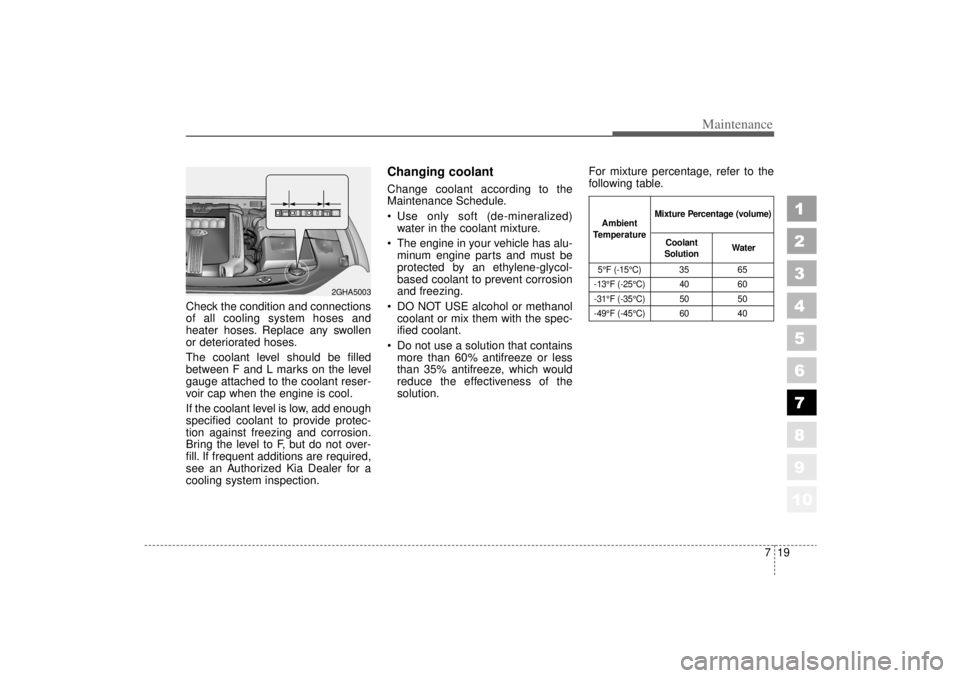
The coolant level should be filled
between F and L marks on the level
gauge attached to the coolant reser-
voir cap when the engine is cool.
If the coolant level is low, add enough
specified coolant to provide protec-
tion against freezing and corrosion.
Bring the level to F, but do not over-
fill. If frequent additions are required,
see an Authorized Kia Dealer for a
cooling system inspection.
Changing coolant Change coolant according to the
Maintenance Schedule.
Use only soft (de-mineralized)water in the coolant mixture.
The engine in your vehicle has alu- minum engine parts and must be
protected by an ethylene-glycol-
based coolant to prevent corrosion
and freezing.
DO NOT USE alcohol or methanol coolant or mix them with the spec-
ified coolant.
Do not use a solution that contains more than 60% antifreeze or less
than 35% antifreeze, which would
reduce the effectiveness of the
solution. For mixture percentage, refer to the
following table.
2GHA5003
5°F (-15°C) 35
65
-13°F (-25°C) 40 60
-31°F (-35°C) 50 50
-49°F (-45°C) 60 40Ambient
Temperature Mixture Percentage (volume)
Coolant
Solution Water
Page 264 of 322
Maintenance20
7
1
2
3
4
5
6
7
8
910
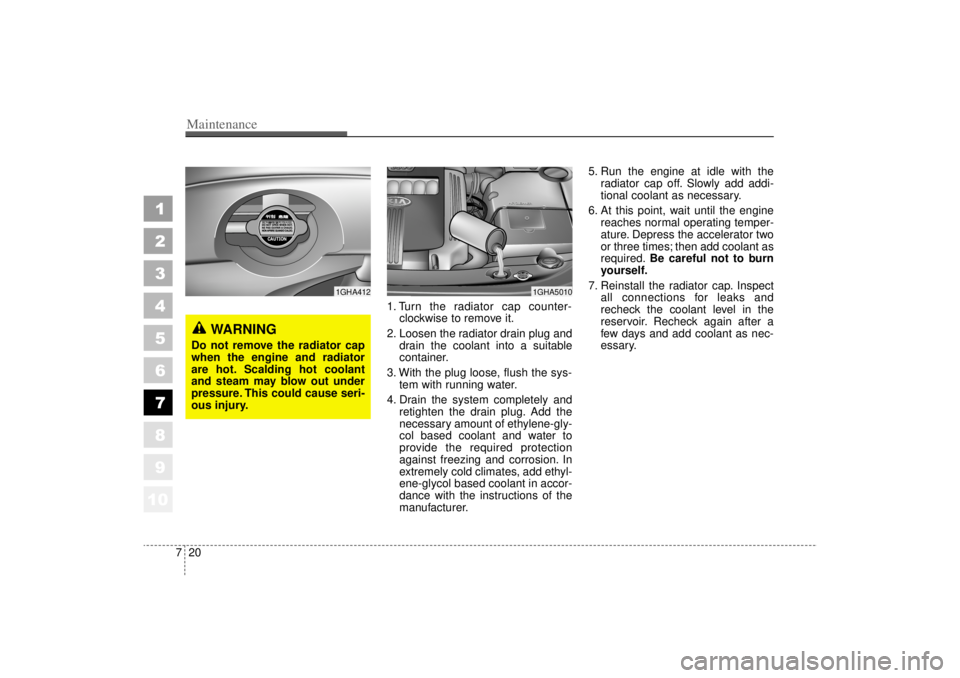
1. Turn the radiator cap counter-
clockwise to remove it.
2. Loosen the radiator drain plug and drain the coolant into a suitable
container.
3. With the plug loose, flush the sys- tem with running water.
4. Drain the system completely and retighten the drain plug. Add the
necessary amount of ethylene-gly-
col based coolant and water to
provide the required protection
against freezing and corrosion. In
extremely cold climates, add ethyl-
ene-glycol based coolant in accor-
dance with the instructions of the
manufacturer. 5. Run the engine at idle with the
radiator cap off. Slowly add addi-
tional coolant as necessary.
6. At this point, wait until the engine reaches normal operating temper-
ature. Depress the accelerator two
or three times; then add coolant as
required. Be careful not to burn
yourself.
7. Reinstall the radiator cap. Inspect all connections for leaks and
recheck the coolant level in the
reservoir. Recheck again after a
few days and add coolant as nec-
essary.
1GHA5010
1GHA412
WARNING
Do not remove the radiator cap
when the engine and radiator
are hot. Scalding hot coolant
and steam may blow out under
pressure. This could cause seri-
ous injury.
Page 272 of 322
Maintenance28
7
1
2
3
4
5
6
7
8
910
LUBRICANTS AND FLUIDS Checking the washer fluid
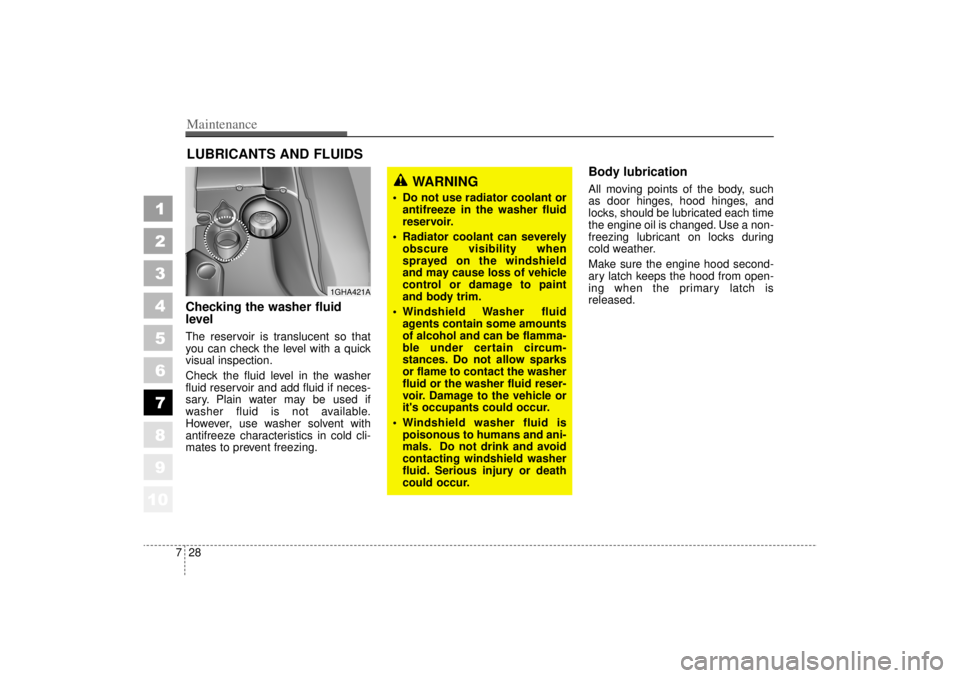
level The reservoir is translucent so that
you can check the level with a quick
visual inspection.
Check the fluid level in the washer
fluid reservoir and add fluid if neces-
sary. Plain water may be used if
washer fluid is not available.
However, use washer solvent with
antifreeze characteristics in cold cli-
mates to prevent freezing.
Body lubrication All moving points of the body, such
as door hinges, hood hinges, and
locks, should be lubricated each time
the engine oil is changed. Use a non-
freezing lubricant on locks during
cold weather.
Make sure the engine hood second-
ary latch keeps the hood from open-
ing when the primary latch is
released.
1GHA421A
WARNING
Do not use radiator coolant or
antifreeze in the washer fluid
reservoir.
Radiator coolant can severely obscure visibility when
sprayed on the windshield
and may cause loss of vehicle
control or damage to paint
and body trim.
Windshield Washer fluid agents contain some amounts
of alcohol and can be flamma-
ble under certain circum-
stances. Do not allow sparks
or flame to contact the washer
fluid or the washer fluid reser-
voir. Damage to the vehicle or
it's occupants could occur.
Windshield washer fluid is poisonous to humans and ani-
mals. Do not drink and avoid
contacting windshield washer
fluid. Serious injury or death
could occur.
Page 315 of 322

10 3
Index
Catalytic Converters, Operating Precautions for . . . . . 5-4
ChainsTire . . . . . . . . . . . . . . . . . . . . . . . . . . . . . . . . . . . .\
5-10
Safety . . . . . . . . . . . . . . . . . . . . . . . . . . . . . . . . . . 5-16
Charging System Warning . . . . . . . . . . . . . . . . . . . . . 4-37
Check Engine (Malfunction Indicator) Light . . . . . . . 4-40
Child Restraint System . . . . . . . . . . . . . . . . . . . . . . . . . . 3-50
Safety lock, rear door . . . . . . . . . . . . . . . . . . . . . . . 3-12
Children Restraint of Infants and Small . . . . . . . . . . . . . . . . 3-48
Restraint of Larger . . . . . . . . . . . . . . . . . . . . . . . . . 3-49
Cigarette Lighter . . . . . . . . . . . . . . . . . . . . . . . . . . . 3-102
Cleaner, Air . . . . . . . . . . . . . . . . . . . . . . . . . . . . . . . . 7-29
Cleaning Interior Window Glass . . . . . . . . . . . . . . . . . . . . . . 7-57
Lap/Shoulder Belt Webbing . . . . . . . . . . . . . . . . . . 7-57
Upholstery and Interior Trim . . . . . . . . . . . . . . . . . 7-57
Clock Analog . . . . . . . . . . . . . . . . . . . . . . . . . . . . . . . . . 3-106
Digital . . . . . . . . . . . . . . . . . . . . . . . . . . . . . . . . . 3-107
Cluster, Instrument . . . . . . . . . . . . . . . . . . . . . . 4-32, 4-33
Compartment, Engine . . . . . . . . . . . . . . . . . . . . . . . . 7-14
Console Storage, center . . . . . . . . . . . . . . . . . . . . . . . 3-99
Consumer Assistance (U.S. only) . . . . . . . . . . . . . . . . 9-1
Coolant, Changing . . . . . . . . . . . . . . . . . . . . . . . . . . 7-29
Coolant Level, Checking the . . . . . . . . . . . . . . . . . . . 7-18
Cooling System, Engine . . . . . . . . . . . . . . . . . . . . . . 7-18
Cruise Control system . . . . . . . . . . . . . . . . . . . . . . . . 4-21
Cup Holder . . . . . . . . . . . . . . . . . . . . . . . . . . . . . . . 3-103 Day/Night Rearview Mirror . . . . . . . . . . . . . . . . . . . 3-94
Defrost Button . . . . . . . . . . . . . . . . . . . . . . . . . . . . . 4-61
Defroster
Rear Window . . . . . . . . . . . . . . . . . . . . . . . . . . . . . 4-52
Digital Clock . . . . . . . . . . . . . . . . . . . . . . . . . . . . . . 3-107
Dimensions . . . . . . . . . . . . . . . . . . . . . . . . . . . . . . . . . 8-2
Disc Brake Wear Indicators . . . . . . . . . . . . . . . . . . . . 4-12
Dome Light . . . . . . . . . . . . . . . . . . . . . . . . . . . . . . . . 3-97
Door Ajar Warning . . . . . . . . . . . . . . . . . . . . . . . . . . . . . 4-40
Locks . . . . . . . . . . . . . . . . . . . . . . . . . . . . . . . . . . . .\
3-9
Locks from inside the vehicle, operating . . . . . . . . 3-11
Locks from outside the vehicle, operating . . . . . . . . 3-9
Child safety lock, rear . . . . . . . . . . . . . . . . . . . . . . 3-12
Drive belts . . . . . . . . . . . . . . . . . . . . . . . . . . . . . . . . 7-23
Driver position memory system . . . . . . . . . . . . . . . . . 3-34
Driving At Night . . . . . . . . . . . . . . . . . . . . . . . . . . . . . . . . . 5-8
Conditions, Special . . . . . . . . . . . . . . . . . . . . . . . . . 5-7
Conditions, Hazardous . . . . . . . . . . . . . . . . . . . . . . . 5-7
In Flooded Areas . . . . . . . . . . . . . . . . . . . . . . . . . . 5-12
In the Rain . . . . . . . . . . . . . . . . . . . . . . . . . . . . . . . . 5-8
Tips . . . . . . . . . . . . . . . . . . . . . . . . . . . . . . . . . . . .\
. 5-1
Your Vehicle . . . . . . . . . . . . . . . . . . . . . . . . . . . . . . .4-1
Winter . . . . . . . . . . . . . . . . . . . . . . . . . . . . . . . . . . . 5-9
Dual Temperature Control Selection Button . . . . . . . 4-56
1
2
3
4
5
6
7
8
910
D