2006 Hyundai Terracan maintenance schedule
[x] Cancel search: maintenance schedulePage 470 of 539
5VEHICLE MAINTENANCE REQUIREMENTS
2
NOTE:The inspection and testing of cer-
tain electronic fuel injection/engine management and automatic trans- mission control systems requirespecialised electronic equipment specifically designed for Hyundai vehicles. The use of general pur-pose electrical test equipment may result in damage to the control unit microprocessors.
DF020C2-E
Specified Scheduled Procedures
The specified scheduled procedures
are listed in the maintenance chartsbeginning at page 5-3. The operationsspecified must be performed at the time or mileage intervals shown irre- spective of whether the mileage inter-val has been reached before the speci- fied time interval.
Certain lubricants and components
degrade with both time and mileage(eg, engine oil and brake fluid) and therefore it is not permissable to basethe maintenance schedule upon mile- age alone. DF020F1-E
SERVICE HISTORY
It is important that all scheduled main-
tenance services are recorded in the warranty and service passport to en- sure that proof of maintenance is avail- able when warranty service is required. It is strongly recommended that the
maintenance operations are performedby a Hyundai authorised repairer be- cause of the need for specialised knowl- edge and tooling and to ensure that nopossibility of invalidating the manufac- turers warranty exists.
The maintenance schedules relate to
vehicles operated under normal condi-tions, vehicles which are operated under adverse conditions will requiremore frequent maintenance which is described at page 5-6. NOTE:
Service schedules may change de-
pending on individual country needs. Please ask your local Hyundai authorised repairer for a copy of the service schedule thatrelates to that country.MAINTENANCE AND SER- VICING REQUIREMENTS
DF020A1-E To ensure the continued reliability and safety of the vehicle, certain routine maintenance operations are requiredat specific mileage or time intervals.It is the responsibility of the vehicleowner to ensure that the maintenanceschedules shown in both this Owner's Manual and the Warranty and Service Passport are adhered to.The new vehicle warranty may beinvalidated if the routine maintenanceoperations are not performed in line with the recommendations outlined and the safety and durability of the vehicleadversely affected.It is recommended that all mainte-nance operations with the exception ofthe daily operating checks are en- trusted to a Hyundai authorised re- pairer to ensure that the latest repairand maintenance procedures and spe- cialized servicing tools are employed. In addition, the use of genuine Hyundaireplacement parts will ensure that the vehicle safety and performance will not be compromised.
Page 471 of 539

5
VEHICLE MAINTENANCE REQUIREMENTS
3
NO. 1 2 3 4 5 6 7 8 DESCRIPTION
ENGINE CONTROL SYSTEM MAINTENANCE (PETROL) ENGINE OIL & FILTER DRIVE BELT (ALT, DAMPER, TENSIONER, IDLER) FUEL FILTER (MPI TYPE) FLUID LEAKS TIMING BELT VENTILATION HOSES AIR CLEANER FILTER SPARK PLUGS (PLATINUM COATED)
F030B02HP-EAT R :Replace I : Inspect and, after Inspection, clean, adjust, repair or replace if necessary.
60 72
R I II
R R
5060
R
I
R
I
4048
R I
R I
R
3036
R
II I I
2024
R I I
R
10 12
R
I I
MILES X 1000 MONTHS
REGULAR SERVICING
YF010A2-E In order to ensure continued reliability, safety and longevity, regular maintenance performed at the intervals specified is
essential. The maintenance intervals specified are based both on time elapsed and mileage covered since the previous maintenance service was performed. However, under severe operating conditions, certain scheduled operations should beperformed at shorter intervals.
Regular maintenance should be entrusted to a Hyundai authorised repairer who is best able to provide the expertise required
to ensure optimum operational performance. In addition the use of Hyundai replacement parts and service consumables will ensure that the original build quality,
operational performance and safety are maintained.
Page 475 of 539
5
VEHICLE MAINTENANCE REQUIREMENTS
7
!
F060B01A-EAT
o Drive belts
Inspect all drive belts for evidence of cuts, cracks, excessive wear or oil contamination and replace if neces-sary. Drive belts should be checked periodically for proper tension and ad- justed as necessary. F060C01A-AAT
o Fuel filter
A clogged filter can limit the speed at
which the vehicle may be driven, dam- age the emission system and cause hard starting. If an excessive amountof foreign matter accumulates in the fuel tank, the filter may require re- placement more frequently. After installing a new filter, run the
engine for several minutes, and checkfor leaks at the connections. Fuel fil- ters should be installed by trained technicians.
F060D01TB-EAT
o Fuel lines, fuel hoses and con- nections
Check the fuel lines, fuel hoses and
connections for leakage and damage. Have a trained technician replace anydamaged or leaking parts immediately. WARNING (Diesel only):
Never work on injection system withengine running or within 30 sec-onds after shutting off engine. High pressure pump, rail, injectors and high pressure pipes are subject tohigh pressure even after the engine stopped. The fuel jet produced by fuel leaks may cause serious injury,if it contacts the body. People using pacemakers should ensure that they keep a distance of 30cm from theECU or wiring harness within the engine room while engine is run- ning, since the high currents in theCommon Rail system produce con- siderable magnetic fields.
EXPLANATION OF SCHED- ULED MAINTENANCE ITEMS
F060M01A-AAT
o Engine oil and filter
The engine oil and filter should be
changed at the intervals specified in the maintenance schedule. If the car is being driven in severe conditions,more frequent oil and filter changes are required.
Page 477 of 539
5
VEHICLE MAINTENANCE REQUIREMENTS
9
F070C01A-AAT
o Coolant
The coolant should be changed at
the intervals specified in the mainte- nance schedule. F070D01HP-AAT
o Manual transmission oil
Inspect the manual transmission oil according to the maintenance sched- ule.
NOTE: If the oil level is low, check forpossible leaks before adding oil. Do not overfill. F070E03HP-GAT
o Automatic transmission fluid
The fluid level should be in the "HOT"
range of the dipstick, after engine andtransmission and filter are at normal operating temperature. Check the Au-tomatic and filter Transmission and filter Fluid level with the engine running and the transmission and filter inneutral, with the parking brake properly applied. Use MOBIL DEXRON-II when adding or changing fluid. Refer to the chapter6. F070F01A-AAT
o Brake hoses and lines
Visually check for proper installation,
chafing, cracks, deterioration and any leakage. Replace any deteriorated or damaged parts immediately. F070G02A-AAT o Brake fluid Check brake fluid level in the brake fluid reservoir. The level should be between "MIN" and "MAX" marks on the side of the reservoir. Use onlyhydraulic brake fluid conforming to DOT 3 or DOT 4. F070H01HP-AAT
o Rear brake linings, pad and parking brake Check the rear brake linings and pads for scoring, burning, leaking fluid, bro-ken parts, and excessive wear. In- spect the parking brake system in- cluding the parking brake lever andcables. For detailed service proce- dures, refer to the Shop Manual.
Page 487 of 539
6
OWNER MAINTENANCE
9
!
!
engine and ensure that no oil leaks exist. Turn off the engine and aftera couple minutes, recheck the oil level.
CAUTION:
Slowly pour the recommended oil by using a funnel. Do not overfill to prevent engine damage.
WARNING:
Prolonged and repeated contact withused engine oils may result in seri- ous skin disorders including der-matitis and cancer. Avoid contact with skin as far as possible and always wash thoroughly after anycontact. Keep used oils out of reach of children. It is illegal to pollute drains, water courses and soil. Useonly authorisedwaste collection fa- cilities including civic amenity sites and garages for the disposalof used oil and oil filters. If in doubt, contact the local authority for dis- posal instructions. WARNING:
Do not remove the radiator cap when
the engine is hot, since the system is pressurised and coolant may be ejected from the radiator resultingin scalding.
SG050B1-E
Coolant recommendations
Only ethylene glycol based coolant
with a corrosion inhibitor suited toaluminium alloy engine componentsshould be used in the cooling system. No further additives or inhibitors should be used. The coolant specificgravity should be checked as pre- scribed in the maintenance schedule to ensure adequate frost and corro-sion protection. In addition, the en- gine coolant must be replaced at the specified interval since the corrosioninhibitor properties deteriorate with time.
ENGINE COOLANT CHECK- ING AND REPLACING
SG050A1-E
! It is important to note that whilst an increase in the concentration of antifreeze gives an increase in the level of frost protection, a solution which is in excess of 65% anti freeze will resultin reduced frost protection and engine overheating. Therefore the recom- mended concentration of 50% shouldnot be exceeded for general use.The use of methanol based anti freezecompounds may result in engine over-heating and will invalidate the vehicle warranty. NOTE: It is imperative that vehicles fitted with an air conditioning systemhave a coolant concentration of the recommended strength at all times. The use of the air condition-ing system when the cooling sys- tem is filled with water only will result in the heater matrix freezingand subsequently bursting.
Page 488 of 539
6 OWNER MAINTENANCE
10
SG050C1-E
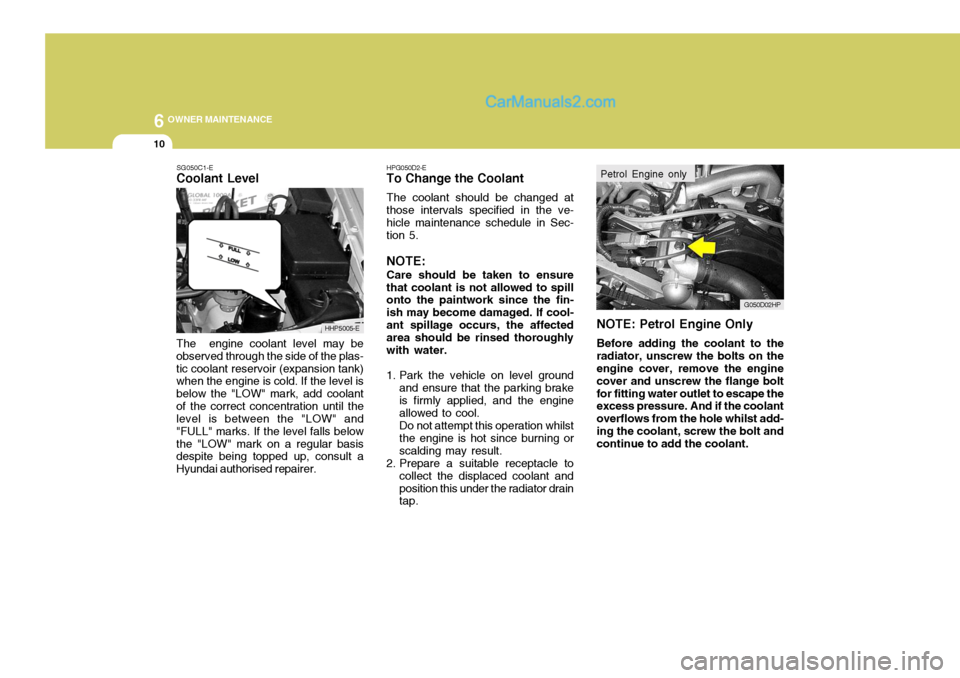
Coolant Level The engine coolant level may be observed through the side of the plas-tic coolant reservoir (expansion tank) when the engine is cold. If the level is below the "LOW" mark, add coolantof the correct concentration until the level is between the "LOW" and "FULL" marks. If the level falls belowthe "LOW" mark on a regular basis despite being topped up, consult a Hyundai authorised repairer. HPG050D2-E
To Change the Coolant
The coolant should be changed atthose intervals specified in the ve- hicle maintenance schedule in Sec- tion 5. NOTE: Care should be taken to ensure that coolant is not allowed to spill onto the paintwork since the fin- ish may become damaged. If cool-ant spillage occurs, the affected area should be rinsed thoroughly with water.
1. Park the vehicle on level ground and ensure that the parking brake is firmly applied, and the engine allowed to cool.Do not attempt this operation whilstthe engine is hot since burning orscalding may result.
2. Prepare a suitable receptacle to
collect the displaced coolant andposition this under the radiator drain tap. NOTE: Petrol Engine Only
Before adding the coolant to the
radiator, unscrew the bolts on theengine cover, remove the engine cover and unscrew the flange boltfor fitting water outlet to escape the excess pressure. And if the coolant overflows from the hole whilst add-ing the coolant, screw the bolt and continue to add the coolant.
HHP5005-E
G050D02HP
Petrol Engine only
Page 494 of 539
6 OWNER MAINTENANCE
16AUTOMATIC TRANSMIS- SION LUBRICANT
G110A04HP-EAT Transmission lubricant should be changed at those intervals specified in the vehicle maintenance schedulein Section 5. NOTE: Basically automatic transmission fluid is red in colour. As driving distance increases, the fluid colourturns darkish red gradually. It is normal condition and you should not use fluid colour as a criterionfor replacing the transmission fluid.You must replace the automatictransmission fluid in accordancewith intervals specified in the ve- hicle maintenances schedule in section 5.
Recommended Lubricant Use only MOBIL DEXRON-II. Dam-age caused by a nonspecified fluid is not covered by your new vehicle lim- ited warranty.
! CAUTION:
The transmission lubricant level should only be checked when the engine is cold to prelude the possi- bility of personal injury by contactwith hot components.
1. To check the transmission lubricant level, the vehicle should be placedon level ground and the level plug removed with a suitable spanner.
2. If the level is correct, lubricant should begin to drip from the plug orifice. In this case the plug shouldbe replaced.If the level is incorrect, lubricantshould be added until it begins to drip from the plug orifice at which time the plug should be replaced.
!
Transmission Fluid Capacity The fluid capacity of the automatic transmission is 10.5 litres (Petrol En- gine)/ 11.8 litres (Diesel Engine).
CAUTION:
The transmission fluid level shouldbe checked when the engine is at normal operating temperature. Thismeans that the engine, radiator, exhaust system etc., are very hot so you should exercise great carenot to burn yourself during this procedure.
Page 537 of 539
10INDEX
4
J Jump Starting .............................................................. 3-3
K
Key ....................................................................... 1-5, 1-7
If you lose y our keys ............................................. 3-16
Positions ................................................................... 2-4
Keyless Entry System .............................................. 1-13
L
Limited-Slip Differential (LSD) ....................................2-22
Lubrication Chart .......................................................... 9-4
Luggage Compartment Cargo Security Screen ........................................... 1-80
Light ........................................................................ 1-79
Net .......................................................................... 1-79
MMaintenance Requirements Explanation of scheduled maintenance items .......... 5-7
Maintenance and servicing requirement s .................. 5-2
Maintenance under severe usage conditions ............ 5-6
Regular servici ng ...................................................... 5-3
Mirrors Interior rearview ...................................................... 1-77
Outside rearview ..................................................... 1-75
Multi Box ................................................................... 1-74Multi-Function Switch
Headlight flash ........................................................ 1-62
High and low beam ................................................. 1-61
Lane change si gnal ................................................. 1-60
Lighting switch ........................................................ 1-61
Sidelight auto cut .................................................... 1-61
Turn signal operation .............................................. 1-60
O Odometer ................................................................... 1-59
Outside Rearview Mirror ............................................ 1-75
P Parking Brake ............................................................ 1-78
Part-time 4WD Opera tion ........................................... 2-15
Power Driver's Seat ................................................... 1-19
Power Outlet .............................................................. 1-68
Power Steering Fluid Level ....... .................................6-29
R Rear Seat Adjustable head restraints ...................................... 1-22
Adjusting seatback angle ....................................... 1-22
Folding rear seatback and seat cushion .................1-23
Rear Seat Warning.................................................... 1-25
Rheostat Sw itch ........................................................ 1-67
Roof Bars .................................................................. 1-81
Running in Your New Hyundai ..................................... 1-4