2006 Hyundai Terracan maintenance schedule
[x] Cancel search: maintenance schedulePage 244 of 539
6
DO-IT-YOURSELF MAINTENANCE
17
!
CHECKING THE TRANS- MISSION OIL (MANUAL)FILLING THE WASHER RESERVOIR
CAUTION:
o Radiator antifreeze (engine cool- ant) should not be used in the washer system because it will damage the car's finish.
o The washer should not be oper- ated if the washer reservoir isempty. This can damage the washer fluid pump.
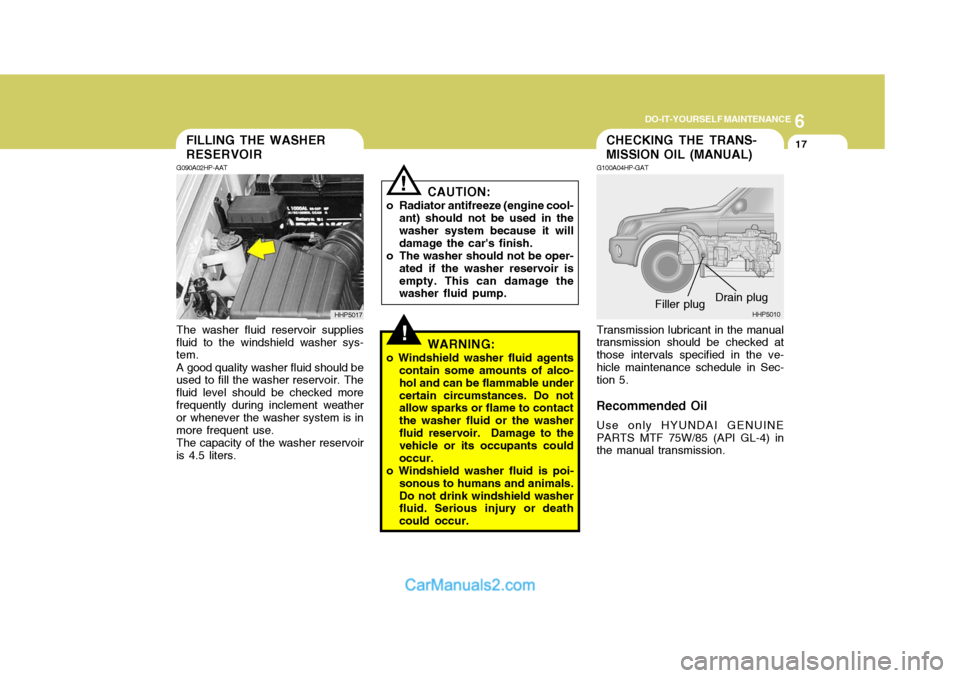
! G100A04HP-GAT Transmission lubricant in the manual transmission should be checked at those intervals specified in the ve-hicle maintenance schedule in Sec- tion 5.
Recommended Oil Use only HYUNDAI GENUINE PARTS MTF 75W/85 (API GL-4) in the manual transmission. Drain plug
G090A02HP-AAT The washer fluid reservoir supplies fluid to the windshield washer sys- tem. A good quality washer fluid should be used to fill the washer reservoir. The fluid level should be checked morefrequently during inclement weather or whenever the washer system is in more frequent use. The capacity of the washer reservoir is 4.5 liters. HHP5017
HHP5010
Filler plug
WARNING:
o Windshield washer fluid agents contain some amounts of alco- hol and can be flammable undercertain circumstances. Do not allow sparks or flame to contact the washer fluid or the washerfluid reservoir. Damage to the vehicle or its occupants could occur.
o Windshield washer fluid is poi- sonous to humans and animals.Do not drink windshield washer fluid. Serious injury or death could occur.
Page 245 of 539
6 DO-IT-YOURSELF MAINTENANCE
18
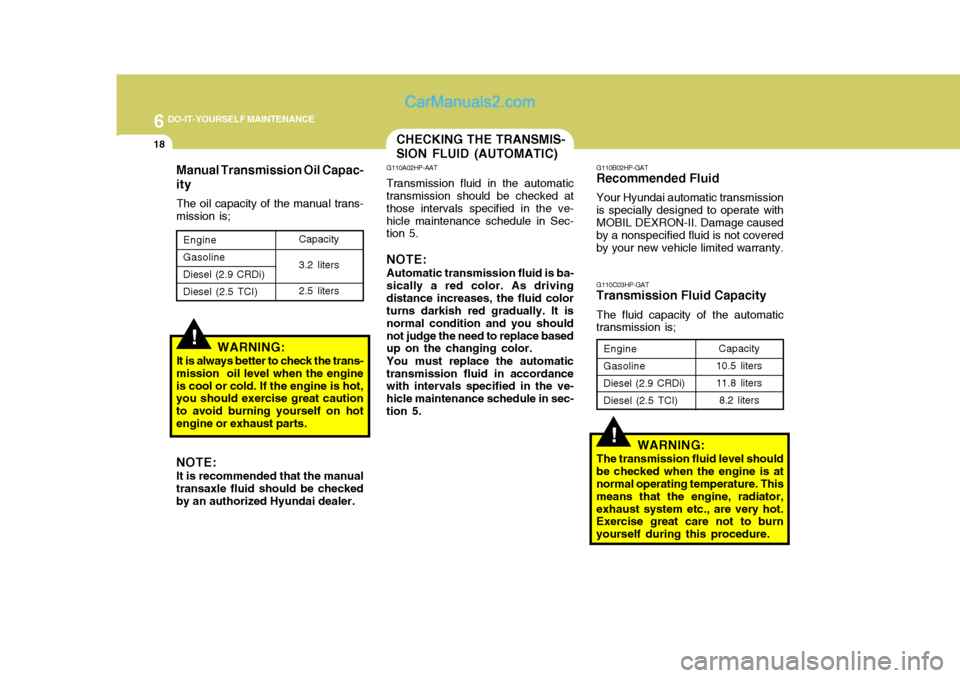
Manual Transmission Oil Capac- ity
The oil capacity of the manual trans-
mission is;
WARNING:
It is always better to check the trans-
mission oil level when the engine is cool or cold. If the engine is hot, you should exercise great caution to avoid burning yourself on hotengine or exhaust parts.
!
Engine GasolineDiesel (2.9 CRDi)Diesel (2.5 TCI) Capacity 3.2 liters 2.5 liters
NOTE: It is recommended that the manual transaxle fluid should be checkedby an authorized Hyundai dealer.
CHECKING THE TRANSMIS- SION FLUID (AUTOMATIC)
!
G110B02HP-GAT
Recommended Fluid
Your Hyundai automatic transmission is specially designed to operate with MOBIL DEXRON-II. Damage caused by a nonspecified fluid is not coveredby your new vehicle limited warranty. G110C03HP-GAT
Transmission Fluid Capacity
The fluid capacity of the automatic transmission is;
WARNING:
The transmission fluid level should be checked when the engine is at normal operating temperature. This means that the engine, radiator,exhaust system etc., are very hot. Exercise great care not to burn yourself during this procedure.
G110A02HP-AAT Transmission fluid in the automatic transmission should be checked at those intervals specified in the ve-hicle maintenance schedule in Sec- tion 5. NOTE: Automatic transmission fluid is ba- sically a red color. As drivingdistance increases, the fluid color turns darkish red gradually. It is normal condition and you shouldnot judge the need to replace based up on the changing color. You must replace the automatic transmission fluid in accordance with intervals specified in the ve- hicle maintenance schedule in sec-tion 5.
Engine GasolineDiesel (2.9 CRDi)Diesel (2.5 TCI)
Capacity
10.5 liters11.8 liters 8.2 liters
Page 248 of 539
6
DO-IT-YOURSELF MAINTENANCE
21CHECKING THE BRAKES
!
!
G120A01A-AAT
CAUTION:
Because brakes are essential to the safe operation of the car, it is sug-gested that they be checked and inspected by your Hyundai dealer. The brakes should be checked andinspected for wear at those intervals specified in the vehicle maintenance schedule in Section 5. G120B02A-AAT
Checking the Brake Fluid Level
WARNING:
Use caution when handling brakefluid. It can damage your vision ifit gets into your eyes. It will also damage your vehicle’s paint if spilled on it and not removed im-mediately. G120C02A-AAT
Recommended Brake Fluid
Use only hydraulic brake fluid con- forming to DOT 3 or DOT 4 specifica- tions in your braking system. Followthe instructions printed on the con- tainer. G120D01A-AAT
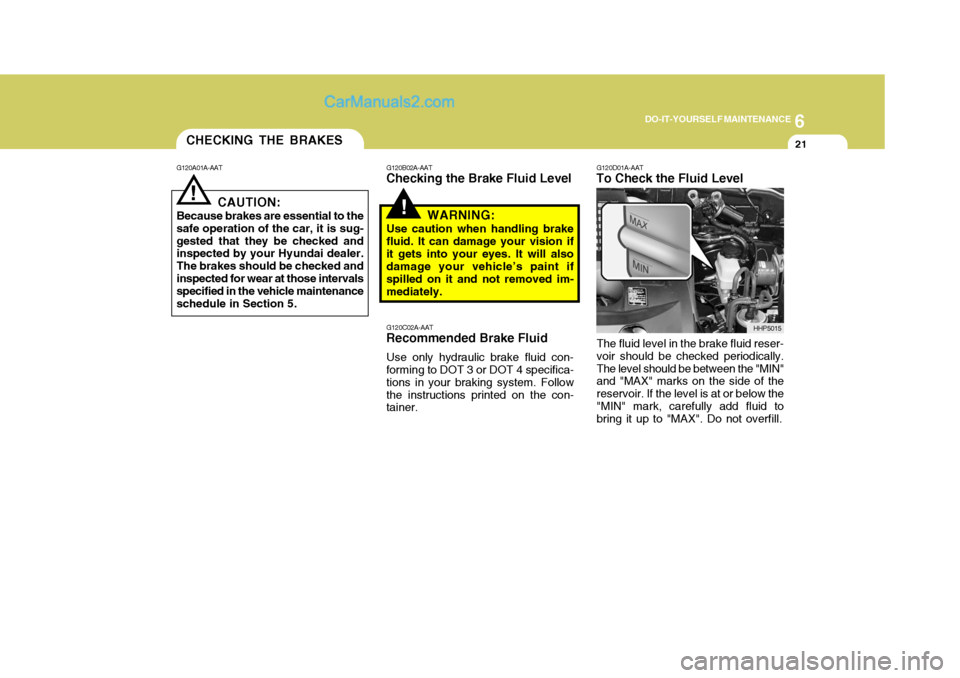
To Check the Fluid Level
The fluid level in the brake fluid reser- voir should be checked periodically.The level should be between the "MIN" and "MAX" marks on the side of the reservoir. If the level is at or below the"MIN" mark, carefully add fluid to bring it up to "MAX". Do not overfill. HHP5015
Page 276 of 539
7EMISSION CONTROL SYSTEMS
2EMISSION CONTROL SYSTEMS
H010A01A-GAT
(If Installed)
Your Hyundai is equipped with an
emission control system to meet all requirements of the Emission prohibi- tion rules of your province.
There are three emission control sys-
tems which are as follows.
(1) Crankcase emission control sys- tem (For a Gasoline Engine)
(2) Evaporative emission control sys- tem (For a Gasoline Engine)
(3) Exhaust emission control system
In order to assure the proper function
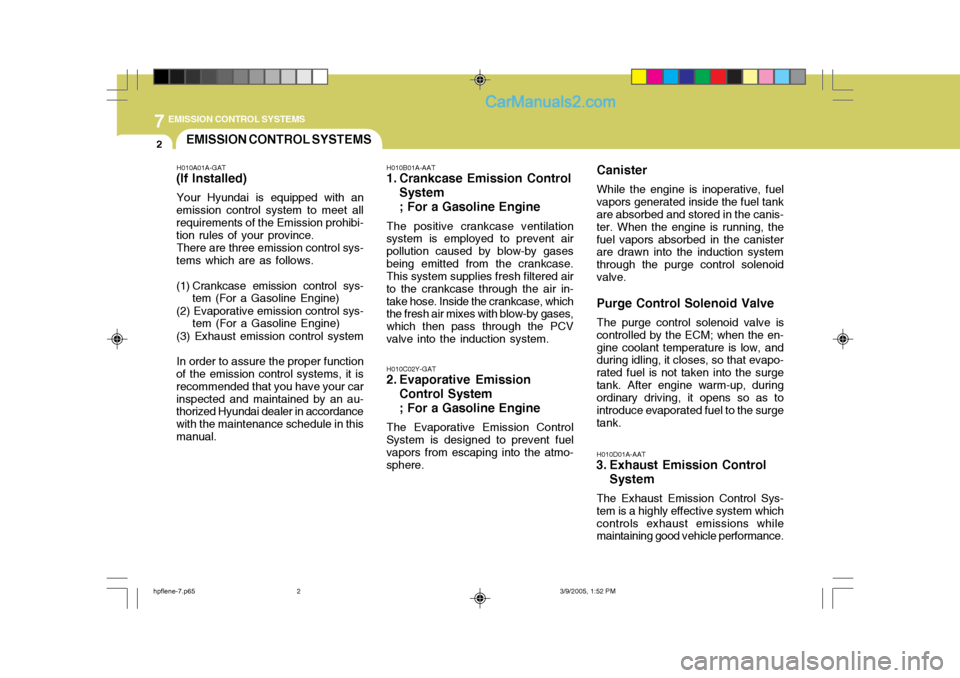
of the emission control systems, it is recommended that you have your carinspected and maintained by an au- thorized Hyundai dealer in accordance with the maintenance schedule in thismanual. H010B01A-AAT
1. Crankcase Emission Control
System ; For a Gasoline Engine
The positive crankcase ventilation
system is employed to prevent air pollution caused by blow-by gasesbeing emitted from the crankcase. This system supplies fresh filtered air to the crankcase through the air in-take hose. Inside the crankcase, which the fresh air mixes with blow-by gases, which then pass through the PCVvalve into the induction system.
H010C02Y-GAT
2. Evaporative Emission
Control System ; For a Gasoline Engine
The Evaporative Emission Control
System is designed to prevent fuel vapors from escaping into the atmo- sphere. Canister
While the engine is inoperative, fuel
vapors generated inside the fuel tankare absorbed and stored in the canis- ter. When the engine is running, thefuel vapors absorbed in the canister are drawn into the induction system through the purge control solenoidvalve. Purge Control Solenoid Valve
The purge control solenoid valve is
controlled by the ECM; when the en- gine coolant temperature is low, and during idling, it closes, so that evapo- rated fuel is not taken into the surgetank. After engine warm-up, during ordinary driving, it opens so as to introduce evaporated fuel to the surgetank. H010D01A-AAT
3. Exhaust Emission Control
System
The Exhaust Emission Control Sys- tem is a highly effective system whichcontrols exhaust emissions while maintaining good vehicle performance.
hpflene-7.p65 3/9/2005, 1:52 PM
2
Page 295 of 539

10INDEX
4
G General Checks .......................................................... 6-5
Glove Box ................................................................. 1-86
HHazard Warning System ............................................ 1-77
Headlight Aiming Adjustm ent ..................................... 6-39
Headlight Leveling Device S ystem ............................1-99
Heating and Ventilation ............................................ 1-104
Air flow control ........................................... 1-105, 1-116
Temperature control .... .......................................... 1-107
High-Mounted Rear Stop Light ...................................1-95
Hood Release ............................................................ 1-97
Horn ........................................................................... 1-98
I Ignition Sw itch ............................................................. 2-3
Immobilizer S ystem ..................................................... 1-5
Limp Home Procedures ................................... 1-7, 1-9
Key ................................................................... 1-5, 1-8
Indicator and Warning Lights.................................... 1-58
Instrument Cluster and Indicator Li ghts................... 1-54
Instrument Panel Light Control (Rheo stat)............... 1-79
Interior Light .............................................................. 1-85
Intermittent Wiper ..................................................... 1-77
J Jump Starting .............................................................. 3-3 K
Key .............................................................................. 1-4
If you lose your keys ............................................. 3-17
Positions ................................................................... 2-4
L Limited-Slip D ifferential ............................................. 2-22
Luggage Compartment
Cargo Security Screen ........................................... 1-93
Light ........................................................................ 1-92
Net .......................................................................... 1-93
M Maintenance Intervals Explanation of scheduled maintenance items ......... 5-9
Maintenance under severe usage conditions .......... 5-8 Scheduled maintenance ........................................... 5-4
Service requ irements............................................... 5-2
Mirrors Day/night inside rearview ....... .................................1-90
Outside rearvi ew ..................................................... 1-88
Multimeter .................................................................. 1-69
Altimeter ................................................................. 1-70
Barometer ............................................................... 1-72
Digital Clock ........................................................... 1-72
Electrical azimuth compass ................................... 1-70
Relative altimeter .................................................... 1-71
Page 300 of 539
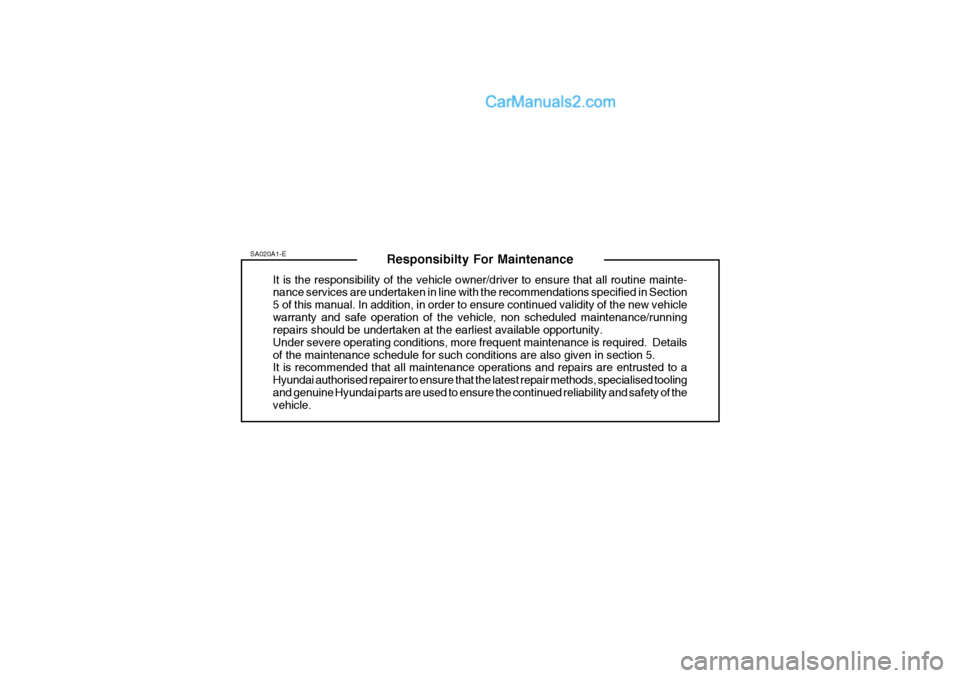
Responsibilty For Maintenance
It is the responsibility of the vehicle owner/driver to ensure that all routine mainte- nance services are undertaken in line with the recommendations specified in Section 5 of this manual. In addition, in order to ensure continued validity of the new vehiclewarranty and safe operation of the vehicle, non scheduled maintenance/running repairs should be undertaken at the earliest available opportunity. Under severe operating conditions, more frequent maintenance is required. Detailsof the maintenance schedule for such conditions are also given in section 5. It is recommended that all maintenance operations and repairs are entrusted to a Hyundai authorised repairer to ensure that the latest repair methods, specialised toolingand genuine Hyundai parts are used to ensure the continued reliability and safety of the vehicle.
SA020A1-E
Page 439 of 539
2
DRIVING YOUR HYUNDAI
23
o Apply the parking brake only when the vehicle is at rest.
o Since the power assistance pro- vided by the brake servo is derived from the engine, coasting with theengine turned off or towing of the vehicle with the engine turned off will result in greatly increased pedalpressures being required to stop the vehicle.
o Do not hold the vehicle on the up- grade with the accelerator pedal.This can cause the transmission to overheat. Always use the brakepedal or parking brake.
o Use caution when parking on a hill.
Engage the parking brake and placethe gear selector lever in "P" (auto- matic transaxle) or in first or reverse gear (manual transaxle). If your caris facing downhill, turn the front wheels into the curb to help keep the car from rolling. If your car is facinguphill, turn the front wheels away from the curb to help keep the car from rolling. If there is no curb or if itis required by other conditions to keep the car from rolling, block the wheels.DRIVING FOR ECONOMY
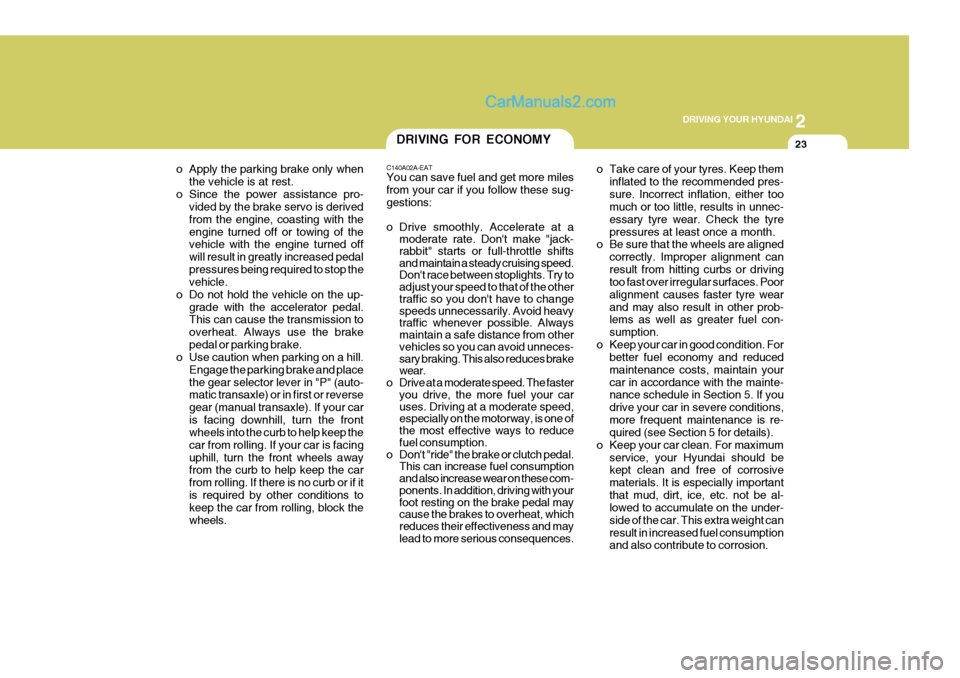
C140A02A-EAT You can save fuel and get more miles from your car if you follow these sug-gestions:
o Drive smoothly. Accelerate at a moderate rate. Don't make "jack- rabbit" starts or full-throttle shifts and maintain a steady cruising speed. Don't race between stoplights. Try to adjust your speed to that of the other traffic so you don't have to change speeds unnecessarily. Avoid heavy traffic whenever possible. Always maintain a safe distance from other vehicles so you can avoid unneces- sary braking. This also reduces brake wear.
o Drive at a moderate speed. The faster you drive, the more fuel your car uses. Driving at a moderate speed, especially on the motorway, is one of the most effective ways to reduce fuel consumption.
o Don't "ride" the brake or clutch pedal. This can increase fuel consumption and also increase wear on these com- ponents. In addition, driving with your foot resting on the brake pedal may cause the brakes to overheat, which reduces their effectiveness and may lead to more serious consequences. o Take care of your tyres. Keep them
inflated to the recommended pres- sure. Incorrect inflation, either too much or too little, results in unnec- essary tyre wear. Check the tyrepressures at least once a month.
o Be sure that the wheels are aligned
correctly. Improper alignment canresult from hitting curbs or driving too fast over irregular surfaces. Poor alignment causes faster tyre wearand may also result in other prob- lems as well as greater fuel con- sumption.
o Keep your car in good condition. For better fuel economy and reducedmaintenance costs, maintain yourcar in accordance with the mainte- nance schedule in Section 5. If you drive your car in severe conditions,more frequent maintenance is re- quired (see Section 5 for details).
o Keep your car clean. For maximum service, your Hyundai should bekept clean and free of corrosive materials. It is especially importantthat mud, dirt, ice, etc. not be al- lowed to accumulate on the under- side of the car. This extra weight canresult in increased fuel consumption and also contribute to corrosion.
Page 469 of 539
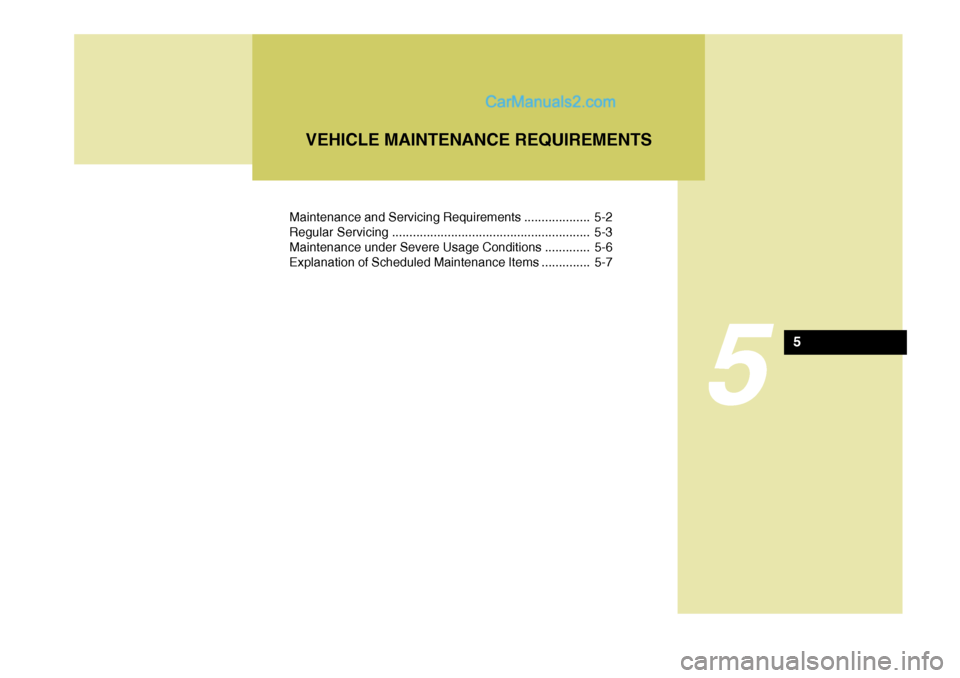
Maintenance and Servicing Requirements ................... 5-2
Regular Servicing ......................................................... 5-3
Maintenance under Severe Usage Conditions ............. 5-6
Explanation of Scheduled Maintenance Items .............. 5-7
5
VEHICLE MAINTENANCE REQUIREMENTS
5