2006 Hyundai Terracan checking oil
[x] Cancel search: checking oilPage 228 of 539

Engine Compartment .................................................... 6-2
General Checks ........................................................... 6-5
Checking the Engine Oil .............................................. 6-6 Changing the Engine Oil and Filter ............................. 6-10
Checking and Changing the Engine Coolant ..............6-11
Changing the Air Cleaner Filte r ...................................6-14
Checking the Transmission Oil (Manual)................... 6-17
Checking the Transmission Fluid (Automatic)............6-18
Checking the Brakes .................................................. 6-21
Checking the Clutch Fluid ........................................... 6-22
Air Conditioning Care .................................................. 6-23
Changing the Climate Control Air Filter .. ....................6-24
Checking Drive Belts .................................................. 6-27
Checking and Replacing Fuses ..................................6-28
Checking The Battery ................................................. 6-31
Checking The Electric Cooling Fans ..........................6-33
Power Steering Fluid Level ......................................... 6-33
Fuel Filter ..................................................................... 6-34
Replacement of Headlight Bulbs ................................. 6-38
Headlight Aiming Adjustment ...................................... 6-39
Bulb Wattages ............................................................. 6-42
Fuse Panel D escription ............................................... 6-43
DO-IT-YOURSELF MAINTENANCE
6
6
Page 233 of 539
6 DO-IT-YOURSELF MAINTENANCE
6CHECKING THE ENGINE OIL
G030A01A-AAT Engine oil is essential to the perfor- mance and service of the engine. It is suggested that you check the oil levelat least once a week in normal use and more often if you are on a trip or driving in severe conditions. G030B06HP-GAT
Recommended Oil 1. Gasoline Engine
(1) Select engine oil of the proper
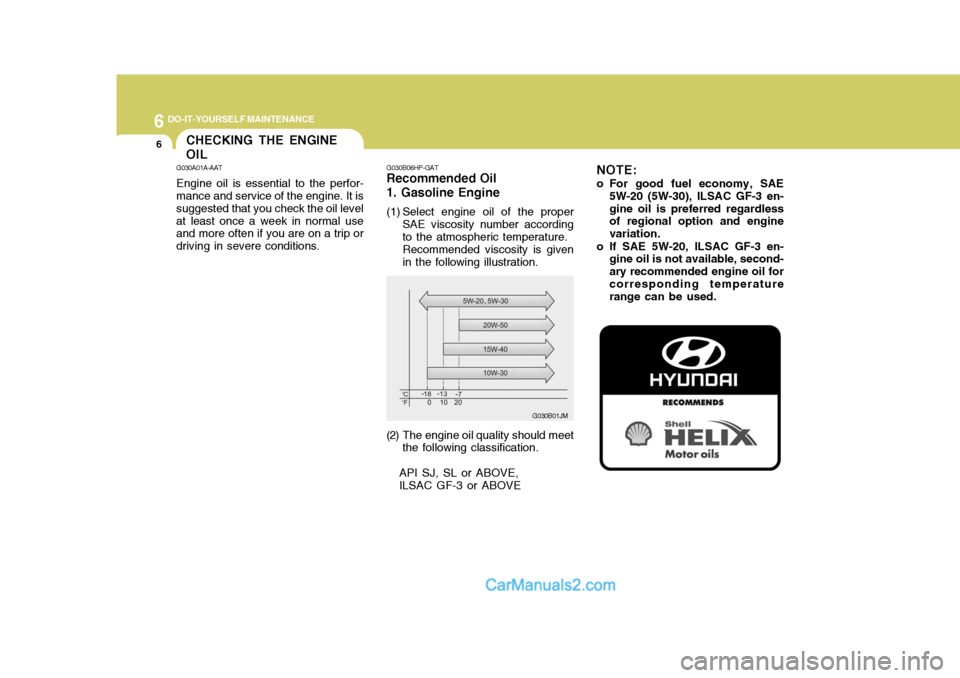
SAE viscosity number according to the atmospheric temperature. Recommended viscosity is given in the following illustration.
(2) The engine oil quality should meet the following classification.
API SJ, SL or ABOVE, ILSAC GF-3 or ABOVE NOTE:
o For good fuel economy, SAE 5W-20 (5W-30), ILSAC GF-3 en- gine oil is preferred regardless of regional option and engine variation.
o If SAE 5W-20, ILSAC GF-3 en- gine oil is not available, second-ary recommended engine oil forcorresponding temperature range can be used.
G030B01JM
Page 234 of 539
6
DO-IT-YOURSELF MAINTENANCE
7
NOTE: For diesel-powered vehicle SAE 0W-
30 oil should be used only in areas where extremely cold temperatures of 10°C(50°F) or below are experi- enced.
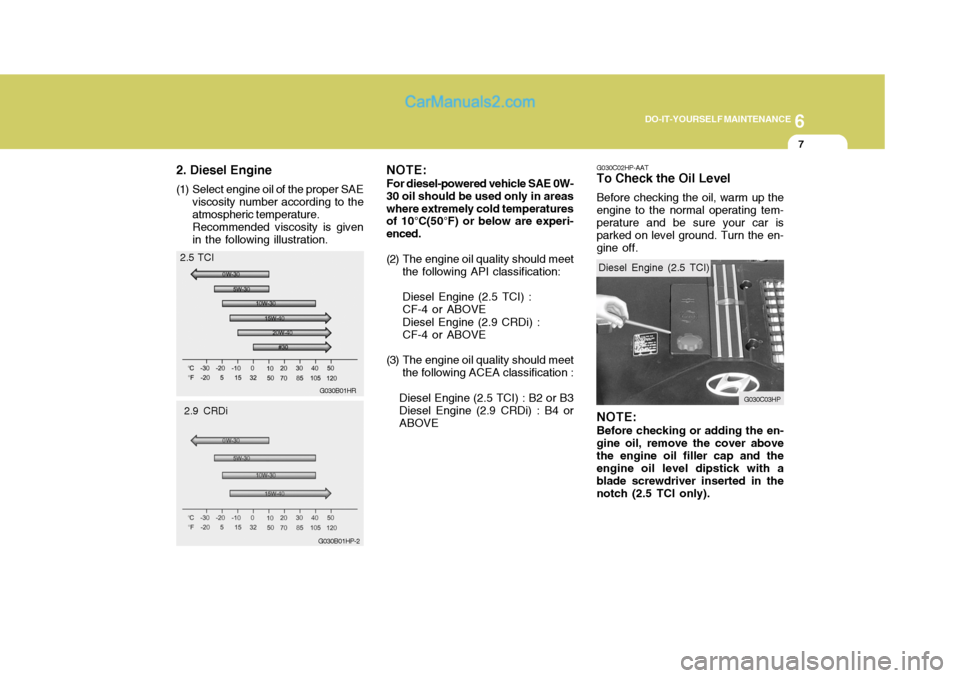
(2) The engine oil quality should meet the following API classification:Diesel Engine (2.5 TCI) : CF-4 or ABOVE Diesel Engine (2.9 CRDi) : CF-4 or ABOVE
(3) The engine oil quality should meet the following ACEA classification :
Diesel Engine (2.5 TCI) : B2 or B3Diesel Engine (2.9 CRDi) : B4 orABOVE G030C02HP-AAT To Check the Oil Level Before checking the oil, warm up the engine to the normal operating tem- perature and be sure your car is parked on level ground. Turn the en-gine off. NOTE: Before checking or adding the en- gine oil, remove the cover abovethe engine oil filler cap and the engine oil level dipstick with a blade screwdriver inserted in thenotch (2.5 TCI only).
G030B01HR
G030B01HP-2 G030C03HP
2.5 TCI
2.9 CRDi
Diesel Engine (2.5 TCI)
2. Diesel Engine
(1) Select engine oil of the proper SAE
viscosity number according to the atmospheric temperature.Recommended viscosity is givenin the following illustration.
Page 235 of 539
6 DO-IT-YOURSELF MAINTENANCE
8
Diesel Engine (2.5 TCI)
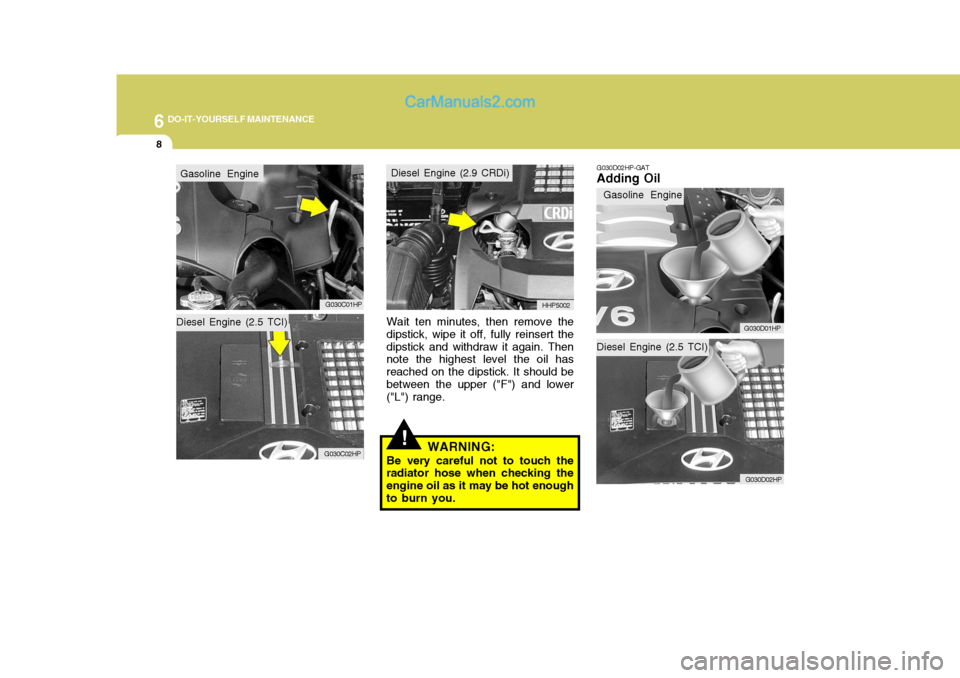
Wait ten minutes, then remove the dipstick, wipe it off, fully reinsert thedipstick and withdraw it again. Then note the highest level the oil has reached on the dipstick. It should bebetween the upper ("F") and lower ("L") range.
Diesel Engine (2.5 TCI) G030D02HP-GAT
Adding Oil
HHP5002
G030C02HP
Gasoline Engine
Diesel Engine (2.9 CRDi)
G030D01HPG030D02HP
Gasoline Engine
!WARNING:
Be very careful not to touch the
radiator hose when checking the engine oil as it may be hot enoughto burn you.
G030C01HP
Page 238 of 539
6
DO-IT-YOURSELF MAINTENANCE
11CHECKING AND CHANG- ING THE ENGINE COOL- ANT
!
G050A01A-AAT
WARNING:
Do not remove the radiator cap when the engine is hot. When the engine is hot, the engine coolant is underpressure and may erupt through the opening if the cap is removed. You could be seriously burned if you donot observe this precaution. Do not remove the radiator cap until the radiator is cool to touch.
!
5. Remove the oil filter by turning it counterclockwise with a oil filter wrench of the proper size. A cer- tain amount of oil will come out when you remove the filter. So besure to have your drain pan in place underneath it.
6. Install a new oil filter in accordance with the instructions on the cartonor on the filter itself. Do not over- tighten (Tightening torque: Gaso-
line- 1.2 ~ 1.6 kgf.m, Diesel - 2.3 ~ 2.5 kgf.m) . Be sure that the
mounting surface on the engine is clean and that the old gasket is removed completely. Lubricate the new gasket on the filter with cleanengine oil before installation.
7. Remove the engine oil level dip- stick.
8. Refill the crankcase with the rec- ommended engine oil slowly. Referto the specification in chapter 9 for engine oil capacity.
! CAUTION:
Slowly pour the recommended oil by using a funnel. Do not overfill not to damage the engine. 9. Start the engine and check to be
sure no oil is leaking from thedrain plug or oil filter.
10.Shut off the engine and recheck
the oil level.
NOTE: Always dispose of used engine oil
in an environmentally acceptable manner. It is suggested that it be placed in a sealed container andtaken to a service station for recla- mation. Do not pour the oil on the ground or put it into the house-hold trash.
WARNING:
Used motor oil may cause irrita-
tion or cancer of the skin if left incontact with the skin for prolongedperiods of time. Wash your hands thoroughly with soap and warm water as soon as possible afterhandling used oil.
Page 244 of 539
6
DO-IT-YOURSELF MAINTENANCE
17
!
CHECKING THE TRANS- MISSION OIL (MANUAL)FILLING THE WASHER RESERVOIR
CAUTION:
o Radiator antifreeze (engine cool- ant) should not be used in the washer system because it will damage the car's finish.
o The washer should not be oper- ated if the washer reservoir isempty. This can damage the washer fluid pump.
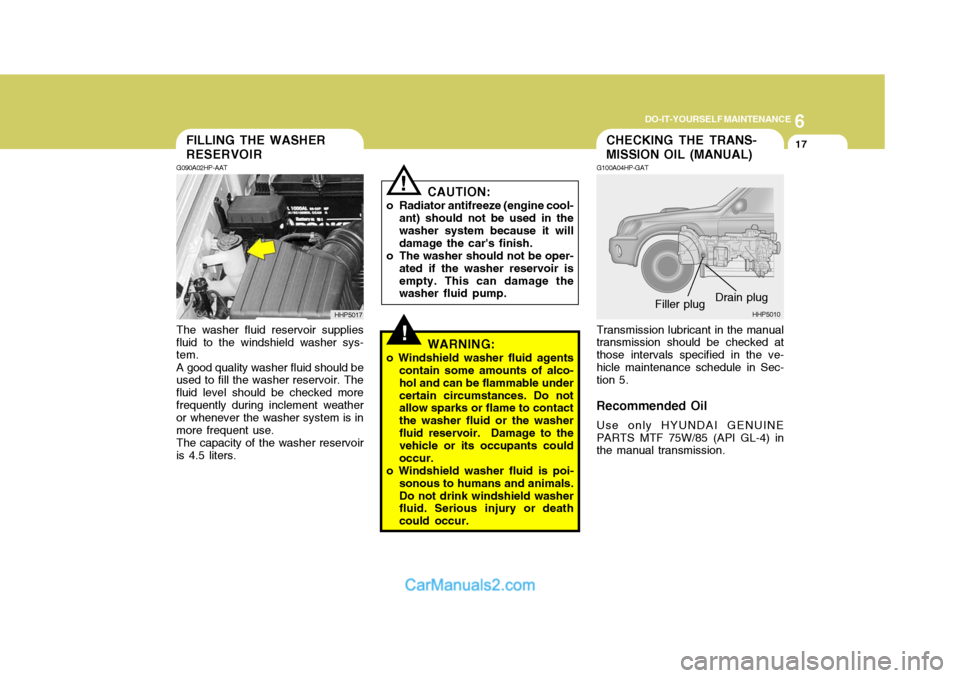
! G100A04HP-GAT Transmission lubricant in the manual transmission should be checked at those intervals specified in the ve-hicle maintenance schedule in Sec- tion 5.
Recommended Oil Use only HYUNDAI GENUINE PARTS MTF 75W/85 (API GL-4) in the manual transmission. Drain plug
G090A02HP-AAT The washer fluid reservoir supplies fluid to the windshield washer sys- tem. A good quality washer fluid should be used to fill the washer reservoir. The fluid level should be checked morefrequently during inclement weather or whenever the washer system is in more frequent use. The capacity of the washer reservoir is 4.5 liters. HHP5017
HHP5010
Filler plug
WARNING:
o Windshield washer fluid agents contain some amounts of alco- hol and can be flammable undercertain circumstances. Do not allow sparks or flame to contact the washer fluid or the washerfluid reservoir. Damage to the vehicle or its occupants could occur.
o Windshield washer fluid is poi- sonous to humans and animals.Do not drink windshield washer fluid. Serious injury or death could occur.
Page 245 of 539
6 DO-IT-YOURSELF MAINTENANCE
18
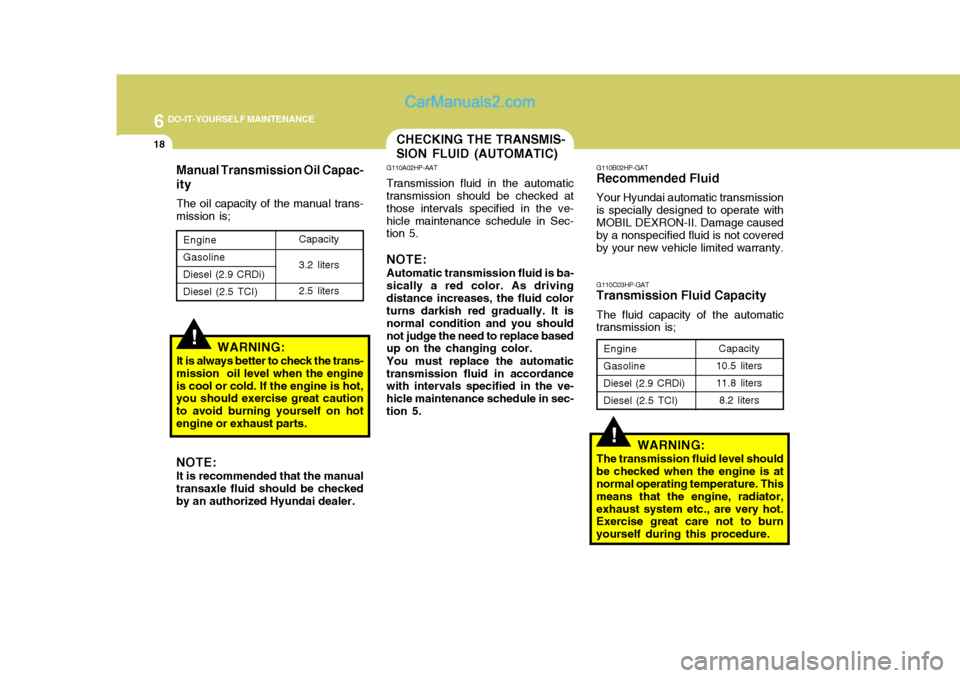
Manual Transmission Oil Capac- ity
The oil capacity of the manual trans-
mission is;
WARNING:
It is always better to check the trans-
mission oil level when the engine is cool or cold. If the engine is hot, you should exercise great caution to avoid burning yourself on hotengine or exhaust parts.
!
Engine GasolineDiesel (2.9 CRDi)Diesel (2.5 TCI) Capacity 3.2 liters 2.5 liters
NOTE: It is recommended that the manual transaxle fluid should be checkedby an authorized Hyundai dealer.
CHECKING THE TRANSMIS- SION FLUID (AUTOMATIC)
!
G110B02HP-GAT
Recommended Fluid
Your Hyundai automatic transmission is specially designed to operate with MOBIL DEXRON-II. Damage caused by a nonspecified fluid is not coveredby your new vehicle limited warranty. G110C03HP-GAT
Transmission Fluid Capacity
The fluid capacity of the automatic transmission is;
WARNING:
The transmission fluid level should be checked when the engine is at normal operating temperature. This means that the engine, radiator,exhaust system etc., are very hot. Exercise great care not to burn yourself during this procedure.
G110A02HP-AAT Transmission fluid in the automatic transmission should be checked at those intervals specified in the ve-hicle maintenance schedule in Sec- tion 5. NOTE: Automatic transmission fluid is ba- sically a red color. As drivingdistance increases, the fluid color turns darkish red gradually. It is normal condition and you shouldnot judge the need to replace based up on the changing color. You must replace the automatic transmission fluid in accordance with intervals specified in the ve- hicle maintenance schedule in sec-tion 5.
Engine GasolineDiesel (2.9 CRDi)Diesel (2.5 TCI)
Capacity
10.5 liters11.8 liters 8.2 liters
Page 258 of 539
6
DO-IT-YOURSELF MAINTENANCE
31CHECKING THE BATTERY
!
G210A01A-AAT
WARNING:
Batteries can be dangerous! When
working with batteries, carefully observe the following precautionsto avoid serious injuries. o If battery fluid is on your skin, flush
the affected areas with water for atleast 15 minutes and then seek medical assistance.
o If battery fluid is in your eyes, rinse out your eyes with water and getmedical assistance as soon as possible. While you are being drivento get medical assistance, continue to rinse your eyes by using a sponge or soft cloth saturated withwater.
o If you swallow battery fluid, drink a large quantity of water or milk fol- lowed by milk of magnesia, eat a raw egg or drink vegetable oil. Getmedical assistance as soon as possible.
While batteries are being charged (either by a battery charger or by thevehicle's alternator), they produce explosive gases. Always observe these warnings to prevent injuries fromoccurring:
o Charge batteries only in a well ven- tilated area.
o Do not permit flames, sparks or smoking in the area.
o Keep children away from the area.
The fluid in the battery contains a
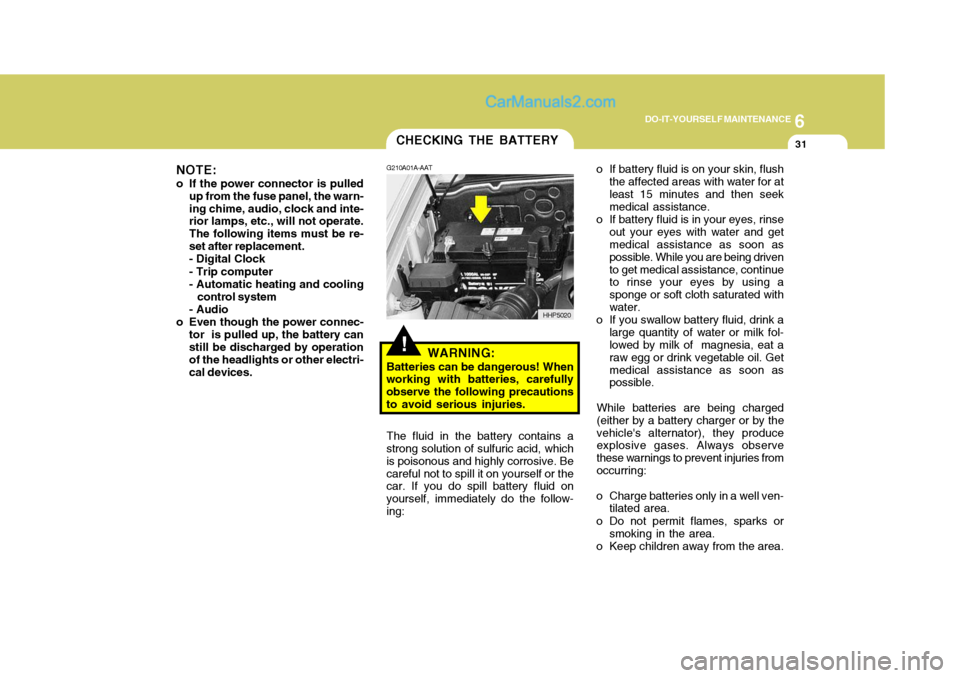
strong solution of sulfuric acid, whichis poisonous and highly corrosive. Becareful not to spill it on yourself or the car. If you do spill battery fluid on yourself, immediately do the follow-ing: HHP5020
NOTE:
o If the power connector is pulled up from the fuse panel, the warn-ing chime, audio, clock and inte- rior lamps, etc., will not operate. The following items must be re-set after replacement.- Digital Clock - Trip computer
- Automatic heating and cooling
control system
- Audio
o Even though the power connec- tor is pulled up, the battery can still be discharged by operation of the headlights or other electri-cal devices.