2006 HONDA PILOT ignition
[x] Cancel search: ignitionPage 279 of 316

If the malf unction indicator lamp
comes on along with the ‘‘D’’
indicator, there is a problem in the
automatic transmission control
system.
Your vehicle has certain ‘‘readiness
codes’’ that are part of the on-board
diagnostics f or the emissions
systems. In some states, part of the
emissions testing is to make sure
these codes are set. If they are not
set, the test cannot be completed.If the battery in your vehicle has
been disconnected or gone dead,
these codes are erased. It
cantake
several days of driving under
various conditions to set the codes
again.
To check if they are set, turn the
ignition switch to the ON (II)
position, without starting the engine.
The malf unction indicator lamp will
come on f or 20 seconds. If it then
goes of f , the readiness codes are set.
If it blinks f ive times, the readiness
codes are not set. If possible, do not
take your vehicle for a state
emissions test until the readiness
codes are set. Ref er to for more
inf ormation (see page ).
If you have recently ref ueled your
vehicle, the indicator could come on
because of a loose or missing f uel f ill
cap. You will also see a ‘‘CHECK
FUEL CAP’’ message on the
inf ormation display. Tighten the cap
until it clicks at least once.
Tightening the cap will not turn the
indicator turn of f immediately; it
can take several days of normal
driving.
If the indicator remains on or the
f uel cap was not loose or missing,
have the vehicle checked by the
dealer as soon as possible. If this indicator comes on
while driving, it means one
of the engine’s emission control
systems may have a problem. Even
though you may f eel no dif f erence in
your vehicle’s perf ormance,
continued operation may cause
serious damage.
296
Malf unction Indicator
Readiness CodesState
Emissions T estingTaking Care of the Unexpected
277
If you keep driving with the
malf unction indicator lamp on, you can
damage your vehicle’s emission
controls and engine. Those repairs may
not be covered by your vehicle’s
warranties.
Page 280 of 316
If you must drive the vehicle a short
distance in this condition, drive
slowly and caref ully.
If the ABS indicator and the VSA
indicator come on with the brake
system indicator, have the vehicle
inspected by your dealer
immediately.
design will still give you braking at
two wheels. You will f eel the brake
pedal go down much f arther bef ore
the vehicle begins to slow down, and
you will have to press harder on the
pedal.
Slow down by shif ting to a lower
gear, and pull to the side of the road
when it is saf e. Because of the long
distance needed to stop, it is
hazardous to drive the vehicle. You
should have it towed and repaired as
soon as possible (see
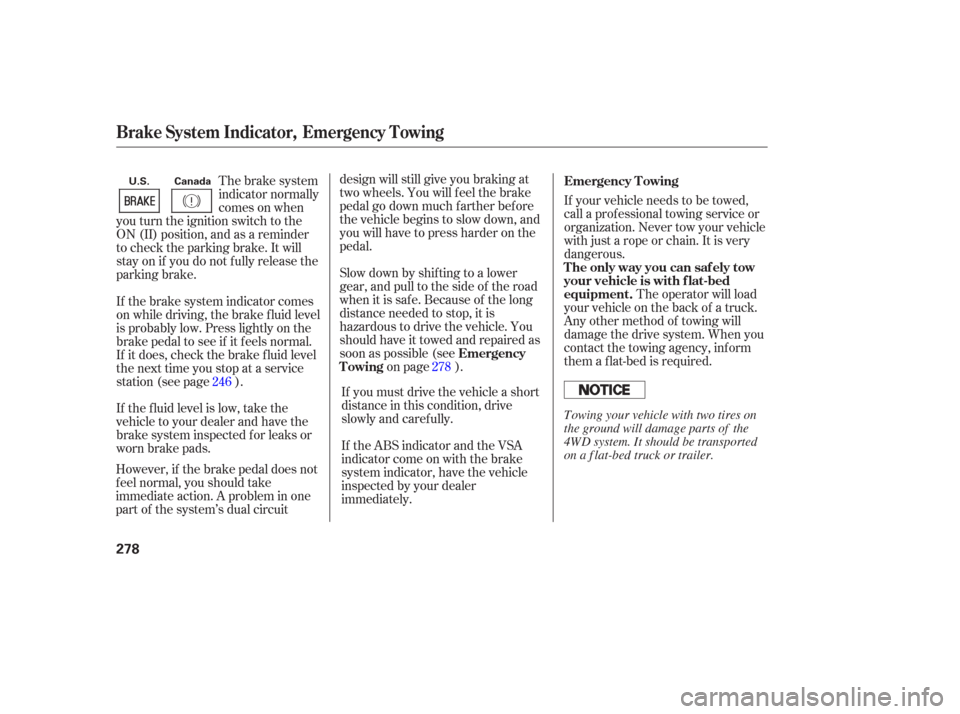
The brake system
indicator normally
comes on when
you turn the ignition switch to the
ON (II) position, and as a reminder
to check the parking brake. It will
stay on if you do not f ully release the
parking brake.
If the f luid level is low, take the
vehicle to your dealer and have the
brake system inspected f or leaks or
worn brake pads. If the brake system indicator comes
on while driving, the brake f luid level
is probably low. Press lightly on the
brake pedal to see if it f eels normal.
If it does, check the brake f luid level
the next time you stop at a service
station (see page ). 246 Emergency
T owing
278
U.S. Canada
Brake System IndicatorEmergency Towing
,
However, if the brake pedal does not
f eel normal, you should take
immediate action. A problem in one
part of the system’s dual circuit on page
278).
Emergency T owing
If your vehicle needs to be towed,
call a prof essional towing service or
organization. Never tow your vehicle
with just a rope or chain. It is very
dangerous.
Any other method of towing will
damage the drive system. When you
contact the towing agency, inf orm
them a f lat-bed is required. The operator will load
your vehicle on the back of a truck. The only way you can saf ely tow
your vehicle is with f lat-bed
equipment.
Towing your vehicle with two tires on
the ground will damage parts of the
4WD system. It s hould be transported
on a f lat-bed truck or trailer.
Page 281 of 316

The vehicle’s f uses are located in
f our f use boxes. The interior f use
boxes are located under the
dashboard on the driver’s and
passenger’s side.
CONT INUED
Emergency Towing, Fuses
Taking Care of the Unexpected
279
DRIVER’ S SIDE INTERIOR
If , due to damage, your vehicle must
be towed with all f our wheels on the
ground, do the f ollowing:With all f our wheels on the ground,
it is best to tow the vehicle no farther
than 50 miles (80 km), and keep the
speed below 35 mph (55 km/h).
Release the parking brake.
Start the engine.
Shif t to D f or several seconds,
then to N.
Turn of f the engine.
Improper towing preparation will
damage the transmission. Follow the
above procedure exactly. If you cannot
shif t the transmission or start the
engine, your vehicle must be
transported with the all f our wheels of f
the ground. The steerin
g system can be damaged if
the steering wheel is locked. Leave the
ignition switch in the ACCESSORY (I)
position, and make sure the steering
wheel turns f reely bef ore you begin
towing.
Trying to lif t or tow your vehicle by the
bumpers will cause serious damage.
The bumpers are not designed to
support the vehicle’s weight. Fuses
Page 282 of 316

To open the passenger’s side, pull
the right edge of the cover.
The primary under-hood f use box is
locatedonthepassenger’sside.The
secondary f use box is next to the
battery.If something electrical in your
vehicle stops working, the first thing
youshouldcheckforisablownfuse.
Determine f rom the chart on pages
and , or the diagram on the
f use box lid, which f use or f uses
control that device. The diagram f or
the interior driver’s side f use box is
on the kick panel below the f use box.
Check those f uses f irst, but check all
the f uses bef ore deciding that a
blown f use is the cause. Replace any
blown f uses, and check if the device
works.
Turn the ignition switch to the
LOCK (0) position. Make sure the
headlights and all other
accessories are of f .
Remove the cover f rom the f use
box.
1.
2. 283 284
Fuses
Checking and Replacing Fuses
280
PASSENGER’ S SIDE INTERIOR
UNDER-
HOOD
FUSE
BOX
Page 287 of 316
Thediagramsinthissectiongive
you the dimensions and capacities of
your vehicle, and the locations of the
identif ication numbers. It also
includes inf ormation you should
know about your vehicle’s tires and
emissions control systems.................
Identif ication Numbers . 286
................................
Specif ications .288
..........
DOT Tire Quality Grading . 290
Unif orm Tire Quality ..................................
Grading .290
.................................
Treadwear .290
......................................
Traction .290
.............................
Temperature .291
.............................
Tire Labeling .291 .......................
Emissions Controls .293
.....................
The Clean Air Act .293
Crankcase Emissions Control ....................................
System .293
Evaporative Emissions Control ....................................
System .293
Onboard Ref ueling Vapor ................................
Recovery .293
...
Exhaust Emissions Controls . 294
....................
PGM-FI System .294
Ignition Timing Control ................................
System .294
Exhaust Gas Recirculation ...................
(EGR) System . 294
Three Way Catalytic ...........................
Converter .294
....................
Replacement Parts . 294
..
Three Way Catalytic Converter . 295
..............
State Emissions Testing . 296
....
Testing of Readiness Codes . 296
T echnical Inf ormation
T echnical Inf ormation
285
Page 296 of 316

The exhaust emissions controls
include f our systems: PGM-FI,
ignition timing control, exhaust gas
recirculation, and three way catalytic
converter. These f our systems work
together to control the engine’s
combustion and minimize the
amount of HC, CO, and NOx that
comes out the tailpipe. The exhaust
emissions control systems are
separate f rom the crankcase and
evaporative emissions control
systems.
The PGM-FI system uses sequential
multiport f uel injection.
It has three subsystems: air intake,
engine control, and f uel control. The
powertrain control module (PCM)
uses various sensors to determine
how much air is going into the
engine. It then controls how much
f uel to inject under all operating
conditions.The emissions control systems are
designed and certif ied to work to-
gether in reducing emissions to
levels that comply with the Clean Air
Act. To make sure the emissions
remain low, you should use only new
Honda replacement parts or their
equivalent f or repairs. Using lower
qualitypartsmayincreasethe
emissions f rom your vehicle.
The emissions control systems are
covered by warranties separate from
the rest of your vehicle. Read your
warranty manual for more informa-
tion.
The three way catalytic converter is
in the exhaust system. Through
chemical reactions, it converts HC,
CO, and NOx in the engine’s exhaust
to carbon dioxide (CO ), nitrogen
(N ), and water vapor. This system constantly adjusts the
ignition timing, reducing the amount
of HC, CO, and NOx produced.
The exhaust gas recirculation (EGR)
system takes some of the exhaust
gas and routes it back into the intake
manif old. Adding exhaust gas to the
air/f uel mixture reduces the amount
of NOx produced when the f uel is
burned.
2
2
Exhaust Emissions Controls Replacement Parts
PGM-FI Syst emT hree Way Cat alyt ic Convert er
Ignit ion T iming Cont rol Syst em
Exhaust Gas Recirculat ion (EGR)Syst em
Emissions Controls
294
Page 307 of 316

CONT INUED
............................
Capacities Chart .288
.............
Carbon Monoxide Hazard . 57
.............................
Carrying Cargo .193
..............
CAUTION, Explanation of . ii
..........................
CD Changer .131, 134
.......................................
CD Player .130
...
Accessories and Modif ications . 191
ACCESSORY (Ignition Key .......................................
Position) .81
............
Accessory Power Sockets . 101
...........................
AC Power Outlet .102
....................
Additives, Engine Oil . 239
...............
AdvancedAirbagSystem . 30
.............................
Airbag (SRS) .11, 25
..........
Airbag System Components . 25
..............
Air Conditioning System . 106
.....................
Rear A/C Control .113
.......................
Air Pressure, Tires .258
......................................
Antif reeze .242
...............
Anti-lock Brakes (ABS) . 209
...............................
Indicator .63, 210
...................................
Operation .209
..............
Anti-thef t, Audio System . 139
.
Anti-thef t Steering Column Lock . 81
................................
Audio System .115
...
Automatic Seat Belt Tensioners . 23
...
Automatic Lighting Off Feature . 76
.............
Automatic Speed Control . 175
..............
Automatic Transmission . 200
..........................
Capacity, Fluid .288 ...............
Checking Fluid Level . 244
.......................................
Shif ting .200
.
Shif t Lever Position Indicator . 200
................
Shif t Lever Positions . 201
....................
Shif t Lock Release . 203
Battery Charging System ...........................
Indicator .62, 276
............................
Jump Starting .272
..............................
Maintenance .262
............................
Specif ications .289
..............................
Bef ore Driving .185
..................................
Belts, Seat .10, 21
...........................
Beverage Holders .99
..................................
Booster Seats .54
Brakes ...........
Anti-lock System (ABS) . 209
.............
Break-in, New Linings . 186
....................
Bulb Replacement .252
...........................................
Fluid .246
.........................................
Parking .97
.................
System Indicator . 63,278
........................
Wear Indicators .209 .............................
Braking System .208
.................
Break-in, New Vehicle . 186
..
Brightness Control, Instruments . 76
........................
Brights, Headlights .75
Bulb Replacement ..........................
Back-up Lights .252
.....................
Brake Lights .252, 253
................
Front Parking Lights . 249
........
Front Side Marker Lights . 249
.................................
Headlights .248
........
High-mount Brake Lights . 253
.................................
Rear Bulbs .252
............................
Specif ications .289
.............
Turn Signal Light . 249,252
..............................
Bulbs, Halogen .248
Index
A
B
C
INDEX
I
Page 310 of 316

........................................
Headlights .75
........................................
Aiming .248
..............
Automatic Lighting Off . 76
............
Daytime Running Lights . 76
..................
High Beam Indicator . 67
...........
High Beams, Turning on . 75
............
Low Beams, Turning on . 75
.........................
Reminder Chime .76
........
Replacing Halogen Bulbs . 248
...................................
Turning on .75
...................................
Headphones .172
..............................
Head Restraints .91
.................................
Heated Mirror .93
.....................................
Heater, Seat .86
.....................
Heating and Cooling .106
.............
High Altitude, Starting at . 199
.................
High-Low Beam Switch . 75
..............
High-mount Brake Light . 253
HomeLink Universal ................................
Transceiver .180
.......................
Hood, Opening the .188
...
Identif ication Number, Vehicle . 286Ignition
..............................................
Keys .79
...........................................
Switch .81
............
Timing Control System . 294
........................
Immobilizer System .79
...
Important Handling Inf ormation . iii
.........
Important Safety Precautions . 8
.........
Indicators, Instrument Panel . 61
...............................
Inf ant Restraint .43
......................................
Inf ant Seats .43
...................
Inf lation, Proper Tire . 257
...................................
Inside Mirror .92
.............................
Inspection, Tire .258
Installing a Child Seat .........................................
LATCH .47
..........
Tether Anchorage Points . 51
........................
Instrument Panel .5 ,61
........
Instrument Panel Brightness . 76
........................................
Introduction .i
.................
Jacking up the Vehicle . 268
.......................................
Jack, Tire .267
................................
Jump Starting .272 ..................................................
Keys .79
.......................
Label, Certif ication .286
.................
Lane Change, Signaling . 75
........................
Lap/Shoulder Belts .22
...........
LATCH Anchorage System . 47
.......................................
Lights .75, 102
....................
Bulb Replacement .248
.......................................
Indicator .61
.........................................
Parking .75
..................................
Turn Signal .75
....................................
Load Limits .194
......
LOCK (Ignition Key Position) . 81
Locks .......
Anti-thef t Steering Column . 81
............................
Fuel Fill Door .187
....................................
Glove Box .99
....................
Lockout Prevention . 82
.................................
Power Door .82
........................
Low Coolant Level .189
.........................
Low Fuel Indicator .67
...
Low Oil Pressure Indicator . 62,276
Index
I JK
L
IV